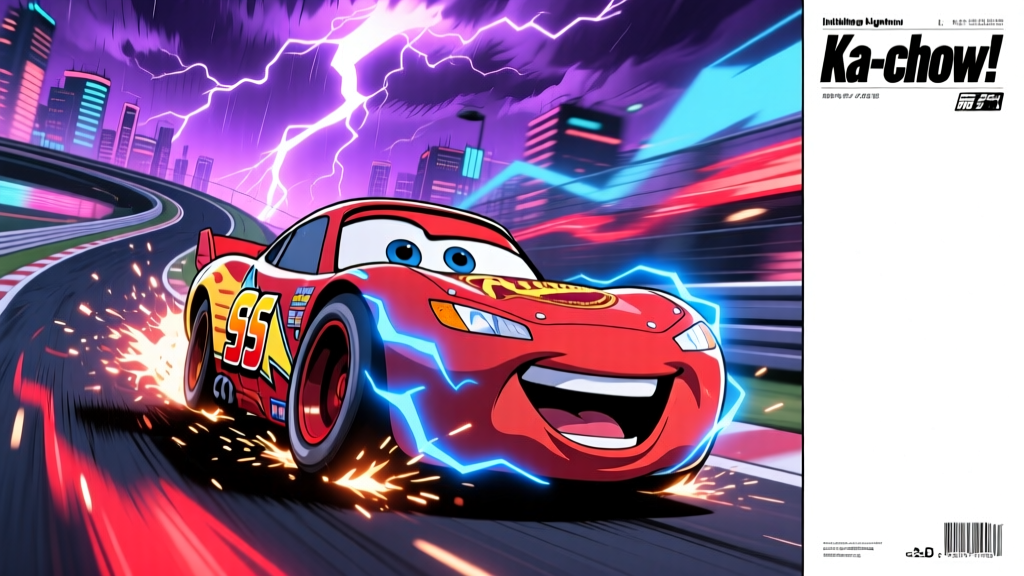
Three hundred feet from the finish line, a red race car with a yellow lightning bolt decal surges past the pack. He crosses the line, spins into a victory pose, flashes his headlights, and shouts two syllables that would echo through toy aisles, birthday parties, and Pixar history for the next two decades: "Ka-chow!"
That scene from Cars (2006) was the first time most audiences heard the catchphrase. It was not the last. Within six months of the film's theatrical release, "Ka-chow" had become one of the most recognized and repeated lines in any Pixar film — a two-word exclamation that toddlers screamed in supermarket aisles, teenagers quoted ironically, and adults found themselves muttering under their breath at green traffic lights. The word did not exist in any dictionary before Lightning McQueen said it. Now it belongs to him completely.
This is the story of how a throwaway victory catchphrase became a cultural landmark — and why, nearly twenty years later, kachow lightning mcqueen remains one of the most searched character-phrase pairings in animation history.
The Pit Stop Where "Ka-chow" Was Born
Every great catchphrase has an origin story that is messier than the finished product suggests. "Ka-chow" was no exception. The Cars writing team, led by director John Lasseter and co-writers Dan Fogelman, Joe Ranft, and Jorgen Klubien, needed something Lightning McQueen could say during his victory celebrations — a signature move that would encapsulate his arrogance, charm, and celebrity obsession in a single burst of sound.
The breakthrough came from a simple observation about what McQueen represents. He is not just a race car. He is a brand. In the film's universe, McQueen is obsessed with media attention, sponsorship deals, and the flashbulb glamour of fame. His catchphrase had to sound like a camera going off — that sharp, percussive burst when photographers swarm a winner.
The Phonetics of a Catchphrase
Linguistically, "Ka-chow" borrows from the English onomatopoeia "ka-ching," the sound associated with cash registers and money. That association is deliberate: McQueen is, in his earliest incarnation, motivated almost entirely by the prospect of landing the Dinoco sponsorship — a deal worth millions. The "-chow" ending swaps the register's metallic ring for something sharper, more explosive, closer to a firecracker or a camera flash. It is a word designed to be shouted, not whispered.
Owen Wilson, who voices McQueen across all three films, delivered the line with a laid-back California drawl that softened the word's aggressive edge. Instead of barking it like a drill sergeant, Wilson stretched it out — "Kaaaaa-chow!" — making it sound effortless, almost lazy. That delivery choice turned what could have been an annoying catchphrase into something oddly cool. McQueen was not trying too hard. He was a natural.
"We wanted McQueen to have something he says for the cameras. Something that feels like he's performing even when he's just celebrating. 'Ka-chow' was one of those happy accidents in the story room — everyone laughed the first time someone pitched it, and that told us it would stick."
— John Lasseter, reflecting on the Cars storyroom process (2006 DVD commentary)
Joe Ranft, the legendary Pixar story artist and head of story on Cars, was instrumental in developing the character's personality before his tragic death in a car accident in August 2005. Ranft understood that the best animated catchphrases are ones children can mimic without effort — think Buzz Lightyear's "To infinity and beyond!" or Woody's "There's a snake in my boot!" The bar for "Ka-chow" was simple: could a four-year-old shout it convincingly from the back seat of a minivan? The answer was yes.
The NASCAR Connection
The Cars creative team spent considerable time researching NASCAR culture, attending races at Daytona, Talladega, and Bristol Motor Speedway. They observed how real drivers created signature moments for fans — Dale Earnhardt Sr.'s post-race victory laps, Richard Petty's trademark cowboy hat and sunglasses, Tony Stewart's unfiltered celebrations. McQueen's "Ka-chow" was Pixar's distilled version of that performative victory energy, packaged into a single, repeatable gesture: headlights flash, McQueen grins, and the catchphrase fires off like a starter pistol.
Three Films, Three McQueens: The Character Arc Behind the Catchphrase
What makes kachow lightning mcqueen more than a novelty is how the phrase — and the character — evolved across the Cars trilogy. McQueen in 2006 was not the same car as McQueen in 2017. The catchphrase stayed, but its meaning shifted as McQueen grew up.
| Film | Year | Box Office (Worldwide) | McQueen's Role | "Ka-chow" Context |
|---|---|---|---|---|
| Cars | 2006 | $462 million | Rookie prodigy, arrogant and self-centered | Victory boast — pure ego and showmanship |
| Cars 2 | 2011 | $562 million | Champion racer, loyal friend, fish out of water | Used sparingly — more reflex than statement |
| Cars 3 | 2017 | $383 million | Aging veteran confronting retirement | Passed to Cruz Ramirez — a torch-lighting moment |
Cars (2006): The Ego Phase
In the first film, "Ka-chow" is inseparable from McQueen's ego. He says it after winning. He says it for the cameras. He says it when he wants to remind everyone in the room that he is Lightning McQueen, Piston Cup contender and future Dinoco sponsorship holder. The Rust-eze medicated bumper ointment logo on his hood might embarrass him, but the catchphrase never does. It is his personal brand distilled into sound.
The brilliance of the first film's structure is that it systematically dismantles everything "Ka-chow" stands for. Radiator Springs — a forgotten desert town bypassed by the interstate — has no use for celebrity. Doc Hudson, the town's judge and mechanic, is a former racing legend (the Fabulous Hudson Hornet) who wants nothing to do with McQueen's showboating. When McQueen flashes his headlights and shouts "Ka-chow" in this context, it lands differently. The townsfolk are unimpressed. Sally Carrera finds it charming but shallow. Mater, the lovable tow truck, thinks it is the greatest thing he has ever heard.
By the film's third act, McQueen has changed. He uses his Piston Cup fame not for self-promotion but to help Radiator Springs. The catchphrase becomes less about ego and more about joy — a genuine expression of a car who has figured out that winning means nothing if you have nobody to share it with.
Cars 2 (2011): The Spy Detour
Cars 2 remains the most divisive entry in the franchise. The film pivoted hard into spy-thriller territory, centering Mater as an accidental secret agent while McQueen competed in the World Grand Prix. Critics dinged it — the film holds a 39% rating on Rotten Tomatoes, the lowest of any Pixar release at the time — but it grossed $562 million worldwide, proving audiences still showed up for McQueen.
In this film, "Ka-chow" appears less frequently and with less swagger. McQueen has matured. He is a three-time Piston Cup champion now, secure in his abilities and more interested in fair competition than self-promotion. When he does drop the catchphrase, it feels more like an old habit than a statement of intent. There is one notable scene where McQueen says "Ka-chow" during a race in Tokyo, and the international crowd's confused reaction plays for comedy — a meta-acknowledgment that the phrase is very much an American pop-culture artifact.
Cars 3 (2017): The Passing of the Torch
If Cars 3 is the most emotionally resonant film in the trilogy — and many fans argue it is — then the handling of "Ka-chow" is a major reason why. The film opens with McQueen as an aging champion, pushed off the track by Jackson Storm, a next-generation racer who represents everything McQueen is not: data-driven, aerodynamically optimized, and completely uninterested in old-school catchphrases.
McQueen's journey in Cars 3 is about accepting that his racing days are numbered. His relationship with Cruz Ramirez — a young trainer who dreams of racing but has been sidelined into a coaching role — becomes the emotional spine of the film. In the climactic scene, when Cruz takes to the track and wins, she flashes her headlights and shouts "Ka-chow!" The catchphrase has been inherited. McQueen, watching from the pit, smiles. He does not need to say it anymore. Someone else carries it forward.
That moment resonates because Pixar understood something about legacy characters: the most powerful thing a hero can do with their signature move is give it away.
The Merchandise Machine: "Ka-chow" as a Brand
Two weeks after Cars opened in theaters, merchandise featuring Lightning McQueen began outselling virtually every other licensed product in the Disney Store. By 2011, the Cars franchise had generated over $10 billion in cumulative merchandise revenue — a figure that placed it among the highest-grossing media franchises in history, ahead of properties like Star Wars original trilogy merchandise and SpongeBob SquarePants.
"Ka-chow" was plastered on everything. It was, and remains, one of the most merchandised catchphrases in animation.
| Product Category | Examples | Price Range | Collector Notes |
|---|---|---|---|
| Die-cast models | Hot Wheels, Mattel 1:55 scale, Disney Store exclusives | $5 – $65 | First-edition 2006 Hot Wheels models now fetch $40+ on secondary markets |
| Apparel | T-shirts, hoodies, racing jackets with "Ka-chow" print | $12 – $80 | Disney Parks exclusive racing jackets are the most sought-after |
| Video games | Cars: The Videogame (2006), Cars 2 (2011), Cars 3: Driven to Win (2017) | $20 – $60 | "Ka-chow" used as in-game victory celebration across all titles |
| Plush and toys | Talking McQueen plush (says "Ka-chow!"), remote-control cars | $15 – $50 | The 2006 talking plush remains a nostalgic grail item |
| LEGO and construction sets | LEGO Duplo Lightning McQueen, Mega Bloks race sets | $15 – $45 | LEGO Duplo set (10924) retired in 2023, prices climbing |
| Theme park exclusives | Radiator Springs Racers merchandise, Cars Land pins | $10 – $120 | Cars Land at Disney California Adventure opened in 2012; limited pins highly valued |
| Sources: Disney Consumer Products licensing data, secondary market pricing (eBay, Mercari), Mattel product catalogs. | |||
Why the Merchandise Never Slowed Down
Part of the Cars merchandise phenomenon is demographic. The franchise's core audience — children aged 3 to 8 — cycles through a new generation roughly every five years. Each cohort discovers Lightning McQueen fresh, as if he were a new character. Disney's strategy of re-releasing toys, apparel, and media tie-ins on a rolling cycle ensures that "Ka-chow" never fully leaves the market. The Hot Wheels Lightning McQueen die-cast car, with the #95 racing number and lightning bolt decal, has been a top-ten seller in the Hot Wheels lineup for most years since 2006.
There is also the collector angle. Limited-edition items — especially those tied to Disney Parks exclusives, anniversary editions, and film release windows — have developed a secondary market. First-edition Mattel die-cast models from 2006, particularly the "Piston Cup Champion" variant, sell for $40 to $65 on platforms like eBay and Mercari. A sealed 2006 talking Lightning McQueen plush in good condition can command $50 or more from collectors who grew up with the character and now want a piece of their childhood.
How "Ka-chow" Infiltrated Pop Culture
Beyond the toy aisle, the catchphrase bled into the wider culture in ways Pixar could not have planned. "Ka-chow" became shorthand for sudden success, a flash of triumph, a moment of showing off. It appeared in contexts far removed from a Pixar film about talking cars.
- Sports broadcasting: NASCAR commentators and analysts began using "Ka-chow" when describing dramatic overtakes or photo-finish wins, especially during the 2007-2010 racing seasons when Cars merchandise was ubiquitous at tracks.
- Internet memes: The phrase spawned image macros, reaction GIFs, and video edits across platforms from early YouTube through TikTok. A GIF of McQueen flashing his headlights with the caption "Ka-chow" became a standard reaction image for moments of unexpected success.
- Everyday language: Parents of young children in the mid-2000s reported hearing "Ka-chow" multiple times daily — after finishing homework, scoring a goal in soccer, or simply walking into a room with confidence.
- Theme parks: Cars Land at Disney California Adventure, which opened in June 2012, incorporated the catchphrase into the Radiator Springs Racers ride experience. Guests hear variations of it during the ride's finale, and the surrounding gift shops sell "Ka-chow" merchandise exclusively.
Mater's Version and the Extended Universe
You cannot discuss Lightning McQueen's catchphrase without acknowledging Mater, the buck-toothed tow truck voiced by Larry the Cable Guy. Mater's adoption of "Ka-chow" — usually delivered with a Southern twang and slightly off-timing — became a running gag across the franchise. In Mater and the Ghostlight (2006), the Pixar short film, Mater's version of the catchphrase adds a comedic layer that reinforced how iconic the original had already become.
The Cars franchise also expanded into Disney+ series territory with Cars on the Road (2022), which followed McQueen and Mater on a cross-country road trip. The series kept "Ka-chow" in circulation for a new streaming-generation audience, introducing it to children who may not have seen the theatrical films.
"The mark of a great catchphrase is that it outlives the thing it came from. People say 'Ka-chow' who have never seen Cars. That is remarkable — and it speaks to how deeply Owen Wilson's delivery embedded the phrase in the culture."
— Scott Mendelson, film industry analyst, Forbes (2017)
The Emotional Weight of Two Syllables
Here is the thing about "Ka-chow" that separates it from most animated catchphrases: it carries emotional weight that shifts depending on who says it and when. In the first film, it is exuberant and self-congratulatory. In Cars 3, when Cruz Ramirez shouts it, it becomes an act of defiance — a young Latina-coded character claiming a phrase that belonged to an aging champion and making it her own.
Pixar has built its reputation on making audiences cry, usually in the final act. The "Ka-chow" handoff in Cars 3 is one of the studio's subtler emotional beats. It does not hit you like the opening montage of Up or the farewell scene in Toy Story 3. It sneaks up. You hear the catchphrase in a new voice, in a new context, and you realize that time has passed — for McQueen, for the franchise, and for you.
That is the secret engine behind kachow lightning mcqueen as a search phenomenon. People are not just looking for merchandise or trivia. They are looking for a feeling — the feeling of being seven years old in a theater in 2006, hearing a red race car shout two syllables, and believing, completely, that winning was the most important thing in the world. And then growing up and learning it was not.
Why the Cars Franchise Still Matters to Fans
The critical establishment has never been especially kind to Cars. The first film, while profitable, scored lower than Pixar's earlier efforts like Finding Nemo and The Incredibles. Cars 2 was widely panned. Even Cars 3, which many fans consider the strongest of the three, received a measured critical response compared to Pixar's prestige titles.
But fandom operates on a different frequency than criticism. For millions of people who grew up with Lightning McQueen, the Cars franchise is not about Rotten Tomatoes scores. It is about Saturday morning viewings, die-cast cars lined up on bedroom shelves, the thrill of riding Radiator Springs Racers at Disney California Adventure, and the specific dopamine hit of shouting "Ka-chow" when something goes right. The fan-driven milestones are worth noting:
- The #KaChowChallenge trend on TikTok (2021) racked up over 140 million views, with users recreating McQueen's victory celebration in increasingly creative settings.
- Fan-built LEGO and 3D-printed Lightning McQueen replicas have become a subgenre on YouTube, with the most-viewed tutorial exceeding 8 million views.
- The Cars subreddit maintains an active community of 95,000+ members who share collectible finds, fan art, and franchise news well into 2026.
- Annual "Cars Day" fan meetups at Disney California Adventure's Cars Land draw thousands of attendees, many dressed as McQueen or sporting custom #95 racing jackets.
That emotional connection is why, as of 2025, Lightning McQueen merchandise still occupies prominent shelf space at Target, Walmart, and Disney Stores worldwide. It is why "Ka-chow" trended on social media when Pixar teased new Cars content. And it is why the catchphrase has achieved a kind of immortality that most marketing teams spend millions trying to engineer and never quite reach.
Frequently Asked Questions
What does Lightning McQueen's "Ka-chow" mean?
"Ka-chow" is an exclamation of victory and excitement. It is derived from "ka-ching," the onomatopoeia for a cash register, but adapted to sound sharper — more like a camera flash or firecracker. McQueen uses it as his signature celebration after winning races and whenever he wants to show off. In the Cars universe, it functions as both a victory cry and a personal branding tool.
Who voices Lightning McQueen in the Cars films?
Owen Wilson voices Lightning McQueen across all three theatrical films (Cars, Cars 2, Cars 3) as well as the Disney+ series Cars on the Road (2022). Wilson's relaxed, drawling delivery style is widely credited with making "Ka-chow" sound cool rather than grating — a balance that was essential for the catchphrase's longevity.
Is Lightning McQueen based on a real NASCAR driver?
McQueen is not a direct portrayal of any single driver, but his character draws inspiration from several NASCAR figures. His rookie-prodigy storyline mirrors elements of Jeff Gordon's early career and Dale Earnhardt Jr.'s rising-star persona. His racing number, #95, was chosen by the Pixar team without direct reference to any specific driver. The Fabulous Hudson Hornet — Doc Hudson's racing identity — is a direct tribute to Herb Thomas, a real NASCAR champion from the 1950s.
Why is "Ka-chow" so popular compared to other Pixar catchphrases?
Several factors converged: Owen Wilson's charismatic delivery, the word's phonetic simplicity (easy for children to shout), the massive Cars merchandise campaign that reinforced the phrase on millions of products, and the cultural timing — 2006 was peak DVD era, and Cars was one of the most-replayed family films of the mid-2000s. Unlike catchphrases from more niche Pixar films, "Ka-chow" had the advantage of being attached to a franchise that was marketed aggressively across every consumer product category.
Does "Ka-chow" appear in Cars 3, and what happens to it?
Yes. In Cars 3 (2017), "Ka-chow" takes on new significance. While McQueen uses it sparingly as an aging racer, the catchphrase's most memorable moment comes when Cruz Ramirez — McQueen's young protege — adopts it as her own victory celebration during the film's climax. This passing of the torch is one of the film's most emotionally resonant scenes and signals that the Cars universe continues beyond McQueen's racing career.
Twenty years after that red race car first flashed his headlights and shouted his name into the spotlight, "Ka-chow" has not faded. It has been shouted by toddlers, printed on millions of t-shirts, woven into theme park rides, and passed from one animated character to another like a championship trophy. The word itself is simple — two syllables, five letters — but what it represents is not. It represents the moment when Pixar decided that a cartoon race car could have a signature move, and then made that move so irresistible that an entire generation adopted it as their own. That is not marketing. That is storytelling with a supercharger bolted on.