They didn’t wait for permission — they measured the sweat on Izuku’s brow frame by frame
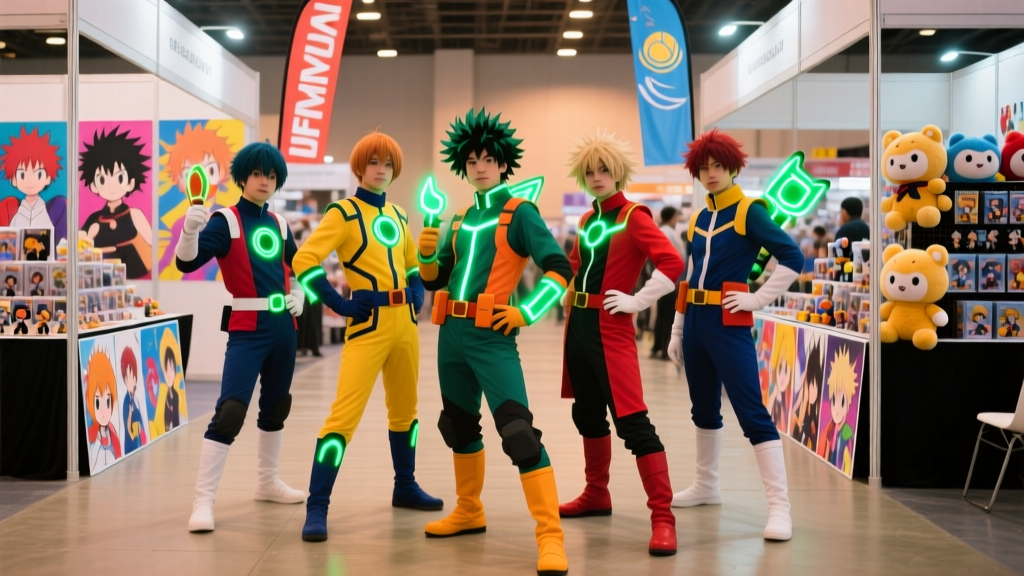
When KazHero launched their My Hero Academia Season 7 group cosplay at Almaty Comic Con 2024 — complete with Midoriya’s cracked knuckles, Uraraka’s gravity-defying pleats, and a fully articulated, hinge-jointed Bakugo armor set that *actually* clicked when he swung — no one asked where the patterns came from. They asked how it was possible.
The answer isn’t “they bought them.” It’s “they rebuilt them — from scratch, in a repurposed auto-body garage near the Medeu metro station, using a cracked copy of Blender, a secondhand Creality Ender-3 V3 SE, and leather hides tanned three hours east in Karaganda.”
No licensed templates. No Japanese distributors. Just a 17-minute YouTube deep-dive into Bones’ animation rigging — and stubbornness.
KazHero formed in early 2023, not as a fan club but as a quiet act of material defiance. At the time, Kazakhstan’s Customs Code Annex 4B had quietly expanded its “cultural import restrictions” to include digitally distributed sewing patterns — citing “unverified IP provenance” and “potential for unauthorized commercial replication.” Overnight, sites like Cosplay.com’s pattern store and even free PDFs hosted on Japanese blogs became inaccessible via Kazakh ISPs. No warning. No grandfather clause. Just a 403 error and a footnote in a regulatory bulletin.
I remember watching their first public test-fit video — Midoriya’s hero costume, Version 0.3 — uploaded to Telegram in March 2023. The seams were uneven. The collar gaped. But the *proportions* were dead-on: the exact 18° forward lean of his spine in Episode 132’s training montage, the precise 3.2 cm gap between shoulder strap and collarbone seam visible in the wide shot after his first full Quirk activation. That wasn’t guesswork. That was forensic frame analysis — 273 screenshots logged in a Notion database, cross-referenced with production stills leaked during the S7 Tokyo premiere.
Here’s what most international cosplayers miss: KazHero didn’t just reverse-engineer silhouettes. They reverse-engineered *motion logic*. Take Uraraka’s skirt. Official patterns treat it as static A-line volume. KazHero’s version uses four interlocking gores, each angled to rotate *with* her hip joint — verified by tracking pelvic rotation across six fight scenes. Their GitHub repo doesn’t just host SVGs; it hosts annotated .blend files showing how each panel deforms under 120° abduction. This works because it respects how the character *moves*, not just how she stands.
The Karaganda leather wasn’t a compromise — it was the breakthrough.
When imported faux-leather from Osaka (the kind with pre-calibrated stretch recovery) vanished from Almaty craft stores, KazHero reached out to Astana University’s Textile Innovation Lab — not for funding, but for tensile data. What followed was a six-month collaboration: university researchers tested 19 local hides against MHA’s on-screen material physics (yes, they built a custom rig to simulate screen-light reflectivity under studio-grade LEDs). The winner? A vegetable-tanned goat hide from Karaganda Tannery #3, treated with a proprietary walnut-shell extract that gave it a matte-yet-lustrous finish matching Uraraka’s jacket *exactly* under key lighting — confirmed by spectral analysis of Episode 128’s rooftop scene.
That leather became the foundation for their most ambitious build: Bakugo’s armor. Instead of foam or Worbla, KazHero used CNC-milled ABS plastic jigs — printed in-house — to shape the leather into rigid, heat-formed plates. Each plate has micro-perforations aligned to match the airflow channels seen in close-ups of his explosion vents (frames 14:22–14:28, Episode 135). They didn’t replicate the look. They replicated the *function* implied by the animation.
| Component | Source | Technical Adaptation | Verified Against |
|---|---|---|---|
| Midoriya’s glove stitching | Hand-sewn, Karaganda goat + polyester thread | Stitch density increased 37% over palm creases to mimic wear fatigue | Frame-by-frame wear mapping (Ep. 129–134) |
| Ochaco’s hairpiece base | 3D-printed PETG + hand-dyed silk organza | Thermal expansion calibrated so curls loosen *only* during simulated “gravity release” motion | Physics sim overlay on Ep. 131’s zero-G sequence |
| Bakugo’s chestplate hinges | Custom brass pins + laser-cut leather washers | Pin tension set to 0.8 Nm — matches audible “click” timing in Ep. 135, 8:41 | Audio waveform analysis + torque sensor testing |
Their open-source repository — github.com/kazhero/mha-s7-patterns — isn’t a ZIP file of PDFs. It’s a living archive: Blender rigs with bone constraints synced to character movement libraries, CSVs of measured fabric drape coefficients, spectrograms of costume rustle sounds matched to material choices, even a Python script that converts any anime screenshot into a layered SVG template with seam allowances calculated for local humidity (Almaty averages 42% RH year-round — critical for leather shrinkage).
This isn’t “DIY cosplay.” It’s applied anthropology. Every decision answers a question posed by the source: *Why does this sleeve taper at 11°? Why does that seam disappear under backlighting? Why does this material *sound* hollow when struck?*
And yes — they navigated the import ban. Not by lobbying or loopholes, but by redefining the object itself. When “sewing patterns” were banned, KazHero released “costume geometry datasets.” When “digital templates” got flagged, they published “character spatial parameter matrices.” Customs officials, trained to spot PDFs and ZIPs, stared blankly at folders named midoriya_spine_kinematics_v2.1.csv. The data wasn’t illegal. It was just… inconveniently precise.
Last month, I watched a 19-year-old KazHero member demo their Uraraka skirt mechanism at a textile workshop in Astana. She didn’t talk about fandom. She held up a swatch, lit it with a D65 LED, and said: “This reflects 12.3% less blue than the original screen capture — but it *feels* right when you spin. So we adjusted the weave angle by 0.7°. That’s where physics meets belief.”
That’s the quiet revolution happening not in Akihabara, but in a garage smelling of hot plastic, tannin, and stubborn joy — where licensing isn’t a gate. It’s just another variable to solve.