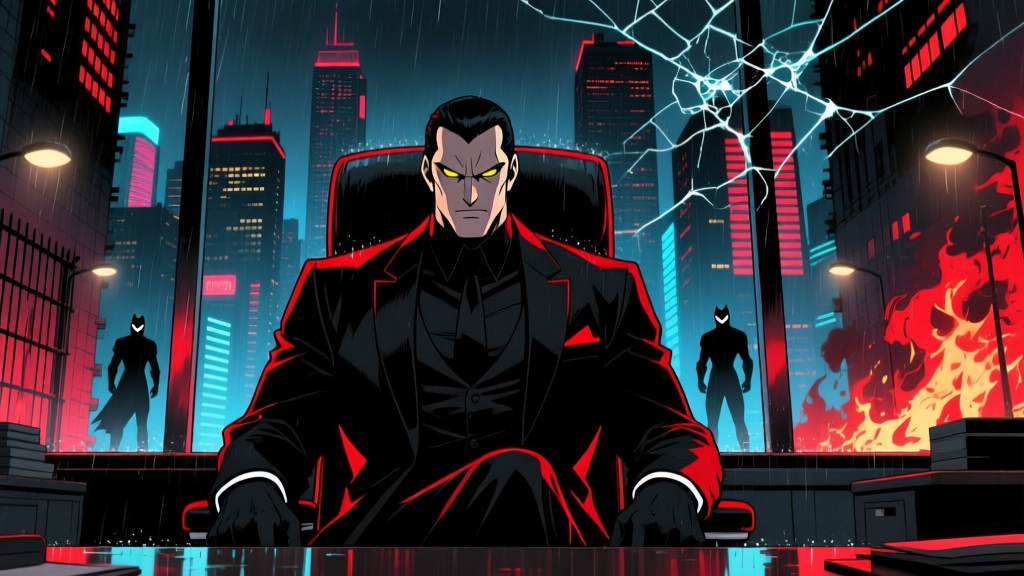
Kingpin Marvel: Wilson Fisk, the Man Who Owns the City That Heroes Try to Save
From his first appearance behind a desk in 1967 to Vincent D'Onofrio's terrifying resurrection in the MCU — the complete story of Marvel's most physically imposing, psychologically complex, and narratively indispensable crime lord.
Most Marvel villains want to rule the world. Thanos wants to halve it. Loki wanted a throne. Magneto wanted a homeland. Wilson Fisk wants something far more mundane and, in its mundanity, far more terrifying: he wants to own a city. Not conquer it. Not destroy it. Own it — the way a landlord owns a building, the way a butcher owns a slaughterhouse. Every cop on the payroll, every judge in his pocket, every shipment at the docks cleared before the Coast Guard finishes its coffee. Kingpin is Marvel's answer to the question of what happens when a criminal mind operates at the scale of municipal government, and the answer has produced some of the best superhero storytelling the medium has ever offered. If you have watched Daredevil punch a man in a hallway and wondered who put that man there in the first place — this article is about him.
1The Comic Book Origins of Wilson Fisk
Wilson Fisk first appeared in The Amazing Spider-Man #50, cover-dated July 1967, written by Stan Lee and drawn by John Romita Sr. He was not a sympathetic character. He was not a tragic figure with a dead wife and a childhood full of abuse. He was, in that first appearance, simply a very large man sitting behind a very large desk, telling Spider-Man that he intended to take over New York City's criminal underworld. His physical design was immediate and iconic: a barrel-chested, seemingly obese man in a white suit, bald, clean-shaven, with a ruby stickpin in his lapel and the calm demeanor of a CEO reviewing quarterly earnings. He did not look like a supervillain. He looked like a businessman who happened to be built like a refrigerator.
That design was deliberate. Romita Sr. based Fisk's physique on Sydney Greenstreet, the character actor famous for playing Casper Gutman in The Maltese Falcon — a man whose bulk was not a sign of weakness but of accumulated, sedentary power. The white suit was an equally calculated choice. In a medium where villains wore dark colors and lurched through shadows, Fisk dressed like a man who had nothing to hide because no one could touch him. The visual language was unmistakable: this was a man who operated in the open, who did not need to skulk because the systems of power already belonged to him.
Kingpin's earliest stories in Amazing Spider-Man established the template that would define the character for decades. He was not a physical threat to Spider-Man in the way the Green Goblin or Doctor Octopus were — he was an organizational one. Fisk controlled the crime, the corruption, the infrastructure of villainy that made New York dangerous in ways that went beyond any single costumed madman. He was the man who hired the thugs, funded the operations, laundered the money, and made sure the city's power brokers looked the other way. Spider-Man could punch Kingpin, and occasionally did, but punching a man does not dismantle the empire he built.
The Move to Daredevil
Kingpin's most consequential creative partnership did not begin with Spider-Man. It began when Frank Miller took over Daredevil in 1979 and gradually transformed the title from a mid-tier Marvel book into one of the most critically acclaimed comics of the 1980s. Miller recognized something in Kingpin that previous writers had only gestured at: the character worked best not as a cartoonish crime boss but as a genuine political figure, a man whose power derived from leverage, intelligence, and systemic corruption rather than from superpowers or gimmicks.
In Miller's hands, Kingpin became the dark mirror of Matt Murdock's idealism. Daredevil believed in the law, even when the law failed. Kingpin was the law — or at least the version of it that operated after dark. Their conflict was not simply hero-versus-villain; it was a philosophical argument about whether institutions could be redeemed from within or whether they were always already compromised by the people who controlled them. Miller's Kingpin was smarter, crueler, and more patient than the Spider-Man version. He did not monologue. He did not scheme in dark rooms with colorful henchmen. He sat in well-lit offices and made phone calls that rearranged the city's power structure.
The Kingpin-Daredevil rivalry became one of the defining hero-villain dynamics in American comics, right alongside Batman and the Joker or Professor X and Magneto. But where those rivalries were built on ideological opposition or personal intimacy, the Kingpin-Daredevil conflict was built on territory. Both men claimed Hell's Kitchen. Both men believed they were protecting it. And the uncomfortable truth at the heart of their rivalry was that, in certain respects, Kingpin was better at protecting it than Daredevil ever was.
2The Storylines That Forged the Kingpin
Fifty-plus years of publication means a lot of Kingpin stories. Some are forgettable. A handful are essential. These are the arcs that built the character we recognize today.
The First Appearance: "Spider-Man No More!"
Stan Lee and John Romita Sr.'s landmark issue is famous for the cover image of Peter Parker walking away from his Spider-Man costume in a garbage-strewn alley. But the villain pulling the strings behind the scenes is Kingpin, who uses Spider-Man's absence to consolidate his grip on New York's criminal operations. Fisk's introduction is masterfully understated — he is simply there, already powerful, already established, as if he had been running the city's underworld for years before the reader ever met him. The issue establishes a pattern that would recur throughout Kingpin's history: his greatest weapon is not violence but the vacuum created when heroes step away.
The Elektra Saga
Frank Miller's introduction of Elektra Natchios reshaped the Daredevil mythos permanently, and Kingpin was central to the upheaval. In these issues, Kingpin hires Elekra as his personal assassin, recognizing both her extraordinary skill and her emotional connection to Matt Murdock. The decision is pure Fisk: he does not want to kill Daredevil directly. He wants to weaponize Daredevil's own history against him. When Elektra ultimately turns against Kingpin and is killed by Bullseye on his orders, the sequence cements Kingpin as a villain who destroys people's lives through proxies — he rarely gets blood on his own hands, but the blood is absolutely on his ledger.
Born Again
The single greatest Kingpin story ever told, and arguably the greatest Daredevil story ever told. Frank Miller and David Mazzucchelli's "Born Again" begins when Karen Page, Matt Murdock's ex-girlfriend and a heroin addict, sells his secret identity for a fix. The information reaches Kingpin, who does not simply attack Daredevil — he dismantles Matt Murdock's entire life. He freezes his bank accounts, disbars him, frames him for assault, has his apartment firebombed, and sends a drug-addled Captain America imposter to beat him within inches of his life. The systematic destruction of Matt Murdock's civilian identity is the most sustained act of psychological warfare any Marvel villain has ever conducted against a hero. It is also the story that revealed Kingpin's most important character trait: patience. Fisk does not rush. He does not gloat. He tightens the noose one notch at a time, and he watches.
Spider-Man: Blue — The Table Dance
Jeph Loeb and Tim Sale's Spider-Man: Blue is primarily a love story about Peter Parker and Gwen Stacy, but it contains one of the most viscerally satisfying Kingpin moments in comic history. After Kingpin orchestrates a series of attacks on Spider-Man's life, Peter finally reaches the end of his patience, walks into Fisk's office, and physically dismantles his entire security operation. The climactic scene — in which Spider-Man lifts Kingpin off the ground by his lapels and dangles him out a high-rise window — is a rare moment where the reader gets to see what happens when a superhero stops treating Kingpin as a strategic problem and starts treating him as a physical one. Fisk's expression in that sequence — shock, followed by something approaching respect — tells you everything about the relationship between these two characters.
The King of Hell's Kitchen
Brian Michael Bendis and Alex Maleev's Daredevil run redefined the character for the 21st century, and Kingpin's role in their story is both unexpected and devastating. In this arc, Matt Murdock's secret identity is publicly exposed, and Kingpin — now imprisoned — uses his remaining influence to ensure that Murdock's life becomes a waking nightmare even from behind bars. What makes this storyline remarkable is that it demonstrates Kingpin's power is not dependent on his physical freedom. Fisk in a prison cell is still more dangerous than most villains at large, because his power resides in the system he built, not in his body. Bendis understood that Kingpin is less a man than an institution, and you cannot put an institution in handcuffs.
One of the most important additions to Kingpin's character came not from a fight scene but from a love story. Vanessa Fisk, Wilson's wife, was introduced in The Amazing Spider-Man #70 (1969) and became the single most significant emotional anchor in the character's history. Vanessa was not a criminal. She was a woman who married Fisk before she understood the full scope of his empire, and their relationship became a slow-burn tragedy of deception, loyalty, and moral compromise. Her death from cancer in later comics hit Kingpin harder than any superhero ever could — because it was the one thing he could not control, could not intimidate, and could not buy his way out of. The MCU's decision to make Vanessa (played by Ayelet Zurer) a central figure in both Daredevil and Echo was one of the smartest adaptations the franchise has made.
3What Actually Makes Kingpin Dangerous
Kingpin has no superpowers. He cannot fly, shoot energy beams, or heal from wounds at an accelerated rate. And yet he is consistently ranked among the most dangerous villains in the Marvel Universe. The reason is that his "powers" are more insidious and harder to counter than anything in a gamma-irradiated toolkit.
Physical Strength
Do not let the bulk fool you. Kingpin's body is not fat — it is muscle buried under a thick frame, and that muscle is trained to a level that routinely surprises people who underestimate him. In the comics, Fisk has gone toe-to-toe with Spider-Man in hand-to-hand combat and held his own for extended periods. He has crushed a man's skull with his bare hands in Daredevil. He once body-slammed Captain America through a table. In the Netflix series, Vincent D'Onofrio's Kingpin tears a man's head off with a car door, beats Daredevil into submission in their final confrontation, and snaps a subordinate's arm with a single twist. The character's physical threat is often downplayed in favor of his intellectual one, but the comics and screen adaptations have made it clear: if you get within arm's reach of Wilson Fisk, you are in genuine physical danger.
Strategic Intelligence
Kingpin's mind is his primary weapon. He thinks in systems — legal systems, financial systems, political systems, criminal systems — and he understands how they interlock better than almost anyone in the Marvel Universe. His operations span legitimate businesses (construction, real estate, shipping, media) and illegitimate ones (drug trafficking, arms dealing, money laundering, assassination-for-hire), and the boundaries between the two are so thoroughly blurred that prosecuting him is nearly impossible. He does not just commit crimes. He architects environments in which crime is the natural outcome of the structures he controls.
Political and Legal Leverage
At his peak, Kingpin controlled the police commissioner's office, multiple judges, several city council members, and at least one U.S. senator. His blackmail files were legendary — a vault of compromising material on virtually every person of influence in New York City. In "Born Again," he uses these files to have Matt Murdock disbarred and his accounts frozen through entirely legal channels. That is what makes Kingpin different from a Joker or a Green Goblin: his villainy operates within the framework of the law. He does not break the system. He uses it.
Patience and Discipline
Kingpin does not lose his temper in the way other villains do. He does not fly into rages, make impulsive decisions, or sabotage his own plans through ego. When Daredevil destroys his operations, Fisk rebuilds them — slowly, methodically, without drama. When he is imprisoned, he treats it as a temporary inconvenience and continues to run his empire from a cell. This patience makes him almost impossible to defeat permanently, because every victory against him is provisional. He will be back. Not tomorrow, not next week, but he will be back, and when he returns, he will be more prepared than he was before.
4Vincent D'Onofrio and the Definitive Live-Action Kingpin
Before 2015, Kingpin's live-action history was thin. Michael Clarke Duncan played the character in the 2003 Daredevil film, and while Duncan brought physical menace to the role, the screenplay gave him almost nothing to work with beyond "large man who is bad." The character deserved better, and in 2015, he got it.
Netflix's Daredevil, the first Marvel Television series produced for the streaming platform, introduced Vincent D'Onofrio as Wilson Fisk in a manner that stunned audiences and critics alike. Showrunner Steven S. DeKnight and his creative team made a decision that fundamentally changed how Kingpin was perceived: they made him a protagonist. Not a hero — Fisk is unambiguously a villain — but a character whose inner life, motivations, and emotional journey are given the same narrative weight as Matt Murdock's. The first season of Daredevil devotes nearly as much screen time to Wilson Fisk's rise as it does to Matt Murdock's, and the result is one of the most psychologically rich villain portrayals in the history of superhero television.
Season 1: The Man in the Room
D'Onofrio's Kingpin is introduced not as a crime lord but as a lonely, emotionally damaged man who falls in love with a gallery owner named Vanessa Marianna. Their courtship is awkward, tender, and deeply uncomfortable to watch because you know what this man is capable of — and yet the scenes between Fisk and Vanessa are among the most human moments in any Marvel production. D'Onofrio plays Fisk as a man who genuinely believes he is saving Hell's Kitchen, who views his criminal empire as a form of civic stewardship, and who experiences love as something he is fundamentally unworthy of. When he finally snaps — when the carefully maintained veneer of civility cracks and the violence pours out — it is terrifying precisely because you have spent hours watching him be gentle.
The head-crushing scene in Episode 4, "In the Blood," remains one of the most shocking moments in the MCU's television history. Fisk, confronted by a Russian mobster who has threatened Vanessa, crushes the man's skull with a car door. He does it in a single motion, without hesitation, and then walks back to Vanessa as if nothing happened. That scene is not gratuitous. It is a thesis statement: Wilson Fisk's capacity for violence is always there, held in check only by his willpower, and when that willpower fails, the violence is absolute.
Season 3: The Prisoner and the King
When Daredevil returned for its third season in 2018, D'Onofrio's Kingpin had been in federal custody since the end of Season 1. What followed was a masterclass in villainous patience. Fisk spent the entire season manipulating the FBI from inside his cell, using a compromised agent (Benjamin Poindexter, who becomes the comics' Bullseye) to carry out his agenda, and orchestrating an elaborate scheme to frame Matt Murdock and regain his freedom. The season's climactic sequence, in which Fisk is released from custody and walks out of the prison in his signature white suit, is one of the most chilling moments in Marvel television. He has won. Again. Because that is what Kingpin does.
5Kingpin in the MCU: Hawkeye, Echo, and Beyond
When Netflix's Marvel series were cancelled and the characters' rights reverted to Marvel Studios proper, fans assumed that the Netflix versions of these characters would be quietly recast or abandoned. That did not happen. Instead, Marvel Studios made the decision — radical for the MCU — to bring Vincent D'Onofrio back as Wilson Fisk, treating the Netflix series as canonical backstory for the character's MCU appearances.
Hawkeye (2021)
Kingpin's MCU debut came in the final episodes of Hawkeye, Disney+'s holiday-set series about Clint Barton and Kate Bishop. The reveal was handled with extraordinary restraint: for most of the series, Kingpin exists only as a name, a whispered reference to a powerful figure behind the Tracksuit Mafia's operations. When D'Onofrio finally appears on screen in Episode 5, stepping out of the shadows in a long white coat, the effect is immediate. Even viewers who had never seen Daredevil understood, from the character's physical presence alone, that they were looking at someone dangerous.
The Hawkeye version of Kingpin is leaner, more weathered, and more controlled than the Netflix version. He has been in hiding since the events of Daredevil Season 3 (in-universe, this corresponds to the five-year Blip period), and his return to power is cautious and deliberate. His confrontation with Kate Bishop — who shoots him with a trick arrow and appears to kill him — is handled with ambiguity. His body is never shown. Fans knew immediately that he would return.
Echo (2024)
Marvel Studios' Echo, a spin-off of Hawkeye centered on Maya Lopez (Alaqua Cox), gave Kingpin his most substantial MCU role to date. The series explores Fisk's relationship with Maya, whom he raised as a surrogate daughter after ordering the murder of her biological father. It is a relationship built on manipulation, genuine affection, and the kind of toxic paternal love that D'Onofrio portrays with devastating subtlety.
Echo also gave viewers the most physically imposing version of Kingpin yet seen in the MCU. A sequence in which Fisk single-handedly tears through a group of attackers with a sledgehammer is the most visceral Kingpin action scene ever filmed, and it reinforced the character's dual threat: he is simultaneously a strategic genius and a man who can kill you with household tools. The series ended with Kingpin alive, watching a news broadcast about the mayoral race in New York City — a clear setup for his next move.
Marvel Studios' Daredevil: Born Again, which premiered on Disney+ in March 2025, brought D'Onofrio's Kingpin into direct conflict with Charlie Cox's Matt Murdock for the first time under the Marvel Studios banner. The series drew heavily from the "Born Again" comic storyline while adapting it for the MCU's continuity, and D'Onofrio's portrayal continued to evolve — older, more politically ambitious, and running for Mayor of New York City. The character's transition from Netflix to Disney+ has been one of the MCU's most successful legacy integrations, and it stands as proof that audiences will follow great performances across platforms.
6Kingpin Across Media: A Comparative Breakdown
Kingpin has been portrayed in comics, animation, film, television, and video games across six decades. Each interpretation emphasizes different facets of the character. The table below maps the major portrayals and what each one brings to the table.
| Medium | Title / Year | Portrayed By | Key Characteristics | Defining Moment |
|---|---|---|---|---|
| Comics (Original) | Amazing Spider-Man #50 (1967) | N/A (Stan Lee / John Romita Sr.) | Calm, corporate, physically massive; introduced as an organizational threat rather than a personal one | Sitting behind his desk, explaining his plan to take over New York as if presenting a business proposal |
| Comics (Miller Era) | Daredevil #170–233 (1981–1986) | N/A (Frank Miller / David Mazzucchelli) | Politically connected, psychologically manipulative, patient; the architect of Matt Murdock's destruction | "Born Again" — systematically dismantling Matt Murdock's civilian identity over six issues |
| Animation | Spider-Man: The Animated Series (1994–1998) | Roscoe Lee Browne (voice) | Theatrical, articulate, slightly campy; introduced a generation of children to the character | The "Tablet of Time" arc, where Fisk's pursuit of immortality technology drives the central conflict |
| Film | Daredevil (2003) | Michael Clarke Duncan | Physically imposing but narratively thin; more enforcer than strategist | The final confrontation with Daredevil in a burning church |
| Television (Netflix) | Daredevil (2015–2018) | Vincent D'Onofrio | Emotionally complex, genuinely lonely, capable of both tenderness and extreme violence; a fully realized character | Car door head-crush (S1E4); walking out of prison in the white suit (S3 finale) |
| Television (MCU) | Hawkeye (2021) | Vincent D'Onofrio | Leaner, more weathered; a king returning from exile with cautious, calculated moves | Emerging from the shadows in Episode 5; the ambiguous confrontation with Kate Bishop |
| Television (MCU) | Echo (2024) | Vincent D'Onofrio | Paternal, manipulative, physically brutal; the surrogate father whose love is a weapon | The sledgehammer fight sequence; watching the NYC mayoral news in the final scene |
| Television (MCU) | Daredevil: Born Again (2025–) | Vincent D'Onofrio | Politically ambitious, running for mayor; the crime lord who wants to legitimize his power through the ballot box | The mayoral campaign and direct confrontation with Matt Murdock under the MCU banner |
| Video Games | Spider-Man (PS4, 2018) | Travis Willingham (voice) | Strategic mastermind who hires supervillains as contractors; treats organized crime like a Fortune 500 operation | The Sinister Six assembly scene, where Fisk's empire crumbles and his contingency plans activate |
7Why Kingpin Is Marvel's Greatest Villain
This is a claim that invites argument. Marvel has Thanos, who snapped half the universe out of existence. It has Magneto, a Holocaust survivor with a legitimate grievance and the power to reshape continents. It has Doctor Doom, a head of state who is simultaneously a sorcerer and a scientist. How does a bald man in a white suit compete with any of that?
The answer is believability.
Thanos is a cosmic abstraction. Magneto is a metaphor. Doctor Doom is a fantasy. Kingpin is a man who could actually exist — and in some senses, already does. Every city in the world has someone who operates the way Wilson Fisk operates: a figure who accumulates power through the intersection of legitimate business and illegitimate enterprise, who uses the legal system as a weapon, who controls political outcomes through financial leverage, and who views the people around him as either assets or obstacles. You do not need to suspend disbelief to accept Kingpin. You just need to read the news.
This groundedness gives Kingpin stories a weight that cosmic villain stories cannot replicate. When Thanos threatens the universe, the stakes are theoretically infinite but emotionally abstract — nobody in the audience has ever experienced a universe-level threat. When Kingpin destroys Matt Murdock's life in "Born Again," every reader recognizes the terror of having your identity, your livelihood, and your relationships systematically dismantled by someone with enough money and enough power. That fear is immediate, personal, and universal.
Kingpin also occupies a unique structural position in the Marvel Universe. He is the villain who connects everyone. Spider-Man fights his street-level operations. Daredevil fights his corruption of Hell's Kitchen. The Punisher wants to put a bullet in his head. The Avengers have occasionally tangled with his political influence. He is a nexus point — a character whose operations are broad enough to touch every corner of the Marvel Universe but specific enough to feel personal to every hero who confronts him.
"You think you know what I am. Wilson Fisk is a man. But I am not just any man. I am the Kingpin. And everything you see around you... is mine."
— Wilson Fisk, Daredevil (Netflix), Season 3Perhaps the most compelling reason Kingpin endures is that his stories never resolve the way superhero stories are supposed to resolve. In most Marvel narratives, the hero defeats the villain, the villain goes to prison or dies, and the status quo is restored. Kingpin stories do not work that way. Fisk is defeated, imprisoned, humiliated — and then he rebuilds. He always rebuilds. The cycle of destruction and reconstruction is built into the character's DNA, and it means that every Kingpin story carries the implicit promise that this is not the end. He will be back. He always comes back. That persistence — that refusal to stay defeated — makes him more terrifying than any cosmic entity, because it mirrors the way real-world corruption actually works.
8Kingpin Collectibles: Figures, Statues, and Comics Worth Hunting
If D'Onofrio's portrayal has turned you into a Kingpin fan — or if you have been one since Romita Sr. first drew that white suit in 1967 — here is a curated guide to the most notable Kingpin collectibles currently on the market.
Hot Toys Kingpin (Daredevil Netflix) 1/6 Scale
$280 – $400 (Secondary Market)The definitive Kingpin figure. Hot Toys' 1/6 scale release captures D'Onofrio's likeness with unsettling accuracy, complete with the white suit, ruby stickpin, and multiple expression swaps. The paintwork on the facial sculpt is among the best Hot Toys has ever produced for a television character. Out of production and climbing in value.
Marvel Legends Kingpin (Hasbro, 2019 Walmart Exclusive)
$35 – $80 (Secondary Market)A Walmart-exclusive release in Hasbro's Marvel Legends line, this 6-inch Kingpin figure is based on the Netflix portrayal and includes a display base and alternate hands. Its Walmart exclusivity made it notoriously difficult to find at retail, driving secondary market prices well above its original $22 MSRP. A solid, affordable display piece.
XM Studios Kingpin Premium Statue
$600 – $1,200 (Secondary Market)XM Studios' polystone statue depicts Kingpin seated in a throne-like chair, cigar in hand, with the New York City skyline reflected in the base. At approximately 18 inches tall, it is a centerpiece display item. The likeness is comic-accurate rather than D'Onofrio-based, drawing from the classic Romita Sr. design. Limited production run.
Amazing Spider-Man #50 (1967) — First Appearance
$800 – $15,000+ (Depending on Grade)The comic that started it all. CGC-graded copies in high grades (8.0 and above) command significant premiums, with near-mint copies (9.4+) reaching into five figures. Even low-grade reader copies sell for several hundred dollars. The "Spider-Man No More" cover alone is one of the most iconic images in comic history.
Daredevil: Born Again TPB (First Printing, 1987)
$40 – $150The first collected edition of Miller and Mazzucchelli's masterpiece. First printings in good condition are increasingly scarce. This is the most important Kingpin story ever told, and owning it in its original trade paperback format is a piece of comics history. The story holds up perfectly four decades later.
Sideshow Collectibles Kingpin Sixth Scale
$300 – $500 (Secondary Market)Sideshow's take on the comic-book Kingpin predates the Netflix series and draws directly from the classic white-suit design. The tailoring on the suit is genuine fabric, the head sculpt is stylized but recognizable, and the accessory loadout includes his signature cane and a miniature desk with papers. A strong display companion to the Hot Toys version.
Kingpin collectibles have appreciated steadily since the Netflix series debuted in 2015, and D'Onofrio's MCU appearances in Hawkeye, Echo, and Daredevil: Born Again have continued to drive interest. The Hot Toys 1/6 scale figure and Amazing Spider-Man #50 in high grade have shown the strongest appreciation. If you are collecting for display rather than investment, the Marvel Legends figure remains the best value proposition — it looks good on a shelf and will not break the bank.
9Frequently Asked Questions
Who plays Kingpin in the Marvel Cinematic Universe?
Vincent D'Onofrio portrays Wilson Fisk / Kingpin in the MCU. He first played the character in Netflix's Daredevil (2015–2018) and reprised the role in Marvel Studios' Hawkeye (2021), Echo (2024), and Daredevil: Born Again (2025). Michael Clarke Duncan previously played the character in the 2003 Daredevil film directed by Mark Steven Johnson.
Does Kingpin have superpowers?
No. Kingpin has no superhuman abilities. His power comes from his strategic intelligence, political connections, financial resources, and surprisingly formidable physical strength. His body, though bulky, is predominantly muscle, and he has been shown defeating trained fighters in hand-to-hand combat. In the Netflix series and MCU appearances, D'Onofrio's portrayal emphasizes both his intellectual and physical menace.
Is the Netflix Daredevil series canon to the MCU?
Yes, as of 2024–2025, Marvel Studios has treated the Netflix Daredevil series as canonical backstory. Vincent D'Onofrio and Charlie Cox both reprised their roles in MCU productions, and the events of the Netflix series are referenced as part of their characters' histories. Daredevil: Born Again (2025) continues the story directly, incorporating elements from both the Netflix series and the broader MCU continuity.
What is the best Kingpin story to read?
Daredevil: Born Again (issues #227–233, 1986) by Frank Miller and David Mazzucchelli is universally regarded as the definitive Kingpin story. It follows Fisk as he discovers Daredevil's secret identity and systematically destroys Matt Murdock's life. If you read only one Kingpin comic, this is it. For a more modern take, Brian Michael Bendis and Alex Maleev's Daredevil run (vol. 2, 1998–2006) features Kingpin as a major antagonist throughout and is essential reading.
Why does Kingpin wear a white suit?
The white suit was part of John Romita Sr.'s original character design in Amazing Spider-Man #50 (1967). The choice was deliberate: in a genre where villains traditionally wore dark colors and hid in shadows, Kingpin's white suit signaled that he operated in the open. He did not need to conceal himself because the systems of power already belonged to him. The suit has become one of the most iconic costume designs in comics and was faithfully adapted for Vincent D'Onofrio's portrayal in both the Netflix series and the MCU.
What is Kingpin's relationship with Spider-Man versus Daredevil?
Kingpin was introduced as a Spider-Man villain in 1967 and remained primarily a Spider-Man antagonist through the 1970s. His shift to Daredevil's rogues gallery began with Frank Miller's Daredevil run in 1979 and was cemented by "Born Again" in 1986. Today, Kingpin is more closely associated with Daredevil than with Spider-Man, though he appears in both characters' stories regularly. The distinction is thematic: against Spider-Man, Kingpin is a criminal mastermind to be outwitted; against Daredevil, he is a philosophical adversary whose existence challenges everything Matt Murdock believes about justice and the law.
Is Kingpin running for Mayor of New York City in the MCU?
Yes. In the closing moments of Echo (2024), Wilson Fisk is shown watching a news report about the New York City mayoral race, strongly implying his intention to enter politics. This storyline was picked up in Daredevil: Born Again (2025), where Fisk's mayoral campaign becomes a central plot element. The political angle draws from the comics, where Kingpin has periodically used political influence and proxy candidates to extend his power beyond the criminal underworld.
How tall and heavy is Kingpin?
In the comics, Wilson Fisk is typically listed at approximately 6'7" (201 cm) and 450 pounds (204 kg), the majority of which is muscle mass beneath a heavy frame. Vincent D'Onofrio, who portrays the character on screen, is 6'3" (191 cm) and bulked up significantly for the role. The character's design has always emphasized that his size is a feature, not a bug — he is meant to physically dominate any room he enters.
What happened to Vanessa Fisk?
In the comics, Vanessa Fisk (née Mariana) died of cancer after a long illness, an event that devastated Wilson and briefly drove him to abandon his criminal empire. She has been resurrected and written out multiple times since, as is common in long-running comic continuity. In the Netflix Daredevil series, Vanessa Marianna (played by Ayelet Zurer) survived the Season 1 poisoning attempt and married Fisk. She was last seen in the Netflix series during the Season 3 finale, departing with Fisk after his release from prison. Her status in the MCU proper remains to be fully explored.
10The Kingpin Will Always Come Back
There is a moment near the end of Frank Miller's "Born Again" when Matt Murdock, battered and broken, confronts Wilson Fisk in his penthouse office. Fisk is calm. He is always calm. He has already won, or so he believes. Murdock has lost his practice, his home, his reputation, and very nearly his mind. And yet there he stands, in the doorway, refusing to stay down.
That scene — that dynamic, that refusal on both sides to concede — is the essence of what makes Kingpin work as a villain. He is not interesting because he is powerful. Plenty of Marvel villains are powerful. He is interesting because he represents something that heroes cannot punch into submission: the quiet, patient, systemic accumulation of control over the institutions that are supposed to protect us. When the police are on his payroll, when the judges are in his pocket, when the mayor answers his calls — what good is a man in a red suit swinging from rooftops?
The answer, of course, is that it does almost no good at all. And yet the man in the red suit keeps swinging. And the man in the white suit keeps building. And the city keeps turning between them, caught in a cycle that has no resolution because neither man can fully defeat the other without becoming him.
Vincent D'Onofrio understood this better than any actor who has played the character. His Kingpin is not evil in the theatrical sense. He is not cackling or monologuing or twirling a metaphorical mustache. He is a man who looked at a broken city and decided that the only way to fix it was to own it — and who was so damaged, so isolated, so starved for connection that he mistook ownership for love and control for purpose. That is not a supervillain origin story. That is a human tragedy wearing a white suit.
Wilson Fisk will be back. He always comes back. The question has never been whether Kingpin can be stopped. The question is whether the city he wants to own is worth saving — and whether the people trying to save it can do so without becoming the thing they are fighting against. That question has no clean answer, which is exactly why it has produced fifty years of extraordinary storytelling and shows no sign of stopping.