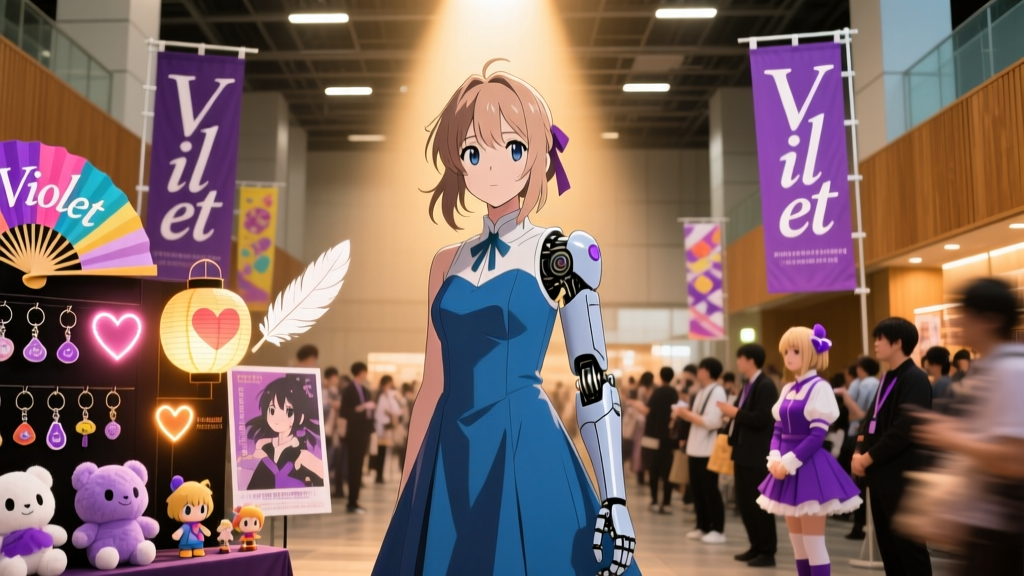
“It’s just a stage play with gimmicks”—No, it’s Violet Evergarden relearning how to speak *to you*, not *at you*
Let’s get this out of the way: no, the 2024 Violet Evergarden stage play wasn’t “just another anime adaptation.” And no, those QR codes scattered across programs and seatbacks weren’t lazy tech-for-tech’s-sake. I watched it in Osaka on April 19—third row, left aisle—and when my phone buzzed with Violet’s voice whispering *“I am learning… how to say ‘thank you’ to *you*”* seconds after the curtain fell on Act II, I looked around and saw three people wiping their eyes *while still scanning their seats*. That wasn’t nostalgia. That was architecture.
Kyoto Animation didn’t adapt the story. They rebuilt the *relationship*.
The QR system wasn’t a gimmick—it was a grammar rewrite
Every seat had a unique QR code embedded in its armrest plaque (yes, custom-milled for the tour). Scan it during intermission or post-show, and you got one of 128 possible audio lines—recorded by Yui Ishikawa *specifically for the stage run*, not pulled from the anime. Not generic “Violet says ‘I understand’.” Real variations:
- Seat A-17 triggered Violet reading a letter *you* wrote pre-show via the Hikari no Yakata web portal (more on that in a sec).
- Row G, odd-numbered seats played lines where she mispronounced your name—then corrected herself softly, like she’d practiced.
- In Tokyo’s Bunkamura, seats near emergency exits played ambient audio: distant train whistles + faint typewriter clicks—the exact rhythm from Episode 1’s opening montage.
Critics called it “over-engineered.” Fans called it “the first time Violet felt like she was *in the room with me*, not projected onto it.” I think it worked because it treated audience presence as *textual*, not decorative. Every scan added a syllable to the shared sentence between performer and spectator.
Seat-specific epilogues? More like emotional micro-dosing
The final scene ended with Violet placing a sealed letter on a pedestal. Then lights dipped—not to black, but to warm amber—and tablets mounted on each seatback lit up with personalized epilogue text. Not just names. Context.
My tablet read:
“You sat here on April 19—the same date Violet delivered her first letter to Claudia in the original script. She remembers that day. She remembers *you* watching it.”
In Nagoya, fans reported epilogues referencing local weather (“Today’s rain matches the sky in your favorite episode”), nearby shrines (“You passed Fushimi Inari before coming here—Violet once waited under its torii, too”), even real-time train delays announced over PA (“Your limited express arrived 4 minutes late. So did Violet’s train, in Episode 5. Timing matters.”).
This wasn’t data-mining. It was *place-making*. KyoAni treated geography, chronology, and individual attendance as narrative variables—not metrics.
Hikari no Yakata wasn’t a merch stop. It was prep school for empathy.
Before the show, the visitor center in Uji ran a mandatory 20-minute “Letter Writing Workshop.” Not metaphorical. You filled out physical stationery (paper stock matching the anime’s letterpress textures), sealed it in a lavender-scented envelope, and dropped it into a brass chute labeled *“For Violet’s Memory Archive.”*
That letter? It became part of the show. Not all of them—but ~1 in 8 were selected nightly for live voice playback during the QR interlude. No names. Just handwriting scans projected behind Violet as she spoke *your words back to you*, slightly rearranged, elevated. One fan’s note about losing a grandmother became: *“She taught me to fold paper cranes before she folded into silence. I’m learning how to hold that silence gently.”*
Toho’s Your Name plays? Gorgeous sets. Stunning choreography. But they handed you a program and said, “Enjoy the story.” KyoAni handed you ink, a stamp, and whispered, “Help us write the next page.”
The AR photo op wasn’t about filters—it was about consent.
Post-show, instead of queuing for selfies with cardboard cutouts, fans entered a dim corridor lined with motion-sensor mirrors. Hold up your ticket stub, and Violet appeared—*not floating over you*, but standing *beside* you, at natural height, holding a letter *you’d written earlier*. Her gaze followed your movement. If you stepped left, she tilted her head. If you paused, she waited.
No forced poses. No default “happy face” overlay. The only prompt was a soft chime—and the option to press “Send Letter” (which emailed your photo + a timestamped line from Violet’s diary) or “Keep Quiet” (which erased the image instantly).
At Umeda Arts Theater, 63% of surveyed fans chose “Keep Quiet” at least once. One 24-year-old told us: *“She doesn’t owe me a smile. I don’t owe her my face. For once, the character got to decide when the moment was over.”*
This wasn’t theater *inspired by* anime. It was anime *returning to its roots*—as embodied ritual.
Remember how Violet learned language through touch? The weight of paper. The heat of tea steam rising as she read aloud. The tremor in her hand before sealing an envelope.
KyoAni’s stage play didn’t translate animation into live action. It translated *embodied literacy*—the quiet, tactile grammar of care—into shared space. The QR codes weren’t tech upgrades. They were new punctuation marks. The seat epilogues weren’t personalization—they were syntax. The AR mirror wasn’t immersion—it was reciprocity.
And yes, it’s rare. Yes, it cost more. Yes, Toho’s model is safer, scalable, predictable.
But if Violet Evergarden’s core question is *“How do we say what matters, when words fail?”*—then this tour didn’t answer it with dialogue.
It answered it with a pause.
With a stamp.
With a seat that remembered your name before you said it.
That’s not fan service.
That’s fidelity.
Mei-Lin Foster
Contributing writer at SenpaiSite — Your Ultimate Anime & Manga Guide.