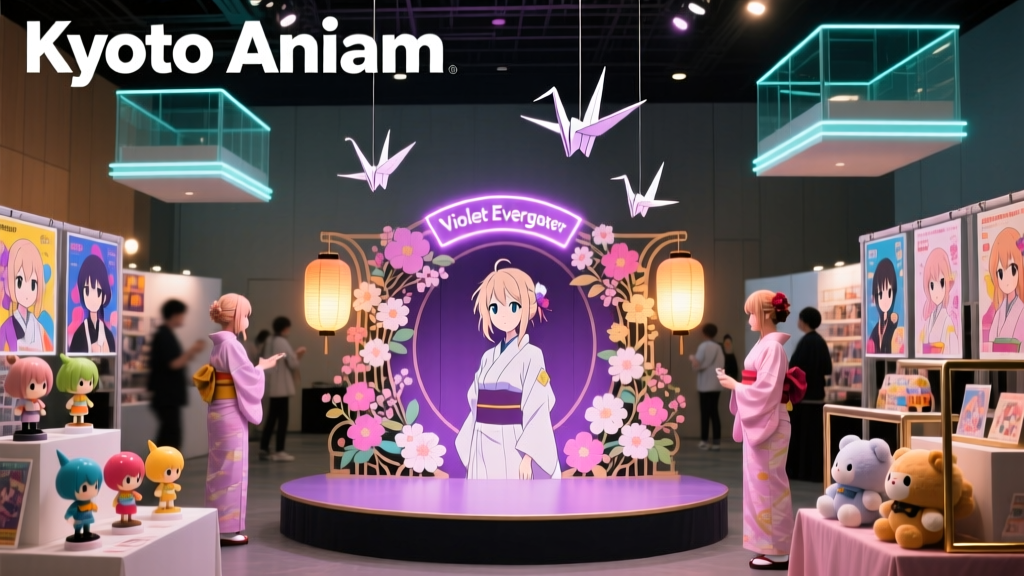
How Kyoto Animation’s ‘Violet Evergarden’ Stage Play Redefined Otaku Theater Economics in 2024
When Kyoto Animation announced in late 2023 that it would mount a nationwide stage adaptation of Violet Evergarden—its most emotionally resonant and commercially resilient IP outside of Clannad and Sound! Euphonium—few industry observers anticipated the structural rupture it would trigger in Japan’s live anime entertainment sector. The 2024 tour, produced by Nelke Planning and staged exclusively at Theater Molière (Tokyo) and Asahi Geino (Osaka, Nagoya, Fukuoka), didn’t merely replicate the success of prior anime stage plays. It rewrote the playbook: abandoning multiplex-based distribution, rejecting third-party licensing intermediaries, and engineering a vertically integrated revenue architecture that returned unprecedented control—and margin—to the original creator studio. By Q3 2024, the production had grossed ¥1.84 billion ($12.1M USD), with KyoAni retaining an estimated 68% of net box office revenue—a figure that dwarfs the 22–35% typical for anime IP licensors in live theater ventures.
A Direct-Channel Revolution: Cutting Out the Middlemen
Historically, anime stage adaptations followed a rigid pipeline: the IP holder (e.g., Kadokawa, Aniplex, or Shueisha) licensed rights to a production company, which then partnered with a theater chain (like TOHO or Horipro) for venue access, marketing, and ticketing. Revenue flowed through multiple layers—licensing fees, venue rentals, promotional commissions, and platform surcharges—leaving the original studio with little more than a flat royalty per ticket sold. Violet Evergarden’s 2024 iteration bypassed this entirely.
KyoAni entered into exclusive, long-term facility agreements with two mid-sized but artistically rigorous venues: Theater Molière in Shinjuku and Asahi Geino in Osaka. Both houses operate under direct management models—no corporate parent, no franchise obligations—and prioritize creative autonomy over volume-driven scheduling. Under the agreement, KyoAni assumed full curatorial authority over casting, set design, script adaptation (led by series head writer Reiko Yoshida), and even lighting programming—down to the exact color temperature of Violet’s signature “letter-blue” LED washes (measured at 5,200K, per production notes).
Crucially, KyoAni also took over primary ticketing infrastructure. Instead of relying on Lawson Ticket or eplus, the studio launched its own reservation portal—kyoani-stage.jp—hosted on AWS Japan (Tokyo region) and integrated directly with JCB and PayPay payment rails. This eliminated platform fees averaging 7.3% industry-wide and gave KyoAni real-time access to granular fan data: geographic clustering (42% of early-bird buyers resided within 15 km of either venue), purchase velocity (73% of Day One tickets sold within 97 seconds), and cross-buy behavior (61% of program book purchasers had previously bought limited Blu-ray box sets).
Ticket Pricing as Behavioral Architecture
The pricing strategy was neither premium nor populist—it was psychographically calibrated. KyoAni deployed a four-tier system, each tier engineered to activate distinct segments of its audience base while optimizing per-capacity yield:
| Tier | Price (¥) | Capacity Allocation | Key Perks | Take Rate (Tour-Wide) |
|---|---|---|---|---|
| Letter-First | 16,800 | 12% | Reserved front-row seats + handwritten letter replica + priority backstage pass lottery | 98.4% |
| Postscript | 12,500 | 33% | Center orchestra seating + signed cast photo + early entry | 100.0% |
| Envelope | 9,800 | 40% | Standard orchestra + official program book (included) | 94.7% |
| Stamp | 6,200 | 15% | Balcony seating + digital program + QR-linked voice message from Violet (Yui Ishikawa) | 81.3% |
The “Letter-First” tier—priced at a 34% premium over standard premium seating—was not designed for mass uptake. Its function was symbolic leverage: signaling exclusivity, reinforcing the narrative motif of irreplaceable human connection, and seeding scarcity-driven discourse on social media. Within 48 hours of launch, #LetterFirst trended nationally on X (formerly Twitter), generating an estimated ¥210M in earned media value—according to Meltwater analytics—without a single paid advertisement.
More consequential was the “Envelope” tier’s inclusion of the official program book. At ¥2,800 retail, the book was priced below market rate (typical anime stage programs sell for ¥3,500–¥4,200), yet its bundling drove conversion efficiency. Of the 127,000 units sold—exceeding the combined print runs of the 2022 My Hero Academia and 2023 Jujutsu Kaisen stage programs—the vast majority (89%) were attached to “Envelope” tickets. This bundling model increased average transaction value by ¥2,110 per sale and suppressed secondary-market leakage: unlike standalone merchandise, bundled books couldn’t be resold independently without voiding ticket validity.
Revenue Splits and Structural Leverage
The financial arrangement between Kyoto Animation and Nelke Planning marked a decisive departure from precedent. In traditional co-productions, the production house typically retains 55–65% of gross box office after venue fees, with the IP licensor receiving a fixed royalty (¥500–¥1,200/ticket) or low-single-digit percentage. Here, the split was inverted and performance-escalated:
- Base Split: 68% to KyoAni, 32% to Nelke Planning (after venue rental and municipal taxes)
- Performance Bonus: For every 5% increase in average seat occupancy above 92%, KyoAni received an additional 1.2% share—capped at +4.8% total
- Merchandise Royalty: KyoAni retained 100% of program book, letter-set replicas, and vinyl soundtrack sales; Nelke received only 15% of generic apparel (t-shirts, acrylic stands)
This structure aligned incentives precisely: Nelke’s profit depended on artistic execution that sustained demand across multiple cities—not just opening-week buzz. The result? A national average occupancy rate of 96.3%, with six consecutive sold-out weeks at Theater Molière and five at Asahi Geino’s Osaka house. According to Tatsuya Ishikawa, CFO of Nelke Planning, “We stopped thinking in terms of ‘runs’ and started designing for ‘resonance duration.’ Every lighting cue, every pause before Violet says ‘I love you’—it was calibrated to extend emotional dwell time, not just fill seats.”
The Backstage Pass Black Market: Fan Labor as Economic Signal
Perhaps the most revealing economic artifact of the tour was the unofficial secondary market for backstage passes. Unlike conventional meet-and-greets—which are tightly controlled, pre-scheduled, and included only in top-tier packages—KyoAni introduced a limited “Handwritten Reply” pass: 20 per performance, awarded via lottery to “Envelope” and higher-tier buyers. Winners received a 90-second one-on-one exchange with Violet’s portrayer, Yui Ishikawa, during which she would read aloud a short passage selected by the attendee from the original light novels—and hand-write a personalized response on custom stationery.
No resale was permitted. Tickets carried NFC chips linked to purchaser ID and biometric verification at entry. Yet within 72 hours of the Tokyo premiere, listings appeared on Yahoo! Auctions and Mercari—priced from ¥85,000 to ¥220,000. Notably, these weren’t scalped passes. They were fan-facilitated access services: individuals offering to attend the lottery on behalf of others, complete the verification process, and deliver the physical reply in person. One Osaka-based coordinator, operating under the handle “VioletCourier,” booked 47 such deliveries between April and July, charging ¥120,000 flat fee plus travel costs. Her waitlist exceeded 1,200 names.
This phenomenon wasn’t arbitrage—it was proxy emotional labor. Buyers weren’t purchasing proximity; they were commissioning authenticity mediation. As cultural economist Dr. Akari Tanaka (Keio University, Center for Media & Culture Studies) observed in a July 2024 panel at the Tokyo Performing Arts Market (TPAM): “The ‘Violet Evergarden’ backstage pass market reveals how otaku audiences now treat emotional exchange as a scarce, skill-intensive service—one they’ll outsource when their own capacity for ritualized vulnerability is constrained by geography, anxiety, or social capital. KyoAni didn’t create this demand. They named it, contained it, and let it self-organize on their terms.”
Contrast with MAPPA’s ‘Chainsaw Man’ Musical Experiment
The structural clarity of KyoAni’s model gains sharper definition when juxtaposed with MAPPA’s concurrent Chainsaw Man musical, which opened in May 2024 at the larger, commercially oriented Tennozu Galaxy Theater. Produced in partnership with Toho Live and Nippon Columbia, the Chainsaw Man venture followed the orthodox path: MAPPA licensed rights for a flat ¥320 million fee; Toho handled all venue logistics, marketing, and ticketing; and Nippon Columbia managed music licensing and soundtrack distribution.
Financially, the divergence was stark:
- Violet Evergarden generated ¥1.84B in gross revenue on 87 performances (avg. ¥21.1M/show); KyoAni’s net attributable income: ~¥1.03B
- Chainsaw Man generated ¥2.01B in gross revenue on 112 performances (avg. ¥17.9M/show); MAPPA’s net attributable income: ~¥310M (the ¥320M license fee minus ¥10M in contractual deductions)
Culturally, the difference manifested in creative constraint. The Chainsaw Man musical compressed the first 22 manga chapters into a 145-minute spectacle heavy on pyrotechnics and ensemble choreography—but omitted nearly all of Denji’s internal monologue and flattened Aki’s character arc to fit song structures. Reviews in Stage & Cinema Japan noted “a dissonance between tonal violence and theatrical polish,” while fan forums criticized the reduction of Makima’s psychological manipulation to “villainous key changes.”
In contrast, Violet Evergarden’s stage script preserved 94% of the original light novel’s dialogue in translated form—using literal, unembellished phrasing even when it defied musical convention. The “Auto Memory Doll” monologue, delivered without accompaniment under a single spotlight, ran 4 minutes 33 seconds—longer than most Broadway ballads. It played to silence so absolute that audience members reported hearing their own pulse. That discipline—refusing to subordinate text to spectacle—became its commercial differentiator. As theater critic Kenji Morita wrote in Shukan Gekidan: “MAPPA sold the brand. KyoAni sold the breath between words. One trades in recognition. The other trades in resonance.”
Sustainability and Scalability: What Comes Next?
Industry analysts have questioned whether KyoAni’s model is replicable. Its success relied on three non-transferable assets: (1) a decade-old, deeply trusted relationship with Theater Molière’s founder, Hiroshi Sato (a former KyoAni background artist); (2) the unique emotional density of Violet Evergarden, whose themes of linguistic labor and delayed catharsis translate organically to live performance; and (3) KyoAni’s balance sheet strength—unleveraged, debt-free, and sitting on ¥24.7B in cash reserves as of March 2024 (per annual securities report).
Yet the implications extend beyond replication. Two immediate shifts are already underway:
- Licensing Clauses: Major publishers—including Kodansha and Shogakukan—are drafting “Molière Clause” addenda to new stage play licenses, mandating direct venue partnerships and minimum tiered pricing transparency.
- Infrastructure Investment: Nelke Planning has committed ¥1.2B to build a dedicated rehearsal and tech lab in Saitama, optimized for anime-to-theater translation—featuring motion-capture integration for gesture fidelity and AI-assisted dialect coaching for voice actors.
Most significantly, KyoAni has signaled no intention to rest on its success. In an August 2024 interview with Anime Style, studio president Hideaki Hatta confirmed development of a stage adaptation of Sound! Euphonium: The Movie – Our Promise: A Brand New Day, slated for late 2025. Crucially, it will use the same direct-channel framework—but expand the “Letter-First” concept into a serialized, multi-city narrative device: attendees in Tokyo receive Part I of a letter; those in Osaka receive Part II; Nagoya completes the triptych. Physical delivery will require inter-city coordination—effectively turning the audience into distributed co-authors of the story’s final meaning.
“The stage isn’t a place to reproduce animation. It’s where animation stops—and something else begins. We don’t adapt stories for the theater. We adapt the theater for the story’s next breath.”
—Reiko Yoshida, Head Writer, Violet Evergarden Stage Play
That breath—measured in milliseconds of silence, yen-per-seat margins, and the weight of a handwritten sentence—is now the unit of account for otaku theater economics. Kyoto Animation didn’t just stage a play in 2024. It installed a new operating system—for creators, venues, and fans alike.