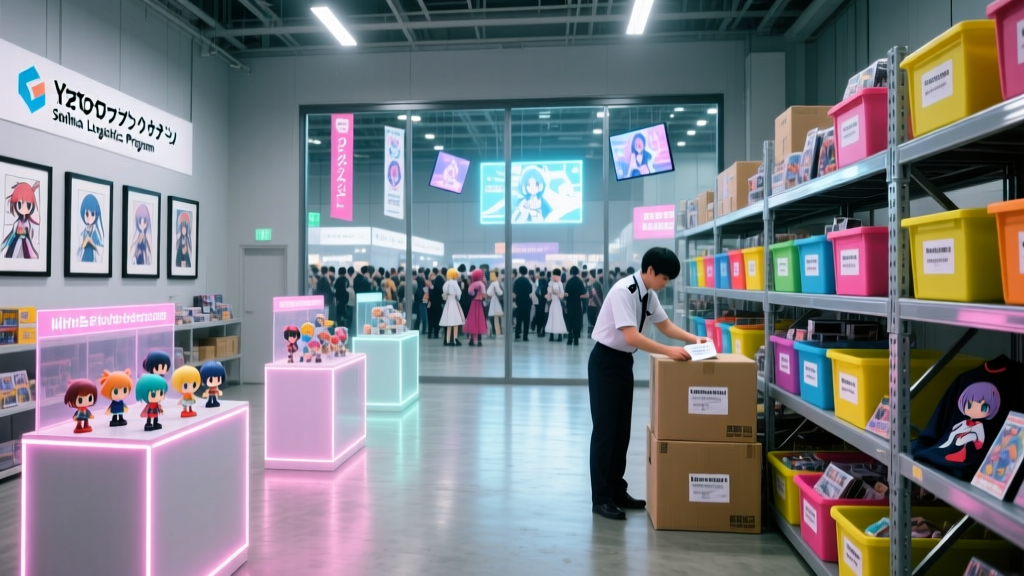
‘K-On! But Make It Logistics’
You know that scene in K-On! Episode 4 — the one where Yui drops her guitar strap, Mio panics about sheet music, and Ritsu tries to “manage” the chaos by yelling orders into a clipboard she’s never opened? That’s not anime slapstick anymore. That’s the opening montage of Kyoto Seika University’s 2024 Anime Industry Support Specialization — and yes, they’re training kids to fix it.
I watched that episode the week before my first visit to Seika’s new logistics lab — a converted warehouse annex smelling faintly of printer toner and instant ramen — and laughed until I choked on my matcha latte. Because here’s the thing no one told me: this isn’t satire. It’s accredited. It’s funded by Bandai Namco. And its first cohort just finished shadowing pallet-jack operators at the Osaka Distribution Center while cross-referencing real-time RFID logs against Aniplex’s Q3 Blu-ray batch IDs.
This program doesn’t ask whether anime is art. It asks: *How many 12cm cases fit in a 900mm-wide Euro pallet when stacked four-high with 25mm inter-layer spacers — and why did Kadokawa’s Tokyo warehouse reject last month’s Spice and Wolf reissue because the carton weight exceeded JIS Z 8112-2017 tolerance by 17 grams?*
The Curriculum Doesn’t Whisper — It Scans
Forget “Narrative Semiotics in Shōjo Manga.” This track runs on manifest sheets, not monographs.
Core classes include:
- Light Novel Fulfillment Math: Not theory. Not abstraction. Students spend three weeks reverse-engineering actual Kadokawa shipping manifests from Q2 2023 — calculating per-title unit cost across air vs. sea freight, factoring in JETRO export subsidies, then adjusting for yen depreciation spikes that triggered the 5% surcharge on overseas print-on-demand orders. One assignment required them to recalculate the optimal container load for Ascendance of a Bookworm Volume 12 (German edition) after discovering the original pallet configuration violated EU Directive 2016/1035 on packaging waste recovery rates. They passed. The German distributor didn’t.
- RFID Tagging & Batch Integrity for Home Video: Taught jointly by Aniplex engineers and Seika faculty, this isn’t “how to stick a sticker.” It’s how to validate EPCglobal Gen2 tag reads across 1,200-unit batches, troubleshoot false-negative rates caused by foil-lined slipcovers (yes, those exist), and reconcile discrepancies between warehouse WMS timestamps and Sony DADC Japan’s disc replication logs. Students run live tests using actual Aniplex SKUs — including the infamous My Hero Academia Season 6 Limited Edition box set, whose dual-layer NFC tags once crashed a regional distribution hub’s reader array. You don’t learn that in a lecture hall. You learn it while holding a handheld interrogator in Bay 7B, sweating under fluorescent lights, watching your screen flash “Tag Collision Detected — Retry?”
- Customs Documentation for Manga Export (JLPT N2 + Harmonized System Code Drill): No vague talk about “global fandom.” This class forces students to file mock HS 4901.99 declarations for manga exports to Brazil, Canada, and Vietnam — each requiring different certificate-of-origin rules, different VAT thresholds, and wildly different censorship annotations. (Brazil requires “violence level” descriptors; Canada mandates bilingual title registration; Vietnam bans all references to “spiritual cultivation,” which once got Tensei Shitara Slime Datta Ken held at Ho Chi Minh City port for 11 days.) Graduates don’t just know what an ATA Carnet is — they’ve filled one out for a physical copy of Black Butler Vol. 30 bound for a Tokyo Comic Con pop-up in Paris.
This isn’t vocational training dressed up as anime studies. It’s anime industry infrastructure made visible — finally. For years, we talked about “the anime business” like it was some mystical black box powered by moe and miracles. Meanwhile, actual people were manually keying SKU numbers into SAP while wondering why the Laid-Back Camp Blu-ray shipment missed its Sapporo launch window because someone misread “Fukushima Prefecture” as “Fukuoka Prefecture” on a customs form. Seika didn’t invent logistics. They stopped pretending it wasn’t the engine.
Why Theory Degrees Got Left at the Loading Dock
Let’s be blunt: “Anime Studies” programs — the kind that analyze color symbolism in Neon Genesis Evangelion while outsourcing their syllabus printing to a local copy shop — have become the humanities equivalent of a limited-edition figurine: beautiful, collectible, and functionally useless outside a glass case.
I remember sitting in a panel at Comiket 101 where a professor from a top-tier university described “otaku labor as affective resistance.” A guy in a Genshiken hoodie raised his hand and asked, “So… does that help me fill out a Bill of Lading for a 40-foot container of Dr. Stone tankōbon going to Chile?” The professor blinked. Said something about “epistemic frameworks.” The kid nodded politely and walked out. He enrolled at Seika six weeks later.
The difference isn’t ideology — it’s accountability. Seika’s program is certified under Japan’s Senmon Gakkō (Specialized Training College) framework. Its syllabus was co-drafted with Toho Logistics, Bandai Namco, and Shogakukan Publishing’s fulfillment division. Its capstone project? Redesigning the inbound receiving workflow at Aniplex’s Kobe facility to cut average pallet-unload time by 12%. Not “explore themes of alienation.” Cut time. By twelve percent.
Graduates Don’t Talk in Metaphors — They Talk in KPIs
I met two 2023 graduates — Haru Tanaka and Saki Morimoto — at Toho Logistics’ Yokohama sorting hub during peak Golden Week prep. Both wore navy vests with embroidered Seika logos and clipboards strapped to their thighs. Neither mentioned “semiotics.” Both referenced Takt Time.
Haru, now a Shift Coordinator, showed me his tablet: a live dashboard tracking inbound shipments for the One Piece Film: Red home video rollout. “See this spike at 14:30?” he said, tapping a red bar. “That’s the Nagoya air freight landing. We had 37 minutes to unload, scan, and route 1,842 units before the outbound truck left for Nagoya Station’s anime store pop-up. Last year? We missed it by 4.5 minutes. This year? We hit it — and added buffer for QC checks. That’s the Seika module on ‘Dynamic Slotting Optimization.’”
Saki, who handles international returns, pulled up a spreadsheet titled “Manga Return Rate Anomalies — Q1 2024.” She pointed to a 32% spike in returned copies of Blue Lock Vol. 27 from Germany. “The ISBN was correct. The cover art matched. But the spine text was printed in Japanese instead of German — a vendor error, not a customs one. Our old system flagged it as ‘damaged goods.’ Now? We tag it ‘language mismatch,’ auto-route to repackaging, and feed the data back to Kodansha Europe’s production team. That’s Light Novel Fulfillment Math — applied. Not theorized.”
They didn’t sound like grads. They sounded like people who’d just recalibrated a barcode scanner and won.
This Isn’t Selling Out — It’s Showing Up
Some fans still scoff. “They’re turning otaku into warehouse clerks!” Yeah — and? Who do you think kept Clannad in stock during the 2013 Blu-ray boom? Who ensured Steins;Gate’s “Beta DVD Box” actually shipped to pre-order customers before the anime aired? Not the critics. Not the professors. The people who knew how to read a packing list, spot a mislabeled carton, and call the carrier before the 5 p.m. cutoff.
Otaku culture has spent decades being studied, fetishized, and monetized — rarely *operated*. Seika’s program flips the script. It says: Your obsession isn’t a hobby. It’s domain expertise. And domain expertise, when paired with inventory velocity charts and HS code drills, pays rent.
So no — this isn’t “K-On! but make it logistics” as a joke.
It’s K-On! — finally getting the backstage pass it always deserved.