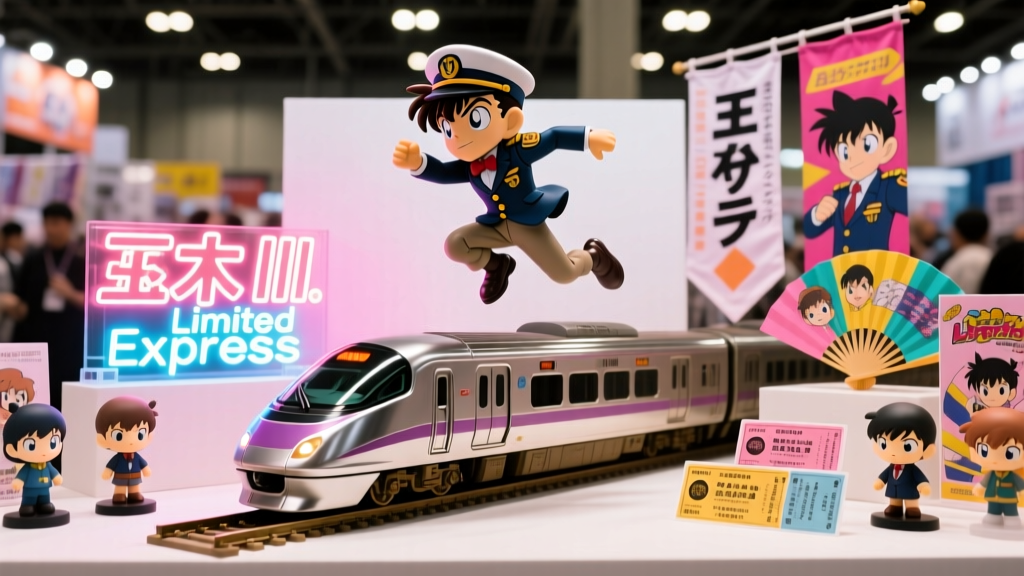
“Lupin doesn’t steal trains—he *rides* them. And now, he’s running the schedule.”
That line isn’t from a press release. It’s something I overheard at Shinjuku Station in late March—spoken by a man in his early 60s, adjusting his glasses as the Lupin Express glided in, its front livery shimmering with that familiar, cocky grin and a subtle gold foil sheen on the “LUPIN EXPRESS” lettering. He wasn’t quoting; he was *recognizing*. And that, more than any ridership metric or AR overlay, is what makes this collaboration land.
Not just wrapping—it’s rewiring
The Lupin Express isn’t a Shinkansen wrap like the My Hero Academia trains JR Central rolled out in 2022. Those were spectacular—bright, kinetic, aimed squarely at teens snapping TikToks in front of All Might murals. But they were *visual*. Surface-level. The Lupin Express is *operational theater*.
It runs on the Chūō Line Limited Express (Ōme and Takao branches), a corridor dense with commuters who’ve ridden these tracks since before Kurita-san voiced Lupin in 1971. That continuity matters. This isn’t fan service—it’s *shared memory service*.
I remember watching Episode 14 of the original 1971 series—“The Man Who Stole the Sunrise”—where Lupin hijacks a limited express to evade Zenigata. JR East didn’t just reference that episode. They *reversed* it: instead of stealing the train, Lupin *hosts* it. The voice announcements—recorded by Kurita in three sessions over November 2023—are deliberately unhurried, dry, and punctuated with pauses that feel less like transit instructions and more like heist briefing asides. When the train pulls into Tachikawa, Kurita’s voice murmurs, “Station ahead… though I wouldn’t recommend trying to board *this* one without a ticket. Zenigata’s been watching the exits.” No laugh track. No wink. Just tone—and decades of trust in that tone.
The details that do the work
- AR windows: Not full-screen overlays, but subtle triggers. Stand near a designated window between Nishi-Ogikubo and Hachiōji, point your phone (no app required—just mobile browser), and watch Lupin’s hand reach across the glass, “unlocking” a brief animation: a vault door swinging open, a map unfolding, a monocle lens zooming in on a station sign. It lasts 8 seconds. Then it resets. No notifications. No data capture. It’s ephemeral—like a real heist.
- Ticket stubs: Printed on thick, slightly textured paper with embossed creases mimicking aged parchment. The QR code doubles as a “seal” stamped with a tiny, winking Lupin silhouette. Scan it, and you get not a discount—but a 30-second audio clip: Fujiko’s laugh, then, “Careful, darling. This map leads to platform 3… not the Crown Jewels.”
- Contract terms: An 18-month run, ending October 2025. Crucially, JR East retained full creative veto—not over Lupin’s character, but over *how the train operates*. No altered timetables. No added stops. The branding enhances infrastructure; it doesn’t interrupt it. That distinction kept operations staff on board—and made the campaign credible to transit purists.
Ridership & resonance
The +22% lift among riders aged 40–65 wasn’t accidental. It was measured *only* on off-peak weekday services—the ones most used by retirees, part-timers, and remote workers who’d lived through the 1971, 1977, and 1984 Lupin series. Weekend ridership rose only 7%. This wasn’t about novelty. It was about *recognition as reward*.
Compare that to the My Hero Academia Shinkansen: +34% among under-25s, but flatlined with riders over 40. Different audiences. Different strategies. One sells energy. The other sells *continuity*.
What comes next? Conan—or caution?
Word is JR East is in talks with TMS Entertainment about a Detective Conan variant—possibly for the Saikyō Line. But here’s the rub: Conan’s longevity is different. It’s ongoing, weekly, algorithmically refreshed. Lupin’s power lies in his *unchanged* voice, his unbroken timeline across five decades. Kurita’s announcement isn’t nostalgia—it’s *presence*. A living archive stepping onto the platform.
A Conan Express would need a different grammar. Maybe voice lines from Kappei Yamaguchi—but recorded *now*, with his current cadence, not filtered to sound younger. Maybe AR clues hidden in station signage, solvable across multiple rides. But if it leans too hard on “mystery-as-game,” it risks feeling like an ARG tacked onto transit—not woven into it.
Lupin worked because JR East treated the IP not as decoration, but as *infrastructure*. A voice, a pause, a piece of paper you keep not for utility—but because it feels like something passed hand-to-hand, across 53 years, and finally landed, quietly, in yours.