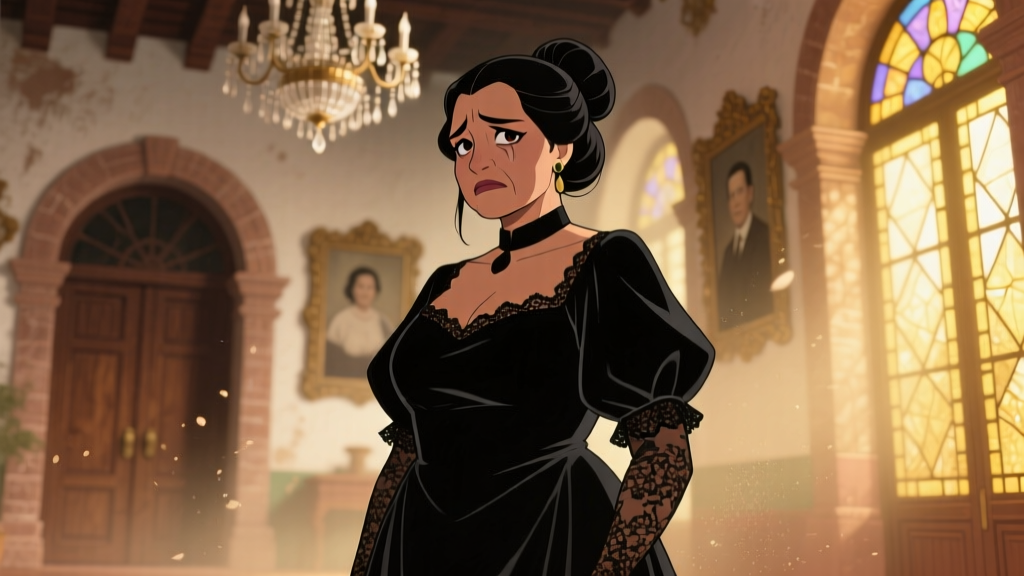
The first time you meet Mama Imelda in Coco, she is already dead. She stands on the marigold bridge in a high-collared dress, flanked by a towering alebrije, radiating the kind of authority that doesn't require raising a voice. She has run the Rivera family from beyond the grave for the better part of a century, enforcing a music ban so absolute that her great-great-grandson doesn't even know what a guitar sounds like up close. And yet, by the time the credits roll, Imelda is the character who breaks your heart wider open than any other figure in the film — not because she was cruel, but because every rule she ever made came from a wound she never let anyone see.
Imelda Rivera is the emotional center of Pixar's most emotionally complex film, and she does it while singing exactly one song. Her story is about what happens when grief hardens into policy, when the person who loves you most is also the person who limits you most, and when forgiveness arrives decades too late for the people who needed it but right on time for the people who inherit the fallout. If Hector is the soul of Coco and Miguel is its heartbeat, Imelda is its spine — the structure everything else depends on.
The Ban That Shaped Generations
The Rivera family's prohibition on music is not a minor plot device. It is the load-bearing wall of the entire story, and Imelda placed it there herself. The film establishes this through the opening narration, a paper-cutout sequence that compresses decades of family history into a few minutes of visual storytelling. Young Imelda sings. Young Hector plays guitar. They have a daughter, Coco. Then Hector leaves — supposedly to pursue a music career with his friend Ernesto de la Cruz — and never comes back. Imelda is left alone with a toddler, no income, and a broken heart she refuses to acknowledge, let alone discuss.
So she tears the music out of her life by the roots. She bans instruments. She bans singing. She pivots the family into shoemaking, a trade that requires precision, discipline, and absolutely no artistic expression. The shoe workshop becomes the family's economic engine and its emotional cage. Imelda's decision is not presented as villainy — the film is far too sophisticated for that — but as a grief response so total that it calcifies into doctrine. The family doesn't just avoid music for a generation. They avoid it for five generations, passing the prohibition down like an heirloom nobody questions because nobody remembers where it came from.
This is the kind of intergenerational trauma that family therapists write case studies about. A wound inflicted on a three-year-old girl named Coco — the abandonment of her father — becomes a rule enforced on a twelve-year-old boy named Miguel roughly ninety years later. Miguel has never met Imelda in life. He has never heard the story of Hector's departure in anything but the most sanitized, villain-edits-the-photo version. He just knows that music is forbidden, that his family's identity is inseparable from shoemaking, and that questioning either of those facts makes him a traitor to people he loves but cannot fully understand.
Imelda's ban works narratively because it works psychologically. Anyone who has grown up in a family with unspoken rules — don't talk about Uncle So-and-So, don't bring up what happened that summer, don't ask Abuela why she cries when she hears certain songs — recognizes the Rivera household immediately. The prohibition on music is not really about music. It is about a woman who was hurt so badly that she decided the safest way to protect her descendants was to amputate the part of life that caused her pain, and the tragedy is that she was partly right. Music did cause her pain. Hector did leave. The problem is that the cure turned out to be almost as damaging as the disease.
Imelda and Hector: A Love Story Told in Negative Space
One of the most remarkable things about Coco is that it presents a genuine love story between two characters who barely interact on screen. Imelda and Hector's relationship exists almost entirely in fragments — a torn photograph, a recalled lullaby, a letter never received. The audience has to assemble their romance from archaeological evidence, and what emerges is devastating.
Hector wrote songs for Imelda. Not for audiences, not for fame, not for Ernesto de la Cruz to steal and put his name on — for her. "Remember Me" was not a stage number. It was a private promise set to melody, a man telling his wife and daughter that absence does not erase love. The film's most devastating reveal is not that Ernesto murdered Hector (though that is devastating in its own right). It is that Hector was coming home. He had decided that his family mattered more than his career, had written a farewell letter to Ernesto, and was boarding a train back to Santa Cecilia when his supposed best friend poisoned him with laced tequila. He died not as a man who abandoned his family, but as a man who was killed while trying to return to them.
Imelda never knew. For nearly a century — first in life, then in the Land of the Dead — she believed the worst possible version of the story. She believed Hector chose music over his wife and daughter. She believed he was a selfish dreamer who traded his family for a guitar. And she built an entire family identity around the conviction that music destroys the people who love it. The photograph on the ofrenda, with Hector's face ripped away, is the physical manifestation of that belief: not just anger, but the systematic erasure of a man who was, in reality, murdered for loving his family too much to stay away.
"The song was not meant for the world. It was meant for Coco. It was meant for Imelda. It was a lullaby from a father who knew he might not come home — and then didn't." — Adrian Molina, Co-Director, Coco (2017)
The reconciliation scene between Imelda and Hector, when it finally comes, is played with extraordinary restraint. There is no sweeping orchestral score. There is no grand speech. Imelda learns the truth — that Hector was murdered, that he was coming home, that every bitter thing she believed about him was a lie manufactured by a murderer — and she processes it in roughly the time it takes to sing one verse of "Remember Me." The animators give Imelda a sequence of micro-expressions: shock, then fury (directed at Ernesto, not Hector), then a grief so raw it barely fits inside her face. Alanna Ubach, who voices Imelda, delivers the performance of a career in about forty-five seconds of screen time, letting the audience hear a woman's entire emotional architecture rearrange itself in real time.
And then Imelda does something that is, in its way, more radical than anything Miguel does in the film. She forgives. Not immediately, not completely, and not without conditions — she still belts Hector in the arm with a marigold when she gets the chance, which is possibly the most culturally accurate depiction of a Mexican grandmother's forgiveness ever committed to animation. But she lets him back. She calls him by name. She sings. The woman who banned music for ninety years opens her mouth and lets a melody out, and the Land of the Dead goes quiet to listen.
"La Llorona" and the Night Imelda Sang
The song Imelda chooses to sing — the one that breaks the silence she imposed on herself and her family for the better part of a century — is "La Llorona." This is not a random selection. "La Llorona" is one of the most storied and haunting folk songs in the Mexican canon, a piece with roots stretching back to the Isthmus of Tehuantepec in Oaxaca, with lyrics that have been rewritten, reinterpreted, and passed down through oral tradition for generations. The song tells the story of a weeping woman — the title translates to "The Weeper" — who wanders rivers and shorelines mourning the loss of her children. It is a song about maternal grief so powerful it becomes supernatural, and its inclusion in Coco is a deliberate parallel to Imelda's own story: a mother whose grief over a lost family member defined every subsequent choice she made.
The scene is staged as a performance within the film's talent competition in the Land of the Dead. Imelda takes the stage ostensibly to stop Miguel from being caught, but what unfolds is something far more intimate. She begins tentatively, almost uncertainly, as though her vocal cords have forgotten what singing feels like. Then Hector joins her on guitar — the same guitar he played for her when they were young — and the song transforms. It becomes a duet between two people who spent decades apart, communicating through a melody they both remember but haven't shared since before tragedy struck. The animators render Imelda's face in warm gold and marigold light, and for the first time in the film, the rigid posture that defines her character softens. She sways. She closes her eyes. She lets the music move through her the way it used to, before she decided music was the enemy.
It is, by any reasonable measure, one of the finest musical sequences in Pixar's filmography, and it works because the film spent two hours earning it. You cannot fake the weight of that moment. You cannot shortcut the emotional investment required to make a woman singing a folk song feel like the climax of an entire narrative. Coco builds the foundation patiently — establishing Imelda's rigidity, her authority, her refusal to bend — specifically so that when she finally does bend, the audience feels the structural shift in their chest.
Imelda as the Mexican Family Matriarch: A Cultural Portrait
Ask any Mexican or Mexican-American viewer to name the most realistic character in Coco, and a significant percentage will say Imelda without hesitation. She is not the loudest character in the film. She is not the funniest or the most visually striking. But she is, for a very specific demographic, the most recognizable person on screen. She is the grandmother who runs everything from a kitchen table that is also a boardroom. She is the woman who never explains her rules but expects them to be followed. She is the matriarch whose love is expressed through food, through structure, through the relentless maintenance of a family that would fall apart the moment she stopped holding it together.
The Mexican family matriarch — the abuela, the bisabuela, the woman at the top of the hierarchy — is a figure with deep cultural roots and enormous social significance. In traditional Mexican family structures, particularly in the post-revolutionary period that shaped Imelda's generation, women were often the de facto heads of household even when men held nominal authority. The matriarch controlled the ofrenda. She managed the family's relationship with the dead, which in a culture as steeped in Día de los Muertos tradition as Mexico's is not a minor responsibility. She decided who was remembered and how. She was the gatekeeper between the living and the departed, and that role carried genuine spiritual weight.
| Trait | How It Appears in Coco | Cultural Context |
|---|---|---|
| Unquestioned authority | The entire Rivera family obeys the music ban for five generations without challenge | Reflects the traditional role of the abuela as the family's moral and practical decision-maker, whose word is rarely questioned openly |
| Love through food and labor | Imelda's family gathers around her table; she provides structure, not verbal affection | In Mexican family culture, cooking and domestic management are primary expressions of maternal love, often substituting for verbal emotional communication |
| Control of the ofrenda | Imelda maintains the family altar and dictates whose photo is displayed | The ofrenda is the spiritual center of a Mexican household during Día de los Muertos; its curator holds symbolic power over family memory and ancestor veneration |
| Emotional stoicism | Imelda processes the truth about Hector with composure; her vulnerability appears only when she sings | Many Mexican matriarchs of Imelda's generation were raised under cultural norms that discouraged public emotional display, especially grief or doubt |
| Discipline as protection | Imelda's music ban is framed as protecting the family from the pain Hector's abandonment caused | Strict parenting in Mexican family culture is often rooted in protective instinct rather than punitive impulse — rules exist to shield children from harm the parent experienced firsthand |
| Forgiveness through action | Imelda hits Hector with a marigold before embracing him; her reconciliation is physical, not verbal | Conflict resolution in Mexican families often proceeds through gestures and actions rather than explicit verbal apology — the hit is the conversation |
Pixar's research team — which spent six years visiting Mexican families, attending Día de los Muertos celebrations, and consulting with cultural advisors including cartoonist Lalo Alcaraz and playwright Octavio Solis — understood that Imelda could not be a generic strict grandmother. She had to be a specifically Mexican strict grandmother, and the distinction is in the details. She hits Hector with a marigold flower rather than shouting at him. She feeds people. She communicates disapproval through silence and approval through the smallest possible gesture — a nod, a loosened grip on someone's hand. These are not universal matriarchal behaviors. They are specific to a culture where grandmothers carry authority in their posture and where love is often expressed through the things you do rather than the things you say.
The character also resonates because she is allowed to be wrong. A significant amount of media aimed at celebrating maternal figures defaults to portraying mothers as infallible, which is its own kind of dishonesty. Imelda made a mistake — a massive, generations-long mistake — based on incomplete information and unprocessed grief. The film does not excuse that mistake. It shows the damage it caused: a boy who nearly lost his connection to his family because the family had lost its connection to its own history. But it also shows that being wrong does not make Imelda a villain, and admitting fault does not diminish her authority. When she finally sings, she does not lose her power. She becomes more fully herself.
Imelda in the Land of the Dead: Visual Design and Symbolism
Imelda's character design in the Land of the Dead is a masterclass in visual storytelling. In life, photographs show her as a young woman with dark hair, a warm smile, and a simple dress — the kind of woman who could fill a room with laughter. In death, she is taller, thinner, more angular. Her skeleton is visible through her skin in the way all Land of the Dead residents are rendered, but her face carries an expression that the living photographs never showed: a set jaw, narrowed eyes, the look of someone who has been holding a fortress together with nothing but willpower and stubbornness.
Her costume is deliberately high-collared and Victorian-influenced, reflecting the era in which she died — roughly the mid-twentieth century, based on the film's timeline. The dress is dark purple and black, with intricate embroidery that echoes the papel picado banners seen throughout Santa Cecilia. She wears her hair in a tight bun, not a strand out of place. The overall effect is of a woman who has maintained absolute control over her appearance the same way she maintains absolute control over her family: through constant, exhausting vigilance.
Her alebrije, Pepita, serves as both companion and visual metaphor. Pepita is a massive, eagle-jaguar hybrid rendered in blazing orange, teal, and gold — enormous, powerful, and visibly dangerous. That Imelda's spirit guide is the most imposing alebrije in the film tells you everything about how the Land of the Dead perceives her. She is not a gentle grandmother here. She is a force. The other dead treat her with a deference that borders on fear, and Pepita's physical presence reinforces that reputation. When Imelda rides Pepita through the sky to track down Miguel, the sequence is staged like a superhero entrance — dramatic, swift, and slightly terrifying.
The contrast between Imelda's controlled, rigid design and the riotous color palette of the Land of the Dead is intentional. She is the only character in the afterlife who looks like she's enforcing a dress code. Everyone else is celebrating. She is governing. And the film's visual arc for her character involves a gradual loosening — her hair comes slightly undone during the "La Llorona" performance, her posture relaxes during the final reconciliation, and in the closing scenes, the animators give her a warmth in the eyes that was entirely absent from her first appearance. The skeleton hasn't changed. The woman inside it has.
Voice Performance: Alanna Ubach's Career-Defining Role
Alanna Ubach was not a household name before Coco, though her voice work spans decades of animation. She was cast as Imelda after an audition process that director Lee Unkrich described as searching for an actor who could project "warm steel" — someone who could make you believe this woman loved her family ferociously and also made their lives considerably harder because of it. Ubach's performance is remarkable for what she does with very little. Imelda has fewer lines of dialogue than Miguel, Hector, or even Ernesto de la Cruz. But every line Ubach delivers carries subtext. When she says "Miguel" — just the name, nothing else — you can hear the entire history of a woman watching a child she loves walk toward the same cliff that destroyed her marriage.
The singing required a separate set of skills. Ubach trained with a vocal coach for several months before recording "La Llorona," working specifically on the regional Oaxacan style the arrangement required. The version of the song used in the film is based on the traditional son istmeño arrangement, with guitar accompaniment that Hector provides in-scene. Ubach's vocal has a raw, slightly unpolished quality that works perfectly for the character — Imelda is not a professional singer. She is a woman who used to sing and hasn't allowed herself to in decades, and that rustiness is audible in a way that makes the performance more emotionally credible than a technically flawless rendition would have been.
The Rivera Shoe Business: Imelda's Legacy in Leather
It is worth pausing to consider what Imelda actually built. When Hector left, she had no trade, no income, and a young daughter. She taught herself shoemaking from scratch — the film implies this through the paper-cutout prologue — and turned it into a multi-generational family business that employs dozens of people and defines the Rivera identity. The shoe workshop is not a hobby. It is an economic institution, and by the time the film's present-day timeline begins, the Rivera family is one of the most prominent in Santa Cecilia. Their shoes are worn by everyone in town. The workshop is the family's gathering place, its economic engine, and its identity.
That Imelda built this from nothing, while grieving, while raising a child alone, while living in a small Mexican town in the mid-twentieth century — that is a story of extraordinary resilience that the film tells almost entirely through background details and production design. The shoe lasts on the workbenches are real, anatomically accurate shoe forms. The leather-working tools are period-appropriate. The workshop's evolution from a single cobbler's bench to a full production facility is visible in the background of several scenes. Imelda did not just survive. She built something that lasted, and the fact that her descendants take it for granted is both proof of her success and a source of quiet irony.
Collectibles and Merchandise: Bringing Mama Imelda Home
While Miguel and Hector dominate the Coco merchandise landscape, Imelda has earned a solid presence in the collectibles market — particularly among adult fans who recognize her as the film's emotional anchor.
Funko Pop! Figures
Funko released a Mama Imelda Pop! figure as part of the core Coco wave. The standard figure depicts her in her Land of the Dead design — high-collared purple dress, tight bun, stern expression — with Pepita included as a smaller companion piece in some exclusive variants. The standard Imelda Pop! retails for approximately $12–$15 and remains in production. A Hot Topic exclusive variant featuring Imelda in her "La Llorona" performance outfit — slightly loosened hair, softer expression — was a limited run and now trades on the secondary market for $35–$55 in mint condition.
Disney Store and Park Exclusives
Disney has produced Imelda figures for their theme park stores and online shop, primarily as part of Coco ensemble sets rather than standalone releases. A vinyl doll set featuring Imelda, Hector, Miguel, and Dante retailed for approximately $40 and remains available through shopDisney. The Disney Parks-exclusive Imelda pin — depicting her silhouette against a marigold backdrop — has become a modest collector's item in the pin-trading community, with resale values around $15–$25.
Higher-End and Artisan Collectibles
For serious collectors, the market offers some distinctive pieces. A hand-painted resin bust of Imelda, produced by a licensed Disney collectibles partner, was released in a limited run and features the character in her full Land of the Dead regalia with Pepita perched on her shoulder. Secondary market prices for this piece typically range from $80 to $150. Mexican artisans, particularly in Oaxaca and Michoacán, have also produced hand-carved copal wood figures of Imelda that blend the character's design with traditional alebrije craftsmanship. These are not officially licensed Disney products, but they are culturally authentic pieces that many collectors prize more highly than mass-market alternatives. Prices vary widely based on size and craftsmanship, from $25 for small figures to $200+ for large, intricately painted pieces.
- Budget pick: Standard Funko Pop! Mama Imelda — readily available, under $15, and captures her signature stern expression well.
- Best display piece: Hot Topic exclusive "La Llorona" Imelda variant — the softer expression and performance costume make it the most emotionally resonant figure in the line.
- Cultural piece: Hand-carved copal wood Imelda from Oaxacan artisans — not officially licensed, but culturally rooted and visually striking.
- For pin traders: Disney Parks-exclusive marigold silhouette pin — compact, affordable, and recognizable to other Coco fans.
Why Imelda Resonates Beyond the Screen
There is a reason Imelda hits different for viewers who grew up with grandmothers like her. She is not a fantasy character dressed in cultural costume. She is a documentary portrait rendered in animation. The way she holds a family together through sheer force of will. The way her love is inseparable from her control. The way she would rather be right than be happy, and the way that preference — understandable, even rational given what she survived — ends up costing the people she loves the most. Anyone who has sat across a kitchen table from a grandmother who refused to talk about the past recognizes Imelda. Anyone who has watched a family argue about a rule nobody can explain the origin of recognizes the Rivera household.
The film's resolution — Imelda learning the truth, forgiving Hector, lifting the music ban, singing — is not a fairy-tale ending. It is a depiction of what intergenerational healing actually looks like: painful, belated, incomplete, and necessary. Imelda does not get her years with Hector back. She does not undo the decades of emotional distance she imposed on her descendants. What she does is stop the cycle. She lets the next generation have what she could not allow herself to have: music, expression, the freedom to love something that once hurt her without assuming it will hurt them the same way.
That is not a small story. It is one of the most honest things Pixar has ever put on screen, and it is anchored by a character who, for most of the film's runtime, is the closest thing it has to an antagonist. Imelda is the obstacle Miguel must overcome. She is the rule he must break. And she is also, when the story finally lets her be, the person who makes his music possible — not because she approves of it, but because she finally understands that the thing she was protecting her family from was never music. It was grief. And grief, unlike music, does not get better when you ban it. It gets louder.
Frequently Asked Questions About Mama Imelda from Coco
Who is Mama Imelda in Coco?
Mama Imelda is the matriarch of the Rivera family and Miguel's great-great-grandmother. In life, she was the wife of Hector Rivera and the mother of Coco. After Hector's departure, she banned music from the family and built a shoemaking business that sustained the Rivera household for generations. In the Land of the Dead, she continues to lead the family with firm authority, accompanied by her alebrije spirit guide, Pepita.
Why did Imelda ban music in the Rivera family?
Imelda banned music because she believed her husband Hector abandoned the family to pursue a music career with Ernesto de la Cruz. The heartbreak of his departure — which she never learned was actually a murder, not an abandonment — led her to associate music with betrayal and loss. She imposed the ban to protect her daughter Coco and all future descendants from the pain she experienced.
Does Imelda forgive Hector?
Yes. After learning the truth — that Hector was murdered by Ernesto de la Cruz and was actually trying to return home to his family when he died — Imelda reconciles with Hector. Their reunion is depicted with characteristic restraint: she hits him with a marigold flower (a very culturally accurate expression of a Mexican grandmother's conflicted emotions) before accepting him back. She then sings "La Llorona" with him on stage, breaking her decades-long self-imposed silence on music.
What song does Imelda sing in Coco?
Imelda sings "La Llorona," a traditional Mexican folk song from the Isthmus of Tehuantepec in Oaxaca. The song tells the story of a weeping woman mourning the loss of her children, making it a thematically perfect choice for a character whose entire life has been shaped by grief over a lost family member. The performance is a duet with Hector, who accompanies her on guitar.
What is Imelda's alebrije in Coco?
Imelda's alebrije is named Pepita, a large eagle-jaguar hybrid rendered in vivid orange, teal, and gold. Pepita is one of the most visually imposing spirit guides in the film, reflecting Imelda's status and authority in the Land of the Dead. Pepita serves as both Imelda's companion and her mode of transportation, carrying her through the sky during the search for Miguel.
Who voices Mama Imelda in Coco?
Mama Imelda is voiced by Alanna Ubach, an actress with extensive voice-over experience in animation. Ubach was cast for her ability to convey both warmth and authority — what the film's director Lee Unkrich described as "warm steel." She also trained with a vocal coach to perform "La Llorona" in the traditional Oaxacan son istmeño style required for the film.
Is Imelda based on a real person?
Not a specific individual, but Imelda's character was informed by extensive cultural research. Pixar's creative team spent six years visiting Mexican families, attending Día de los Muertos celebrations, and consulting with cultural advisors. Imelda is a composite portrait of the Mexican family matriarch — the abuela who holds a household together through discipline, love, food, and an iron will — based on real observations and real family dynamics the research team documented.
What happens to Imelda at the end of Coco?
After learning the truth about Hector's death, Imelda lifts the music ban on the Rivera family. In the film's epilogue — set one year later during the next Día de los Muertos — the family ofrenda now displays Hector's photograph (restored with his face visible), and music has returned to the Rivera household. Miguel plays guitar for the family, and the celebration includes singing, something that would have been unthinkable under Imelda's rule just days earlier. In the Land of the Dead, Imelda and Hector are shown reunited, with Imelda displaying a warmth and openness absent from her earlier appearances.
Sources: The Art of Coco (Chronicle Books, 2017) · Director and Co-Director Commentary, Coco Blu-ray (2018) · National Museum of Mexican Art, Chicago · "La Llorona: From Folk Song to Global Anthem," Smithsonian Folkways · Disney/Pixar Official Production Notes · Alanna Ubach Interview, Animation Magazine (2017)