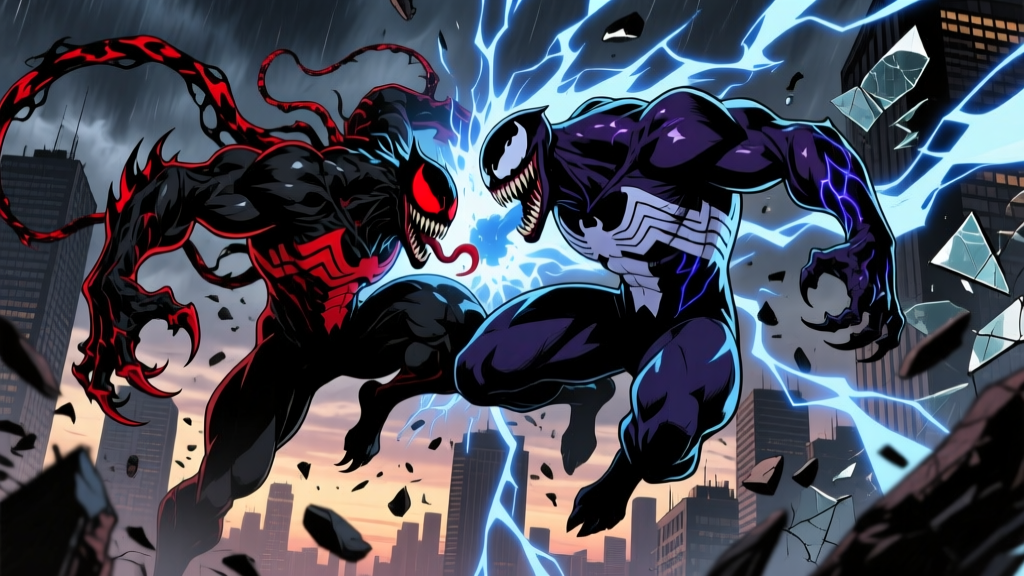
Picture this: a prison cell at Ravencroft Institute. Cletus Kasady bites into a guard's throat, and somewhere across New York, Eddie Brock feels a sickening lurch in his gut. The Venom symbiote shudders. It knows. Its offspring has done something unspeakable again. This parent-child horror is the beating heart behind every fan theory, every "what-if" scenario, and every heated forum debate about a full Carnage and Venom fusion. Two symbiotes, one bloodline, and a collision that would rewrite Marvel's cosmic biology.
But before we can unpack what a true fusion would look like, we need to understand the twisted family tree that makes this idea so compelling in the first place.
A Symbiote Family Tree Straight Out of a Nightmare
The Venom symbiote first appeared in The Amazing Spider-Man #252 (May 1984) as a black costume Spider-Man picked up during the Secret Wars on Battleworld. It bonded with Peter Parker, mimicked his spider-powers, and slowly revealed its true nature: a sentient alien parasite from the planet Klyntar. When Parker rejected it in Web of Spider-Man #1 (April 1985), the symbiote found Eddie Brock, a disgraced journalist burning with hatred for Spider-Man. Amazing Spider-Man #300 (May 1988) gave birth to the character fans now recognize as Venom, written by David Michelinie and illustrated by Todd McFarlane.
Here's where the genealogy gets disturbing. During Venom's imprisonment in the Vault, the symbiote asexually reproduced, spawning a red-and-black offspring. This infant symbiote bonded with serial killer Cletus Kasady, Venom's cellmate at Ryker's Island, first appearing in Amazing Spider-Man #361 (April 1992). The writers never intended for Carnage to be a one-off villain. The character was too visceral, too unpredictable, and too terrifying to ignore.
So the lineage is clear: the Klyntar species produced the Venom symbiote. Venom produced Carnage. And Carnage, in turn, has produced his own offspring, including Toxin, who bonded with police officer Patrick Mulligan in Venom vs. Carnage #1 (August 2004). Three generations of alien parasites, each one more unstable than the last.
"Every generation of symbiote becomes more dangerous. Venom was a predator. Carnage is a force of nature. And whatever comes next will make us look like we were playing with matches." — Eddie Brock, Absolute Carnage #1 (2019)
Cletus Kasady vs. Eddie Brock: Two Hosts, Two Philosophies of Chaos
Understanding the carnage and Venom fusion concept requires understanding the humans behind the monsters. Eddie Brock and Cletus Kasady could not be more different, and those differences shaped their symbiotes in fundamentally incompatible ways.
Eddie Brock was a man consumed by rage, yes, but he operated within a moral framework, however warped. As Venom, he targeted criminals. He saw himself as a "lethal protector," a vigilante with a code. The Venom symbiote adapted to that psychology, developing what comic writers have occasionally referred to as a conscience. Over decades of publication, Venom evolved from villain to antihero to outright hero, with Eddie Brock eventually becoming the King in Black during Donny Cates's landmark 2020 run. Brock's journey through 35+ years of Marvel continuity shows a character who learned to coexist with his parasite and, in many ways, transcend it.
Cletus Kasady had no code. A psychopath since childhood (his backstory in Carnage U.S.A. #1, January 2012, established that he murdered his grandmother at age six and pushed his mother off a cliff), Kasady bonded with the Carnage symbiote and found the perfect amplification of his insanity. Where Venom threatens, Carnage butchers. Where Venom has goals, Carnage has impulses. The symbiote bonded to Kasady through his bloodstream, creating a connection far more intimate and far harder to sever than the surface-level bonding Venom uses.
Host Psychology Shapes Symbiote Behavior
This is the critical detail most fusion theories overlook. The Klyntar are not static organisms. They adapt to their host's neurochemistry, emotional patterns, and moral frameworks. Venom bonded to Brock's anger but also his protectiveness. Carnage bonded to Kasady's complete absence of empathy. Fusing the two symbiotes would mean forcing two radically different psychological imprints into a single organism. The result, according to decades of Marvel continuity, would be catastrophic and unstable.
| Attribute | Venom Symbiote | Carnage Symbiote |
|---|---|---|
| First Full Appearance | Amazing Spider-Man #300 (1988) | Amazing Spider-Man #361 (1992) |
| Primary Host | Eddie Brock (later Flash Thompson, Mac Gargan, others) | Cletus Kasady |
| Color Scheme | Black with white spider emblem | Red and black |
| Bonding Method | Surface-level skin contact | Bloodstream integration |
| Estimated Strength (tons lifted) | ~65 tons (Marvel Handbook 2007) | ~80 tons (Marvel Handbook 2007) |
| Known Weaknesses | Sonics, fire, anti-venom serum | Extreme sonics (higher threshold than Venom), fire |
| Moral Alignment of Host | Antihero / Vigilante code | Pure psychopath, no moral constraints |
| Generation | 1st generation Klyntar on Earth | 2nd generation (Venom's offspring) |
Every Time Marvel Flirted With a Symbiote Merger
Marvel has never given fans a clean, permanent Carnage and Venom fusion in main continuity. What they have done is dance around the concept for three decades, offering glimpses, near-misses, and alternate-universe experiments that keep the idea alive.
Maximum Carnage (1993)
The first major crossover event to bring Venom and Carnage into direct, sustained conflict. Published across 14 issues spanning Amazing Spider-Man, Spectacular Spider-Man, Web of Spider-Man, Spider-Man Unlimited, and Spider-Man (the 1990 series), Maximum Carnage forced Eddie Brock's Venom into an uneasy alliance with Spider-Man, Black Cat, and Cloak & Dagger to stop Carnage's killing spree across New York. The symbiotes never merged here, but the event established the power gap: Carnage was physically stronger, but Venom was smarter and more strategic. Maximum Carnage sold over 4 million copies across its tie-in issues, making it one of the best-selling crossover events of the 1990s.
Planet of the Symbiotes (1995)
This five-part annual crossover (Amazing Spider-Man Super Special, Spider-Man Super Special, Venom Super Special, Spectacular Spider-Man Super Special, and Web of Spider-Man Super Special) brought five symbiotes together on Earth: Venom, Carnage, Scream, Lasher, Phage, Riot, and Agony. While the story focused on the symbiote invasion from the planet Klyntar, it planted seeds about symbiote merging. The five "Life Foundation" symbiotes could combine their biomass, and the idea that Venom and Carnage might do the same entered fan consciousness permanently.
Absolute Carnage (2019)
Donny Cates's five-issue limited series, with art by Ryan Stegman, came closer to the fusion concept than any prior event. Carnage sought to connect every symbiote on Earth to a hive mind, essentially absorbing their collective power. Eddie Brock, now bonded with the Venom symbiote and empowered by the Enigma Force, fought to stop this proto-fusion. In Absolute Carnage #5 (December 2019), Carnage briefly absorbed portions of Venom's biomass during their final confrontation, creating a momentary hybrid form before Brock's Enigma Force powers ripped the stolen material back. It lasted maybe three pages, but fans dissected those panels for months.
King in Black (2020-2021)
The spiritual successor to Absolute Carnage and the culmination of Cates's symbiote saga. Eddie Brock became the King in Black, wielding godlike power over all symbiotes. In King in Black #5 (April 2021), Brock absorbed the combined power of symbiotes across the universe to defeat Knull, the symbiote god. While Carnage himself was not a factor in this finale (Kasady had been seemingly killed in Absolute Carnage), the event demonstrated that symbiote fusion at a cosmic scale was possible within Marvel's power system. If one host can command every symbiote simultaneously, the barrier to a focused two-symbiote fusion becomes a matter of narrative choice, not biological impossibility.
The Official Handbook of the Marvel Universe (2007 update) lists Carnage's strength at approximately 80 tons, compared to Venom's 65-ton rating. The offspring is demonstrably stronger than its parent. A fusion would theoretically stack these values, producing an entity capable of lifting in excess of 140 tons before accounting for synergistic amplification.
The Biology Problem: Why a True Fusion Is So Difficult
Klyntar biology, as established across decades of Marvel comics, presents several hard barriers to a stable Carnage and Venom fusion. Understanding these barriers explains why Marvel's writers keep circling the idea without fully committing.
The Codex Conflict. In Donny Cates's Venom run (beginning with Venom #1, May 2018), it was revealed that every symbiote host leaves behind a "codex," a genetic imprint stored in the symbiote's biomass. Eddie Brock's codex and Cletus Kasady's codex carry contradictory instructions. Brock's imprint carries patterns of restraint, protection, and tactical thinking. Kasady's imprint carries pure entropy, sadism, and self-destruction. Forcing these two codexes into one organism would create what Klyntar lore calls a "codex war," essentially a civil war within the symbiote's own cellular structure.
Generational Degradation. Each successive generation of Klyntar symbiote is more powerful but also more unstable. The Venom symbiote is already considered somewhat aberrant by Klyntar standards, having spent decades bonded to human hosts and absorbing human emotional patterns. Carnage, as a second-generation symbiote born in a prison cell and bonded through blood, is even further from the Klyntar baseline. A fusion would combine two already-degraded symbiotes, potentially accelerating the instability rather than creating a balanced hybrid.
The Bloodstream Problem. Carnage bonds at the cellular level through Kasady's bloodstream. Venom bonds at the surface level through skin contact. These two bonding mechanisms are fundamentally different, and Marvel's in-universe scientists (including Reed Richards in Fantastic Four #570, September 2009) have noted that separating Carnage from Kasady requires destroying the host. You cannot simply "peel off" Carnage and layer it onto another symbiote the way you might combine two pieces of technology. The blood-level integration makes extraction nearly fatal.
What About Toxin?
Toxin, the third-generation symbiote spawned by Carnage, offers a partial answer. Patrick Mulligan bonded with Toxin and demonstrated that a symbiote born from Carnage could develop a moral compass when paired with the right host. Toxin was physically stronger than both Venom and Carnage, consistent with the pattern of generational power increase. If a third-generation symbiote can be "good," then perhaps the barrier to fusing Venom and Carnage is not purely biological but depends heavily on the host's psychological profile. A host with enough willpower and moral clarity might stabilize a fusion. Or so the theory goes.
Alternate Universes and "What If" Scenarios
Marvel's What If? series and alternate-universe imprints have occasionally touched on symbiote combinations, though never the specific Carnage-Venom fusion fans crave. In What If? Spider-Man: The Other (2007), Peter Parker permanently bonds with the Venom symbiote, creating a version of Spider-Man that carries Venom's power set without Brock's rage. The Venomverse event (2017) presented dozens of alternate-reality Venom hosts, including a Venomized Captain America, Doctor Strange, and even a Venomized Groot. None of these directly addressed the Carnage-Venom question, but they established that the Venom symbiote can bond with virtually any host and adapt its morphology accordingly.
The more relevant data point comes from Edge of Venomverse #4 (2017), which featured a reality where the Carnage symbiote had consumed the Venom symbiote entirely. The result was a Carnage entity with Venom's tactical intelligence layered over Kasady's psychotic impulses, arguably the most dangerous symbiote configuration ever depicted in a Marvel comic. It was a one-off, non-canon appearance, but it gave fans their clearest look at what a hostile takeover (rather than a mutual fusion) would produce.
In mobile gaming, Marvel Contest of Champions introduced "Carnage" as a playable character with move sets that reference the symbiote's shapeshifting abilities, while Marvel Snap (2022) features both Venom and Carnage cards with mechanics that hint at their parent-offspring relationship. Neither game has implemented a fusion character, though the fan demand for one is documented across Reddit communities and gaming forums with thousands of upvoted requests.
What a True Fusion Would Actually Mean for Marvel
If Marvel committed to a permanent, main-continuity Carnage and Venom fusion, the narrative consequences would be staggering. Let's think through the implications honestly, the way a Marvel editor might during a planning retreat.
Power scaling breaks. A fused symbiote entity, drawing on both Venom's 65-ton strength baseline and Carnage's 80-ton rating, with generational synergy amplification, would rank among the physically strongest non-cosmic entities in the Marvel Universe. For reference, the Hulk's base strength starts around 100 tons and scales upward with rage. A Carnage-Venom fusion would occupy a similar tier, but with the added advantages of symbiote shapeshifting, tendril projection, camouflage, and the ability to bypass Spider-Man's spider-sense. That is not a villain Spider-Man can fight with his standard toolkit. You need cosmic-level intervention.
The host question becomes existential. Who wears the fused symbiote? Eddie Brock? Cletus Kasady? A new host entirely? Each answer creates a different character. Brock in a fused symbiote would be an unstoppable antihero with Carnage's raw power filtered through his moral code. Kasady in a fused symbiote would be an extinction-level event. A new host would essentially be a new character, one that inherits the combined legacy of two of Marvel's most iconic villains.
It solves a franchise problem. Marvel has been cycling through symbiote events for 30 years. Maximum Carnage, Planet of the Symbiotes, Carnage U.S.A., Absolute Carnage, King in Black, and the 2023 All-New Venom series by Al Ewington. The franchise risks fatigue. A genuine Carnage and Venom fusion would feel like a genuine escalation rather than a rehash, giving the symbiote corner of the Marvel Universe a new status quo to explore for the next decade.
Frequently Asked Questions
Has Carnage and Venom ever officially fused in Marvel comics?
Not as a permanent, stable fusion in main continuity. The closest moment occurred in Absolute Carnage #5 (2019), when Carnage briefly absorbed portions of Venom's biomass during a fight. The absorption lasted only a few pages before Eddie Brock reclaimed the stolen material. In alternate universes, Edge of Venomverse #4 (2017) depicted a reality where Carnage consumed Venom entirely, but this was non-canon.
Why is Carnage stronger than Venom if Venom is the original?
Klyntar symbiotes follow a pattern of generational power increase. Each offspring is born with greater baseline abilities than its parent. The Official Handbook of the Marvel Universe (2007) rates Carnage at approximately 80 tons of lifting strength versus Venom's 65 tons. Additionally, Carnage's bloodstream-level bonding with Kasady creates a deeper integration that grants more efficient use of the symbiote's shapeshifting and weapon-forming capabilities.
Could Eddie Brock survive bonding with both symbiotes at once?
Theoretically, yes. Eddie Brock's experience as a long-term symbiote host (over 35 years of publication history) and his eventual elevation to King in Black status in King in Black #5 (2021) suggest he has the psychological resilience to handle multiple symbiote consciousnesses. However, the codex conflict between his own imprint and Kasady's imprint within the fused symbiote would create internal instability that even Brock's willpower might not contain indefinitely.
What about the MCU and the Venom movies? Will we see a fusion on screen?
Sony's Venom film franchise, starring Tom Hardy as Eddie Brock, has introduced the Venom symbiote and teased Carnage through Woody Harrelson's Cletus Kasady in Venom: Let There Be Carnage (2021). That film depicted Carnage and Venom as separate entities in direct conflict, not fusion. With the MCU's multiverse mechanics now established and Sony's Spider-Man universe increasingly interconnected, a future film exploring a symbiote fusion is plausible but has not been announced as of mid-2026.
Is Toxin a fusion of Venom and Carnage?
No. Toxin is a third-generation symbiote spawned by Carnage, making it Venom's grand-offspring rather than a fusion. Toxin first appeared in Venom vs. Carnage #1 (2004) and bonded with police officer Patrick Mulligan. Toxin is physically stronger than both Venom and Carnage, continuing the generational power increase pattern, but it is a distinct organism with its own identity rather than a combination of its ancestors.
Which symbiote is the strongest in Marvel comics?
Among named Earth-based symbiotes, Toxin holds the raw strength record. However, Eddie Brock's Venom, after becoming King in Black (King in Black #5, 2021), achieved godlike power that surpasses any individual symbiote. Knull, the primordial symbiote god introduced in Venom #3 (August 2018), is the most powerful symbiote entity in Marvel lore, predating the Klyntar species itself.
The Carnage and Venom fusion remains one of Marvel's most tantalizing unresolved concepts, a collision of biology, psychology, and narrative potential that the publisher keeps approaching but never fully commits to. Whether it arrives as a limited series, a What If special, or a twist in the next symbiote event, the groundwork has been laid across 35+ years of continuous publication. The symbiote family tree is rooted deep, and its branches keep growing toward each other.