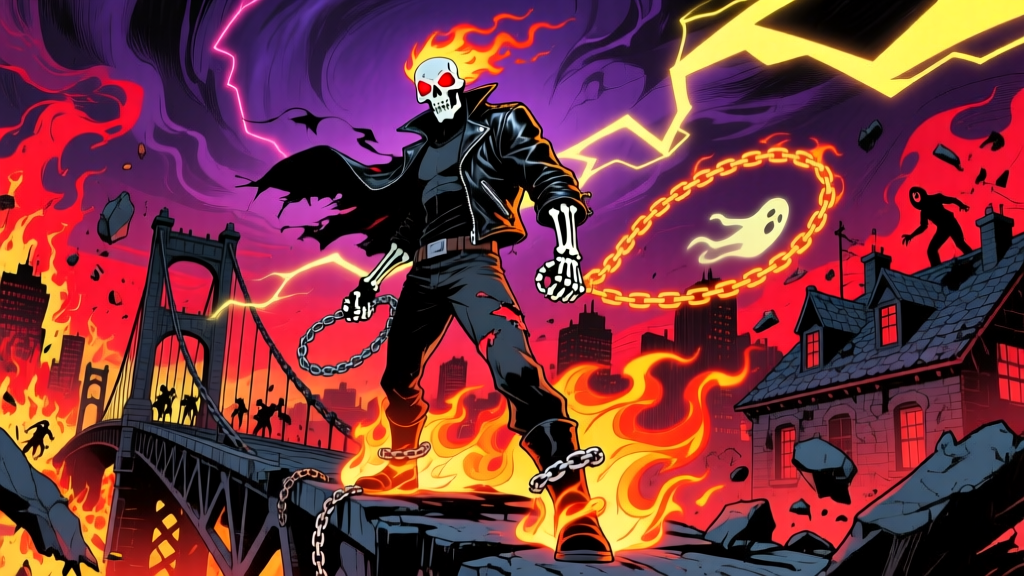
August 1990. A teenager named Danny Ketch runs through a Brooklyn junkyard, bullets chewing up the rusted cars behind him. His sister Barbara is bleeding out on the pavement, shot by gang members who mistook them for witnesses to a mob hit. Danny stumbles over a motorcycle—an old, beat-up Harley—and the moment his fingers touch the handlebars, hellfire erupts from the engine block. His flesh melts. His skull ignites. A leather jacket materializes from nowhere, studded and snarling. A chain whips itself into his fist like a living thing.
That single splash page from Ghost Rider Vol. 3 #1 didn't just launch a new character. It launched an entire era. Howard Mackie and Javier Saltares had taken Marvel's forgotten 1970s supernatural hero and rebuilt him from the ground up for a decade that worshipped excess, attitude, and leather-clad rebellion. Johnny Blaze had worn a stunt-rider jumpsuit. Danny Ketch wore the streets.
For an entire generation of comic readers—the kids who discovered comics at gas stations and spinner racks, not specialty shops—Ghost Rider Danny Ketch was the definitive Ghost Rider. Not the original. Not the movie version. The one with the chain, the penance stare, and the motorcycle that could drive up the side of a building.
• • •A Different Kind of Hellfire: How Danny Ketch Reshaped the Character
Before Danny Ketch, Ghost Rider was Johnny Blaze—a motorcycle stuntman who made a deal with the devil (Mephisto, in Marvel's cosmology) and got saddled with Zarathos, a demon who occasionally took the wheel whether Blaze wanted it or not. The original 1973 series by Gary Friedrich and Mike Ploog was genuinely good horror comics, but by the mid-1980s, the character had faded into obscurity, reduced to guest appearances and reprints.
Mackie's pitch was simple but radical: give the Spirit of Vengeance a new host, one who wasn't a grown man with a complicated past but a kid—a teenager thrust into a supernatural nightmare he didn't ask for and couldn't control. Danny Ketch was 18 years old, lived in Brooklyn, and had the kind of earnest, slightly naive personality that made his transformation into a flaming skeleton-thing genuinely horrifying. He didn't want the power. He didn't understand it. Every time the change came over him, he lost time, lost control, and woke up surrounded by wreckage.
This was the core tension that the Blaze version had always struggled with: the host and the demon wanted different things. Blaze wanted to be left alone. Zarathos wanted to punish the guilty. With Danny, the conflict was sharper because Danny was younger, more vulnerable, and more desperate. He had a sister in a coma. He had a mother who didn't understand why her son kept disappearing. He had a life that was being dismantled piece by piece, every time the fire came.
"We wanted the reader to feel Danny's panic. Not cool, not badass—panicked. This kid is losing himself and he can't stop it. The leather jacket and the chain were window dressing. The real story was a teenager watching his life burn down." — Howard Mackie, interview with Comic Book Artist magazine, 1996
Saltares' artwork sealed the deal. His Ghost Rider wasn't just a skeleton in a jacket. The skull had personality—expressive eye sockets, a jaw that seemed to grin wider when the violence escalated. The chain was drawn like a prehensile weapon, coiling around Danny's arm, lashing out in impossible arcs, wrapping around enemies' throats. The motorcycle was a character unto itself: chrome, massive, and perpetually wreathed in flame that cast deep red shadows across every panel.
The Look That Defined an Era
You can't talk about Ghost Rider Danny Ketch without talking about 1990s comic book aesthetics, because this character was arguably the poster child for the "extreme" movement before Image Comics even existed. Saltares was drawing leather jackets, spikes, chains, and oversized guns in 1990—two full years before Rob Liefeld founded Image and made that look the industry standard.
Consider what Danny Ketch's Ghost Rider brought to the visual table:
- The leather jacket: Not a costume. Not spandex. A battered, studded leather jacket that looked like it had been dragged through hell—which, narratively, it had. This replaced Blaze's yellow stunt-rider suit entirely.
- The chain: Blaze used hellfire blasts. Danny used a spiked chain that could extend, wrap, slash, and strangle. It was brutal, visceral, and drew blood in ways that made the Comics Code Authority nervous.
- The motorcycle: An impossibly large, chrome-and-flame monstrosity that could ride vertically up buildings, across water, and through dimensional barriers. Saltares drew it like a muscle car on two wheels.
- The flaming skull: Larger than Blaze's, with more dramatic fire effects. Saltares and later Mark Texeira rendered the flames in deep oranges and whites that practically glowed against the ink-black backgrounds.
- The boots: Heavy, spiked, military-style. Danny's Ghost Rider didn't wear shoes. He wore weaponized footwear.
Texeira Takes Over: Grunge Meets Hellfire
Mark Texeira took over art duties around issue #15 and pushed the design even further into grunge territory. His inking was loose, scratchy, almost ugly—and it was perfect. Texeira's Ghost Rider looked like he smelled like gasoline and bad decisions. The art community was split: traditionalists hated it, but sales told a different story. Ghost Rider Vol. 3 was consistently one of Marvel's top-selling titles between 1991 and 1993, regularly moving over 300,000 copies per issue at a time when the industry average for a non-event title hovered around 120,000.
"SALES REGULARLY EXCEEDED 300,000 COPIES PER ISSUE — AT A TIME WHEN THE INDUSTRY AVERAGE FOR A NON-EVENT TITLE WAS AROUND 120,000."The Midnight Sons: Marvel's Supernatural Supergroup
Danny Ketch didn't ride alone. In 1992, Marvel launched what amounted to a full supernatural universe within its main continuity, and Ghost Rider was the linchpin. The Midnight Sons brought together a roster that reads like a who's-who of Marvel horror:
| Character | First Appearance | Role in the Team | Signature Ability |
|---|---|---|---|
| Ghost Rider (Danny Ketch) | Ghost Rider Vol. 3 #1 (1990) | Heavy hitter / frontline brawler | Penance Stare, hellfire chain |
| Morbius the Living Vampire | Amazing Spider-Man #101 (1971) | Science officer / reluctant ally | Vampiric physiology, biochemistry genius |
| Blade | Tomb of Dracula #10 (1973) | Vampire hunter / tracker | Daywalker abilities, bladed weapons |
| Doctor Strange | Strange Tales #110 (1963) | Mystical advisor / heavy magic | Sorcerer Supreme-level spellcasting |
| Hannibal King | Tomb of Dracula #25 (1974) | Private investigator / street-level | Vampiric abilities (resisted bloodlust) |
| Victoria Montesi | Doctor Strange, Sorcerer Supreme #54 (1993) | Darkhold host / occult knowledge | Darkhold connection, chaos magic |
| Sam Buchanan | Ghost Rider / Blaze: Spirits of Vengeance #12 (1993) | Law enforcement liaison | Tactical training, firearms |
| Johnny Blaze (Ghost Rider) | Marvel Spotlight #5 (1972) | Veteran / second Ghost Rider | Hellfire projection, stunt riding |
The Midnight Sons initiative launched with Rise of the Midnight Sons (August 1992), a crossover that spanned Ghost Rider, Morbius, Darkhold, Nightstalkers, and Ghost Rider / Blaze: Spirits of Vengeance. The villain was Lilith, Mother of All Demons—a threat big enough to justify pulling together characters who, under normal circumstances, would never share a page.
What made the Midnight Sons work wasn't the crossover mechanics. It was the tone. These books were dark. Morbius was a tragic figure wrestling with bloodlust. Blade was a hunter who didn't trust anyone. Hannibal King was a vampire trying not to be a vampire. And Danny Ketch was a teenager caught in the middle of all of it, the youngest member of a team that treated him like a kid brother they weren't sure could be trusted with the power he carried.
The Nine-Title Experiment
The line ran for roughly three years before the speculator bubble burst and Marvel's supernatural imprint contracted. But during its peak, the Midnight Sons franchise encompassed nine concurrent monthly series—a level of coordinated publishing for a non-X-Men, non-Avengers property that Marvel wouldn't attempt again until the MCU era.
Brothers in Hellfire: The Danny Ketch / Johnny Blaze Connection
Here's where the story gets complicated, because Marvel retconned it at least twice and neither version fully stuck.
In the original Mackie run, the Spirit of Vengeance bonding with Danny was identified as Zarathos—the same demon that had possessed Johnny Blaze. This created an immediate question: why would the same entity bond with two different people? Mackie's answer came slowly, over dozens of issues. Johnny Blaze and Danny Ketch were brothers—separated as children, Blaze having been taken in by a traveling carnival while Danny was raised in Brooklyn by their mother, Naomi Kale (later retconned further into the Kale family bloodline).
The Kale Bloodline: A Generational Curse
The Kale family, it turned out, carried a generational curse. The Spirit of Vengeance wasn't just a random demon looking for hosts. It was bound to the Kale bloodline specifically, passed down like a terrible inheritance. Danny didn't get the Ghost Rider by accident. He got it because it was always going to find him.
This revelation recontextualized everything. Blaze's possession wasn't a bad deal with Mephisto—it was destiny, or something close to it. And Danny's transformation wasn't random violence striking an innocent kid. It was a family legacy asserting itself.
Later writers complicated the picture further. The Spirit of Vengeance was retconned from Zarathos to Noble Kale—a human ancestor of the Kale family who had been transformed into an angel of vengeance by Zadkiel (and then further mangled by heavenly politics). By the time Jason Aaron got his hands on the mythology in the late 2000s, the lineage of Ghost Riders stretched back to prehistoric times, with a new Rider appearing in every era. Danny Ketch was just one link in a chain that went back to a caveman who bonded with a spirit and beat a woolly mammoth to death with its own trunk.
But in the 1990s, during the original run, it was simpler and more emotionally resonant: two brothers, same curse, trying to figure out if they were heroes or monsters. The Spirits of Vengeance series, which ran from 1992 to 1994 (35 issues), was essentially a road-trip book about Blaze and Ketch learning to work together, learning to trust each other, and slowly realizing that neither of them had chosen this life.
The Penance Stare: One Look and You Feel Every Sin
Danny Ketch's Ghost Rider had one ability that set him apart from every other supernatural character in Marvel's lineup: the Penance Stare.
The mechanic was simple. Ghost Rider locks eyes with you. In that instant, you feel the full weight of every sin you've ever committed—every act of cruelty, every moment of selfishness, every life you've damaged—all at once, compressed into a single overwhelming psychic assault. For a serial killer, it's incapacitating. For a war criminal, it might be lethal. For an ordinary person who's made ordinary mistakes, it's still enough to leave you sobbing on the ground.
This was Mackie's smartest addition to the character because it created genuine moral complexity. The Penance Stare doesn't kill. It forces you to reckon. And that reckoning doesn't always produce redemption. Some villains break. Some go catatonic. Some, paradoxically, become worse—overwhelmed by guilt and rage, they double down on violence because the alternative is self-destruction.
The most interesting Penance Stare moments in the Danny Ketch run weren't the ones where he used it on obvious monsters. They were the moments where he used it on people who'd done bad things for complicated reasons—a mother who'd stolen to feed her children, a soldier who'd followed orders he disagreed with—and the stare still worked, because the stare doesn't care about context. It cares about guilt. And guilt, Mackie argued across 93 issues, is not a clean emotion.
The Stare Beyond the Comics
The Penance Stare became so iconic that it survived every subsequent reboot and reimagining. It appeared in both Nicolas Cage Ghost Rider films (2007, 2012). It was a core mechanic in the 2006 Ghost Rider video game. And when Robbie Reyes became the new Ghost Rider in 2014, fans immediately asked: does he have the stare? (He didn't—Reyes' version used a different power set built around his car and the spirit of his uncle Eli.)
• • •93 Issues, Three Creative Teams, One Unfinished Story
Ghost Rider Vol. 3 ran for 93 issues (August 1990 through March 1998), plus 12 annuals and numerous crossover tie-ins. That's an unusually long run for a character who, prior to 1990, had been considered a B-list Marvel property at best.
| Issues | Writer(s) | Artist(s) | Defining Arcs |
|---|---|---|---|
| #1–14 | Howard Mackie | Javier Saltares | Origin, Danny's first transformations, introduction of the chain weapon |
| #15–34 | Howard Mackie | Mark Texeira | Blackout arc, Vengeance, the grunge art shift, rising sales peak |
| #35–55 | Steven Grant / Mackie | Various (including Texeira, Saltares) | Midnight Sons crossover, Lilith arc, deepening mythology |
| #56–75 | Ivan Velez Jr. | Various | Danny's descent, identity crisis, Blaze/Ketch tensions |
| #76–93 | Ivan Velez Jr. | Various | Final arc, Danny's death, the Spirit of Vengeance departs |
The series ended badly. By 1997, Marvel was in financial crisis—the company filed for bankruptcy in December 1996—and the speculator market that had propped up sales across the industry had collapsed. Ghost Rider Vol. 3 limped to its conclusion with declining sales and a creative team that had lost its way. Danny Ketch was killed in issue #93 (March 1998), the Spirit of Vengeance leaving his body and drifting away, effectively ending the character.
It was an ugly death. Not heroic, not meaningful in the way superhero deaths are supposed to be. Danny just... stopped. And the fire went out. For a character whose entire narrative arc was about a kid trying to find meaning in suffering, the ending felt like the publishers had run out of meaning too.
Resurrection and Retcons: Danny Ketch After the 90s
Comic book deaths never stick, and Danny Ketch was no exception. He returned in Ghost Rider: Danny Ketch (2008), a five-issue miniseries by Jason Aaron and Tanino Liberatore that resurrected the character under radically different circumstances. In Aaron's version, Danny was alive but had been living without the Spirit of Vengeance for a decade—clean, sober, and desperately trying to be a normal person.
Naturally, that didn't last. The miniseries reintroduced Danny to the Ghost Rider mythology, though Aaron's larger plan (which he executed in the main Ghost Rider series with Johnny Blaze) positioned Danny as a secondary figure rather than the lead. By the time Ghost Rider Vol. 7 launched in 2014 with Robbie Reyes, Danny Ketch had been reduced to occasional cameos.
The 2007 Nicolas Cage film adaptation drew primarily from the Johnny Blaze mythology, which meant that an entire generation of moviegoers encountered Ghost Rider without any awareness of the Danny Ketch version. Cage's Ghost Rider wore a leather jacket (a nod to Ketch's design) but carried Blaze's origin story and personality—a hybrid that satisfied neither fanbase completely.
Still, the Ketch version persists in the collective memory of 90s comic readers. Walk into any comic shop that has a back-issue bin and pull out a copy of Ghost Rider Vol. 3 #1. The cover price is $1.00. That single issue, at its peak in 1993, was selling for $15–$20 on the speculator market. Today it goes for roughly $8–$12 in near-mint condition—not a fortune, but proof enough that people kept those copies because they meant something.
Why Danny Ketch Still Matters to 90s Comic Readers
Strip away the leather, the chain, the flaming motorcycle. What made Danny Ketch's Ghost Rider resonate wasn't the spectacle. It was the vulnerability.
The 1990s were a decade of excess in comics—big guns, big muscles, big shoulder pads, big everything. The anti-hero archetype was everywhere: Spawn, Wolverine, Punisher, Cable, Deadpool. Most of them were emotionally invulnerable. They were tough guys who did tough things and never flinched. Danny Ketch was different. He flinched. He cried. He begged the Spirit of Vengeance to leave him alone, and it never did.
For readers who were themselves teenagers—navigating family dysfunction, identity confusion, the sense that something was changing inside them that they couldn't control—Danny Ketch was recognizable. The metaphor wasn't subtle: puberty as demonic possession, the body transforming against your will, the anger and confusion that came with powers you didn't ask for. Every comic book reader who felt like an outsider in the 1990s found something in Danny Ketch's story.
The Midnight Sons books also created something rare in superhero comics: a genuinely atmospheric reading experience. These weren't bright, four-color adventures. They were dark—literally and tonally. The color palettes were dominated by blacks, deep reds, and sickly greens. The stories involved blood magic, demonic possession, and moral compromise. For a teenager who'd outgrown Spider-Man but wasn't ready for Vertigo, the Midnight Sons line was the perfect bridge into more mature storytelling.
And the Danny Ketch run proved that Marvel's supernatural corner could sustain long-form, character-driven narratives. Without the foundation that Mackie, Saltares, Texeira, and the Midnight Sons creative teams built in the early 1990s, there would be no Jason Aaron Ghost Rider run, no Spirits of Vengeance revival, and almost certainly no Ghost Rider in the MCU. Every supernatural Marvel character that appeared after 1998—from Moon Knight's 2006 revival to the Werewolf by Night MCU special—owes a debt to the era when a Brooklyn teenager in a leather jacket proved that horror comics could sell.
• • •Frequently Asked Questions
Is Danny Ketch the brother of Johnny Blaze? In the original 1990s continuity, yes—Danny Ketch and Johnny Blaze were revealed to be brothers from the Kale family bloodline, both carrying the generational curse of the Spirit of Vengeance. Later retcons have complicated this relationship (the 2007 film dropped the connection entirely), but in the Mackie run, the brother dynamic was central to both Ghost Rider Vol. 3 and the Spirits of Vengeance spinoff. What is the Penance Stare and who created it? The Penance Stare is an ability introduced during the Danny Ketch era. When Ghost Rider makes direct eye contact with a target, that person experiences the full emotional weight of every sin they have ever committed, simultaneously. Howard Mackie introduced it early in the Vol. 3 run as Danny's signature finishing move. It has since become a permanent part of the Ghost Rider mythology across all versions of the character. How many issues did Ghost Rider Vol. 3 run? 93 regular issues, published from August 1990 to March 1998, plus 12 annuals. The series also spawned the spinoff Ghost Rider / Blaze: Spirits of Vengeance, which ran for 35 issues from 1992 to 1994. Was Danny Ketch's Ghost Rider part of the Midnight Sons? Yes. Danny Ketch was a founding member of the Midnight Sons, Marvel's supernatural supergroup that launched in 1992. The team included Morbius, Blade, Doctor Strange, Hannibal King, and others. The Rise of the Midnight Sons crossover was one of Marvel's most ambitious publishing initiatives of the decade, spanning nine concurrent monthly titles. Does Danny Ketch appear in the Ghost Rider movies? No. Both the 2007 Ghost Rider and 2012 Ghost Rider: Spirit of Vengeance starred Nicolas Cage as Johnny Blaze. However, the films borrowed visual elements from the Danny Ketch era—notably the leather jacket design and the chain weapon—creating a hybrid version that combined Blaze's origin with Ketch's aesthetic. Who is the Spirit of Vengeance in Danny Ketch's version? Originally, the spirit was identified as Zarathos, the same demon bonded to Johnny Blaze. This was later retconned: the spirit was revealed to be Noble Kale, a human ancestor of the Kale family who had been transformed into an angel of vengeance. Subsequent rewrites by Jason Aaron further expanded the mythology, establishing that Ghost Riders have existed since prehistoric times, each bonded to a fragment of the original Spirit of Vengeance. Why did the Ghost Rider Vol. 3 series end? A combination of factors: Marvel's financial crisis (the company filed for bankruptcy in December 1996), the collapse of the comic book speculator market that had inflated sales across the industry, and declining creative momentum as the writing and art teams changed. Danny Ketch was killed in issue #93, and the series was cancelled as Marvel restructured its publishing line. • • •Sources: Ghost Rider Vol. 3 #1–93 (Marvel Comics, 1990–1998); Ghost Rider / Blaze: Spirits of Vengeance #1–35 (1992–1994); Rise of the Midnight Sons (1992); Ghost Rider: Danny Ketch Vol. 1 #1–5 (2008); Marvel Comics sales data via Diamond Comic Distributors (1991–1993); Comic Book Artist magazine, Howard Mackie interview (1996).