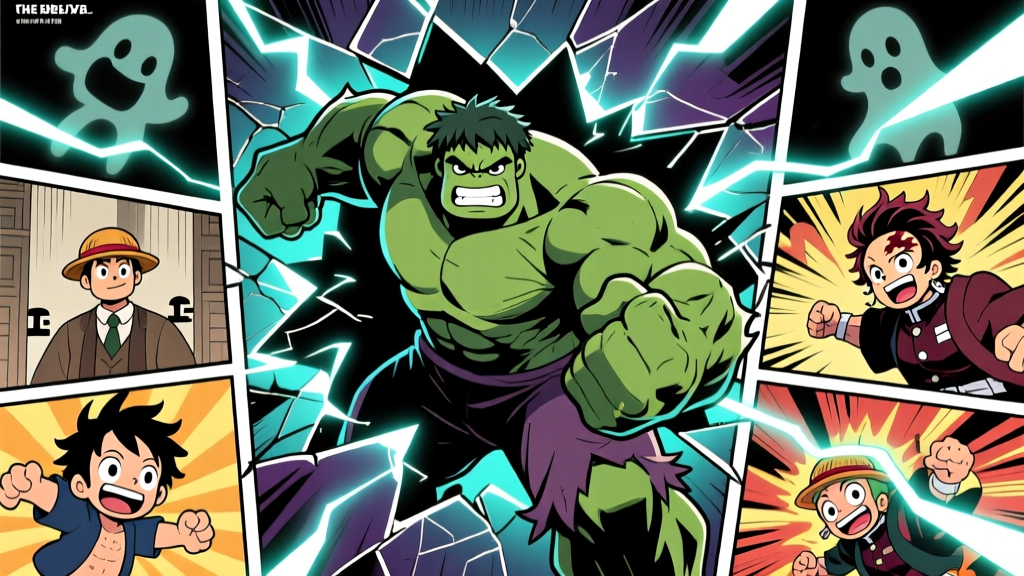
The panel opens on Las Vegas. Neon bleeds across the desert night. Somewhere inside the Coliseum Casino, a grey-skinned giant in a tailored pinstripe suit adjusts his cuffs, cracks a crooked smile, and introduces himself as "Joe Fixit." He doesn't smash tanks. He doesn't roar at helicopters. He leans against a craps table like a man who owns the room — because, for all practical purposes, he does. This is September 1988, and the Hulk has just become the most unlikely mob enforcer in comic book history.
Incredible Hulk #347 didn't just change the Hulk. It shattered the entire concept of what a Hulk comic could be and rebuilt it from the ground up with blackjack chips, broken kneecaps, and a grey-skinned hustler who'd rather break your arm than throw a car at you. Written by Peter David with art by Jeff Purves and inked by Bob McLeod, this single issue launched a twenty-one-issue arc that remains the most critically celebrated run in the character's sixty-plus-year publication history.
The Setup: How a Green Rage Monster Became a Vegas Wise Guy
To appreciate what #347 does, you have to understand the mess that preceded it. By 1988, the Hulk was a character in crisis. The green-skinned "Savage Hulk" — the childlike, monosyllabic brute who smashed first and asked questions never — had run its course narratively. Writers had exhausted the "misunderstood monster on the run" formula across 346 issues. Sales were steady but uninspired. Marvel's editorial brass was open to a shakeup.
Peter David had been writing the title since issue #331 (June 1987), and he'd already begun tinkering with the character's psychology. In the pages leading up to #346, David orchestrated an elaborate storyline where Bruce Banner appeared to die in a gamma bomb explosion — a staged death designed to free the Hulk from his human alter ego's constant moral interference. The world believed the Hulk was gone.
What nobody expected was what came next. Instead of the green, childlike Savage Hulk returning, the grey-skinned persona — originally introduced in Incredible Hulk #1 (1962) but dormant for decades — resurfaced. Except this time, he wasn't a snarling caveman. He was smart. Cunning. Articulate. And he had a plan.
The gamma bomb "death" of Bruce Banner gave the grey Hulk cover to disappear. He surfaced in Las Vegas under the name Joe Fixit, took a job as an enforcer for mob boss Michael Berengetti, and started living a life that looked less like a superhero comic and more like a Martin Scorsese picture with a seven-foot-tall lead.
Inside Issue #347: "Crap Shoot"
The issue, titled "Crap Shoot," wastes no time establishing its new status quo. We find Joe Fixit already embedded in the Coliseum Casino, working the floor as Berengetti's muscle. He wears expensive suits — custom-tailored to accommodate his massive frame — speaks in complete, sardonic sentences, and carries himself with the swagger of a man who knows he could kill everyone in the room but would rather just take their money at the poker table.
The plot thickens when Anthony Gold, a rival casino figure, crosses paths with Berengetti's operation. Gold operates his own gambling establishment in Las Vegas, and the power dynamics between the two men create the central tension of the issue. Fixit finds himself navigating a world of backroom deals, territorial disputes, and the particular brand of violence that comes with organized crime — except he's the only guy in any of these rooms who could bench-press a Buick.
The issue's standout sequence takes place back at a burned-out section of the casino, where Gold's men confront the situation and Berengetti's operation faces its first real test. Fixit handles the conflict not with the indiscriminate destruction that defined the Savage Hulk, but with calculated, precise brutality. He breaks specific bones. He sends specific messages. It's surgical violence with a grin, and it's deeply unsettling in a way that "Hulk smash" never was.
Then there's Marlo Chandler. Making her first appearance in this issue, Marlo is introduced as a woman connected to the casino world — sharp, observant, and far more perceptive than anyone around her gives her credit for. She encounters Joe Fixit and, unlike nearly everyone else, seems to sense there's more behind the grey skin and expensive wardrobe. Her introduction here is quietly momentous: Marlo Chandler would eventually become one of the most important people in Bruce Banner's life, marrying him years later in a relationship that anchored the character through some of his most turbulent storylines.
The issue closes with a teaser that sent chills through readers: the Absorbing Man is coming. A villain who can transform his body into any material he touches — steel, glass, concrete — is headed for Vegas, and a collision between him and Joe Fixit promises to be anything but clean.
The Creative Team That Rewrote the Rules
Peter David: The Writer Who Made You Care About a Monster
Peter David's twelve-year run on Incredible Hulk (issues #331–467, spanning 1987–1998 and 136 issues) is the gold standard for long-form superhero storytelling. When he took over the book, Hulk was widely considered a second-tier Marvel property — the character your older brother read before graduating to Spider-Man or X-Men. David changed that by treating the Hulk not as a smashing machine but as a psychological case study.
His approach was radical for the era. Rather than writing the Hulk as a simple monster or a misunderstood hero, David drew on the emerging concept of Dissociative Identity Disorder (then called Multiple Personality Disorder) to reframe the Banner/Hulk dynamic. The grey Hulk — Joe Fixit — wasn't just a different color. He represented a distinct personality fragment: Banner's repressed id given physical form. Where the Savage Hulk was the child Banner never got to be, Joe Fixit was the adult Banner never allowed himself to become — ruthless, self-interested, sexually confident, and morally flexible.
David's genius was making this work within the constraints of a monthly superhero comic. He gave Fixit a voice that was genuinely funny — dry, sarcastic, laced with street-level wit — without ever letting you forget that this creature was still capable of ripping someone's spine out if the mood struck. The Vegas arc reads like a crime drama that happens to star a gamma-irradiated giant, and that tonal balance is almost impossibly difficult to sustain. David made it look effortless for twenty-one consecutive issues.
Jeff Purves and Bob McLeod: The Art of Grey-Skinned Noir
Jeff Purves took over pencilling duties at a critical juncture. His art style — angular, shadow-heavy, with an almost exaggerated sense of physicality — was perfectly suited to the noir-inflected Vegas storyline. Purves drew Joe Fixit not as the bloated, vein-popping muscle mountain that earlier artists favored. His Fixit was leaner (relatively speaking), more agile, with a face that could actually hold a conversation. The suits, the smirks, the body language of a man who's comfortable in a casino backroom — Purves sold all of it.
Bob McLeod's inks gave Purves' pencils a crispness that elevated the entire book. McLeod, a veteran artist whose career stretched back to the 1970s and included co-creating the New Mutants, brought a discipline to the linework that kept the shadows sharp and the action readable. Together, they established a visual language for the Joe Fixit era: dimly lit casino floors, rain-slicked Vegas streets, and fight scenes that felt more like barroom brawls than superhero battles.
The cover of #347 itself — illustrated by Purves — features the grey Hulk in his Fixit attire, immediately signaling to readers that this was not their parents' Hulk comic. The grey skin was a visual shock in a rack full of bright, primary-colored covers, and the tailored suit completed the reinvention.
Why Joe Fixit Changed Hulk Forever
Before #347, the Hulk had exactly two modes: mindless rage monster and occasional reluctant hero. That binary had powered the character since 1962, and while it produced some great stories — notably Bill Mantlo's and John Byrne's runs in the early 1980s — it was fundamentally limiting. You can only tell the "Hulk smashes things and runs away" story so many times before the audience checks out.
Joe Fixit broke the binary. For the first time, the Hulk had agency. He wasn't reacting to the world; he was operating in it. He held a job. He had relationships. He made strategic decisions. He negotiated. He lied. He seduced. He gambled. He did all the things a human character in a crime comic does — except he weighed fourteen hundred pounds and could put his fist through a bank vault.
This opened narrative doors that Peter David spent years walking through. The Vegas arc led directly to the introduction of "The Professor" — a merged persona that combined Banner's genius, the Savage Hulk's strength, and Joe Fixit's attitude into a single integrated character. That merger, which debuted in issue #377 (January 1991), became the template for what the MCU would eventually call "Smart Hulk" in Avengers: Endgame (2019), roughly thirty years later.
The psychological framework David established — that Banner's various Hulk personas are dissociative fragments of a traumatized mind — became the foundational text for every subsequent Hulk writer. Al Ewing's Immortal Hulk (2018–2021), widely considered the second-greatest Hulk run, directly builds on David's dissociative identity model. The "Green Door" mythology, the War, the Devil Hulk — all of it traces back to the conceptual architecture that Peter David built, and #347 is where the first load-bearing wall went up.
The Vegas Arc in Context: A 21-Issue Masterpiece
Issue #347 kicks off what is commonly referred to as the "Vegas arc," though it's more accurate to call it the Joe Fixit era. This storyline runs through approximately issue #368 (1990), and its key beats read like a prestige crime novel:
- Issues #347–353: Fixit establishes himself as Berengetti's enforcer, navigates casino politics, and his relationship with Marlo Chandler deepens. The Absorbing Man arrives in Vegas, leading to a brutal confrontation that showcases Fixit's combination of brains and brawn.
- Issues #354–359: The stakes escalate. The Leader — Banner's genius-level gamma-powered nemesis — re-enters the picture, forcing Fixit to confront threats that can't be solved with a well-placed fist. The tension between Fixit's self-interest and the residual heroism buried in Banner's psyche becomes unsustainable.
- Issues #360–368: The arc builds toward the merger. Bruce Banner, the Savage Hulk, and Joe Fixit are forced to confront each other — not physically, but psychologically — in a storyline that culminates in the creation of the Professor persona.
What makes this era extraordinary is that David never treats the Vegas setting as a gimmick. Las Vegas is a character in these comics — its desperation, its performative glamour, the way it attracts people who are running from something. Joe Fixit belongs in Vegas the way Batman belongs in Gotham: the environment reflects the character's internal landscape. A grey-skinned creature in an expensive suit, doing morally questionable work in a city built on morally questionable money — it's so thematically coherent that it's hard to believe Marvel let it happen in a mainstream superhero title.
| Detail | Information |
|---|---|
| Issue Number | Incredible Hulk Vol. 1, #347 |
| Cover Date | September 1988 |
| Story Title | "Crap Shoot" |
| Writer | Peter David |
| Penciller / Cover | Jeff Purves |
| Inker | Bob McLeod |
| Letterer | Rick Parker |
| Colorist | Christie Scheele |
| Editor | Bobbie Chase |
| Original Cover Price | $0.75 (Direct Edition) / $0.75 (Newsstand) |
| First Appearances | Joe Fixit (alias), Marlo Chandler |
| Key Characters | Grey Hulk / Joe Fixit, Michael Berengetti, Marlo Chandler, Anthony Gold |
Collector's Breakdown: What Hulk #347 Is Worth Today
Let's talk money. Incredible Hulk #347 occupies a specific niche in the collector's market: it's a Bronze/Copper Age key issue with first-appearance significance, but it sits in the long shadow of the 1990s speculator boom that inflated prices for later issues. That creates an interesting dynamic where #347 is undervalued relative to its narrative importance.
Here's the thing about this issue's market position. It doesn't carry the "first appearance" premium of a character's debut (that's Hulk #1 for the character, or #181 for Wolverine). Instead, #347 is valued as a key storyline issue — the start of what many consider the definitive Hulk creative run. The first appearance of Joe Fixit and the first appearance of Marlo Chandler give it two collectible hooks, which is unusual for a single issue outside of a character debut.
| Grade | Condition | Estimated Value (Direct) | Newsstand Premium |
|---|---|---|---|
| CGC 9.8 (NM/MT) | Near Mint / Mint | $300 – $600 | +30–50% |
| CGC 9.6 (NM+) | Near Mint+ | $200 – $350 | +30–50% |
| CGC 9.4 (NM) | Near Mint | $150 – $250 | +25–40% |
| CGC 9.0 (VF/NM) | Very Fine / Near Mint | $80 – $150 | +20–35% |
| CGC 8.0 (VF) | Very Fine | $40 – $75 | +15–25% |
| Raw (VF or below) | Uncertified | $15 – $40 | Varies |
Newsstand editions carry a premium over direct editions across all grades. This is standard for late-1980s Marvel comics — newsstand distribution was declining by 1988, making those copies scarcer in high grade. The price gap widens at the top end: a CGC 9.8 newsstand copy with white pages can command $500–$800 or more at auction, particularly when Hulk-related media attention spikes.
Several market forces are worth watching. The MCU's continued integration of Hulk storylines — particularly any adaptation of the Joe Fixit / grey Hulk material — would likely drive a significant price increase. The She-Hulk: Attorney at Law series (2022) already referenced grey Hulk concepts, and fan demand for a Joe Fixit adaptation has been vocal for years. Additionally, Marvel's 2023 facsimile reprint of #347 introduced the issue to a new generation of readers, which tends to stimulate collector interest in the original printings.
"I always felt the grey Hulk was the most interesting version of the character because he was the one who actually enjoyed being the Hulk. The green Hulk was always angry about something. The grey Hulk? He was having the time of his life."
— Peter David, from a convention panel discussion (reported by CBR, 2018)
The Character Chemistry: Fixit, Marlo, and the Mob
The Joe Fixit arc succeeded because of its character dynamics, not just its concept. The relationship between Fixit and Marlo Chandler is where the emotional weight lives. Marlo isn't a love interest in the traditional comic book sense — she's not a damsel, she's not a groupie, and she doesn't exist solely to motivate the hero. She's a fully realized character who happens to find herself drawn to a seven-foot grey monster in a bespoke suit, and the comic takes that attraction seriously.
Their dynamic works because Joe Fixit, for all his criminal entanglements, is capable of a kind of honesty that Bruce Banner never could be. Banner lies — to himself, to Betty Ross, to everyone. Fixit doesn't. He's upfront about what he is, what he does, and what he wants. Marlo recognizes that directness as a form of integrity, even if the things he's direct about aren't always pleasant. It's a relationship built on mutual recognition rather than rescue fantasies, and it laid the groundwork for one of Marvel's most enduring romantic pairings when Banner and Marlo eventually married.
Berengetti functions as the perfect foil for Fixit's moral ambiguity. He's a mob boss — not a sympathetic one, not a "man with a code," but a genuine criminal who uses people as tools. Fixit's willingness to work for him, even knowing what Berengetti is, forces the reader to confront uncomfortable questions about the Hulk's capacity for moral compromise. This isn't a hero who's been mind-controlled or tricked into doing bad things. This is a persona who chooses to operate in grey areas — literally and figuratively.
Questions Readers Keep Asking About Hulk #347
Is Hulk #347 the first appearance of the grey Hulk?
No. The grey Hulk first appeared in Incredible Hulk #1 (May 1962), the character's very first issue. Stan Lee originally intended the Hulk to be grey, but printing inconsistencies caused the color to shift between grey and green across that issue. By #2, the Hulk was firmly green. The grey persona was reintroduced in issue #324 (October 1986), also by Peter David, but #347 marks the first time the grey Hulk adopts the "Joe Fixit" alias and enters the Vegas storyline.
Why did Bruce Banner "die" before issue #347?
In the lead-up to #347, Bruce Banner staged his own death using a gamma bomb — a dark mirror of the accident that created the Hulk in the first place. The idea was to eliminate Banner's human identity so the Hulk could exist without the constant struggle for control. The "death" was actually a separation of the Banner and Hulk consciousnesses, which allowed the grey persona to emerge without Banner's moral influence holding it back.
How strong is Joe Fixit compared to the Savage Hulk?
Physically weaker. The grey Hulk / Joe Fixit is generally depicted as operating at around 75–90 tons of lifting capacity, compared to the Savage Hulk's 100+ tons (which scales upward with his anger). However, Fixit's intelligence and willingness to fight dirty more than compensate for the raw strength difference. He's also more durable in a practical sense because he fights strategically rather than relying on rage-fueled invulnerability.
Does the MCU feature Joe Fixit?
Not directly, as of mid-2026. However, the "Smart Hulk" / "Professor Hulk" depicted in Avengers: Endgame (2019) is a conceptual descendant of the Joe Fixit → Professor evolution from Peter David's run. The She-Hulk: Attorney at Law series (2022) introduced a grey-skinned Hulk variant briefly, and fan speculation about a Joe Fixit adaptation has been persistent. Given Marvel Studios' increasing willingness to pull from David's run, a grey Hulk Vegas arc seems like a matter of "when" rather than "if."
What issues make up the complete Joe Fixit / Vegas arc?
The core Vegas storyline runs from Incredible Hulk #347 through approximately #368 (September 1988 to mid-1990), encompassing roughly 21 issues. After that, the narrative shifts toward the merger storyline that creates the Professor persona. Some collectors and readers extend the "Joe Fixit era" to include #369–377, which deal with the immediate aftermath of the Vegas period and lead into the merger.
The Lasting Imprint of a Grey-Skinned Gambler
Thirty-eight years after its publication, Incredible Hulk #347 still reads like a dare. Peter David looked at a character defined almost entirely by his capacity for destruction and asked: what if he could talk? What if he had ambition? What if, instead of running from civilization, he decided to join it — on his own terms, in the seediest corner he could find?
The answer was Joe Fixit, and the answer changed everything. Consider what this single issue set in motion:
- The Professor persona (Incredible Hulk #377, 1991) — the merged identity that became the definitive Hulk for much of the 1990s, directly derived from the Fixit/Savage/Banner dynamic that #347 established.
- Marlo Chandler as Bruce Banner's wife — introduced here in #347, she became the longest-running romantic partner in Hulk's publication history, appearing across dozens of issues and multiple creative teams.
- The dissociative identity framework — Peter David's psychological model for the Banner/Hulk relationship, first fully explored in the Vegas arc, became the foundation for every subsequent Hulk writer, including Al Ewing's Immortal Hulk (2018–2021).
- MCU's "Smart Hulk" — the integrated Banner-Hulk depicted in Avengers: Endgame (2019) is a direct conceptual descendant of the Joe Fixit to Professor evolution that began on this page.
Every Hulk story that came after #347 carries its DNA — from the Professor's confident authority, to the Immortal Hulk's horror-tinged introspection, to the MCU's integrated Banner-Hulk hybrid. The idea that the Hulk could be more than a rage machine started, in its fully realized form, in a Vegas casino with a grey-skinned enforcer who called himself Mr. Fixit.
For collectors, it's a key issue that punches above its weight class. For readers, it's the start of a twenty-one-issue run that belongs on any short list of the greatest superhero writing in American comics. And for the character of Bruce Banner, it was the moment he stopped being just a man who turns into a monster and became something far more complicated — a man with multitudes, each one demanding to be heard.
Sources: Marvel Database (Fandom), Comics.org (Grand Comics Database), PriceCharting.com market data (2025–2026), Peter David convention interviews via CBR (2018), Marvel.com official reading guides.