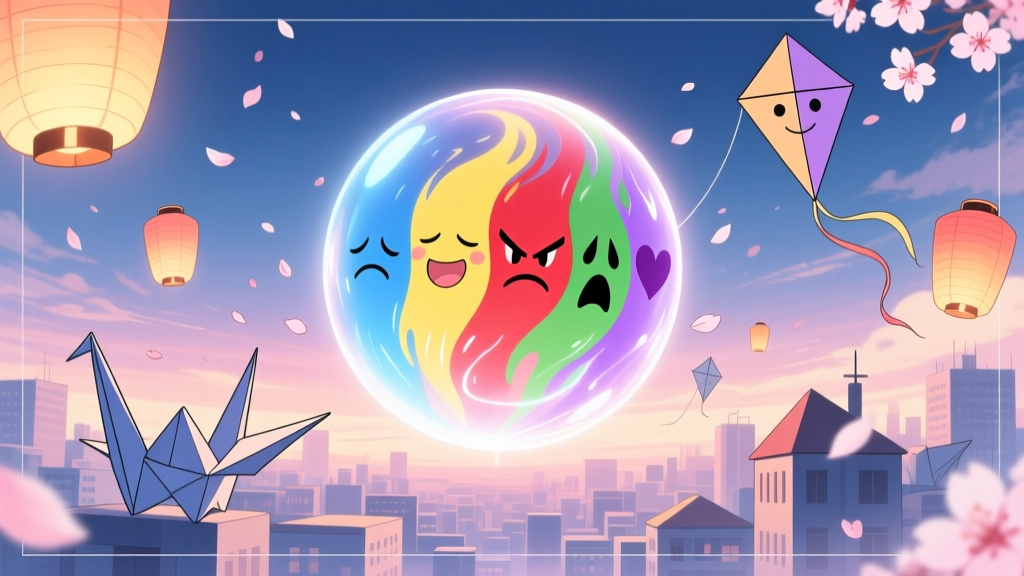
There's a moment early in Inside Out that most viewers don't think twice about. Eleven-year-old Riley bites into a slice of pizza for the first time, and somewhere inside her brain, Joy cups a glowing golden orb in her hands, cradles it like something sacred, then slides it into a pneumatic tube that whisks it away to long-term storage. It's a throwaway gag. It's also, according to the psychologists who consulted on the film, one of the more accurate depictions of memory consolidation ever put in an animated feature.
The thing is, Pixar didn't stumble into that accuracy by accident. They spent two years in conversation with researchers at UC Berkeley and Stanford, sat through lectures on affective neuroscience, and argued about whether a memory could literally change color when you recall it at a different age. What ended up on screen was a compromise between laboratory science and storytelling — and the places where those two goals diverge tell us more about how memory actually works than any textbook diagram.
Joy — #FFD93D Sadness — #5B9BD5 Anger — #E74C3C Fear — #9B59B6 Disgust — #2ECC71How Pixar Built a Brain You Could Walk Around In
Director Pete Docter has said in interviews that the original spark for Inside Out came from watching his own daughter, Elie, go through adolescence. She'd been the voice of young Ellie in Up, cheerful and outgoing, and then somewhere around age 11 she went quiet. Docter wanted to understand what was happening inside her head. So he did something unusual for a filmmaker: he called a scientist.
That scientist was Dacher Keltner, a professor of psychology at UC Berkeley who had spent two decades studying emotion, compassion, and the social functions of embarrassment. Keltner didn't just answer a few questions over coffee. He became a regular presence at Pixar's Emeryville campus, giving informal lectures, reviewing storyboards, and pushing back when the writers got something wrong. He brought in his colleague Paul Ekman, the psychologist famous for identifying six universal facial expressions across cultures — work that directly inspired the film's five emotion characters (Ekman's original list included surprise, which the team cut for narrative reasons).
The research pipeline was substantial. According to production notes released by Pixar, the creative team attended at least 18 formal consultations with academic psychologists between 2011 and 2014. They reviewed literature on emotional development in pre-adolescents, studied fMRI scans showing memory formation in the hippocampus, and debated whether Disgust should be more closely tied to physical revulsion or social judgment. (They split the difference: Disgust polices both broccoli and fashion choices.)
The film's production budget was approximately $175 million, with an unpublicized but meaningful slice allocated to scientific consultation — a rarity in animation, where research budgets typically cover visual reference trips rather than neuroscience seminars. The payoff was tangible. When Inside Out premiered at Cannes in May 2015, Keltner told The Atlantic that the film's depiction of how emotions organize memory was "about as close to the real science as you could get in a story about talking feelings."
The Memory Orbs: A Surprisingly Honest Metaphor
Every memory in Riley's head takes the form of a translucent sphere, color-coded by its dominant emotional tone. Happy memories glow yellow. Sad ones pulse blue. A frustrating encounter at the dinner table burns red. It's elegant, intuitive, and — here's where it gets interesting — partially grounded in how neuroscientists actually think about emotional encoding.
The amygdala, a pair of almond-shaped structures buried deep in each temporal lobe, acts as the brain's emotional tagger. When you experience something emotionally significant, the amygdala flags that memory for priority storage. It doesn't produce colored orbs, obviously, but it does attach an affective label to each encoded experience — a marker that says this mattered, keep it accessible. Research published by James McGaugh at UC Irvine (2004, Annual Review of Psychology) demonstrated that emotional arousal triggers the release of stress hormones like norepinephrine, which strengthen synaptic connections in the hippocampus during memory consolidation. In plain terms: the more you feel something, the more durably you remember it.
Inside Out captures this process with the pneumatic tube system. Memories form in Headquarters (a reasonable stand-in for working memory and conscious awareness), then travel through transparent tubes to long-term storage — a vast warehouse of shelves stretching to the horizon. The tube network mimics what neuroscientists call systems consolidation: the gradual transfer of memories from the hippocampus, where they're initially fragile and easily disrupted, to the neocortex, where they become stable and distributed across neural networks. In humans, this process takes anywhere from weeks to years. In Riley's head, it happens in about four seconds with a satisfying whoosh.
2.5 PB Estimated storage capacity of the human brain (petabytes) 86B Neurons in the average adult brain 100T Synaptic connections (estimated)Where the orb metaphor breaks down is in its suggestion that memories are discrete, self-contained units. Real memories aren't stored as single objects. They're distributed patterns of activation spread across thousands of neural circuits — a fragment of smell in the olfactory cortex, a spatial layout in the parietal lobe, an emotional tone in the amygdala, a narrative thread in the prefrontal cortex.
When you remember your tenth birthday, you're not pulling a single orb off a shelf. You're reconstructing the experience from fragments scattered across at least five distinct neural subsystems:
- Sensory cortex — the smell of the cake, the texture of wrapping paper
- Hippocampus — the spatial layout of the room, who sat where
- Amygdala — the emotional tone: excitement, surprise, maybe disappointment
- Prefrontal cortex — the narrative thread: "First we played games, then we opened presents"
- Temporal lobe — language and names: "Grandma was there, and Uncle Dave"
And you're doing it imperfectly every time. That's not a bug. It's how the system is designed.
Core Memories: The Islands of Personality, and What Holds Them Together
Five core memories anchor Riley's personality. Each one powers an Island of Personality that floats above the memory landscape like a theme park built from the things that matter most:
- Hockey Island — built from the thrill of her first skating goal
- Friendship Island — anchored by memories of her best friend back in Minnesota
- Honesty Island — tied to moments where telling the truth had real stakes
- Family Island — the largest and most structurally complex, for obvious reasons
- Goofball Island — powered by pure, undiluted silliness
When a core memory is removed or altered, the corresponding island collapses. This is one of the film's more ambitious metaphors, and it maps onto a genuine concept in developmental psychology.
This is one of the film's more ambitious metaphors, and it maps onto a genuine concept in developmental psychology. Psychologists refer to self-defining memories — a term coined by Jefferson Singer and Peter Salovey in 1993 — as vivid, emotionally intense recollections that people identify as central to who they are. Studies show that most adults can point to roughly 3 to 7 self-defining memories that feel foundational to their identity: a moment of triumph, a significant loss, a decision that changed everything. The number isn't far from Riley's five.
But here's where the film takes creative license. Self-defining memories don't power personality traits the way a battery powers a machine. Personality emerges from a dense interplay of temperament (which is partly genetic), learned behavior, social context, and ongoing cognitive processes. There is no single memory whose removal would cause your sense of honesty to physically crumble into an abyss. The brain is more resilient than that — and also more diffuse.
That said, the film nails something important about how core memories interact with emotion over time. In one of the movie's most quietly devastating scenes, Joy holds a core memory of Riley scoring her first hockey goal — golden and warm. Then Sadness touches it, and the orb shifts to blue. The memory itself hasn't changed. What's changed is Riley's relationship to it. She now remembers that goal through the lens of missing Minnesota, and the happiness is braided with loss.
This is called reconsolidation. Every time you retrieve a memory, it becomes temporarily malleable — open to modification by your current emotional state, new information, and the context in which you're remembering. Research by Karim Nader at McGill University (2000, Nature) showed that reactivated memories must be re-stored at the synaptic level, and during that re-storage window (roughly 2 to 6 hours), the memory can be altered. You don't just recall the past. You rewrite it, slightly, every time you visit.
The Memory Dump: Where Forgotten Things Go to Fade
Below the shelves of long-term memory lies the Memory Dump — a dark, cavernous pit where memories go to die. Orbs that haven't been accessed in years tumble down into this grey chasm, where they gradually lose their color and dissolve into nothing. Bing Bong, Riley's imaginary friend, is trapped there, his body literally disintegrating as Riley's childhood recollections of him erode.
It's heartbreaking. It's also a reasonable approximation of a process called synaptic pruning — though the real mechanism is considerably less dramatic and considerably more useful.
The human brain doesn't have a graveyard for old memories. What it has is a set of efficiency protocols. During childhood and adolescence, the brain eliminates roughly 40% to 50% of its synaptic connections through pruning, a process documented extensively in the work of Patricia Goldman-Rakic (Yale, 1990s) and later mapped in detail by the NIH's longitudinal MRI study of adolescent brain development (2004–2018). Connections that aren't reinforced through use are weakened and eventually eliminated. The brain doesn't store everything forever. It can't afford to. A brain that kept every memory at equal strength would be paralyzed by noise — unable to distinguish the name of your third-grade teacher from the license plate you saw this morning.
"The brain is not a vessel to be filled, but a fire to be kindled." — Plutarch, On Listening to Lectures (c. 100 AD). The Inside Out writers reportedly kept a version of this quote on the wall of their story room.
The Memory Dump implies that forgotten memories still exist somewhere, just inaccessible — buried but intact. Modern neuroscience suggests otherwise. Many "forgotten" memories were never consolidated into long-term storage in the first place. They existed only as transient patterns in working memory, lasting seconds or minutes, and then dissolved without ever leaving a durable trace. Others were encoded but then overwritten during reconsolidation, their neural circuits repurposed for newer, more relevant information. Forgetting isn't a storage failure. It's a feature.
And here's the detail that Bing Bong's fate gets exactly right: emotional significance protects memories from pruning. The amygdala's tagging system ensures that experiences with strong emotional content — joy, fear, grief, surprise — receive preferential consolidation. Riley forgets Bing Bong not because he wasn't loved, but because she stopped thinking about him. The neural circuits that held his image went quiet, and quiet circuits get pruned. That's the cruelest accuracy in the whole film.
What the Film Gets Right, What It Fudges, and What It Invents
After spending months in Pixar's story room, Keltner compiled a list of scientific concepts that the film handled responsibly and areas where storytelling needs overrode accuracy. Here's a breakdown of how the major memory mechanics in Inside Out compare to what we know from peer-reviewed research:
| Film Concept | Real-World Equivalent | Accuracy |
|---|---|---|
| Memory orbs — discrete, colored spheres for each experience | Distributed neural patterns across multiple brain regions; no single "unit" of memory | Partial — Emotion tagging is real, but memories aren't stored as unified objects |
| Core memories — foundational experiences that shape personality | Self-defining memories (Singer & Salovey, 1993); autobiographical memory anchors | Accurate — 3–7 self-defining memories is consistent with research |
| Pneumatic tubes — memories shipped from HQ to long-term storage | Systems consolidation: hippocampus-to-neocortex transfer over weeks to years | Partial — The transfer process is real; the speed and mechanism are compressed for narrative |
| The Memory Dump — a pit where unused memories dissolve | Synaptic pruning; reconsolidation failure; encoding failure | Partial — Forgetting is real, but memories don't sit in a "graveyard"; most were never fully stored |
| Memory recoloring — touching a memory changes its emotional color | Reconsolidation (Nader, 2000); mood-congruent memory retrieval | Accurate — Memories do change emotionally each time they're recalled |
| Dream Productions — a studio where dreams are manufactured | Dreams as memory replay and emotional processing (Hobson, 2005; Walker, 2017) | Partial — Dreams do incorporate recent memories, but there's no "production crew"; it's spontaneous neural replay |
| Islands of Personality — physical structures powered by core memories | Personality as emergent property of temperament, learning, and social context | Creative Liberty — Personality traits don't depend on individual memories this directly |
| Train of Thought — a literal train delivering ideas | Working memory circuits; prefrontal cortex activation patterns | Creative Liberty — A charming metaphor, but cognition doesn't operate on rails |
The pattern is clear: Inside Out is most scientifically rigorous when dealing with emotional memory — the exact area where Keltner's expertise was most directly relevant. The film's weakest scientific moments are its spatial metaphors for abstract processes. The brain doesn't have geography; it has connectivity. But you can't animate connectivity as compellingly as you can animate a train derailing.
The Scene That Made Neuroscientists Cry
Spoiler for a film from 2015, but if you haven't seen it by now: Bing Bong sacrifices himself in the Memory Dump so that Joy can escape. He fades away, whispering "take her to the moon for me," and an entire generation of viewers lost their minds in a theater.
What makes this scene neurologically resonant — beyond the writing and the voice acting — is that it mirrors a specific, well-documented phenomenon: the loss of childhood imaginary companions. Studies by Marjorie Taylor at the University of Oregon (2004, Developmental Psychology) found that approximately 65% of children under age 7 have an imaginary friend at some point. Most of these companions vanish from a child's awareness between ages 8 and 11, not through a dramatic farewell, but through gradual disuse. The child simply stops thinking about them, and the neural representation fades.
Inside Out gives that invisible process a face, a voice, and a death scene. It externalizes something that happens inside every developing brain — the pruning of early childhood's creative social cognition — and turns it into a loss that the audience can mourn alongside Riley. That's not science, exactly. But it's scientifically informed storytelling, and the distinction matters.
Inside Out 2: Memories Get More Complicated
When Inside Out 2 arrived in June 2024, Riley was 13 and puberty had arrived at Headquarters with a demolition crew. The sequel introduced Anxiety, Envy, Ennui, and Embarrassment — four new emotions that complicated the memory system in ways the original film hadn't attempted. More importantly for our purposes, it introduced the concept of a Belief System: a structure deep in the mind where repeated emotional patterns crystallize into sentences like "I'm a good friend" or "I'm not good enough."
This maps directly onto what cognitive psychologists call core beliefs or schemas — the foundational assumptions about yourself and the world that Aaron Beck identified in the 1960s as central to cognitive behavioral therapy. Core beliefs aren't single memories. They're patterns that emerge from many memories over time, like a mosaic that only reveals its image when you step back. The film visualizes this as glowing threads of light that weave together from multiple memory orbs to form written affirmations. It's one of the most sophisticated representations of abstract cognition in mainstream animation.
The sequel also expanded on what happens when Anxiety takes control of memory processing. Under Anxiety's influence, Riley's brain begins projecting — creating memories of things that haven't happened yet, colored entirely by fear. This isn't memory in the traditional sense, but it reflects a real phenomenon: prospective anxiety, where the brain's prediction systems (centered in the anterior cingulate cortex and the dorsolateral prefrontal cortex) generate vivid simulations of negative future scenarios and tag them with the same emotional weight as actual memories. People with generalized anxiety disorder often report difficulty distinguishing between things that happened and things they worried might happen. The film captures this blurring with uncomfortable precision.
By the end of Inside Out 2, Riley's core belief shifts from the simple "I'm a good person" to something more layered and conditional — a messy, multicolored thread that reads differently depending on which emotion is looking at it. It's the film's quiet argument that maturity isn't about replacing bad memories with good ones. It's about holding contradictions. About a single memory being golden and blue at the same time.
Why Your Brain Recognizes Riley's Brain
The reason Inside Out resonated so broadly — $858 million at the global box office, making it the seventh-highest-grossing film of 2015 — isn't just that it's a well-crafted Pixar movie. It's that the film's memory architecture feels intuitively familiar to anyone who's ever tried to remember something and failed, or tried to forget something and couldn't.
Psychologists call this metacognitive awareness — the ability to think about your own thinking. Most people have a rough, folk-psychological model of how their memory works: things go in, they get stored somewhere, sometimes they come back out. Inside Out gives that folk model a physical space, characters, and rules. And because those rules are mostly consistent with real neuroscience, the film doesn't just entertain. It educates by alignment. Viewers leave the theater with a slightly better mental model of their own cognition, even if they can't articulate exactly why.
A 2016 study published in Cerebrum (the Dana Foundation's neuroscience journal) surveyed college students who had seen the film and found that they were significantly more likely to correctly describe memory consolidation and emotional encoding than a control group who hadn't. The effect wasn't large — this is a cartoon about feelings, not a lecture — but it was measurable. Pop culture, it turns out, is one of the most effective delivery systems for scientific literacy. Especially when the pop culture gets the science mostly right.
The film's legacy in neuroscience education is still unfolding. As of 2025, at least three university psychology departments (UC Berkeley, McGill, and the University of Edinburgh, based on publicly available syllabi) have used clips from Inside Out as teaching aids in introductory courses on memory and emotion. Keltner himself has given over 40 invited talks on the science behind the film, including a keynote at the 2016 American Psychological Association convention.
Questions People Actually Ask About Inside Out and Memory
Did Pixar really consult with psychologists for Inside Out?
Yes. The two primary consultants were Dacher Keltner, a psychology professor at UC Berkeley specializing in emotion science, and Paul Ekman, the psychologist who identified universal facial expressions. Keltner participated in at least 18 formal consultations during the film's development (2011–2014) and has spoken publicly about the experience in interviews with The Atlantic, Greater Good Magazine, and the APA. Ekman's research on basic emotions directly informed the character designs, though the film ultimately used five of his six universal emotions, omitting surprise.
Are core memories a real psychological concept?
The specific term "core memory" as used in the film is a Pixar invention, but the underlying concept is real. Psychologists Jefferson Singer and Peter Salovey defined "self-defining memories" in 1993 as vivid, emotionally intense autobiographical memories that people consider central to their identity. Research suggests most adults have between 3 and 7 such memories, which aligns closely with the film's five core memories. The key difference: real self-defining memories don't literally "power" personality traits the way the film depicts.
Can memories actually change color (emotion) when you recall them?
Not in a visual sense, but the emotional content of a memory absolutely shifts over time. This process is called memory reconsolidation. Each time a memory is retrieved, it enters a labile state for approximately 2–6 hours (based on research by Karim Nader at McGill University, published in Nature, 2000). During this window, the memory can be modified by your current emotional state before being re-stored. A happy memory recalled during grief may genuinely feel sadder afterward — not just in your interpretation, but in the neural encoding itself.
Is the Memory Dump scientifically accurate?
Partially. The brain does eliminate unused memories through synaptic pruning (the brain eliminates roughly 40–50% of childhood synapses during development) and encoding failure. However, the film's depiction of a physical "dump" where memories sit and slowly dissolve is misleading. Most forgotten memories were never fully consolidated into long-term storage. Others are overwritten during reconsolidation, their neural circuits repurposed. There's no single location in the brain where dead memories accumulate.
How does Inside Out 2 expand on the memory science?
The sequel introduces Belief Systems, which correspond to what cognitive psychology calls core beliefs or schemas (Aaron Beck, 1960s). These are overarching self-concepts formed from patterns across many memories — visualized in the film as threads of light woven from multiple memory orbs into written statements like "I'm a good friend." The film also depicts prospective anxiety, where the brain generates emotionally charged simulations of future events that blur the line between memory and imagination — a phenomenon well-documented in anxiety research.
Is Inside Out used in actual psychology education?
Yes. As of 2025, multiple university psychology departments — including UC Berkeley, McGill University, and the University of Edinburgh — have incorporated Inside Out clips into introductory courses on memory and emotion. A 2016 study in Cerebrum (Dana Foundation) found that students who had seen the film demonstrated measurably better understanding of memory consolidation concepts. Dacher Keltner has given over 40 invited academic talks specifically on the neuroscience depicted in the film.