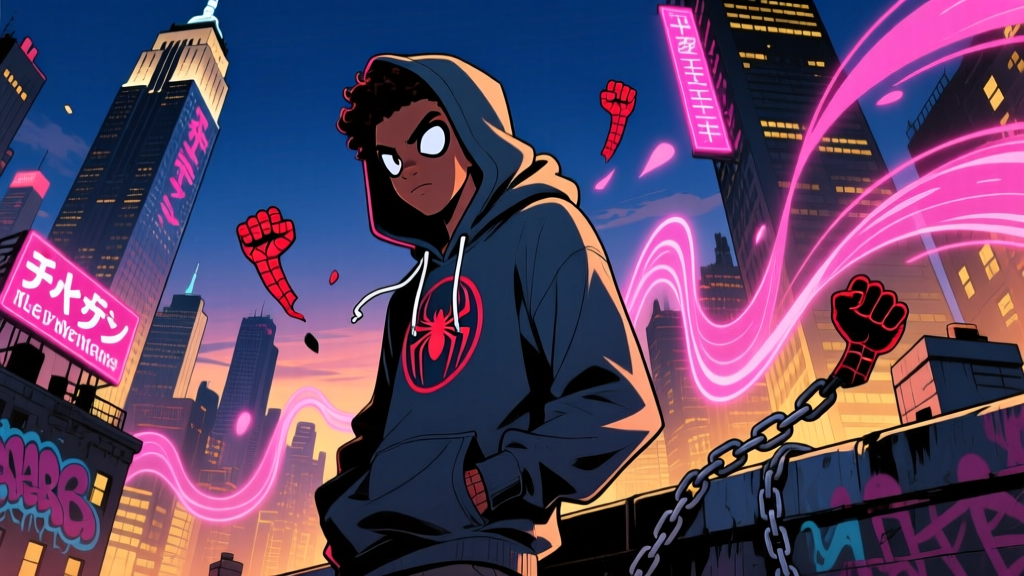
The red-and-black hoodie Miles Morales wears in the Spider-Verse films is not just a costume. It's a statement about identity, streetwear, and what it means to be a hero who actually looks like the people watching.
Spider-Verse Streetwear Cosplay & CollectiblesYou know the shot. Miles standing on the edge of a Brooklyn rooftop, wind catching the oversized red hoodie, the black spider emblem stretched across his chest. He pulls the hood up. The city hums below him. That single image has been plastered on everything from fan art walls in Bushwick to high-fashion runways in Paris, and it's not going anywhere.
Before Into the Spider-Verse dropped in December 2018, Miles Morales was already a fan-favorite character in the comics. Brian Michael Bendis and Sara Pichelli created him in 2011 as a Black-Latino teenager from Brooklyn who picks up the mantle after Peter Parker's death in the Ultimate universe. But the comics version of Miles wore a fairly conventional Spider-Man suit—red and black, sure, but still very much a "superhero costume." The hoodie? That was Sony Pictures Animation's invention. And it changed everything.
This isn't an article about a piece of fabric. This is about how a hoodie became shorthand for an entire generation's relationship with heroism, identity, and style. Let's break down why Miles Morales with hoodie became one of the most recognizable silhouettes in modern pop culture.
The Hoodie Design: What Makes It Different
Costume designer Danny Dimian and the art team at Sony Pictures Animation went through over a hundred iterations before landing on the final hoodie look. The challenge was deceptively simple: Miles had to look like a kid from Brooklyn who happened to become Spider-Man, not a kid wearing a Spider-Man costume.
The solution was a layered approach. Underneath, Miles wears a standard black-and-red Spider-Man suit. But over it goes the hoodie—oversized, slightly baggy, unmistakably streetwear. The hoodie is red with a black spider web pattern printed across it, the hood itself styled to mimic the spider mask shape when pulled up. It's a piece of clothing that says "I'm Spider-Man" and "I'm just a dude from the block" at the same time.
What sells the design is the imperfection. The hoodie is too big for Miles in Into the Spider-Verse. The sleeves hang past his hands. The fabric bunches around his shoulders. This isn't a tailored suit—it's a kid wearing his dad's jacket. That vulnerability is the entire point. Miles is fifteen years old, terrified, and trying to figure out who he is. The oversized hoodie makes you feel all of that before he says a single word.
Compare this to Peter Parker's classic suit. Peter's costume is sleek, form-fitting, iconic in the traditional sense. It's designed to make you look up. Miles's hoodie is designed to make you look at him—at eye level, where you'd stand if you were talking to him on the street. That shift in perspective was revolutionary for superhero animation.
Into the Spider-Verse: The Hoodie as a Coming-of-Age Symbol
The first film uses the hoodie as a narrative device. Early on, Miles gets bitten by the radioactive spider and his body starts changing. He can't control his powers. His hands stick to things. He's confused, scared, and the last thing he wants is to wear a skintight superhero suit that screams "I have my life together." The hoodie is his compromise—a way to be Spider-Man while still hiding inside something familiar.
There's a scene where Miles spray-paints his own spider logo onto the hoodie. He's in a graffiti-covered alley, surrounded by the visual language of Brooklyn street art, and he's literally writing his own identity onto the costume. This moment is the thesis of the entire film. Miles isn't inheriting Peter Parker's legacy—he's remixing it. He's taking the Spider-Man mythos and making it his own, the same way a kid in Bed-Stuy might customize a pair of Jordans or tag their name on a wall.
The "Leap of Faith" scene—where Miles jumps off a building and the camera flips so he's falling upward into the city—is one of the most visually stunning sequences in animation history. And at the center of it is the hoodie. The fabric ripples and stretches as Miles falls. The hood billows. The spider logo catches the neon light. It's a superhero moment, but it's also a fashion moment. Sony knew exactly what they were doing when they designed that shot. The image of Miles Morales with hoodie, falling upward through the Brooklyn skyline, became the defining poster shot of 2018.
"We wanted the hoodie to feel like something a real kid would wear. Not a costume piece, but actual clothing. The idea was that if you saw Miles on the street, you'd think he was just another teenager in Brooklyn—and then you'd notice the spider web pattern and realize he's Spider-Man."
— Justin K. Thompson, Production Designer, Into the Spider-Verse
By the end of the first film, Miles has fully claimed the hoodie as his own. He's no longer hiding inside it. He's wearing it with confidence, the way you wear something that makes you feel like yourself. That arc—from oversized and awkward to fitted and purposeful—mirrors Miles's entire character journey. The hoodie grows with him.
Across the Spider-Verse: The Hoodie Grows Up
When Across the Spider-Verse arrived in June 2023, Miles had changed. He was older, more confident, more in control of his powers. And the hoodie reflected that. The new design was tighter, more structured, less "borrowed from dad" and more "I bought this for myself." The spider web pattern was more defined. The colors were richer. Miles wore it less as a blanket and more as armor.
The second film also introduced the idea that Miles's choices—including how he presents himself—have consequences across the multiverse. Miguel O'Hara's Spider-Society operates on strict rules about who gets to be Spider-Man and how. Miles's hoodie, with its DIY energy and streetwear roots, stands in direct opposition to that institutional mindset. Every other Spider in the Society wears some version of the classic red-and-blue suit. Miles shows up in a hoodie and immediately looks like he doesn't belong. Which is exactly the point.
The film's art direction doubles down on this contrast. When Miles runs through the Spider-Society headquarters—a sterile, futuristic space full of hundreds of Spiders in matching suits—his red hoodie is the only warm color in a sea of cold blues and whites. He's a walking disruption. The hoodie isn't just clothing anymore; it's a flag for individuality in a system that demands conformity.
The cliffhanger ending of Across the Spider-Verse (Miles trapped in Earth-42, facing a version of himself who never became Spider-Man) also reframes the hoodie's meaning. In that world, Miles wears regular street clothes. No hoodie. No spider. And the absence of it is devastating. You realize the hoodie has become so tied to Miles's identity that seeing him without it feels like watching someone lose themselves.
Why Miles Morales With Hoodie Hit Different
Spider-Man has always been the "everyman" superhero. Peter Parker was a broke kid from Queens who worried about rent and getting bullied. That relatability was the character's DNA from day one. But Peter Parker's everyman-ness was coded as white, nerdy, and suburban-adjacent. Miles Morales brought something new to the table: a different kind of everyman, one who reflected the actual demographics of New York City.
The hoodie is central to that shift. In American culture, a Black teenager in a hoodie carries weight. Trayvon Martin was wearing a hoodie when he was killed in 2012. The garment became a symbol of racial profiling, of how the same piece of clothing reads differently depending on who's wearing it. Spider-Verse doesn't lecture about this, but it doesn't have to. The imagery is already there. When Miles pulls his hood up and swings through Brooklyn, the visual carries decades of cultural context.
At the same time, the hoodie is just... cool. It's the kind of piece that a fifteen-year-old would actually choose to wear. Superhero costumes have a long history of being impractical and weird-looking. The idea that Spider-Man would wear something you could buy at a sneaker store made the character feel tangible in a way that no amount of CGI muscle definition ever could.
Parents noticed. Teachers noticed. Kids who had never picked up a comic book in their lives suddenly wanted to be Spider-Man because Miles looked like them, dressed like them, and lived in a neighborhood that felt real. The hoodie was the bridge between the comic book world and the actual world, and that bridge was built out of cotton and screen-printed web patterns.
Cosplay Impact: The Hoodie That Launched a Thousand Conventions
If you've been to any comic convention since 2019, you've seen Miles Morales hoodies. Not the elaborate, screen-accurate replicas (though those exist and they're incredible). The more common version is simpler: a red hoodie with a black spider web pattern, maybe a mask pulled up underneath. It's one of the most accessible cosplays in convention history, and that accessibility is the whole point.
You don't need a 3D printer. You don't need sewing skills. You don't need to spend six months building armor pieces from EVA foam. A Miles Morales hoodie cosplay can be assembled from off-the-rack clothing for under fifty dollars. That's not an accident—it's a direct result of the character's design philosophy. The costume is meant to feel attainable, and the cosplay follows the same logic.
The cosplay community has taken the basic template and run with it. You'll see Miles hoodies customized with LED web-shooter effects, hand-painted graffiti details, distressed and weathered versions that look like they've been through a multiverse battle. Some cosplayers pair the hoodie with Jordan 1s (the "Chicago" colorway is the unofficial Miles Morales shoe). Others add Brooklyn-specific details—a MetroCard tucked into the pocket, a Knicks cap peeking out from under the hood.
Budget Cosplay
Red hoodie + black web pattern + mask. Under $50 total. The most common convention version.
Screen-Accurate
Custom-printed hoodie with exact film patterns, official mask replica, $150-$300 range.
Custom / Artisan
Hand-painted, LED-integrated, distressed. Convention competition entries. $200-$500+.
Kid-Friendly
Licensed kids' hoodies from Target/Amazon. Halloween staple since 2019.
Streetwear and Fashion: When Superhero Clothing Left the Comic Shop
Here's where things get interesting. The Miles Morales hoodie didn't stay in the cosplay and costume aisle. It crossed over into actual streetwear. Brands noticed that people—especially younger people, especially Black and Latino kids—were wearing Spider-Verse hoodies not as costumes but as fashion. The hoodie looked good with jeans. It looked good with cargos. It looked good layered over a white tee on a warm Brooklyn evening.
Sony and Marvel's licensing teams leaned into this hard. Official Miles Morales hoodies started appearing in places like Foot Locker, Zumiez, and Urban Outfitters, positioned alongside streetwear brands rather than in the "costumes" section. The price points ranged from $40 for basic versions to $120+ for premium collaborations. Jordan Brand got in on it with the Air Jordan 1 "Next Chapter" colorway, explicitly designed to match Miles's look. The shoe sold out in minutes.
Independent designers also jumped on the wave. Etsy and Depop flooded with hand-made Miles Morales hoodies, each adding their own twist—embroidered spider logos, custom distressing, patchwork versions, cropped cuts for a feminine silhouette. The unauthorized market was massive, and it existed because the official merchandise couldn't keep up with demand. People didn't want a costume. They wanted a piece of clothing that carried the energy of the character.
High fashion took notice too. Hoodies had already been having a moment in the luxury space (Balenciaga, Off-White, Fear of God), but Spider-Verse gave the trend a new visual language. You started seeing runway pieces that borrowed directly from Miles's aesthetic—oversized silhouettes, bold red-and-black color blocking, web-like graphic patterns. It wasn't officially Spider-Man merch, but anyone who'd seen the film recognized the reference. The line between superhero costume and fashion statement had been erased.
Collectibles and Merchandise: A Buyer's Landscape
The Miles Morales hoodie has spawned an entire collectibles ecosystem. Here's a breakdown of the major product categories and what collectors should know about each one.
| Category | Price Range | Availability | Collector Value |
|---|---|---|---|
| Official Licensed Hoodies | $40–$80 | Wide | Low–Medium |
| Hot Toys 1/6 Scale Figure | $230–$310 | Limited | High |
| Funko Pop! (Hoodie Variant) | $12–$65 | Wide | Medium (Exclusive) |
| Jordan 1 "Next Chapter" | $180–$400 | Sold Out / Resale | High |
| Marvel Legends Action Figure | $22–$45 | Wide | Low–Medium |
| Lego Miles Morales (Set 76225) | $30–$55 | Moderate | Medium |
| Handmade / Custom Hoodies (Etsy) | $50–$200 | Variable | Low (Sentimental) |
| Sideshow Collectibles Statue | $250–$500 | Limited | High |
Prices reflect approximate market values as of 2025. Collector value for limited editions tends to increase post-retirement.
Brooklyn, Graffiti, and the Urban Canvas
You can't talk about Miles Morales with hoodie without talking about Brooklyn. The borough isn't just a setting in Spider-Verse—it's a character. The animation team rendered Brooklyn with obsessive detail: the elevated train tracks, the bodega signs in Spanish and English, the murals on the side of brownstones, the way light filters through the fire escapes at golden hour. Miles exists within that environment, and his hoodie is part of its texture.
The graffiti element is particularly important. In both films, street art is woven into every surface. Miles himself is an artist—he draws in his notebook, he stickers his laptop, he tags walls. When he spray-paints the spider logo on his hoodie in the first film, he's participating in a tradition of self-expression that's deeply rooted in New York's hip-hop and street art culture. The hoodie becomes a canvas, and Miles becomes the artist of his own identity.
This visual language resonates beyond the screen. In cities across the world, street artists have painted murals of Miles Morales in his hoodie. You'll find them in London, Tokyo, Sao Paulo, Mexico City. The image translates because it's built on visual codes that already exist in urban spaces globally. A kid in a hoodie standing in front of a wall of graffiti isn't a superhero image—it's a street image. The superhero part is secondary. That's what makes it work.
Sony's marketing team understood this connection and leaned into it. The promotional campaigns for both films featured real graffiti artists creating Miles Morales murals in major cities. They didn't put him on billboards—they put him on walls. The hoodie, in those murals, always looks a little different each time: different proportions, different colors in the web pattern, different wear and tear. Like any good piece of street art, it gets reinterpreted by whoever's holding the spray can.
Beyond the Films: The Hoodie in Games, Comics, and Media
Insomniac's Spider-Man: Miles Morales (2020, PS4/PS5) gave players direct control of the hoodie-wearing hero, and the game's costume select screen treated the hoodie as the default look. The comics eventually folded the hoodie into Miles's wardrobe too—in recent issues of Miles Morales: Spider-Man by Cody Ziglar and Federico Vicentini, you'll see Miles wearing a version of the hoodie over his suit, bridging the gap between the animated and comic versions of the character.
The PS5 game also introduced additional hoodie variants as unlockable suits, each with slight design tweaks. The "Programatt" suit, the "Crimson Cowl" suit, and several others borrowed the hoodie silhouette while remixing colors and materials. It's a smart move—giving players more hoodie options acknowledges that the look is the core of Miles's visual identity, not a one-off costume variant.
Marvel Rivals, the 2024 team-based hero shooter, included the hoodie as one of Miles's selectable skins, confirming that the look has become a permanent part of the character's brand across every medium he appears in. Whether you're watching a movie, reading a comic, or playing a game, Miles Morales with hoodie is now the default mental image for an entire generation of fans.
What the Hoodie Actually Means
Strip away the marketing and the merchandise and the billion-dollar franchise machinery, and what you're left with is this: a Black-Latino teenager from Brooklyn wearing a hoodie that's too big for him, standing on a rooftop, looking out at a city that doesn't always see him as a hero.
That image matters. It matters because for decades, the default superhero was someone who looked nothing like Miles. The hoodie makes Miles visible in a specific, culturally loaded way. It places him in a lineage of Black youth culture—hip-hop, skateboarding, street art, sneaker culture—that mainstream superhero media had largely ignored. When Miles pulls his hood up, he's not hiding. He's announcing who he is.
The fact that this image became a global phenomenon—that Miles Morales with hoodie ended up on backpacks, lunchboxes, bedroom walls, and fashion runways—tells you something about what audiences were hungry for. People wanted a hero who felt real. Not just relatable in the abstract, "oh he has problems too" sense, but specifically, concretely real in the way he dressed, the way he moved, the neighborhood he came from.
The hoodie is a small thing. It's a piece of clothing. But it's also proof that design choices in animation can ripple outward and reshape how people think about heroism, identity, and style. Miles Morales didn't need a billion-dollar suit of armor or a magic hammer. He needed a hoodie, and he needed it to look like he'd picked it out himself at a store in Brooklyn. That's the whole trick. That's why it works.
Frequently Asked Questions
Is the Miles Morales hoodie an actual Spider-Man suit or just regular clothing?
In the Spider-Verse films, the hoodie is worn over Miles's Spider-Man suit. It's not a suit itself—it's a piece of streetwear layered on top. The idea is that Miles added the hoodie to make the Spider-Man look his own, rather than wearing a suit designed by someone else. The spider web pattern on the hoodie is something he creates himself, which makes it more personal than a standard-issue superhero costume.
Where can I buy an official Miles Morales hoodie?
Official licensed Miles Morales hoodies are sold through retailers like Foot Locker, Zumiez, Amazon, and the Marvel Shop. Sony Pictures also sells versions through their official merchandise store. Prices typically range from $40 to $80 for standard versions, while premium or collaboration pieces can go higher. Keep in mind that many "Miles Morales hoodies" on Amazon and Etsy are unauthorized reproductions—quality varies widely on those.
Does Miles Morales wear the hoodie in the comics?
Originally, no. Miles wore a standard Spider-Man suit in the comics for years. After the Spider-Verse films became massive hits, Marvel Comics began incorporating the hoodie into Miles's comic book wardrobe. Recent issues of Miles Morales: Spider-Man have shown him wearing a version of the hoodie, reflecting the animated design back into the source material. It's a case of the adaptation influencing the original.
What shoes does Miles Morales wear with the hoodie?
In the films, Miles wears a pair of Air Jordan 1s, which led to the official Jordan Brand collaboration: the Air Jordan 1 "Next Chapter" (also called the "Miles Morales" colorway) featuring black and red with a cracked leather texture reminiscent of the Spider-Verse animation style. The shoe released in 2023 and sold out almost immediately. On the resale market, they typically run $250 to $400 depending on size.
Why is the Miles Morales hoodie so popular compared to other superhero costumes?
The hoodie works because it sits at the intersection of several cultural currents: superhero fandom, streetwear fashion, representation in media, and the general popularity of hoodies as a garment. Most superhero costumes aren't something you'd actually wear outside of a convention. The Miles Morales hoodie is. It functions as regular clothing that happens to reference a character, which gives it a versatility that a full spandex suit will never have. Add in the cultural significance of a Black-Latino hero wearing a garment loaded with real-world meaning, and you get something that transcends the usual superhero merchandise cycle.
Will Miles wear the hoodie in Beyond the Spider-Verse?
No official details about costume design for Beyond the Spider-Verse have been released as of mid-2025. However, given how central the hoodie has become to Miles's visual identity across films, games, and comics, it would be surprising if it didn't appear in some form. The cliffhanger ending of Across the Spider-Verse (Miles on Earth-42 without his powers or costume) suggests the third film may explore what the hoodie means by showing Miles without it—and then earning it back.
Got a Miles Morales Hoodie Story? Drop It Below
Whether you built one from scratch for a convention, grabbed a pair of the Jordan 1s on release day, or just wear the licensed hoodie to class—we want to hear about it. What does the hoodie mean to you? Did seeing Miles on screen change how you think about who gets to be a hero?
Share this with someone who still thinks Peter Parker is the only Spider-Man. Time to educate them.
Share on Twitter Share on Reddit Copy Link