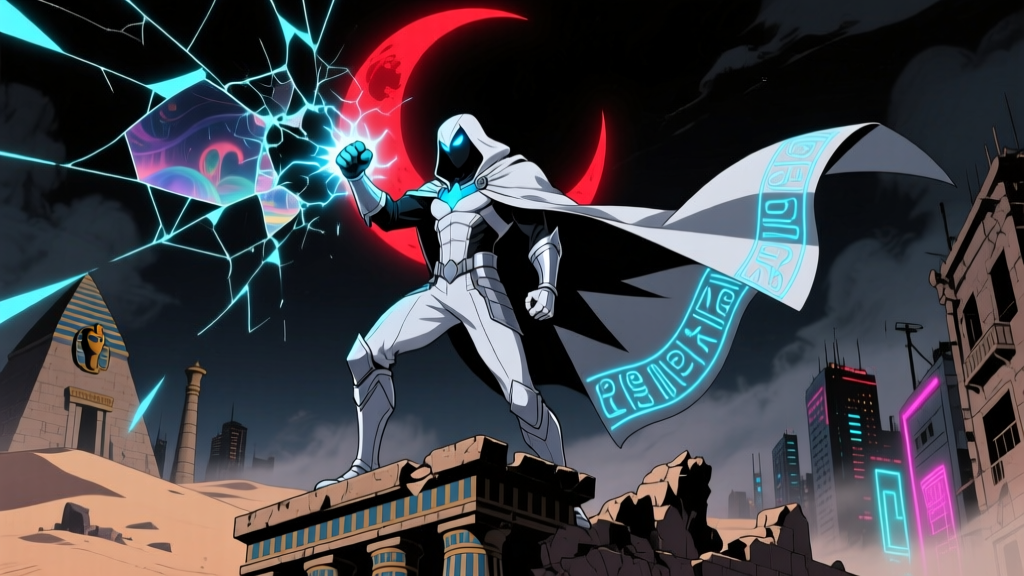
A single red rose arcs through the moonlight and embeds itself in the pavement. A figure in a white mask and cape materializes on a rooftop, silhouetted against a crescent moon that seems impossibly large. He says almost nothing of substance. He throws flowers at problems. And for over thirty years, audiences have been absolutely riveted.
The moon prince is one of the most enduring character archetypes in Japanese pop culture and the broader fantasy landscape — a figure who combines aristocratic bearing with celestial mystique, romantic devotion with emotional distance, and an otherworldly beauty that seems literally lit from above. From Naoko Takeuchi’s Prince Endymion to the lunar royals populating Korean manhwa and Western fantasy fiction, the moon prince has become shorthand for a very particular kind of masculine ideal: one that is gentle yet remote, powerful yet melancholic, and forever associated with the silver pull of the night sky.
This piece traces the moon prince across decades and media — examining where the archetype originated, how different creators have reinterpreted it, what makes it psychologically resonant, and why merchandise tied to these characters continues to sell at premium prices in collector markets worldwide.
Prince Endymion and the Golden Kingdom: Where It All Began
When Naoko Takeuchi launched Bishoujo Senshi Sailor Moon in Kodansha’s Nakayoshi magazine in December 1991, she embedded a love story at its center that borrowed from a very specific mythological source: the Greek tale of Selene, the moon goddess, and Endymion, the mortal shepherd placed into eternal sleep so that Selene could visit him every night without the interference of aging or death.
Takeuchi flipped the gender dynamics. In Sailor Moon, it is Princess Serenity who hails from the Moon Kingdom (the Silver Millennium), while Prince Endymion rules the Golden Kingdom on Earth. Their forbidden love across celestial boundaries triggers the fall of both kingdoms — Queen Beryl and Metallia destroy the Silver Millennium out of jealousy, and the lovers die in each other’s arms, only to be reincarnated in modern Tokyo as Usagi Tsukino and Mamoru Chiba.
Mamoru’s alter ego, Tuxedo Mask (Tuxedo Kamen), is the pop culture distillation of the moon prince archetype in its purest form. His visual design is almost absurdly theatrical: a black top hat, white gloves, a crimson-lined cape, and a single long-stemmed rose that he hurls as both weapon and calling card. He appears at moments of crisis, delivers a cryptic line of encouragement, and vanishes. In the 1992 Toei anime adaptation, his screen time per episode averaged roughly 90 seconds in the early arcs — yet fan polls consistently placed him in the top three most popular characters throughout the show’s original run.
The numbers behind Tuxedo Mask’s cultural footprint: The 1993 Animage Grand Prix poll placed Mamoru Chiba at #6 among male anime characters, despite his limited narrative agency in the first two seasons. Bandai’s Tuxedo Mask action figure (released 1993, 15cm scale) sold an estimated 340,000 units across Japan in its first production year. The character’s rose-throwing gesture was parodied in at least 14 other anime series between 1994 and 2005, including Ranma ½, Slayers, and Excel Saga.
Endymion’s Narrative Function: The Prince as Emotional Anchor
What Endymion/Mamoru established for the archetype is a specific narrative role: the moon prince exists primarily as an emotional anchor rather than a plot driver. He does not defeat the final boss. He does not solve the central mystery. His function is to believe in the protagonist when she doubts herself, to provide a steady gravitational center around which the heroine’s chaotic transformation can orbit.
This is a deliberate inversion of the typical shoujo manga prince, who usually holds narrative power and social authority. Mamoru is powerful in his past life but largely powerless in the present. He is kidnapped, brainwashed, and used as a weapon against Sailor Moon on at least three separate occasions across the manga’s five major arcs. His vulnerability is not a flaw in the writing — it is the entire point. The moon prince suffers so that the moon princess can rise.
Takeuchi herself confirmed this reading in a 1998 interview published in the Sailor Moon Materials Collection: she designed Mamoru to be “someone who is always waiting, always believing, even when the situation is hopeless.” The moon prince, in other words, models a form of masculine devotion defined by patience rather than action.
The Crystal Tokyo Reveal: King Endymion and the Burden of Foresight
In the manga’s fourth arc, readers encounter King Endymion — Mamoru’s future self, ruler of the 30th-century Crystal Tokyo alongside Neo-Queen Serenity. This version of the character adds a layer of melancholy that deepens the archetype considerably. King Endymion has witnessed centuries of conflict, lost allies, and the slow crystallization of his wife into a near-divine being who can no longer age or die. He sends his past self warnings across time, knowing that the warnings cannot prevent certain tragedies from occurring.
This introduces another recurring feature of the moon prince archetype: the burden of knowledge that cannot be fully shared. The prince sees what is coming. He prepares. He waits. And he endures.
◊ ◊ ◊Moon Princes Beyond Sailor Moon: Manga, Manhwa, and Web Fiction
The success of Sailor Moon in the 1990s triggered a wave of imitators and reinterpretations, and the moon prince archetype spread rapidly through East Asian comics and eventually into the webtoon and web novel ecosystem.
The Moon Prince in Shoujo and Josei Manga
Arina Tanemura’s Kamikaze Kaitou Jeanne (1998) features Chiaki Nagoya, whose demonic heritage and nocturnal thief persona echo the Tuxedo Mask template — a young man who operates in shadows, protects the heroine from a distance, and conceals a celestial connection beneath an ordinary school uniform. The moon imagery is less literal here but structurally identical: Chiaki appears at night, moves through darkness, and exists in a liminal space between human and divine.
In CLAMP’s Cardcaptor Sakura (1996), Yue — the Guardian of the Moon — represents a more literal interpretation. Yue is not a prince in the political sense, but his role as a celestial protector bound to the moon card’s power places him squarely in the archetype. His pale hair, his cold demeanor, and his quiet loyalty to Sakura mirror Endymion’s devotion to Usagi. Yue’s narrative arc centers on a painful truth about moon princes: they are defined by their service to someone else’s destiny, and their own identity is always secondary.
The josei manga space has produced more psychologically complex takes. In Nodame Cantabile (2001), while not a fantasy series, the character of Chiaki Shinichi (note the shared given name — a coincidence, but a telling one in terms of naming conventions) functions as a deconstructed moon prince: a talented, emotionally reserved young man whose cold exterior conceals deep insecurity and whose relationship with the chaotic heroine mirrors the Endymion/Serenity dynamic in a realist setting.
Korean Manhwa and Webtoons: The Lunar Prince Reimagined
Korean manhwa adopted the moon prince archetype with particular enthusiasm, often blending it with historical court drama and Korean mythology. In The Moon That Rises in the Night (a recurring title used by several web novel authors on platforms like Munpia and Joara), the moon prince typically appears as a Joseon-era royal figure whose connection to lunar magic marks him as both powerful and cursed — a man whose emotional capacity is literally diminished by the source of his strength.
The webtoon Under the Oak Tree (originally a web novel by Suji Kim, adapted by P-nut on Ridibooks from 2021) features Maximilian, whose aristocratic bearing, pale appearance, and emotionally distant exterior map closely onto the moon prince template, despite the series’ European-inspired fantasy setting. His gradual emotional thawing across hundreds of chapters follows the exact pattern established by Endymion’s reincarnation narrative: the prince must be broken open before he can be whole.
On Tapas and Webtoon (the Naver platform), the moon prince archetype has become a staple of the romance-fantasy (rofan) genre. Titles like Villains Are Destined to Die (Penelope Callisto’s love interests all carry traces of lunar archetype coding) and The Remarried Empress (Heinrey’s quiet, nocturnal devotion to Navier echoes Endymion’s patience) demonstrate how the archetype has been absorbed into a broader vocabulary of romantic character design.
| Character | Source | Year | Lunar Connection | Core Archetype Trait |
|---|---|---|---|---|
| Prince Endymion / Mamoru Chiba | Sailor Moon (manga/anime) | 1992 | Ruler of Golden Kingdom (Earth); paired with Moon Princess | Devotion through suffering; emotional anchor |
| Yue | Cardcaptor Sakura | 1996 | Guardian of the Moon; lunar magic wielder | Cold exterior masking deep loyalty |
| Chiaki Nagoya / Sinbad | Kamikaze Kaitou Jeanne | 1998 | Nocturnal thief persona; moonlit operations | Hidden identity; protector from shadows |
| Heinrey | The Remarried Empress (webtoon) | 2020 | Night-associated emperor; quiet devotion | Patience; love expressed through restraint |
| Zuko | Avatar: The Last Airbender | 2005 | Fire Nation prince; moon spirit connection (Season 1, Ch. 20) | Redemptive arc; dual nature |
| Prince Nuada | Hellboy II: The Golden Army | 2008 | Moon-based elven prince; silver aesthetics | Tragic nobility; sacrifice for dying world |
| Loki (moon-associated arcs) | Marvel Comics / MCU | 2011+ | Trickster prince; moon imagery in several arcs | Charming antagonist with sympathetic core |
The Archetype Itself: What Makes the Moon Prince Tick
Strip away the capes, the roses, and the silver hair, and the moon prince archetype rests on a specific cluster of psychological and narrative features that recur across cultures and centuries. Understanding these features explains why the archetype persists — and why audiences return to it generation after generation.
Distance and Longing
The moon is, by definition, remote. It hangs above, beautiful and unreachable. A character associated with the moon inherits this quality: he is present but not fully available, visible but not fully known. Endymion sleeps while Serenity watches. Yue stands apart from Sakura even as he protects her. Heinrey waits years before confessing what he feels. The moon prince is defined by an emotional distance that he cannot fully close, no matter how much he wants to.
This resonates because it mirrors a real experience that many readers and viewers recognize: loving someone who is emotionally unavailable not because they are cruel, but because something in their nature or circumstance prevents full openness. The moon prince fantasy is not about taming a cold man — it is about discovering that the coldness was always a form of protection, and that warmth exists beneath it.
Passive Power and the Refusal to Dominate
Unlike the sun king archetype — associated with overt authority, conquest, and radiant self-assertion — the moon prince exercises power through restraint. He could destroy his enemies but chooses not to. He could seize the throne but waits instead. This is not weakness. It is a deliberate philosophy of power held in check.
The literary scholar Marianna Torgovnick noted in her 1996 study Primitive Passions that Western fiction has historically associated male heroism with solar imagery (Apollo, Arthur, the Lion King). The moon prince represents a counter-tradition — one rooted in lunar deities like Thoth, Tsukuyomi, and Mani, who are associated with knowledge, time, and introspection rather than force. In East Asian narrative traditions, where yin energy (cool, receptive, lunar) is not coded as inferior to yang, this archetype sits more naturally at the center of a story.
The Aesthetic Package: Silver, Pale Skin, and Nocturnal Elegance
Let’s be honest about something: a significant portion of the moon prince’s appeal is purely visual. The design language is extraordinarily consistent across decades and cultures:
- Hair: Silver, white, pale gold, or deep blue-black — almost never warm brown or red
- Eyes: Cool blue, violet, silver, or an inhuman shade that shifts with mood
- Skin: Pale to the point of translucence, often described as “glowing” or “moonlit”
- Clothing: High-collared coats, capes, military-inspired formalwear with silver or gold trim
- Signature accessory: A single striking item — a rose, a pendant, a crescent-shaped weapon, or a mask
This visual consistency makes moon prince characters immediately recognizable in cosplay, fan art, and merchandise design — which feeds directly into their commercial viability.
◊ ◊ ◊Moon Princes in Western Fantasy and Animation
The archetype is not confined to East Asian media. Western fantasy has produced its own lunar royals, though they tend to be less romantically coded and more often positioned as antagonists or tragic figures.
Prince Nuada Silverlance in Guillermo del Toro’s Hellboy II: The Golden Army (2008) is perhaps the most visually and narratively faithful Western interpretation of the moon prince. Nuada is an elven prince who wages war against humanity not out of malice but out of grief for a dying magical world. His silver armor, his pale features, his sorrowful demeanor, and his willingness to sacrifice himself (and his twin sister) rather than accept the erasure of his people — all of these map directly onto the archetype. Del Toro confirmed in the film’s DVD commentary that Nuada’s visual design was explicitly influenced by “the kind of prince you see in Japanese animation.”
In Disney’s animated canon, the moon prince archetype surfaces indirectly. Aladdin’s Prince Ali presentation sequence is drenched in lunar imagery — the “75 golden camels” parade takes place at night, and Aladdin’s princely disguise is built around the fantasy of celestial wealth and otherworldly beauty. The sequence’s visual designers cited Sailor Moon’s Crystal Tokyo sequences as a reference point in a 2004 animation retrospective published by Animation Magazine.
The Avatar: The Last Airbender franchise (2005) gives us Prince Zuko, whose connection to the moon is less about romance and more about duality. In the episode “The Siege of the North, Part 1,” Zuko’s infiltration of the Northern Water Tribe coincides with the Moon Spirit’s mortal vulnerability — a narrative choice that links Zuko’s personal crisis of identity to the literal imbalance of lunar power. Zuko’s arc from antagonist to ally follows the moon prince’s signature trajectory: initial coldness, gradual thawing, and eventual self-sacrifice for someone he loves.
“The moon prince is the character who makes waiting look heroic. He doesn’t charge into battle screaming. He stands in the moonlight, says almost nothing, and somehow becomes the most memorable person in the room.”
— Dr. Sharalyn Orbaugh, Japanese Visual Culture: Explorations in the World of Manga and Anime, Brill (2007)
The Merchandise Shelf: Collecting the Moon Prince
The commercial footprint of moon prince characters is substantial and, in some cases, staggering. Because these characters combine aristocratic aesthetics with devoted fanbases, they occupy a premium tier in the collectibles market.
Scale Figures and Statues
The most commercially significant moon prince merchandise category is the PVC scale figure market. Good Smile Company’s 1/7 scale Tuxedo Mask figure (released 2017, retail price ¥14,800 / approximately $135 USD at launch) sold out its initial production run of 18,000 units within 72 hours of pre-orders opening on AmiAmi. Secondary market prices on Mandarake and Yahoo Auctions Japan reached ¥28,000–35,000 within six months.
Kotobukiya’s ARTFX J line has released several moon-adjacent prince figures that follow the same design logic: pale color palettes, dramatic cape flourishes, and bases incorporating lunar motifs. Their 2020 release of a Yue figure from Cardcaptor Sakura (1/8 scale, ¥12,000) featured translucent resin wings and a glow-in-the-dark crescent base — a design choice that directly references the character’s lunar associations.
Apparel and Accessories
The fashion crossover market has embraced moon prince aesthetics with notable enthusiasm. Brands like SuperGroupies and COSPA have released Tuxedo Mask-inspired outerwear: a 2019 collaboration jacket (retail ¥42,000) reinterpreted the character’s cape as a tailored wool overcoat with a concealed red satin lining. It sold out across all sizes in two weeks. Similarly, the Japanese jewelry brand U-Treasure produces a Sailor Moon-licensed Prince Endymion pendant in 18k gold with a small blue sapphire — retailing at ¥88,000 (roughly $600 USD) — targeting adult fans who grew up with the 1990s anime.
Print and Ephemera
Collector-grade art books and reproduction cels remain a steady revenue stream. The Sailor Moon Materials Collection art books (Volumes 1–3, published 1996–1999) feature extensive Endymion concept art and command prices of ¥8,000–15,000 per volume on the secondary market. Original animation cels depicting Tuxedo Mask from the 1992–1997 Toei series regularly sell for $200–$800 at Heritage Auctions, with particularly iconic frames (the rose-throw pose from Episode 1, for instance) reaching $1,200 or more.
Collector’s tip: First-edition Bandai role-play toys from the 1990s Sailor Moon line — including the Moon Stick, the Transformation Brooch, and Tuxedo Mask’s top hat — have appreciated roughly 400–600% in value since their original retail prices, according to price tracking data from MyFigureCollection.net. Mint-in-box specimens of the Tuxedo Mask top hat (original retail ¥1,980, 1993) now sell for $180–$250 on eBay.
Starting a Moon Prince Collection: Where to Begin
For readers looking to start rather than admire from afar, here is a practical acquisition ladder based on budget and availability:
- Entry tier ($20–$60): Banpresto prize figures of Tuxedo Mask (15–18cm, widely available on Amazon Japan proxy) and acrylic stands from the Sailor Moon Eternal movie line
- Mid tier ($80–$200): Scale figures from Good Smile Company or MegaHouse, plus the Sailor Moon Store exclusive jewelry line (rings, pendants, and brooches featuring Endymion motifs)
- Collector tier ($200–$800): Vintage Bandai role-play toys from the 1990s (mint-in-box), original Toei animation cels, and limited-edition art book sets
- Investment tier ($800+): Signed production materials, convention-exclusive statue releases, and complete vintage merchandise sets graded by professional authenticators
The moon prince collector market has one notable advantage over other anime merchandise categories: because the archetype’s visual identity is so consistent (silver, navy, gold, roses), collections tend to look cohesive on display in ways that mixed-franchise shelves rarely achieve.
◊ ◊ ◊Why the Moon Prince Endures
There is a version of this essay where I explain the moon prince’s longevity through market demographics or narrative convenience. Those factors matter. Shoujo publishers know that a brooding prince moves units. Webtoon platforms know that a silver-haired love interest drives subscriber retention. These are real commercial incentives, and they explain part of the archetype’s persistence.
But they don’t explain why a fourteen-year-old in 1993 and a twenty-two-year-old in 2024 can both look at Tuxedo Mask standing on that rooftop and feel the exact same pull in their chest. That has to do with something older than marketing.
The moon prince represents a form of love that does not demand to be the center of the story. He supports. He waits. He endures pain without complaint. He throws a single rose — not a bouquet, not a declaration, just one perfect, impossible flower — and then he disappears into the night. For audiences who have been taught that masculine love must be loud, aggressive, and centering itself, the moon prince offers an alternative so quiet it almost slips past you: the man who loves by showing up at exactly the right moment, saying exactly one true thing, and then trusting you to handle the rest.
That’s why he keeps coming back. Not because the cape looks good in figure form — though it absolutely does — but because the archetype speaks to a kind of devotion that most people have experienced or wanted to experience and never quite found the words for. The moon prince is those words. He has been those words for thirty years. And he’ll probably be those words for thirty more.
◊ ◊ ◊Questions Readers Ask About the Moon Prince
Is Tuxedo Mask actually a prince, or just called one?
Both. In his past life as Prince Endymion, he literally ruled the Golden Kingdom on Earth during the Silver Millennium era. In his reincarnated life as Mamoru Chiba, he retains no political authority, but his royal identity is restored in the Crystal Tokyo timeline when he becomes King Endymion. So the title is earned, inherited, and reclaimed across three lifetimes.
What’s the difference between a moon prince and a dark prince?
There is significant overlap, but the distinction lies in moral alignment and narrative function. A dark prince (Vegeta in Dragon Ball Z, Sasuke in Naruto) is typically defined by ambition, rage, and a desire for power that he must be redeemed from. A moon prince (Endymion, Yue, Heinrey) is defined by restraint, patience, and a willingness to subordinate his own desires. Both are brooding. But the dark prince broods because he wants more; the moon prince broods because he has accepted less.
Are there female moon prince equivalents?
Yes, and they are far more common than the male version. Sailor Moon herself is the most prominent example — a lunar princess whose power is tied to the moon and whose narrative arc involves learning to wield that power with grace. The broader archetype of the “moon princess” (Kaguya from Japanese folklore, Chang’e from Chinese mythology, Selene from Greek myth) predates the moon prince by millennia. The male version is, in many ways, a derivative construction that borrows the princess archetype’s emotional vocabulary and applies it to a male character.
Which modern anime or webtoons feature the strongest moon prince characters?
For anime, Sailor Moon Crystal (2014–2016) offers a more faithful adaptation of Takeuchi’s manga and gives Endymion/Mamoru substantially more narrative agency than the 1990s Toei version. For webtoons, The Remarried Empress and Your Throne (MEDUSA, on Webtoon) both feature male leads with strong moon prince coding. In the web novel space, The Villainess Lives Twice and Beware the Villainess! incorporate moon prince elements into their romantic leads.
Where can I find authentic moon prince merchandise?
For Japanese-licensed goods, the most reliable sources are AmiAmi, HobbySearch, and the official Sailor Moon store (Sailor Moon Store.com / Premium Bandai). For secondary market items and vintage collectibles, Mandarake, Yahoo Auctions Japan (via proxy services like Buyee or ZenMarket), and MyFigureCollection’s marketplace are the standard options. Be cautious with eBay listings priced significantly below market value — counterfeit Bandai and Good Smile Company products are widespread in the vintage tier.
Why do so many moon prince characters have silver or white hair?
The visual shorthand is deliberate. In Japanese character design, silver and white hair signals otherworldliness, age beyond appearance, and a connection to the supernatural. It also creates a stark visual contrast against the typical dark-haired protagonist, making the moon prince immediately legible as “different” in any ensemble scene. From a production standpoint, silver hair photographs well in promotional materials and reproduces cleanly in merchandise — which is a non-trivial consideration for characters designed to anchor a licensing franchise.