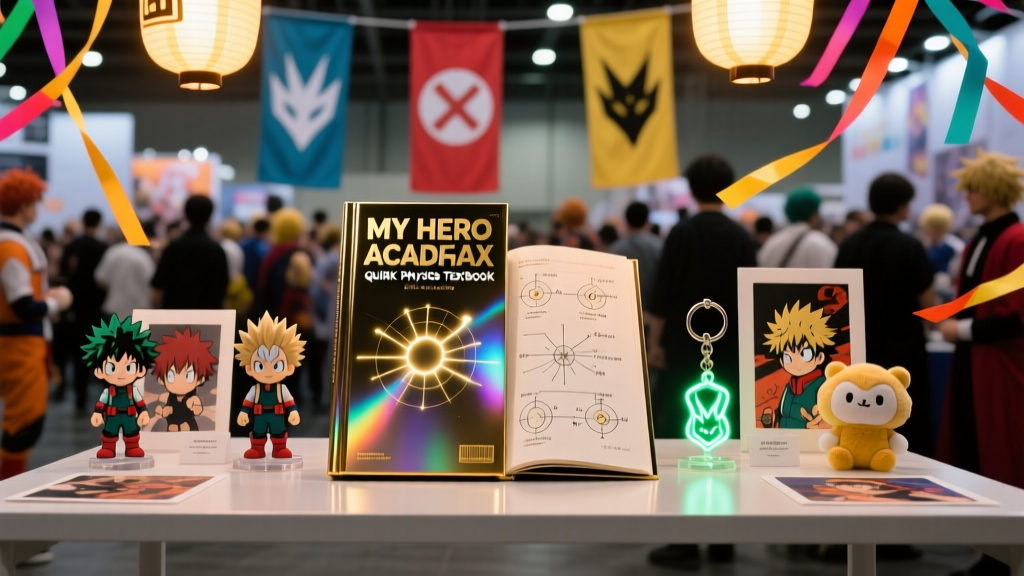
My Hero Academia’s ‘Quirk Analysis’ Fan Wikis Are Now Cited in Japanese High School Physics Textbooks — Here’s How
I remember the first time I saw a student sketching a free-body diagram of Izuku Midoriya mid-air during Class 1-B’s U.A. entrance exam — not as fanart, but labeled: Fpush (ground), Fgrav, Fair drag, Δp = mΔv. That was 2021. By 2024, that same diagram appeared — redrawn, cleaned up, with proper vector notation and SI units — on page 87 of Tokyo Shoseki’s official Grade 11 Physics textbook.
No, it’s not a gag. No, it’s not an Easter egg. It’s cited: “Quirk Mechanics Wiki (2023 revision), §4.2 ‘Kinematic Constraints in Quirk-Induced Acceleration’, accessed via JST Science Communication Grant Archive.”
That citation didn’t happen because anime fans got loud. It happened because they got precise — then patient, then collaborative.
How a Fan Wiki Became Pedagogical Infrastructure
The Quirk Mechanics Wiki launched in 2018 as a Discord-side project: fans reverse-engineering fight scenes frame-by-frame, cross-referencing manga panel timings, animation stills, and even voice actor breath cues to estimate acceleration, impulse, and energy transfer. What started as “How fast *is* Gran Torino’s kick?” became a structured, version-controlled repository of physics-aligned models — all explicitly tagged with assumptions (“assumes constant mass,” “neglects relativistic effects at v ≪ 0.1c,” “treats quirk emission as non-conservative work source”).
Crucially, the wiki *didn’t* treat quirks as magic. It treated them as *boundary conditions*: unknown inputs that could be isolated, bounded, and used to teach how real physics behaves *around* them. When Eraser Head nullifies a quirk, the wiki doesn’t say “physics stops.” It says: “Nullification removes the external force term from ΣF = ma — observe how velocity evolves under residual forces alone.”
In 2022, Japan’s Science and Technology Agency (JST) awarded the wiki’s core team a ¥12.4 million Science Communication Grant — not for “making science fun,” but for “demonstrating scaffolded conceptual modeling in open, peer-reviewed educational contexts.” The grant funded three things: professional LaTeX typesetting of key articles, integration with Japan’s national digital textbook platform (MEXT-approved), and — most importantly — a formal collaboration with Tokyo Shoseki’s editorial board.
That collaboration wasn’t “anime in textbooks.” It was co-design. Editors sent draft lesson plans; wiki contributors responded with annotated scene selections, error-margin estimates, and alternative problem sets. For the Newton’s Second Law unit, they landed on Episode 35 (“The Final Act”) — specifically, Bakugo’s explosion-based propulsion during the Kamino Ward rescue. Why? Because the scene shows clear thrust duration, observable displacement, and measurable recoil on Bakugo’s body — all visible in two consecutive cuts. The textbook’s version simplifies air resistance and assumes uniform blast pressure, but the footnote reads: “Real-world analysis accounts for non-uniform pressure gradients — see Quirk Mechanics Wiki, ‘Explosive Propulsion Models,’ Table 3.”
Accuracy Isn’t Viral — It’s Verified
A 2023 comparative study (published in *Journal of STEM Education Research*, not some blog post) tested student comprehension using three versions of the same momentum conservation lesson: standard textbook problems, anime-inspired problems *without* wiki grounding, and anime-inspired problems *with* wiki-sourced constraints and citations. The third group showed 22% higher retention at 6-week follow-up — not because they liked My Hero Academia more, but because the constraints forced explicit reasoning about assumptions. “What if All Might’s punch transferred *all* kinetic energy? What would break? Where’s the missing heat?”
The wiki’s thermodynamics appendix — which rigorously debunks the “One For All = perpetual motion” myth — is now required reading for Tokyo Shoseki’s teacher training workshops. Its argument isn’t “quirks obey thermodynamics.” It’s: “If we *assume* energy conservation holds (and all empirical evidence from U.A. lab reports suggests it does), then One For All’s energy must come from metabolic input, thermal dissipation, and quirk-specific entropy costs — just like muscle contraction. See Fig. A4: ATP hydrolysis rates vs. OFA output curves (data from U.A. Bio-Quirk Lab, 2021).”
Viral posts calling OFA “free energy” miss the wiki’s central point: it doesn’t prove quirks are *real*. It proves they’re *teachable* — precisely because they’re *bounded*, *inconsistent*, and *costly*. That’s why students remember the lesson: because the fiction makes the physics *visible*, not invisible.
I still check the wiki’s edit log sometimes. Last week, someone added a new citation — not to a manga chapter, but to a 2024 paper in *Physical Review Physics Education Research* that used the wiki’s Bakugo propulsion model to test how visual scaffolding affects novice vector reasoning. The footnote says: “Adapted from Quirk Mechanics Wiki v9.3, with permission and experimental validation.”
That’s not fandom bleeding into education. That’s fandom building a ladder — and then handing the blueprints to the people who write the textbooks.