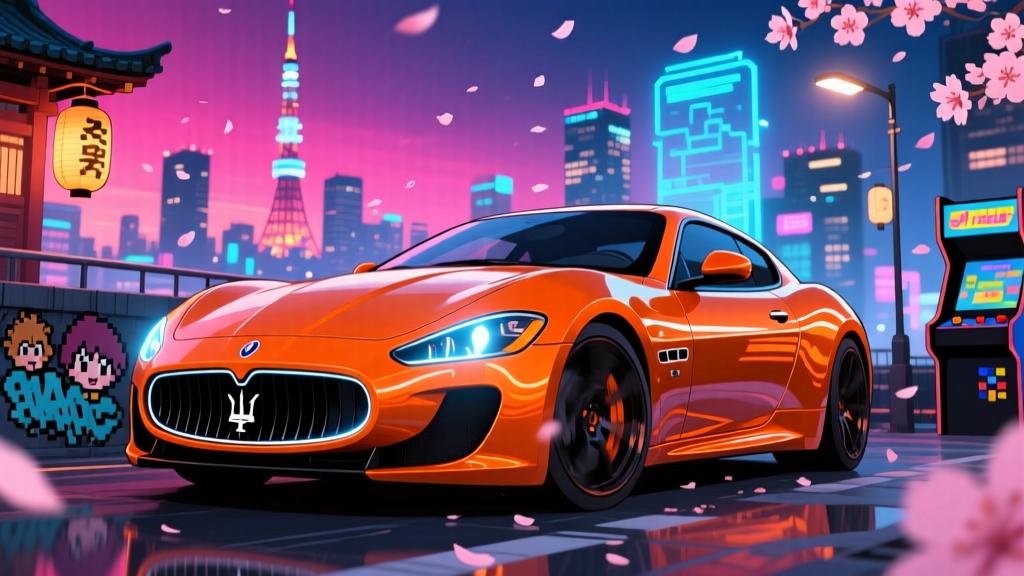
The camera pans low across wet asphalt. Rain slicks the Miami streets, neon reflections dancing in puddles. A door opens, and there it is — not the expected black or silver, but a searing, unapologetic wedge of orange metal. The Maserati doesn't just appear in scenes like this. It arrives.
For decades, the orange Maserati has occupied a peculiar space in the collective imagination. It's not merely a car. It's a statement that refuses to whisper when it could shout. While Ferrari claimed Rosso Corsa as its birthright and Lamborghini made yellow its calling card, Maserati carved out territory with Arancio — Italian for orange — a color that signals something different from Maranello's aggression or Sant'Agata's flamboyance.
The Trident brand's orange says: "I know exactly what I'm doing, and I don't need to explain it."
The Color That Refused to Be Ignored
Orange wasn't always part of Maserati's official palette. The brand's racing heritage traces back to 1914 in Bologna, where the Maserati brothers built machines that wore Rosso Corsa — the mandatory Italian racing red dictated by international motorsport regulations through much of the 20th century. The trident logo itself, inspired by Neptune's fountain in Piazza Maggiore, appeared against that crimson backdrop for generations.
But something shifted when Maserati transitioned from pure racing outfit to luxury grand tourer manufacturer. The 1950s and 60s brought cars like the 3500 GT and the Sebring, machines designed for gentlemen who wanted racing blood in a tailored suit. Color options expanded. By the time the Ghibli debuted in 1967 — that impossibly low, impossibly beautiful coupe designed by Giugiaro at Ghia — orange had entered the conversation.
Today, Maserati offers several orange variants across its lineup. Arancio Devil arrived as a special saturated orange, a direct homage to the brand's racing DNA, most notably featured on the F-Tributo special editions of the Levante and Ghibli in 2023. Arancio Argos takes a more sophisticated approach — a three-layer pearlescent finish that shifts under different lighting conditions, catching sunlight with a copper warmth that metallic paints simply cannot replicate.
The Fuoriserie program, Maserati's bespoke customization division launched in 2020, opened the floodgates. Clients can now specify virtually any shade of orange imaginable, from tangerine cream to burnt sienna, with prices starting at approximately $8,000 just for the paint upgrade on a GranTurismo. The Officine Fuoriserie facility in Modena treats color selection like a sommelier approaches wine — with reverence, patience, and an almost spiritual seriousness.
GranTurismo: The Grand Tourer That Became a Cultural Artifact
If you've seen an orange Maserati in media, odds are strong it was a GranTurismo. The nameplate, resurrected in 2007 after the original's 1947-1954 run, created something the automotive world hadn't quite seen before: a four-seat coupe that looked like it belonged on a concours lawn but could genuinely cross continents at speed.
The 2007-2019 GranTurismo generation became ubiquitous in ways its creators probably didn't anticipate. Powered by a Ferrari-derived 4.7-liter V8 producing 454 horsepower (later versions), it delivered a soundtrack that automotive journalists consistently described as "the best-sounding car under $200,000." That exhaust note — baritone at idle, operatic at 7,500 RPM — made it a natural for screen appearances where audio mattered as much as visuals.
The second-generation GranTurismo, launched for 2024, brought twin-turbocharged V6 power (483 hp in Modena trim, 542 hp in Trofeo) and the Folgore electric variant with 760 horsepower. Starting prices range from approximately $198,000 for the Modena to north of $235,000 for the Folgore, positioning it against the Porsche 911 Turbo and the BMW 8 Series in a segment where emotional appeal often trumps spec-sheet logic.
An orange GranTurismo doesn't apologize. It shows up at the valet stand of a Beverly Hills hotel and immediately becomes the most photographed car in the lot — not because it's the most expensive (it isn't), but because that color on those curves creates something the eye cannot ignore. Pininfarina's design language, all flowing haunches and that concave grille with the trident suspended in chrome, seems almost designed for warm-spectrum paint.
The GranTurismo's Screen Time
The GranTurismo accumulated a substantial resume in film and television throughout the 2010s. It appeared in countless reality shows — Keeping Up with the Kardashians featured various Maseratis across its run, and the brand became shorthand in production design for "successful but not ostentatious." A character stepping out of an orange GranTurismo communicated something specific: wealth, yes, but also taste. A preference for the road less traveled over the obvious Lamborghini.
Music videos embraced the GranTurismo with particular enthusiasm. Hip-hop's relationship with Maserati dates back decades, but the GranTurismo's photogenic qualities made it a favorite for directors who needed a luxury car that read as aspirational without crossing into supercar territory. It appeared in videos from artists across multiple genres, often in — you guessed it — orange or Arancio finishes that popped on camera.
MC20: The Supercar That Carried Orange Into a New Era
September 2020. Maserati unveils the MC20 — Maserati Corse, 2020 — and the brand's first mid-engine supercar since the MC12 ended production in 2005. The reveal happened in Modena, naturally, and among the launch colors was an orange that made automotive media lose collective composure.
The MC20 represents something different from the GranTurismo. Where the GT is a grand tourer that can handle a canyon road, the MC20 is a dedicated performance machine that happens to have enough refinement for daily use. Its Nettuno V6 engine — a twin-turbocharged 3.0-liter unit producing 630 horsepower and 538 lb-ft of torque — uses pre-chamber combustion technology derived from Formula 1, a genuine engineering first for a production road car.
Performance numbers tell part of the story: 0-62 mph in under 2.9 seconds, top speed exceeding 202 mph (325 km/h). But numbers alone don't explain why an orange MC20 stops traffic the way it does. The car's dihedral doors open upward and forward, revealing a cabin trimmed in carbon fiber and Alcantara. In orange, the MC20's sculptural bodywork — those air intakes carved into the rear haunches, the aerodynamic underbody that eliminates the need for a rear spoiler — becomes three-dimensional art.
With starting prices around $217,000 for the coupe and $260,000 for the Cielo spyder variant, the MC20 competes against the McLaren Artura and Ferrari 296 GTB. The GT2 Stradale variant, the track-focused version, commands approximately $350,000. For collectors, an orange MC20 represents Maserati's return to the supercar elite after a 15-year absence — and that provenance matters when values eventually stabilize.
MC20 in the Wild
The MC20's relative rarity (production remains limited by Maserati standards) makes each sighting an event. Orange examples are particularly scarce, as many buyers default to Grigio Mistero (grey) or Nero Noctis (black) — safe choices that depreciate more gracefully but lack the visual impact of Arancio. Industry estimates suggest fewer than 15% of MC20 buyers select orange or yellow exterior colors, making these examples instant conversation pieces at any Cars & Coffee or concours event.
Automotive influencers and YouTube personalities have helped normalize the orange MC20. Channels with millions of subscribers have featured Arancio examples, documenting everything from delivery day to track sessions. The algorithm rewards spectacle, and an orange Italian supercar delivers spectacle in abundance.
From Fast & Furious to James Bond: Maserati's Hollywood Problem Child
Here's where things get interesting — and slightly complicated for Maserati fans.
The Fast & Furious franchise, responsible for more automotive enthusiasm than any film series in history, has featured Maseratis across multiple installments. The Maserati Ghibli appeared in The Fate of the Furious (2017), and various Maserati models have shown up throughout the franchise's merchandise and diecast tie-ins. Hot Wheels released Fast & Furious-themed Maserati Ghibli models in orange, creating a feedback loop where the toy car reinforced the real car's pop culture status and vice versa.
For collectors of 1:64 scale models, an orange Maserati Hot Wheels — particularly the vintage 1969 releases — commands significant premiums. Original '69 orange Maserati Hot Wheels in good condition regularly sell for $300-$500 on the collector market, with mint-condition examples in the original blister pack pushing toward $1,000 at auction. That's roughly 10,000% markup over the original $0.99 retail price, adjusted for inflation.
Then there's Bond. No Time to Die (2021) included a Maserati Quattroporte IV — the 1990s generation, not the modern one — in a scene that caught enthusiasts off guard. While Aston Martin dominated the film's hero car duties (as they should, given the brand's 60-year Bond relationship), the Maserati's appearance as a villain-adjacent vehicle created an interesting tension. Maserati has historically played both sides in cinema: the hero's chariot in some films, the antagonist's ride in others. Orange variants tend to land on the protagonist's side, while darker colors often signal trouble.
"The orange Maserati in a film scene does something that a black or silver car simply cannot. It creates an emotional anchor. The audience remembers the car, even if they forget the dialogue."
— Production designer, speaking on condition of anonymity about luxury car placement in film
Hip Hop's Trident Affair
Car and Driver's analysis of vehicle mentions in rap and hip-hop songs places Maserati in the upper echelon of automotive brand references — trailing Ferrari and Mercedes-Benz but ahead of Porsche and Bentley. The brand's association with hip-hop culture runs deep, dating back to the 1980s when the Biturbo and later the Quattroporte became symbols of having "made it" without selling out to mainstream German luxury.
Rick Ross, whose car collection reportedly exceeds 100 vehicles, has featured Maseratis prominently. The Miami rapper's love for the Trident brand — often in bold colors rather than conservative shades — influenced a generation of artists who saw Maserati ownership as a specific kind of flex: successful enough to afford Italian exoticism, discerning enough to choose it over the obvious alternatives.
Floyd Mayweather Jr., whose car collection has been valued at over $20 million, has owned multiple Maseratis alongside his Bugattis and Rolls-Royces. The boxing champion's willingness to spec his cars in vibrant colors — including oranges and yellows — helped normalize bold color choices among athletes and entertainers who might otherwise default to black or white.
The Maserati MC12, that mid-2000s supercar limited to 62 road-going examples (with an additional 12 for racing), became something of a unicorn in hip-hop culture. P. Diddy's MC12, finished in a distinctive shade, generated coverage that Maserati's marketing budget couldn't have purchased. When artists reference "the MC12" in lyrics, they're signaling deep automotive knowledge — this isn't the surface-level Ferrari or Lambo reference that anyone can make.
The Collectibility Question
Does an orange Maserati hold value? The honest answer requires splitting the conversation into distinct categories.
For modern production models — the current GranTurismo, MC20, and their predecessors from 2007 onward — orange examples typically command a small premium (5-10%) over black or silver equivalents in the secondary market. The reasoning is straightforward: they're rarer, and Maserati collectors tend to be enthusiasts who appreciate specification over safety.
For classic and vintage models, the calculus shifts dramatically. A Maserati Ghibli SS in Arancio from the early 1970s, one of approximately 1,295 examples built across all colors, would command significant premiums at auction. Hagerty's valuation tools show that Ghibli SS values have appreciated roughly 40% over the past decade, with desirable color combinations pushing toward the high end of the $200,000-$350,000 range depending on provenance and condition.
For diecast and model cars, orange Maserati pieces occupy a sweet spot. Hot Wheels, Kyosho, AutoArt, and BBR Models all produce Maserati subjects in orange, and collectors actively seek these out. A 1:18 scale AutoArt Maserati GranTurismo in Arancio typically retails for $180-$240, with limited editions commanding more.
A Collector's Reference: Orange Maserati Models Through the Years
| Model | Production Years | Orange Color Name(s) | Approx. Current Value Range | Collectibility Factor |
|---|---|---|---|---|
| Ghibli SS (1st gen) | 1969-1973 | Arancio (period orange) | $200,000 - $350,000 | ★★★★★ (Elite) |
| GranTurismo (1st gen) | 2007-2019 | Arancio, Arancio Argos | $35,000 - $75,000 | ★★★☆☆ (Rising) |
| MC12 | 2004-2005 | Bianco/Blue (rare orange specs exist) | $800,000 - $1.2M | ★★★★★ (Legendary) |
| GranTurismo (2nd gen) | 2024-present | Arancio Devil, custom Arancio | $180,000 - $240,000 | ★★★☆☆ (Too new) |
| MC20 | 2021-present | Arancio Audace, custom options | $200,000 - $280,000 | ★★★★☆ (High potential) |
| Ghibli F-Tributo | 2023 | Arancio Devil (exclusive) | $85,000 - $110,000 | ★★★★☆ (Limited edition) |
| Levante F-Tributo | 2023 | Arancio Devil (exclusive) | $90,000 - $115,000 | ★★★☆☆ (Niche appeal) |
| Values reflect 2025-2026 market conditions for well-maintained examples. Actual values vary by condition, mileage, provenance, and specific color specification. | ||||
The Diecast Dimension: Orange Maserati on Your Shelf
For many collectors, the orange Maserati experience begins at 1:64 scale and never stops escalating. Hot Wheels' relationship with Maserati stretches back to the brand's earliest years, and orange examples consistently rank among the most sought-after colorways.
The 1969 Hot Wheels Maserati Mistral in orange remains one of the line's holy grails — not just for Maserati collectors but for Hot Wheels collectors broadly. A redline example (the term for early Hot Wheels with red stripe tires) in Spectraflame Orange can fetch $2,000-$4,000 depending on condition, making it one of the most valuable regular-production Hot Wheels from that era.
Modern diecast manufacturers haven't ignored the orange Maserati either. Kyosho's 1:18 Maserati GranTurismo in Arancio sells consistently in the $180-$250 range, while AutoArt's more detailed renditions push toward $300. BBR Models, the Italian outfit that produces some of the most accurate Maserati models available, offers Arancio versions that retail above $400 — reflecting the hand-applied paint, photo-etched details, and genuine carbon fiber trim that justify the premium.
The diecast market reveals something important about the orange Maserati phenomenon: it transcends the actual car. People who will never own a real Maserati — and who might not even particularly care about cars — will buy an orange Maserati model because it looks right on a shelf. The color, the shape, the trident badge combine into something that functions as decorative art as much as automotive representation.
The Anime and Gaming Connection
If you've spent time in automotive-adjacent anime or racing games, you've encountered the orange Maserati, whether you registered it consciously or not.
The Gran Turismo video game franchise — named after the Maserati, yes, though the brand appears alongside dozens of others — has featured multiple Maserati models across its installments. Players spec their virtual Maseratis in Arancio at rates that likely exceed real-world color selection, because in a world without depreciation concerns, why not go bold?
Forza Horizon and Forza Motorsport include Maserati models, and again, orange tends to be the community's default choice for the brand. There's something about seeing an MC20 in Arancio against Forza's recreations of Italian coastal roads that scratches an itch the real car might never reach for most players.
Japanese automotive manga and anime have a complicated relationship with Italian exotics — they appear less frequently than Japanese performance cars, but when they do, color choices tend toward the dramatic. An orange Maserati in a manga panel communicates the same things it communicates in a film scene: confidence, taste, and a certain disregard for conventional wisdom.
Frequently Asked Questions
Why is orange significant for Maserati specifically?
Orange (Arancio) represents Maserati's evolution from a pure racing marque to a luxury lifestyle brand. While Ferrari owns red and Lamborghini owns yellow, Maserati staked its claim on orange as a distinctive alternative — particularly with special edition colors like Arancio Devil on the F-Tributo models. The color connects to Italian design heritage without mimicking competitors.
Which Maserati models come in orange from the factory?
Current Maserati models offering orange options include the GranTurismo (Arancio and custom Fuoriserie options), MC20 (Arancio Audace among others), Ghibli (Arancio Devil on F-Tributo), and Levante (also Arancio Devil on F-Tributo). The Quattroporte and Grecale offer more subdued palettes, though the Fuoriserie program can accommodate any color request at premium cost.
Is an orange Maserati a good investment?
For vintage models like the Ghibli SS, orange examples command premiums due to rarity and desirability. Modern orange Maseratis typically hold value 5-10% better than conservative colors due to their scarcity. The MC20 in Arancio shows strong collector potential given its limited production numbers. However, luxury cars remain depreciating assets in most cases — buy because you love it, not because you expect returns.
How much does a custom orange paint job cost through Maserati's Fuoriserie program?
The Fuoriserie bespoke program starts at approximately $8,000-$12,000 for special paint colors beyond the standard palette, with prices escalating based on complexity (three-layer pearlescent finishes, matte options, etc.). Full customization including interior color-matching can push well beyond $25,000. The program operates similarly to Ferrari's Tailor Made or Lamborghini's Ad Personam.
What movies or TV shows feature an orange Maserati?
While specific orange Maserati appearances in major films are relatively rare (most productions opt for darker colors that photograph more predictably), Maseratis broadly have appeared in the Fast & Furious franchise, James Bond films, Entourage, and numerous reality television programs. The orange colorway is more common in music videos and automotive media where bold visuals drive engagement.
Are there Hot Wheels or diecast models of orange Maseratis worth collecting?
Absolutely. The 1969 Hot Wheels Maserati Mistral in Spectraflame Orange ranks among the most valuable regular-production Hot Wheels, with redline examples fetching $2,000-$4,000. Modern 1:18 scale models from AutoArt, Kyosho, and BBR Models in Arancio colors typically retail between $180-$400 and maintain value well among collectors.
The orange Maserati endures because it represents a choice — not the obvious choice, not the safe choice, but a choice that says something about the person making it. Whether that person is a filmmaker framing a scene, a rapper shooting a video, a collector curating a garage, or a kid placing a diecast model on a bedroom shelf, the orange Trident communicates the same message it always has: some things are worth doing loudly.