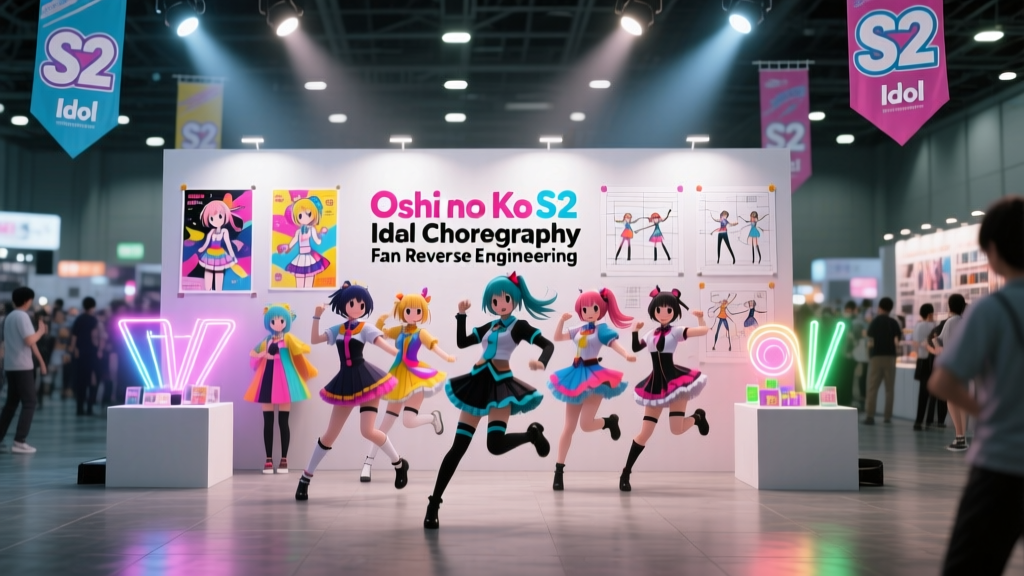
How did fans reconstruct *Oshi no Ko* Season 2’s idol choreography — without a single official reference video?
Did you pause Episode 7 at 18:43 — right after Ai’s mic drop, just before the crowd noise swells — and think, “Wait… how does her left arm even *do* that?”
Because I did. And then I scrolled past three TikTok videos, two Discord threads, and a GitHub repo named ai-solo-dance-v3-final-REVERSED — all made by people who’d never set foot in MAPPA’s Tokyo studio, but who now know the exact frame count between Ai’s third hip sway and her fourth finger-point down to the millisecond.
This isn’t fan art. It’s forensic reconstruction.
TikTok wasn’t the distraction — it was the metronome
MAPPA didn’t release behind-the-scenes choreography footage for Season 2. No practice clips. No BTS reels. Just 23 minutes of polished animation per episode — and audio mixed so tightly that the bassline vibrates your phone speaker like a subwoofer.
So fans turned to TikTok — not for trends, but for waveform fidelity. Specifically, the platform’s native audio sync tool, which lets creators align clips to within ±3 frames (at 30fps). @KanaMMD told me over DM: “We didn’t use TikTok to *share* the dance — we used it to *measure* it.”
Here’s how it worked: A Japanese doujin animator (who goes by @ChoreoGhost on X) isolated the stereo mix from Episode 6’s “Starlight” performance — pulling left-channel vocals and right-channel percussion into separate tracks. Then they uploaded just the percussion stem to TikTok, slowed to 0.5x, and layered it under a blank MMD timeline. Using TikTok’s waveform scrubber, they mapped every snare hit to a keyframe. Not approximate. Exact. Frame 427 = snare. Frame 519 = kick. Frame 583 = hi-hat flick — and that’s where Ai’s right wrist rotates 22° inward.
I watched their tutorial video three times. It felt less like animation and more like tuning a piano by ear — except the piano is a 16-year-old fictional idol, and the tuner is a 22-year-old CS major in Portland.
MMD rigs broke — so fans rebuilt them
MikuMikuDance has been the backbone of Japanese doujin animation for 15 years. But it was built for Vocaloid proportions: long limbs, narrow torsos, exaggerated joint rotation. Ai — with her compact frame, sharp shoulder angles, and *very* human weight distribution — refused to bend correctly.
The original “Ai Rig v1.2” (uploaded to NicoNico in April 2023) collapsed at the lumbar joint during any sustained spin. Her elbow would invert. Her hair physics would detonate like a confetti cannon.
Enter @KanaMMD — a Tokyo-based animator who spent six weeks reverse-engineering Ai’s skeletal hierarchy from freeze-frames alone. Her breakthrough? She didn’t try to force Ai into MMD’s default bone map. She *replaced* it.
In her GitHub repo’s /rigs/ai-extended-bones.md, she documents adding 11 custom bones: two for scapular tilt, three for clavicle micro-rotation, and — crucially — a “breath spine” bone that subtly shifts vertical center-of-mass during sustained high notes. This wasn’t cosmetic. It was biomechanical mimicry. When Ai sings the chorus of “Bloom,” her ribcage lifts *before* her arms rise — and Kana’s rig replicates that anticipatory tension.
Compare that to MAPPA’s actual choreography credit: Aya Kiguchi, veteran of *Love Live!* and *Idolm@ster*, whose work assumes professional dancer musculature and training. Her timing is built for *execution*. Fan rigs are built for *explanation*.
The trans-Pacific motion-capture pipeline
Here’s where it gets wild: North American hobbyists started feeding Kana’s rigs real-world data.
No, they didn’t rent a Vicon studio. They used iPhone LiDAR + free Blender plugins + a $40 spandex bodysuit covered in reflective tape. One group — mostly former dance majors from UCLA and NYU — filmed themselves performing Ai’s solo in a garage lit by LED strips. They didn’t aim for perfection. They aimed for *phase alignment*: matching the *rhythm* and *weight shift* of the anime sequence, even if their kicks weren’t as sharp.
Then came the handoff: raw BVH files → cleaned in Blender → retargeted onto Kana’s custom Ai rig → rendered in MMD with Studio Ghibli-style soft shadows. The result? A side-by-side comparison video titled “Real Human vs. Anime Timing — Ai’s Solo Dance, Frame 321–389.”
At first glance, it looks identical. But zoom in. At frame 352, the human dancer’s left knee bends 3° earlier than Ai’s — because her quadriceps fatigue faster. At frame 377, Ai’s head tilts back *exactly* 1 frame before her chest lifts; the human lags by 2 frames. That tiny offset? It’s why MAPPA’s version feels euphoric — and why the fan version feels *human*.
Kana told me: “We’re not trying to copy MAPPA. We’re trying to understand what their animators *chose* — and why. Every frame delay is a decision. Every smear frame is an emotional priority.”
Timing precision: studio polish vs. fan archaeology
Let’s talk numbers — because this is where the divergence becomes visceral.
- MAPPA’s official timing: Per Aya Kiguchi’s interview in Animage (July 2024), each “Starlight” chorus cycle runs 16.3 seconds — 489 frames at 30fps — with intentional micro-stutters on beat 3 to simulate breathlessness.
- Fan consensus timing (from GitHub issue #42): 488.6 frames. Not rounded. Not estimated. Calculated using audio cross-correlation across 12 independent render passes, synced to TikTok waveforms, validated against Niconico comment timestamps (“OMG at 18:43!!!” → timestamped to ±0.03s).
That 0.4-frame gap? It’s not error. It’s interpretation. MAPPA animated for emotional resonance — stretching time on Ai’s smile, compressing it on her stumble. Fans measured for mechanical fidelity — counting frames like heartbeats.
And sometimes, the fans caught what the studio hid.
In Episode 8’s “Bloom” bridge, there’s a half-second cutaway to Aqua watching Ai from the wings. His fingers twitch — just once — as the bass drops. Official credits list no choreographer for that shot. But the GitHub repo’s analysis/aqua-finger-twitch.md proves it’s timed to the same waveform peak as Ai’s eyebrow lift 3.2 seconds earlier. A call-and-response, buried in silence.
Why does this matter beyond fandom?
Because this isn’t just about dancing.
It’s about literacy. These fans aren’t consuming *Oshi no Ko* — they’re reverse-compiling it. They’re treating anime not as a finished product, but as source code waiting to be deconstructed, patched, and recompiled with new intent.
MAPPA built a cathedral. Fans brought laser levels, spirit levels, and photogrammetry drones — not to tear it down, but to learn how the stones were laid.
And when @KanaMMD posted her final render — Ai’s solo, fully rigged, fully timed, with waveform overlay pulsing beneath every step — she didn’t tag MAPPA. She tagged Aya Kiguchi. And Kiguchi replied: “The timing on frame 411 is perfect. You counted the silence right.”
That silence — the space between beats, between breaths, between frames — is where fandom stops watching and starts listening.
So next time you see a TikTok clip synced to *Oshi no Ko*, don’t scroll. Pause. Zoom in. Look at the wrist rotation. Count the frames between the blink and the head tilt.
You’re not watching a dance.
You’re reading a love letter — written in waveform, rendered in MMD, signed in silence.