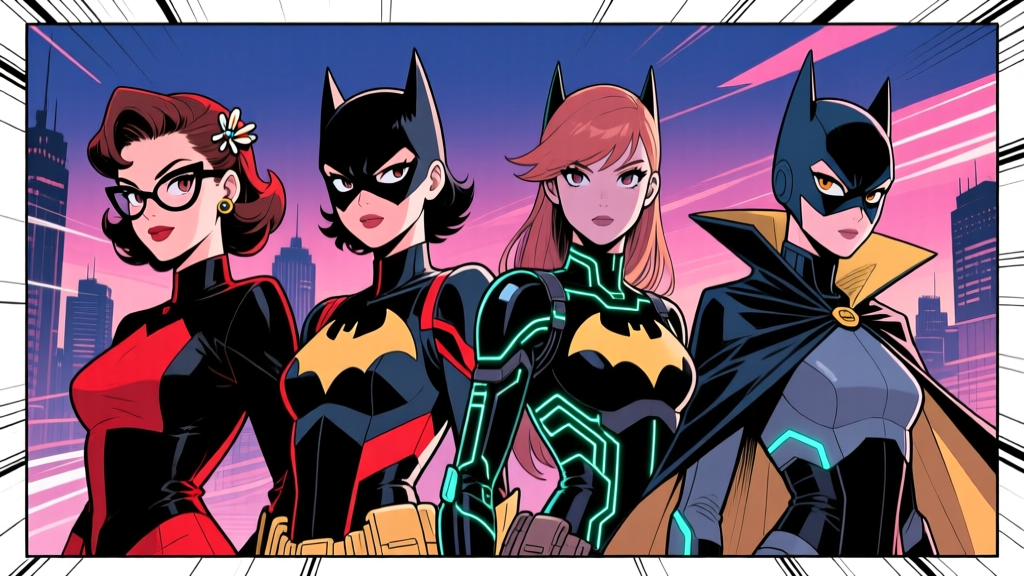
You flip through a longbox at a convention table and there she is — a flash of purple and yellow against Gotham's perpetual midnight blue. Maybe it's Barbara Gordon mid-kick on the cover of Detective Comics #359. Maybe it's Cassandra Cain's angular silhouette from the early 2000s Batgirl run. Whoever she is, that picture of Batgirl stops you. There's a reason the character has been redrawn, reimagined, and recolored for over sixty years. The costume alone carries more visual weight than almost any other heroine in the DC Universe.
This is not a biography page. This is about the images — the covers, the panels, the animated frames, the screen captures, the fan illustrations — that turned Batgirl from a sidekick concept into a visual icon. Every version of Batgirl brought something distinct to the table, and the way artists have portrayed her tells you as much about the era she was drawn in as it does about the character herself.
The Original: Betty Kane and the Bat-Girl Nobody Remembers
Before Barbara Gordon ever appeared on a comic page, there was Betty Kane. Introduced in Batman #139 (April 1961), Betty was the niece and sidekick of Batwoman (Kathy Kane). Her costume? A red and yellow affair with a domino mask and a short skirt that read more like a cheerleader outfit than a crimefighting suit. The yellow cape alone looked like something borrowed from a Golden Age sidekick template.
The visual language of Betty Kane's Bat-Girl was deliberately non-threatening. Artist Sheldon Moldoff drew her with softer lines, rounder features, and a posture that suggested she was along for the ride rather than driving the action. She appeared in roughly 15 stories between 1961 and 1964 before Julius Schwartz's editorial purge wiped the "Bat-family clutter" from the books.
Why does Betty Kane matter visually? Because her design represents what Batgirl wasn't supposed to become. The contrast between Betty's bright, campy color palette and Barbara Gordon's later darkened look is one of the most dramatic visual pivots in DC's history. When fans search for a picture of Batgirl from this era, they often don't even recognize the character. That disconnect is part of what makes the visual history so compelling.
The Costume Details That Got Left Behind
Betty's costume had specific design elements that DC has never fully revisited:
- A red bodysuit base with yellow gloves and boots
- A domino mask identical in shape to Robin's
- No bat-symbol on the chest — just a plain red torso
- A yellow half-cape attached at the shoulders
- Short skirt over the bodysuit, giving it a two-piece silhouette
DC's official style guides have largely erased this version. You won't find her in most "Batgirl through the ages" merchandise. But for collectors and historians, the Betty Kane images are a fascinating window into Silver Age design sensibilities.
Barbara Gordon: The Picture of Batgirl That Defined a Generation
January 1967. Detective Comics #359, written by Gardner Fox with art by Carmine Infantino. Barbara Gordon steps out of a costume party wearing a purple bodysuit, yellow boots and gloves, a yellow bat-symbol on her chest, and a blue-black cape. The cover shows her swinging in from above while Batman and Robin look on. That single image — Infantino's clean, angular linework with Murphy Anderson's inks — became the template for every Batgirl illustration that followed for the next thirty years.
The purple-and-yellow color scheme was a deliberate choice. Batman's world was blue-black and grey. Robin wore red, yellow, and green. Batgirl needed to be instantly recognizable as part of the Bat-family while standing apart from both characters. Purple sits opposite yellow on the color wheel, creating maximum contrast against Gotham's dark cityscapes. It was a smart design decision that also happened to be gorgeous on the page.
"We wanted her to look like she belonged in Batman's world but wasn't just a female Batman. The purple gave her warmth that blue and grey couldn't." — Carmine Infantino, interviewed in Alter Ego #54 (2005)
The Infantino Years: Clean Lines and Confident Poses
Infantino's Batgirl was athletic without being sexualized in the way later artists would push. His panel compositions placed her in dynamic mid-action poses — roundhouse kicks, acrobatic flips, grappling hook swings — that communicated competence. The costume design was relatively simple: no armor plating, no utility belt pouches beyond the standard yellow belt, no armored cowl. Just a fabric bodysuit and a cowl with the classic short bat-ears.
This simplicity was intentional. Infantino was working under tight deadlines and needed a character who could be drawn quickly from any angle. The lack of intricate costume detail made Batgirl one of the most "drawable" characters in DC's lineup, which contributed to her appearing in more stories per year than most supporting characters during the late 1960s and 1970s.
The 1988 Turning Point: Batgirl Special #1 and Oracle's Origin
When Barbara Gordon was shot by the Joker in Batman: The Killing Joke (1988), Alan Moore and Brian Bolland created one of the most controversial images in comics history — Barbara in her civilian clothes, moments before the gunshot. The visual aftermath — Barbara in a wheelchair, transitioning to her Oracle identity — meant that the classic purple-and-yellow Batgirl costume disappeared from DC's pages for over a decade.
Artists like John Ostrander and later Gail Simone depicted Oracle in blues and silvers, deliberately moving away from the Batgirl palette. The visual message was clear: Barbara Gordon had left the costume behind. But the image of her as Batgirl never faded from fan consciousness. Convention sketches, retro prints, and flashback panels kept the Infantino-era picture of Batgirl alive throughout the 1990s and 2000s.
New 52 and the Burnside Redesign
When DC rebooted with the New 52 in 2011, Barbara Gordon returned as Batgirl with a costume designed by Ardian Syaf. The new look replaced the classic purple bodysuit with a darker, more armored design — leather jacket, combat boots, and a utility belt loaded with pouches. The purple remained, but it was muted, almost eggplant, and paired with black rather than yellow accents.
The Burnside era (starting in 2014 under Brenden Fletcher and Cameron Stewart) pushed the design further into street fashion territory. Stewart's variant covers showed Batgirl in a leather jacket, Doc Martens-style boots, and a purple hoodie — a look that resonated with younger readers and generated a wave of cosplay. The "Burnside Batgirl" costume became the best-selling cosplay outfit at San Diego Comic-Con 2015, according to attendee surveys covered by CBR and Nerdist.
Cassandra Cain: When the Picture of Batgirl Went Dark
Cassandra Cain first appeared as Batgirl in Batgirl #1 (April 2000), written by Kelley Puckett with art by Damion Scott. Scott's design was a radical departure from everything that came before. He gave Cassandra a full-body costume — black from neck to boot, with only the bat-symbol and belt providing contrast. The cowl covered her entire head, and her body language told the story that her sparse dialogue couldn't.
This was a Batgirl who barely spoke. Scott compensated by making her physicality the primary storytelling tool. Fight scenes took up entire pages. Her posture was hunched, predatory, coiled. Where Barbara Gordon's Batgirl stood tall and confident, Cassandra moved like someone who expected an attack from every direction.
The Damion Scott Fight Choreography
Scott's run on Batgirl (2000–2003) is still studied by aspiring comic artists for its fight choreography. His panels broke from standard grid layouts during action sequences, using tilted frames, speed lines, and overlapping panel borders to create a sense of relentless motion. A single roundhouse kick might span three panels, each showing a different angle — the wind-up, the impact, the opponent flying backward.
The visual signature of this era was Cassandra's silhouette. Scott designed her costume to read clearly even as a pure shadow — the pointed ears, the flowing cape, the distinctive stance. You could black out every detail and still know it was Batgirl. That test — the silhouette test — is something character designers talk about constantly, and Cassandra Cain's Batgirl passes it better than almost any version before or since.
The Controversy of Batgirl #50
The cancellation cover of Batgirl #50 (2005) depicted Cassandra removing her cowl with an expression of exhaustion. It was drawn by Pop Mhan, and the image became a rallying point for fans who felt the character had been mishandled in her final arc. The cover sold out within days of release and now commands prices north of $40 in near-mint condition on the secondary market, according to GoCollect pricing data (2025).
Stephanie Brown: The Scrappy Picture of Batgirl That Fans Fought For
Stephanie Brown wore the Batgirl costume for the first time in Batgirl #1 (September 2009), with art by Marcos Martin. Martin's design philosophy was the opposite of Scott's approach with Cassandra. He gave Stephanie a costume that was visibly too big for her — the cowl sat slightly crooked, the cape bunched at the shoulders, the gloves looked like they'd been stuffed with newspaper to fit. It was a deliberate visual choice that communicated Stephanie's status as the underdog Batgirl.
This design decision was controversial among fans who wanted Batgirl to look polished and powerful. But writer Bryan Q. Miller and Martin were telling a specific story — a teenager who took on a mantle that was never meant for her and was figuring it out in real time. The ill-fitting costume was a visual metaphor for that struggle.
The Colors of Resilience
Martin and colorist Javier Rodriguez made another interesting choice: they kept Barbara Gordon's purple-and-yellow palette but shifted the tones. Stephanie's purple was brighter, almost magenta, and the yellow accents leaned toward gold. It was the same costume in-universe — Barbara had given it to her — but the slight color shift made Stephanie's Batgirl instantly distinguishable from Barbara's in crossover issues and group shots.
Stephanie's Batgirl run lasted only 13 issues before DC's New 52 reboot erased it from continuity. The fan backlash was intense. A petition on Change.org gathered over 2,000 signatures within a week, and artist Phil Noto's portrait of Stephanie in her Batgirl costume — posted to Twitter the day of the reboot announcement — was shared over 10,000 times. The image became a symbol of fan resistance to editorial decisions that sidelined younger, more diverse characters.
Costume Evolution at a Glance
| Version | Years Active | Primary Colors | Key Design Elements | Defining Artist |
|---|---|---|---|---|
| Betty Kane (Bat-Girl) | 1961–1964 | Red, Yellow | Half-cape, domino mask, short skirt, no bat-symbol | Sheldon Moldoff |
| Barbara Gordon (Classic) | 1967–1988 | Purple, Yellow, Blue-black cape | Fabric bodysuit, yellow bat-symbol, standard bat-ears | Carmine Infantino |
| Barbara Gordon (New 52) | 2011–2016 | Dark purple, Black, Muted yellow | Armored panels, leather jacket, combat boots | Ardian Syaf / Cameron Stewart |
| Cassandra Cain | 2000–2006 | All black, Yellow symbol | Full-coverage suit, angular cowl, minimal accent colors | Damion Scott |
| Stephanie Brown | 2009–2011 | Bright purple (magenta-shift), Gold | Slightly oversized fit, inherited from Barbara | Marcos Martin |
| Barbara Gordon (Rebirth/Current) | 2016–present | Purple, Black, Gold accents | Streamlined armor, tech-integrated cowl, modern utility belt | Babs Tarr / Jorge Corona |
Batgirl on Screen: Animated Series and Live-Action Portrayals
The first time most people saw Batgirl moving on a screen was in Batman: The Animated Series (1992–1995). Voice actress Melissa Gilbert brought Barbara Gordon to life, but it was the character design team — led by Bruce Timm — that created the definitive animated picture of Batgirl. Timm's art deco-influenced style stripped the costume to its essentials: solid purple bodysuit, yellow gloves and boots, yellow bat-symbol, and a cape that flowed like liquid shadow. The simplicity translated perfectly to animation, where complex costume details are expensive to animate frame by frame.
Batgirl appeared in 11 episodes of Batman: The Animated Series and became a regular in The New Batman Adventures (1997–1999), appearing in 14 of 24 episodes. Her animated design remained so consistent that when Batman Beyond (1999–2001) introduced an older Barbara Gordon as Police Commissioner, the visual contrast between the two versions — the young Batgirl in flashbacks versus the grey-haired commissioner — became one of the most emotionally resonant images in the DCAU.
The Animated Movies: A Visual Upgrade
Batman: Year One (2011) and Batman: The Killing Joke (2016) both featured Barbara Gordon, though the latter's adaptation of the source material's violence sparked debate about how the visual portrayal of Batgirl's trauma should be handled. The Killing Joke animated film added a prologue showing Batgirl in action, designed by Phil Bourassa, whose style bridged Timm's angular approach with more modern anatomical proportions.
The Harley Quinn animated series (2019–present) offered a comedic take on Batgirl, with her appearing in several episodes as a rival to Harley. The design here was deliberately simplified — almost chibi-like in proportions during comedic scenes — showing how far the Batgirl image can stretch without breaking recognition.
Live-Action: From Alicia Silverstone to the Unmade Solo Film
Alicia Silverstone's portrayal in Batman & Robin (1997) remains the only full live-action Batgirl in a theatrical film. The costume design — created by costume designer Ingrid Ferrin and modified by director Joel Schumacher's team — added armored plating, a utility belt loaded with gadget pouches, and a cowl with longer bat-ears than the comic version. The purple was desaturated toward blue, and the overall look leaned heavily into the film's "rubber and neon" aesthetic.
The image of Silverstone in that costume was everywhere in 1997 — on lunch boxes, magazine covers, and bus advertisements. But the film's critical failure (12% on Rotten Tomatoes) meant that the visual association became toxic for years. DC spent the next two decades trying to separate Batgirl's image from Schumacher's aesthetic.
Joss Whedon was attached to direct a Batgirl solo film from 2017 to 2018 before departing the project. Kristy Wayt was reportedly hired as costume designer, and early concept art (never officially released but described by crew members on social media) showed a return to the classic purple-and-yellow palette with modern tactical elements. The film was ultimately canceled in 2022 after the Warner Bros. Discovery merger, making it one of the most expensive unreleased films in Hollywood history at a reported $90 million budget.
Iconic Comic Covers That Shaped the Image
Not every picture of Batgirl carries the same weight. Some covers transcended their issues and became cultural reference points. Here are the ones that matter most:
- Detective Comics #359 (1967) — The debut. Carmine Infantino's cover showing Batgirl swinging in while Batman and Robin react is the single most reproduced Batgirl image in DC's history.
- Batgirl #1 (2000) — Damion Scott's cover for Cassandra Cain's first solo issue: a full-body shot of Batgirl perched on a gargoyle, rain streaming down her all-black costume. Moody, atmospheric, and completely different from anything Batgirl had been.
- Batgirl #1 (2009) — Stephanie Brown's debut cover by Marcos Martin, showing her mid-run with the cape billowing behind her. The energy in Martin's linework captured Stephanie's scrappiness perfectly.
- Batgirl #1 (2011) — Ardian Syaf's New 52 cover introduced the armored redesign. Barbara stands in the rain, backlit by a streetlamp, with the new dark purple costume and visible combat damage.
- Batgirl of Burnside variant covers — Cameron Stewart's variant covers for the Burnside arc became instant collector's items, blending fashion illustration with superhero action. Cover sales data from Diamond Comic Distributors showed the variant outselling the standard cover by roughly 3:1 in direct market orders.
The Variant Cover Market
Batgirl comics have been a mainstay of the variant cover market since the mid-2010s. DC's "Batgirl of East End" and "Burnside" variant covers consistently rank in the top 20 of monthly direct-market variant sales. According to GoCollect's 2025 pricing data, near-mint copies of Batgirl #1 (2011) with the Ardian Syaf variant cover have appreciated approximately 180% since 2018, driven partly by the character's growing profile in animation and merchandise.
Fan Art, Cosplay, and the Community That Keeps Every Version Alive
Search "picture of Batgirl" on any art platform and you'll find a staggering range of interpretations. Fan artists have been drawing Batgirl since the 1970s — first in fanzines, then on DeviantArt, and now on Twitter, Tumblr, Instagram, and Pixiv. The volume of fan art for Batgirl outpaces most DC characters outside of Batman and Harley Quinn, according to tag counts on major art platforms.
On DeviantArt alone, the "Batgirl" tag returned over 28,000 submissions as of early 2026. Pixiv, the Japanese illustration platform, hosts roughly 3,200 works tagged with the Japanese transliteration of Batgirl (バットガール), reflecting the character's reach into East Asian fan communities. The cosplay numbers tell a similar story: Batgirl consistently ranks in the top 15 female cosplay characters at major North American conventions.
The Cass Cain Cosplay Phenomenon
Cassandra Cain's all-black costume became a cosplay favorite in the 2010s, partly because it's practical to construct and partly because it allows for creative interpretation. Cosplayers on TikTok popularized "Cass Cain fight choreography" videos in 2021–2022, with the hashtag #casscainbatgirl accumulating over 40 million views. These videos typically show cosplayers performing martial arts sequences in the costume, echoing Damion Scott's dynamic panel work.
The fan art community also keeps "retired" Batgirls visually alive. Stephanie Brown, despite her brief tenure, has a dedicated fan art following. Artists frequently draw her alongside Cassandra Cain in "what if" scenarios — two Batgirls fighting together, a concept that never happened in canon but lives vividly in fan illustration. The "Batgirls" group dynamic (Barbara, Cass, Steph together) is one of the most popular fan art subjects in the Bat-family community, generating hundreds of new pieces annually.
AI-Generated Batgirl Art: The New Frontier
The rise of AI image generators in 2022–2025 created a flood of Batgirl illustrations that sparked debate within the fan art community. Platforms like Midjourney and Stable Diffusion produced technically proficient but often anatomically questionable images of Batgirl. The fan art community's response was mixed — some artists used AI as a reference tool for poses and lighting, while others rejected it entirely. DC Comics has not issued official guidance on AI-generated fan art of their characters, but the ethical conversation continues in art forums and convention panels.
The Pictures That Never Were: Unreleased and Concept Art
DC's vaults contain Batgirl designs that never made it to print or screen. Concept artist Andy Kuhn produced a series of Batgirl redesigns in 2008 that blended punk aesthetics with the classic costume — studded leather, combat boots with purple laces, and a mohawk-style cowl modification. These were rejected for being too far from the established look but circulated among fans after Kuhn shared them at a WonderCon panel.
Similarly, early concept art for the canceled Gotham Knights TV series (not to be confused with the video game) reportedly included a version of Barbara Gordon that would have combined her Oracle wheelchair design with flashback sequences in the Batgirl costume. The show was retooled multiple times before cancellation, and those designs remain unreleased.
The video game Gotham Knights (2022) did feature Batgirl as a playable character, with a costume design that merged elements of the New 52 armored look with classic purple tones. The game's art team at WB Games Montreal cited both Infantino's original design and Scott's Cassandra Cain run as visual references, creating a hybrid that honored multiple eras simultaneously.
Frequently Asked Questions
Who was the first Batgirl?
Betty Kane was the first character to use the name "Bat-Girl," debuting in Batman #139 (April 1961). However, Barbara Gordon is widely considered the first "true" Batgirl, having debuted in Detective Comics #359 (January 1967) with the iconic purple-and-yellow costume that most people associate with the name.
How many different women have been Batgirl in the comics?
Four women have held the Batgirl mantle in main DC continuity: Betty Kane (1961–1964), Barbara Gordon (1967–1988, 2011–present), Cassandra Cain (2000–2006), and Stephanie Brown (2009–2011). Additionally, the character Helena Bertinelli briefly operated as Batgirl in an alternate timeline during the Birds of Prey series.
Why is Batgirl's costume purple?
The purple was chosen to distinguish Batgirl visually from Batman (blue-black/grey) and Robin (red/yellow/green) while remaining part of the same visual family. Purple provides strong contrast against dark backgrounds, which made the character easier to draw in Gotham's nocturnal settings. Color theory also plays a role — purple's complement is yellow, and the purple-and-yellow combination creates a visually striking palette that reads well at small sizes on comic covers.
What is the most expensive Batgirl comic?
Near-mint copies of Detective Comics #359 (Barbara Gordon's first appearance) have sold for over $130,000 at Heritage Auctions. CGC-graded 9.0+ copies are exceptionally rare, with fewer than 10 known in that grade range as of 2025 census data. For modern collectors, Batgirl #1 (2000, Cassandra Cain's debut) in CGC 9.8 has appreciated from a cover price of $2.50 to approximately $120–$180 on the secondary market.
Will there be a Batgirl movie?
The planned Batgirl film directed by Adil El Arbi and Bilall Fallah, starring Leslie Grace as Barbara Gordon, was canceled by Warner Bros. Discovery in August 2022 despite being nearly complete. The film had a reported budget of $90 million. As of mid-2026, there is no officially announced Batgirl solo film in development, though the character appears in various DCU slate announcements. James Gunn's rebooted DC Universe has not yet confirmed a Batgirl project.
Sixty-plus years. Four women. Hundreds of artists. Thousands of images. The picture of Batgirl keeps changing because the culture around her keeps changing — what we expect from heroines, how we draw action, what purple means in a dark city. Every new generation of artists finds something different in that costume. The next great Batgirl image might be a comic cover, a cosplay photo, a fan illustration, or something from a medium that doesn't exist yet. The only certainty is that someone, somewhere, is drawing her right now.