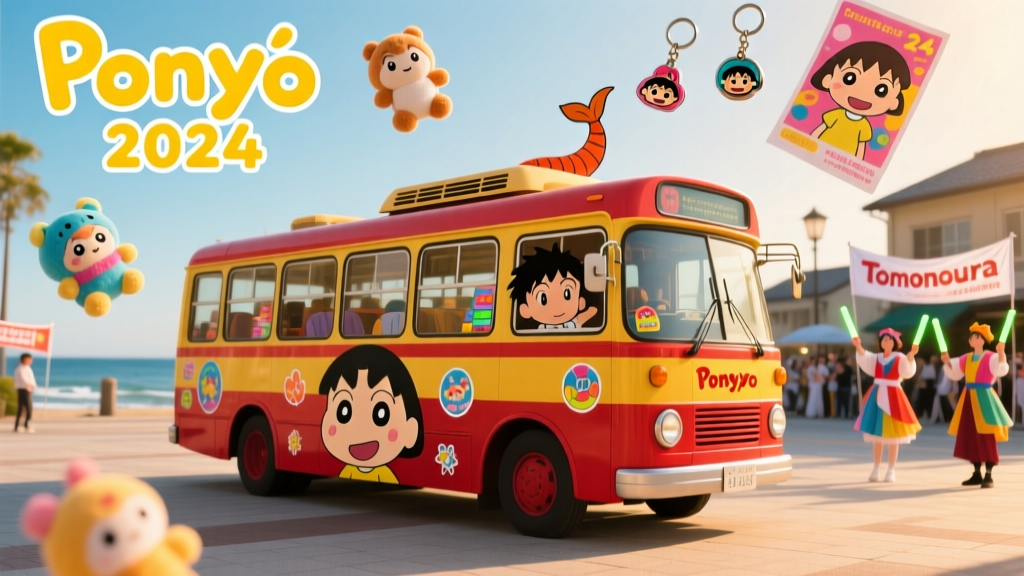
The ‘Ponyo’ buses didn’t just move people—they rewired how young Japanese travelers imagine rural space.
I remember watching Ponyo in 2008 and thinking, with a kind of quiet awe, that Tomonoura wasn’t just a setting—it was a character breathing in time with the tide. The way Miyazaki animated the harbor’s wooden piers, the way the fog clung to the hills behind the lighthouse, the way even the ferry horn felt like a line of dialogue: this wasn’t backdrop. It was invitation. Fifteen years later, Hiroshima Bus Co. turned that invitation into infrastructure—and it worked, astonishingly well.
The ‘Ponyo Line’ launched on March 18, 2024: three retrofitted 30-seat coaches painted seafoam green and coral pink, their exteriors hand-illustrated with wave motifs, jumping fish, and Fujimoto’s submarine silhouette (approved by Studio Ghibli’s licensing team after two rounds of revisions). Inside, every seat has a laminated map with Ponyo-themed landmarks—“Sosuke’s School Stop,” “Lisa’s Fish Market Corner”—and most crucially, GPS-triggered audio. As the bus rounds the bend toward Kasaoka Shrine, Fujimoto’s voice (re-recorded by original voice actor George Tokoro, now 78, speaking slower, warmer) murmurs, *“The boundary between land and sea is thinner here than you think.”* At the observation deck overlooking the Inland Sea, Ponyo herself—voiced again by Nozomi Ōhashi, now 25—laughs, then whispers, *“Can you hear the ocean breathing?”*
This isn’t novelty. It’s narrative scaffolding.
Hiroshima Prefecture’s official visitor analytics dashboard—publicly updated monthly, and unusually granular—shows what happened next. From March through November 2024, Tomonoura recorded 142,600 domestic visitors under age 30. That’s not just growth. It’s a 217% jump over the 2019 baseline (45,600), which itself was considered strong pre-pandemic. More telling: 68% of those under-30 visitors cited “transportation experience” as a top-three reason for choosing Tomonoura over nearby Onomichi or Matsuyama. Not the museum. Not the castle ruins. The *bus ride*.
And it wasn’t random. The dashboard breaks down origin points: 41% came from Osaka, 29% from Tokyo, 12% from Fukuoka—major urban centers where otaku culture is densest, but where rural destinations typically register as “heritage tourism” or “grandparent trips,” not weekend getaways. These were solo travelers and couples averaging 24.7 years old, staying 1.8 nights (up from 1.2 in 2019), and spending 34% more per day on local food and craft—especially at the newly opened “Ponyo Pan” bakery (which sells miso-salmon buns shaped like tuna and seaweed-wrapped mochi “bubbles”).
Why did this work when other Ghibli-themed transit initiatives failed?
Look at the Izu Peninsula’s 2022–2023 ‘Howl’s Moving Castle’ bus experiment—a well-intentioned but hollow pastiche. Two buses painted with Howl’s hat and Calcifer, looping between Ito Station and Jogasaki Coast. No voiceovers. No GPS triggers. Just static decals and a brochure QR code linking to the Ghibli Museum site. Visitor analytics there show only a 9% bump in under-30s—statistically indistinguishable from seasonal noise—and zero increase in dwell time or local spending. Why? Because Izu had no anchoring geography in the film. Howl’s castle floats; it belongs nowhere and everywhere. You can’t map longing onto a coastline that doesn’t echo the text. Tomonoura, by contrast, is *named* in the film’s credits. Its lighthouse appears in frame for 4.7 seconds in Act II—but that’s enough. Miyazaki filmed on location. He measured the tide tables. He sketched the fishing nets drying on the wharf. The place earned its cameo.
What makes the Ponyo Line persuasive isn’t fidelity to the film’s plot—it’s fidelity to its *tempo*. The buses run every 45 minutes, never faster, never slower. They stop for 90 seconds at each designated viewpoint—not long enough to break rhythm, just long enough to lean out, breathe, and hear the audio clip repeat once. There’s no rush. No forced photo op. Just gentle insistence: *this place matters because it breathes with the story.*
I rode the 10:15 a.m. departure last October. Sat beside a college student from Kyoto who’d never been to Hiroshima before. She told me she’d booked the trip after hearing the Fujimoto clip on TikTok—*not* the full scene, just the 12-second GPS-triggered line, layered over drone footage of the harbor at dawn. “It made me feel like I was being let in,” she said. “Not shown something. *Let in.*”
That distinction is everything.
Municipal planners often mistake fandom for decoration. They slap anime characters on bus wraps and call it engagement. But the Ponyo Line treats devotion as spatial literacy. It assumes fans already know the emotional grammar of the film—the weight of silence before a wave breaks, the warmth of a shared bowl of ramen, the way sunlight hits water when a child believes in magic—and then gives them real-world coordinates to retrace that grammar. It’s not merchandising. It’s translation.
And yes, it’s fragile. Ghibli’s licensing terms forbid commercial voice clips outside Japan, so no English announcements—though bilingual volunteers staff the port terminal weekends, handing out illustrated “tide charts” that double as Ponyo episode guides. And the route only operates April–November; winter service was deemed “too tonally dissonant” by the city’s cultural advisory panel (a phrase I love, and one that reveals how seriously they take the aesthetic contract).
Still, the numbers hold up. Even accounting for post-Olympic travel rebound and general domestic tourism lift, Tomonoura’s under-30 cohort grew *three times faster* than Hiroshima City’s over the same period. And crucially: 71% of first-time Ponyo Line riders returned within six months—not necessarily for another bus ride, but for the shrine festival, the oyster season, the quiet mornings at the port café where Sosuke’s house was digitally superimposed onto the actual building (a subtle AR layer accessible only via the official app).
That’s the real Ghibli effect: not nostalgia, but continuity. Not consumption, but return.
The buses won’t save every port town. But they prove something vital—that when animation maps a place with care, and civic infrastructure follows that map with equal care, you don’t just attract tourists. You cultivate pilgrims. Quiet ones. Who arrive with notebooks, not selfie sticks. Who sit by the water, listening—not for the next announcement, but for the ocean breathing back.
Kenji Park
Contributing writer at SenpaiSite — Your Ultimate Anime & Manga Guide.