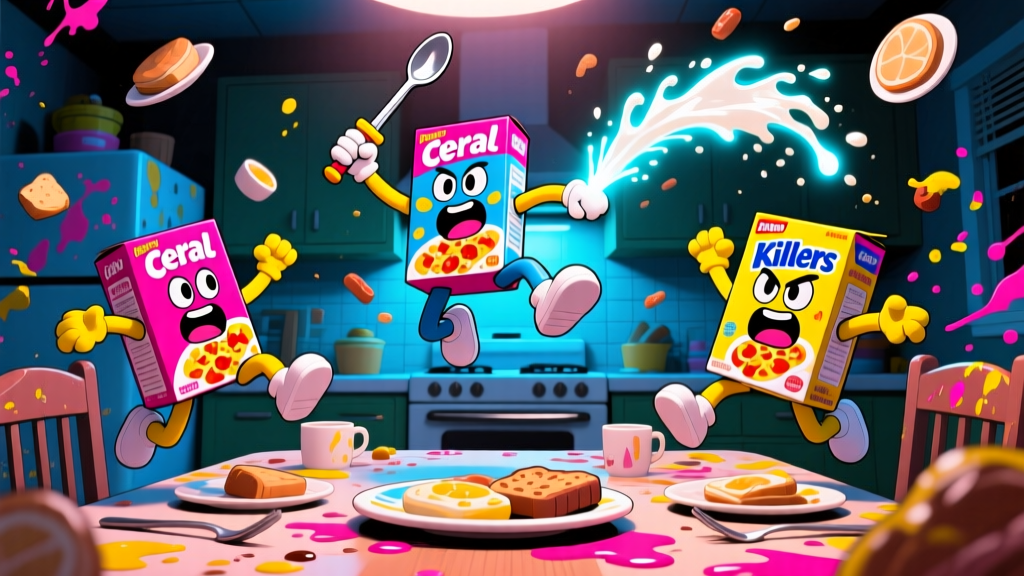
Walk into any gallery showing Ron English's work and something specific happens: a twelve-year-old laughs at the cartoon mascots while their parent feels mildly ill. That split response is the entire point. English has built a four-decade career on making Americans confront the imagery they swallowed uncritically as children, and nowhere does that mission hit harder than the Cereal Killers collection — a line of vinyl art figures that takes the smiling faces off cereal boxes and replaces them with something uncomfortably close to the truth.
The Ron English cereal killers occupy a strange intersection in contemporary collectibles. They are, simultaneously, limited-edition designer toys that trade for hundreds of dollars on the secondary market, legitimate pop art objects with exhibition pedigrees at institutions like the Whitney Museum of American Art, and scathing critiques of an industry that spends roughly $500 million annually marketing sugar to children through cartoon characters. Few collectible lines manage to be culturally subversive and commercially desirable at the same time. The Cereal Killers pull it off.
The POPaganda Architect Behind the Cereal Aisle
Ron English grew up in Dallas, Texas, in 1959, surrounded by the exact visual culture he would later dismantle. Television commercials, billboards, cereal boxes — the full spectrum of mid-century American advertising formed his visual vocabulary. By the time he reached the University of North Texas in the late 1970s, he had already developed the technical chops of a classical realist painter. But classical realism was never going to contain what English wanted to say.
His breakthrough came in the early 1980s through billboard alteration. Working under cover of darkness, English would climb to roadside advertisements and paint over them, transforming corporate messages into surreal commentaries. A cigarette ad became a skull grinning through tar-stained teeth. A fast-food billboard showed the actual consequences of a diet built around deep-fried meat. The technique — overlaying truth onto advertising — became his signature. He called it POPaganda: a portmanteau capturing how pop culture and propaganda share the same visual DNA.
By the mid-1990s, English had moved from illegal billboard modification to legitimate gallery exhibitions, though his work lost none of its confrontational edge. His 2002 showing at the Whitney Museum of American Art confirmed that the institutional art world was ready to embrace what the street art community had known for years: Ron English was producing some of the most technically accomplished and conceptually sharp pop art in America. That same period saw him gravitating toward three-dimensional work, particularly vinyl figures — a medium that would give the Cereal Killers their physical form.
"The cereal mascot is the most insidious character in American advertising. It's designed to create brand loyalty in children too young to understand persuasion, linking sugar consumption to emotional fulfillment through character design. I just showed them without their makeup." — Ron English, interview with Beautiful Losers documentary team, 2008
The Breakfast Table Massacre: How Cereal Killers Came to Exist
The concept behind the Cereal Killers requires almost no explanation once you see the figures. English took the most recognizable cereal mascots in American history — characters engineered by advertising agencies to be maximally appealing to children — and pushed their features past the point of charm into grotesque honesty. The captain who sells you sugar-coated corn becomes a bloated, desperate figure in a stained uniform. The rabbit who goes insane for fruit-flavored cereal becomes genuinely psychotic, pupils dilated, fur matted with the product he craves.
This was not parody for its own sake. English understood something fundamental about the cereal aisle that most consumers never consciously process: it is a battlefield of psychological manipulation aimed at the most vulnerable demographic in the population. According to a 2019 report by the Rudd Center for Food Policy and Health at the University of Connecticut, children view an average of 10 food and beverage ads per day on television alone, with the vast majority promoting products high in sugar, fat, or sodium. The cereal industry accounts for a disproportionate share of that advertising spend.
The Cereal Killers concept first surfaced in English's paintings and prints during the early 2000s, appearing alongside his other recurring characters like MC Supersized (a morbidly obese Uncle Sam figure) and Grin (a skeletal billboard grin stripped of its advertising context). The transition to vinyl figures happened around 2006, when the designer toy movement had developed enough infrastructure — skilled sculptors, established manufacturers in China, a growing collector base — to support limited-edition art toy production at the quality level English demanded.
Each figure in the Cereal Killers lineup was developed with input from professional sculptors who translated English's two-dimensional character designs into three-dimensional vinyl forms. The production process typically involved hand-painted editions, with English himself overseeing color approvals and, in some cases, personally painting artist-proof variants. This hands-on approach distinguished the Cereal Killers from mass-produced licensed toys and positioned them squarely in the designer art toy category.
The Lineup: Every Cereal Killer Figure, Ranked by Collector Demand
Below is the core Cereal Killers vinyl figure roster — the characters that defined the collection and established Ron English as a serious force in the designer toy world. Each figure carries its own edition history, production details, and current market profile.
Cap'n Corn Starch
The undisputed anchor of the Cereal Killers collection. Cap'n Corn Starch takes the familiar naval officer from the Quaker Oats Cap'n Crunch box and presents him as he might actually look after decades of consuming his own product. The figure stands approximately 9 inches tall, rendered in bold primary blues and golds that mirror the original cereal packaging — but the body is grotesquely distended, the uniform jacket pulled tight across a swollen midsection. The character's trademark smile remains intact, which somehow makes the whole thing worse.
The first edition, released in 2006 through authorized gallery channels, was limited to approximately 500 pieces and retailed for around $120. A 2008 reissue in an alternate colorway (inverted palette, navy and crimson) produced an additional 300 units. Hand-painted artist proofs from the original run — estimated at fewer than 25 pieces — carry English's personal stamp and represent the most coveted variants in the entire Cereal Killers catalog.
Sugar Frosted Fat
Based on the Honey Smacks mascot (known in different markets as Dig 'Em the Frog or Wally the Bee), Sugar Frosted Fat presents a bloated, barely-functional insect figure slumped under the weight of its own sugar addiction. Standing roughly 7 inches tall, the figure was produced in a vivid yellow-and-black palette with a semi-gloss vinyl finish designed to mimic the appearance of honey coating. The eyes are half-closed, the limbs hang loose, and a trail of crystallized sugar drips from the character's mouth to the base.
The original 2007 edition was limited to 250 pieces, making it one of the smallest production runs in the Cereal Killers lineup. Retail price was approximately $135. A "frosted" translucent variant — produced in a run of roughly 50 pieces for a New York gallery exclusive — remains among the hardest Cereal Killers figures to locate on the secondary market. The translucent resin version catches light in a way that standard vinyl cannot, and collectors specifically hunt this variant.
Trix Killer
The Trix rabbit was always the most psychologically interesting mascot in the General Mills stable — a character defined entirely by his inability to obtain the product he desires, perpetually tormented by children who deny him access. English seized on this narrative and pushed it to its logical conclusion: a rabbit who has finally snapped. The Trix Killer figure depicts the character in a frenzied state, fur splattered in neon hot pink, electric orange, and lime green, with dilated pupils and contorted limbs suggesting a complete mental break.
Released in 2008 as a limited edition of 400 pieces, the Trix Killer was packaged in a miniature cereal box that has become nearly as collectible as the figure itself. The box art features English's interpretation of the Trix logo, with the word "KILLER" hand-stamped over the original product name. Original retail was $150. The packaging alone, when found in mint condition, trades for $60 to $90 among collectors who specialize in designer toy packaging.
The Quaker
Perhaps the most unsettling figure in the lineup. The Quaker takes the serene, wholesome Quaker Oats gentleman — a character based on William Penn and used in branding since 1877 — and strips him to a skeletal frame. The colonial garb remains, rendered in pale whites and grays, but the body inside has withered to bone. The figure stands about 8.5 inches tall and projects an almost funereal stillness that contrasts sharply with the other Cereal Killers' manic energy.
This figure carries additional weight given the Quaker Oats brand's historical controversies, including the company's involvement in radiation experiments on children during the 1940s and 1950s (a fact documented in congressional hearings and Department of Energy reports released in 1995). English did not shy away from this context, and the figure's packaging included a small insert card referencing the brand's darker history. The 2009 edition of 300 pieces retailed for $140.
Cocoa Binge
Based on the Cocoa Puffs bird (Sonny the Cuckoo Bird), Cocoa Binge captures the manic energy of a character defined by sugar-fueled obsession. The figure depicts the bird in a vibrating, almost seizure-like state — pupils contracted to pinpoints, feathers ruffled, beak agape. At roughly 7.5 inches tall, the colorway runs chocolate brown, burnt orange, and neon yellow, with the figure mounted on a base designed to resemble a shattered cereal bowl.
Released in 2009 with an edition size of 350 pieces and a $140 retail price. A "sugar crash" variant — rendered entirely in desaturated grays and whites, representing the inevitable comedown — followed in 2010 with a run of just 150 pieces. The sugar crash variant has become significantly more valuable than the standard edition on the secondary market, a pattern consistent across designer toys where variant editions carry smaller production numbers.
The Numbers Game: Secondary Market Pricing and Collector Economics
The secondary market for Ron English vinyl figures has followed a trajectory familiar to anyone tracking the designer toy economy over the past fifteen years. Early editions, produced in small quantities before English's name reached a broader audience, have appreciated significantly. The market experienced its sharpest growth between 2015 and 2019, when designer toys and art vinyls crossed over from niche collector communities into mainstream art market awareness.
| Figure | Base Character | Year | Edition Size | Original Retail | 2026 Market Range |
|---|---|---|---|---|---|
| Cap'n Corn Starch | Cap'n Crunch | 2006 | 500 (1st ed.) | $120 | $400 – $900 |
| Sugar Frosted Fat | Honey Smacks Mascot | 2007 | 250 | $135 | $350 – $650 |
| Trix Killer | Trix Rabbit | 2008 | 400 | $150 | $450 – $850 |
| The Quaker | Quaker Oats Man | 2009 | 300 | $140 | $300 – $600 |
| Cocoa Binge | Cocoa Puffs Bird | 2009 | 350 | $140 | $280 – $550 |
| Cocoa Binge (Sugar Crash) | Cocoa Puffs Bird (variant) | 2010 | 150 | $140 | $500 – $1,100 |
| Cap'n Corn Starch (Artist Proof) | Cap'n Crunch (AP) | 2006 | <25 | N/A | $1,500 – $2,800 |
Several factors drive pricing within the Cereal Killers market. Edition scarcity is the primary lever — the Sugar Frosted Fat translucent variant (approximately 50 pieces) consistently commands higher prices than the standard edition despite the standard Cap'n Corn Starch being the more recognizable character. Condition and packaging matter enormously: mint-in-box specimens trade at 30-50% premiums over loose figures. Artist proofs and convention exclusives occupy their own tier, with hand-painted one-of-ones selling for $1,500 to $2,800+ when they surface at auction.
The broader designer toy market saw a correction following the 2020-2022 pandemic-era boom, when speculative buying inflated prices across categories from Bearbricks to KAWS Companions. Ron English figures were somewhat insulated from the worst of this correction because their collector base skews toward art buyers rather than pure speculators. English's name carries weight in fine art circles — his paintings sell in the $10,000 to $100,000+ range at auction — which provides a floor of legitimacy under his vinyl editions that purely commercial toy lines lack.
Unlike KAWS Companions, which retail through global drops and reach edition sizes in the thousands, the Cereal Killers maintained intentionally limited production. The average edition size across the core lineup was roughly 320 pieces — small enough to sustain genuine scarcity, large enough to build a distributed collector community.
When Breakfast Becomes Art: Pop Art Meets Designer Toys
The designer toy movement — sometimes called art vinyl or urban vinyl — traces its origins to Hong Kong in the late 1990s, when artists like Michael Lau began producing limited-run figures that treated the toy format as a legitimate artistic medium rather than a commercial product category. By the early 2000s, the movement had spread to Tokyo, New York, and Los Angeles, building an infrastructure of specialty retailers, collector conventions, and online communities.
Ron English entered this space with a credential set that most designer toy artists lacked. He was not a graphic designer or illustrator pivoting into three dimensions. He was an established fine artist with museum exhibition history, a painter whose canvases hung alongside Warhol and Haring in institutional collections. When English produced a vinyl figure, it carried the implicit claim that this object belonged in the same conversation as a gallery print or a bronze sculpture.
The Cereal Killers tested that claim more aggressively than most designer toys because the subject matter was so deliberately uncomfortable. A KAWS Companion is aesthetically pleasing — its X-ed eyes and slumped posture read as cool, melancholic, abstract. A Trix Killer figure vibrating with psychotic energy, splattered in the same neon colors used to sell breakfast cereal to six-year-olds, asks the viewer to think about why those colors were chosen and who they were designed to manipulate. It is, in other words, art that demands critical engagement rather than passive admiration.
This distinction mattered in how institutions received the work. Art critics writing for publications like Juxtapoz and Beautiful Losers (the 2004 book by Aaron Rose and Christian Strike that documented the intersection of street art and contemporary culture) positioned the Cereal Killers within a tradition of culture jamming that stretches back through the Situationist International of 1960s Paris to the Dadaists of Weimar-era Berlin. English was not the first artist to appropriate advertising imagery for subversive purposes — Andy Warhol's Brillo Boxes did something structurally similar in 1964 — but he was arguably the first to translate that practice into the specific format of limited-edition vinyl collectibles.
The comparison with Warhol is not incidental. Both artists built their practice on the tension between commercial imagery and fine art context. Both used repetition and variation (multiple colorways, limited editions) as core strategies. The difference is that Warhol's soup cans maintained a cool, ironic distance from their subject, while English's cereal mascots burn with genuine outrage. Where Warhol asked "what does it mean that we consume these images?", English asks "what does it mean that we fed these images to our children?"
Gallery and Exhibition History
The Cereal Killers have appeared in both solo and group exhibitions across three continents, building an institutional resume that separates them from the vast majority of designer toy lines. Key exhibition milestones include:
- Whitney Museum of American Art, New York (2002) — While predating the vinyl figure line specifically, English's exhibition at the Whitney included the Cereal Killers paintings and prints that established the visual vocabulary the figures would later inhabit. This showing cemented English's institutional credibility.
- Magda Danysz Gallery, Paris (2009) — Hosted a solo exhibition featuring the Cereal Killers vinyl collection alongside new paintings. The Paris showing was significant because it introduced the figures to the European collector market, which had been less exposed to English's work than the US audience.
- Jonathan LeVine Gallery, New York (2010) — Group exhibition "POPaganda: The Art of Ron English" provided a comprehensive survey including the full Cereal Killers lineup. Jonathan LeVine was instrumental in bridging the gap between street art and the gallery system during this period.
- Museum of Contemporary Art, Los Angeles (2011) — Group show "Art in the Streets" (curated by Jeffrey Deitch) included English's work alongside Banksy, Shepard Fairey, and KAWS, positioning the Cereal Killers within the broader street-art-to-gallery pipeline.
- ToyQube, Queens, NY (2014) — Dedicated designer toy exhibition where English's Cereal Killers were presented alongside works by Michael Lau, Bounty Hunter, and Sketcho. This showing emphasized the figures' position within the art vinyl movement rather than the fine art world.
- Ron English Retrospective, Various US Venues (2015-2016) — A traveling retrospective that traced the full arc of English's career, with the Cereal Killers occupying a dedicated section exploring the intersection of character design, consumer critique, and three-dimensional art production.
Beyond gallery walls, the Cereal Killers maintained visibility through art toy conventions like ComplexCon and Designer Toy Awards events, where English's booth signings routinely drew long queues. These convention appearances served a dual purpose: they reinforced the figures' status as collectible objects within the toy community while simultaneously reminding that community that the artist behind these figures had a Whitney exhibition on his resume.
Collecting the Cereal Killers: What New Buyers Should Know
If you are entering the Cereal Killers market in 2026, a few practical realities deserve attention before you place a bid.
Authentication is non-negotiable. The secondary market for designer toys is flooded with counterfeits, and Ron English figures are no exception. Chinese manufacturers have produced unauthorized reproductions of several Cereal Killers characters, particularly Cap'n Corn Starch and Trix Killer. Authentic pieces carry specific markers: the Last Bullet studio stamp on the base, edition numbering (typically hand-written or stamped), and in many cases a certificate of authenticity from the issuing gallery. If a seller cannot provide clear photographs of these markers, walk away.
Vinyl degrades under UV exposure. Prolonged sunlight exposure causes the soft vinyl used in Cereal Killers production to become brittle and the paint to fade. Figures displayed in direct sunlight for years lose significant value. When buying pre-owned, ask specifically about display conditions — a figure kept in a dark cabinet is worth materially more than one displayed on a sunlit shelf.
Packaging multiplies value. The cereal box-style packaging used for Cereal Killers releases is integral to the collecting experience and carries independent value. A mint-condition Trix Killer in its original box commands 40-60% more than the same figure without packaging. If you acquire a piece with original packaging, preserve it — acid-free tissue paper inside the box prevents the figure from rubbing against the cardboard interior during storage.
Artist proofs are a different market. The gap between standard editions and artist proofs is wider for Ron English than for many designer toy artists, because English's fine art reputation creates a pricing floor that lifts unique pieces significantly. An artist-proof Cap'n Corn Starch — hand-painted by English, potentially with custom color choices or additional detail work — trades in the $1,500 to $2,800 range, roughly three to four times the value of a standard edition. These pieces surface infrequently and typically sell through private transactions or specialized auction houses rather than open-market platforms.
The Wider Pantheon: Related Figures in the Ron English Universe
The Cereal Killers did not exist in isolation within English's vinyl output. Several companion lines and related characters populated the same artistic universe and frequently appeared alongside the Cereal Killers in gallery exhibitions:
MC Supersized — Perhaps English's most iconic character, a morbidly obese Uncle Sam figure that became the unofficial mascot of Morgan Spurlock's 2004 documentary Super Size Me. Produced in multiple vinyl editions by various manufacturers, MC Supersized remains the most widely recognized Ron English figure and serves as a gateway for collectors who later discover the Cereal Killers.
Abraham Obama — A mashup of Abraham Lincoln and Barack Obama, produced as a vinyl figure during the 2008 election cycle. While not part of the Cereal Killers specifically, this figure demonstrates English's practice of appropriating recognizable imagery (in this case political rather than commercial) and recontextualizing it as collectible art.
Happy Grin — The skeletal grin extracted from billboard advertising, produced as a standalone figure in various sizes and colorways. Happy Grin shares the Cereal Killers' critical DNA — both strip commercial imagery of its intended emotional payload and present something raw underneath.
Collectors who pursue the Cereal Killers often build out a broader Ron English vinyl collection, and the secondary market reflects this: pieces from different lines tend to sell in clusters, with knowledgeable buyers seeking matched sets from the same production period.
The Questions Every Collector Eventually Asks
How can I verify that a Ron English Cereal Killers figure is authentic?
Check three things: the Last Bullet Productions studio stamp on the base of the figure, the edition number (hand-written or stamped, matching the stated edition size), and any certificate of authenticity from the issuing gallery or retailer. Compare the figure's paint quality, proportions, and base markings against known authentic examples — collector forums and Facebook groups dedicated to designer toys maintain photo reference libraries. When buying from online marketplaces, request high-resolution photos of the base and any markings before committing.
What does POPaganda actually mean, and why does it matter for these figures?
POPaganda is Ron English's self-coined term combining "pop" (as in pop culture and pop art) with "propaganda." It describes his artistic strategy of using the visual language of mass media — advertising, branding, character design — to deliver messages that subvert the original intent of that language. The Cereal Killers are textbook POPaganda: they look like the thing they are critiquing. They use the same bright colors, the same cartoon aesthetic, the same visual appeal that cereal companies use to attract children. The difference is the payload — instead of "buy this cereal," the message becomes "look at what this cereal actually does."
Are Ron English still producing new Cereal Killers figures?
English's studio has continued to release vinyl figures periodically, though the core Cereal Killers lineup (the five characters detailed above) has not received new standard editions since the 2010-2011 period. Occasional convention exclusives, gallery-specific variants, and collaboration pieces surface through English's gallery representation and at designer toy events. For current release information, follow English's official channels and authorized gallery partners — Last Bullet Productions and the galleries that handle his editioned work.
Where can I currently buy authentic Cereal Killers figures?
The primary retail window for standard editions has closed, which means most acquisitions happen through the secondary market. Reliable channels include established designer toy resellers (both online and brick-and-mortar), auction houses that specialize in contemporary art and collectibles, and private transactions through collector communities. Platforms like eBay can work, but authentication is essential — use the verification guidelines above. Some specialty galleries that originally retailed the figures occasionally receive consignment pieces and can vouch for provenance.
Which other artists produce similar work in the pop-art-meets-designer-toys space?
The closest contemporaries include KAWS (Brian Donnelly), whose Companion figures bridged street art and designer toys at a larger commercial scale; KAWS collaborated with brands like Uniqlo and Dior, pushing designer toys into fashion and luxury markets. Sketcho One (Alex Pardee) produces vinyl figures rooted in street art and pop surrealism. Michael Lau, often credited as the godfather of the designer toy movement, produces limited vinyl figures from his Hong Kong studio. Huck Gee and Bounty Hunter (Travis Howell) were instrumental in the early designer toy scene and produced figures that share the Cereal Killers' ethos of treating the toy format as a legitimate artistic medium. English differs from most of these artists in the explicitness of his cultural critique — where KAWS deals in mood and abstraction, English deals in confrontation.
What is the best way to display and preserve Cereal Killers figures?
Display in a UV-protected cabinet, away from direct sunlight and heat sources. Maintain stable temperature (65-75°F) and moderate humidity (40-50%). Avoid handling painted surfaces with bare hands — skin oils degrade paint over time. For long-term storage, keep figures in acid-free tissue inside their original packaging if available. Serious collectors photograph their pieces for insurance documentation, noting condition at time of acquisition. If displaying outside original packaging, use acrylic risers or display cases that protect against dust without requiring the figure to be sealed in an airtight environment (vinyl benefits from minimal air circulation to prevent off-gassing buildup).
The Cereal Killers will likely outlast the cereal brands they parody. General Mills and Kellogg's reformulate packaging every few years, retire mascots, introduce new characters, respond to market pressure and parental advocacy groups. The imagery shifts. But Ron English captured something permanent in these figures — the specific mechanism by which American corporations colonized childhood imagination through cartoon characters, and the strange alchemy by which that same imagery, inverted and exposed, becomes art worth collecting. The captain is still grinning. Now at least you know what he's grinning about.