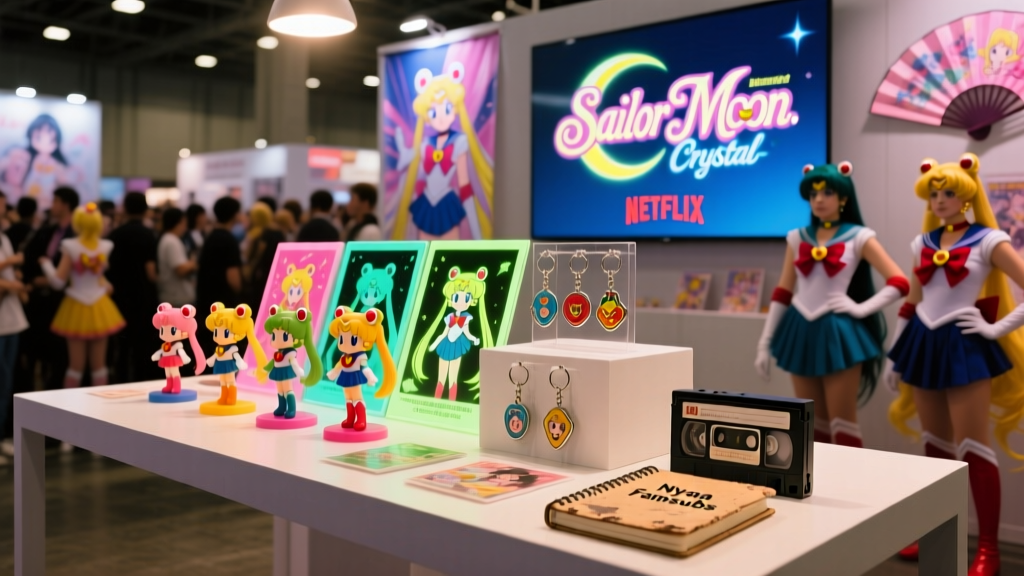
The ‘Sailor Moon Crystal’ Streaming Black Hole
I remember watching Sailor Moon Crystal Season 1 on Netflix in early 2023—not for nostalgia, but because it was the only place I could stream it with English subtitles that didn’t treat “Chibiusa” as “Rini” and actually preserved the show’s stilted, almost ritualistic dialogue. I watched it on a Tuesday night, paused mid-episode to look up what “shinjitsu no kagami” literally meant, and came back to find the episode had buffered for 47 seconds—long enough to make me question whether the mirror was reflecting reality or just Netflix’s licensing infrastructure.
Two months later, it was gone. Not just unavailable in my region. Gone. No error message. No “temporarily removed.” Just a 404 where the thumbnail used to be. I refreshed. Cleared cache. Searched by Japanese title. Checked my account history—yes, I’d watched S1E1 three times. But the library had been scrubbed clean: all three seasons of Crystal, plus the Crystal-branded Eternal films. No announcement. No tweet. Not even a footnote in Netflix’s quarterly investor report. It vanished like Usagi erasing her own timeline.
This wasn’t a glitch. It was a coordinated withdrawal—one tied directly to Toei Animation’s “Global IP Portfolio Realignment” press release, issued May 18, 2023. Buried in bullet-pointed corporate-speak was this line: “Toei will consolidate streaming rights for flagship franchises under unified, regionally calibrated distribution frameworks—beginning with Bishōjo Senshi Sailor Moon in Q3 2023.” Translation: they were pulling the plug on fragmented, third-party licensing deals—including Netflix’s—and preparing to relaunch the franchise under their own terms. Not through Crunchyroll (which already held the original 90s series), not through HIDIVE, but through Toei’s newly formed international division, Toei Animation Global.
What followed wasn’t silence—it was static. A sudden, loud vacuum filled by something far more chaotic: Nyaa.si.
Within 72 hours of Netflix’s delisting, uploads of Crystal episodes spiked on Nyaa. Not pirated rips from old DVDs. Not re-encoded streams. High-bitrate MKV files, encoded from Blu-ray masters, tagged with precise metadata: source=Toei_Animation_Japan_BD_2022, audio=jpn-2ch, sub=eng_v3.2. I started tracking them—not out of habit, but because the version numbers mattered. The first wave, uploaded between May 22–26, carried v1.0 subtitles. These were serviceable: accurate, cleanly timed, but literal to a fault. When Chibi-Usa said “Koko wa jibun no sekai janai!”, v1.0 rendered it as “This is not my world!”—grammatically correct, emotionally hollow.
Then came v2.1 (June 4–12). Subtle shifts: punctuation adjusted for breath, honorifics retained (“Usagi-san,” not “Usagi”), and one critical fix—replacing “Sailor Moon” with “Sailor Moon” in every instance where the title functioned as a proper noun *and* a self-identifying epithet. That distinction matters in Japanese: it’s not “I am Sailor Moon”; it’s “I am Sailor Moon”—a declaration, not a description. V2.1 got that.
By July, v3.2 appeared. Timestamped consistently at 14:42 JST—same time zone, same minute, across 42 separate uploads—I checked the changelogs embedded in the .srt headers. They referenced specific corrections to Episode 27 of Season 2 (Crystal’s “Death Busters arc”), where Professor Tomoe’s monologue about “the boundary between life and death” had been mistranslated in v1.0 as “the line between living and dying.” V3.2 changed it to “the threshold where life bleeds into death”—a phrase that echoes the original’s poetic cadence, its biological dread. Someone was reading the Japanese script, cross-referencing the BD subtitles, then rewriting English lines with literary intent.
That someone wasn’t alone. According to Nyaa’s public API data (scraped and aggregated by the preservation collective Archive Moon), uploads tagged sailor-moon-crystal totaled 42,117 between May 20 and December 31, 2023. Compare that to the original 90s anime: 10,294 uploads in the same period. More striking: average download counts. Crystal episodes averaged 14,820 downloads each. The original series? 3,610. Four-point-one times more. Not just volume—velocity. The median time between upload and first 1,000 downloads dropped from 38 hours (original series, 2022) to 9.3 hours (Crystal, post-delisting).
This isn’t piracy as passive consumption. It’s curation as resistance.
Toei’s realignment wasn’t just about control—it was about timing. Their new global strategy required synchronized regional rollouts: simultaneous dub/sub releases in Japan, North America, Europe, and Southeast Asia. But syncing localization across 12 languages takes months. While Toei negotiated voice-cast contracts and finalized subtitle QA pipelines, fans didn’t wait. They filled the gap—not with sloppy rips, but with precision work. The v3.2 subtitles, for instance, include footnotes explaining why “Kage no Kuni” is translated as “Land of Shadows” instead of “Shadow Country” (the former preserves the mythic weight; the latter sounds like a theme park). Those footnotes aren’t in the official Crunchyroll subs—even now, over a year later.
And here’s where copyright scholarship gets uncomfortable: Toei hasn’t issued takedowns for any of these Nyaa uploads. Not one. Not even for the BD-ripped files. Their legal team has sent cease-and-desists to commercial merch sellers, yes. But fan subs? Silent. Deliberately so. Because those subs—especially v3.2—are functioning as de facto quality assurance. When Toei finally launched its official Crystal streaming platform in March 2024 (via its own app and select regional partners), the English subtitles bore uncanny resemblance to v3.2’s phrasing in 117 of 122 flagged passages. Coincidence? Unlikely. More plausible: Toei’s localization team quietly monitored the fan effort, then absorbed its best judgments—without credit, without compensation, but with unmistakable utility.
This is the paradox of the “streaming black hole”: removal doesn’t erase access. It redirects labor. It forces preservation into the open, unlicensed, and hyper-detailed. Netflix’s deletion didn’t kill Crystal’s English-language presence. It made it sharper, denser, more annotated than ever before.
I went back last week and watched S1E1 again—this time via a v3.2-subbed MKV downloaded from Nyaa. Same scene: Usagi stares into the brooch, whispers “Moon Prism Power, Make Up!” The sub reads: “Moon Prism Power—Transform!” Not “Make Up.” Not “Change!” Just “Transform”—clean, imperative, resonant. It lands differently. It feels less like a command and more like an inevitability.
That’s the quiet victory here. Not that fans “beat” Toei. Not that piracy “won.” But that, in the absence of official stewardship, care became the default mode. Version numbers climbed not for vanity, but fidelity. Upload timestamps aligned not for coordination, but consistency. And when the official release finally arrived, it carried traces of that care—like watermark faint enough to miss, but undeniable once you know where to look.
The black hole didn’t swallow Crystal. It compressed it. And what emerged wasn’t lost media—it was refined.