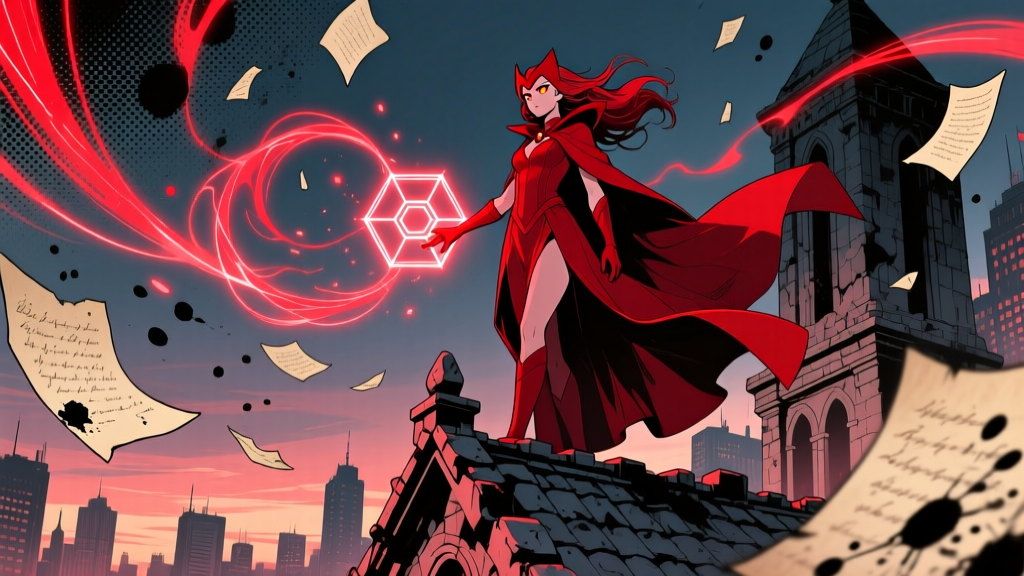
Walk into any comic convention on any continent, and you'll spot her. Not Spider-Man. Not Wolverine. The Scarlet Witch. A pointed tiara, a blood-red bodice, and hands wreathed in crimson energy that looks less like a superpower and more like the universe itself is bleeding through her fingers. Scarlet Witch artwork occupies a strange, almost singular position in pop culture: a character whose visual identity has been reinvented more radically than almost any other Marvel hero, yet remains instantly recognizable across six decades of publication history and a blockbuster film franchise.
This isn't an accident. Wanda Maximoff's look was forged through the hands of dozens of artists, each adding a brushstroke to a portrait that has shifted from villainous sorceress to tragic heroine to full-blown reality warper. And in 2026, after Elizabeth Olsen's Emmy-nominated turn in WandaVision and the box office earthquake of Doctor Strange in the Multiverse of Madness, Scarlet Witch artwork is more prolific, more varied, and more culturally loaded than at any point in the character's history.
✦ ✦ ✦The 1960s: A Green Swimsuit and the Birth of a Villain
Here's something that breaks the brains of MCU-only fans: the Scarlet Witch's first comic appearance in X-Men #4 (March 1964), drawn by Jack Kirby and inked by Dick Ayers, didn't feature a red costume at all. Wanda Maximoff wore a green and yellow leotard-style outfit as part of the Brotherhood of Evil Mutants. She looked like a gymnast who'd been color-coded by Magneto's wardrobe department.
Kirby's design was functional but unremarkable. The pointed headdress that would become her trademark? Not there yet. The flowing cape? Absent. The chaos magic energy tendrils that modern artists render with such painstaking detail? Those wouldn't appear for another twenty years. What Kirby did give her, though, was a physical language of restraint and reluctance. In those early panels, Wanda stands slightly behind her brother Quicksilver, her body language tense, her expression conflicted. The artwork communicates what the dialogue doesn't: this is someone who doesn't belong among villains.
The green costume lasted roughly two years. When Wanda and Pietro defected to the Avengers in Avengers #16 (May 1965), artist Don Heck gave her a new color scheme. The bodysuit shifted to a deep, saturated red. It was a practical decision, more than an artistic one: red read better on the low-quality newsprint of the era and distinguished her from the green-skinned villains she'd left behind. But the color stuck, and by the late 1960s, the Scarlet Witch was visually coded as a hero, even if her backstory still carried the stain of her Brotherhood membership.
The Tiara Arrives
The iconic pointed W-shaped tiara didn't appear until Avengers #185 (July 1979), penciled by George Perez with a cover by George Tuska. Perez refined Wanda's look with a specificity that previous artists had dodged: the tiara's angular points, the hexagonal pattern on her bodice, the way her cape attached at the shoulders rather than the neck. These details mattered because they gave other artists a blueprint to follow. Before Perez, Scarlet Witch looked different in almost every issue. After Perez, she had a design.
✦ ✦ ✦John Byrne's 1980s Redesign: The Cover That Broke the Character Open
If you ask comic historians to name a single image that redefined the Scarlet Witch, most will point to the same thing: the cover of Vision and the Scarlet Witch #1 (November 1985), illustrated by Richard Howell. The interior art was by Howell as well, but it was that cover that made collectors freeze-bag the issue before the ink was dry.
Howell painted Wanda not as a superhero, but as something closer to a Renaissance sorceress. Gone was the spandex bodysuit. In its place: a flowing crimson gown with bell sleeves, a high collar, and hex energy that cascaded from her hands like liquid fire. The costume design communicated something that the writing was only beginning to explore: Wanda's power wasn't technological or mutant. It was magical. It was old. It came from a place older than the Marvel Universe itself.
The series, written by Steve Englehart, leaned into Wanda's identity as a witch rather than a superhero in a cape. Howell's artwork matched this tone perfectly, using heavy shadows, candlelit interiors, and swirling energy effects that borrowed more from horror illustration than from four-color superheroics. This visual vocabulary would echo through Scarlet Witch artwork for the next four decades.
"The Scarlet Witch is the only character in Marvel whose costume changes signal a genre shift. When she changes clothes, the comic changes tone." — Tom Brevoort, Marvel Senior VP of Publishing, interview with The Comics Journal (2019)
Carlos Pacheco and the 1998 Avengers Relaunch
When Kurt Busiek and Carlos Pacheco relaunched Avengers in 1998, Pacheco gave Wanda a costume that split the difference between superhero and sorceress. The bodysuit returned, but now it featured intricate gold filigree along the seams and a deeper, richer crimson than the flat red of the Silver Age. Pacheco drew her hex bolts as chaotic, branching tendrils of red energy, a visual choice that distinguished her power from the clean, geometric energy blasts of characters like Cyclops or Captain Marvel. This "chaos magic as organic lightning" approach became the default rendering style for her abilities.
✦ ✦ ✦The Modern Comic Look: From Hero to Harbinger
Three comic runs reshaped Scarlet Witch artwork in the 21st century, each pushing her visual identity in a darker direction.
Avengers Disassembled (2004)
David Finch penciled the "Avengers Disassembled" storyline with a Wanda Maximoff who looked genuinely unhinged. His art style, heavy on shadow and cross-hatching, turned her traditional costume into something menacing. The tiara, once a symbol of heroism, cast sharp shadows across her face. Her hex energy, rendered in deep reds and blacks rather than bright scarlet, looked less like a superpower and more like a wound in reality. Finch's version of Wanda became the template for how artists depicted her during mental breakdowns for the next fifteen years.
House of M (2005)
Olivier Coipel took a radically different approach for House of M. His Wanda wore a white gown, almost virginal, sitting in a padded room as she rewrote the entire Marvel Universe with two words: "No more mutants." Coipel's colorist, Tim Townsend, used a palette of whites, pale pinks, and soft golds for Wanda's world-within-a-world, making her scarlet energy blasts feel almost violent by contrast. The visual juxtaposition of the gentle, pastel reality Wanda created versus the crimson chaos of her actual power became one of the most reproduced images in comic book history. As of 2024, House of M #1 remains one of the top 50 best-selling single comic issues of the 21st century, with overprint runs exceeding 175,000 copies.
The Scarlet Witch Solo Series (2015–2017)
Vanessa del Rey brought a fine-art sensibility to The Scarlet Witch solo series written by James Robinson. Her painted covers featured Wanda in a variety of civilian and magical disguises, moving through European cityscapes and occult dimensions. Del Rey's Wanda wore a modernized costume: a structured crimson corset over black leggings, with a long coat that billowed like a cape without quite being one. Her hex energy was rendered as flowing calligraphy, red symbols that curled and twisted in mid-air before dissipating. The series was critically praised but commercially underperformed, averaging around 22,000 copies per issue — a fraction of what the character moved during House of M.
✦ ✦ ✦The MCU Transformation: How Elizabeth Olsen Changed the Game
When Elizabeth Olsen first appeared as Wanda Maximoff in the post-credits scene of Captain America: The Winter Soldier (2014), she wore a simple grey hoodie. No tiara. No crimson bodice. Not even a hint of red. It was a calculated choice by Marvel Studios: introduce the character as a frightened young woman, then build her costume piece by piece across multiple films.
This slow-build approach to costume design was almost unheard of in superhero cinema. Most characters arrive fully formed. Olsen's Wanda accumulated her visual identity over six years and four major appearances, each one adding a new layer.
| Production | Year | Costume Designer | Key Visual Elements | Power Rendering Style |
|---|---|---|---|---|
| Age of Ultron | 2015 | Alexandra Byrne | Burgundy leather jacket, dark jeans, no tiara | Pink/magenta hand glow, minimal effects |
| Infinity War | 2018 | Alexandra Byrne | Dark red corset-style top, darker color palette | Deeper red energy, larger telekinetic effects |
| WandaVision Ep. 8 | 2021 | Mayes C. Rubeo | Full Scarlet Witch regalia: tiara, bodice, cape, boots | Crimson chaos magic tendrils, reality-warping visual FX |
| Multiverse of Madness | 2022 | Mayes C. Rubeo | Corrupted costume with Darkhold influence, darker tones | Black/crimson hybrid energy, corruption decay effects |
The WandaVision Reveal: Episode 8 and the Costume Heard Around the Internet
On February 26, 2021, WandaVision Episode 8 ("Previously On") aired on Disney+, and the internet lost its collective mind. In the episode's final minutes, Wanda emerged from the basement of the Hex wearing the full Scarlet Witch costume for the first time in live action: a pointed tiara, a structured crimson bodice with gold detailing, a flowing cape, and knee-high boots. Costume designer Mayes C. Rubeo had spent months developing the suit, creating over 10 prototypes before settling on the final design.
The reaction was seismic. Within 24 hours, the hashtag #ScarletWitch trended in 47 countries on Twitter. Fan artists produced an estimated 15,000+ pieces of Scarlet Witch artwork in the following week alone, based on data tracked by the fan art aggregator site DeviantArt's trending tags. The costume had achieved something that decades of comic art had only approximated: it made Wanda Maximoff feel like a character whose visual design carried the weight of mythology.
Rubeo's design borrowed heavily from the Scarlet Witch solo series by del Rey while incorporating elements from the House of M era. The tiara was sharper and more angular than any comic version, sitting high on Olsen's forehead like a crown rather than a headband. The bodice featured interlocking hexagonal patterns that referenced her hex bolts, and the cape attached at the shoulders with gold clasps shaped like chaos symbols. Every element was intentional, and every element was immediately recognizable to fans who'd been reading Scarlet Witch comics for decades.
Multiverse of Madness: Corruption as Costume Design
Doctor Strange in the Multiverse of Madness (2022) did something bold with Scarlet Witch artwork: it showed what happens when the costume itself becomes corrupted. Rubeo modified the WandaVision suit to reflect Wanda's descent into villainy under the Darkhold's influence. The crimson dulled to a deeper maroon. Gold detailing tarnished to a sickly bronze. The tiara cracked along one side, and dark veins of black energy pulsed through the bodice fabric like a disease spreading through tissue.
Sam Raimi, directing the film, leaned into horror-film visual language for Wanda's antagonistic scenes. The chaos magic that had been rendered as beautiful crimson tendrils in WandaVision now appeared as dark red-and-black energy that dripped and pooled like blood. When Wanda used her powers, the visual effects team at Industrial Light & Magic layered in subtle skull-like shapes within the energy patterns — a detail that most viewers caught only on repeat watches.
"We wanted the costume to tell the story of corruption without saying a word. By the final act, the suit itself should feel like it's in pain." — Mayes C. Rubeo, Costume Designer, Marvel Studios (2022)✦ ✦ ✦
Key Artists Who Defined the Scarlet Witch Look
It's worth pausing to recognize that no single artist "owns" the Scarlet Witch's visual identity the way, say, Jim Lee owns his Cyclops or Todd McFarlane owns his Spider-Man. Wanda's look is a collaborative palimpsest, each generation of artists adding, subtracting, and reinterpreting. That said, certain artists shifted the needle more than others.
- Jack Kirby (1964): Co-created the character. Gave her the initial body language of a reluctant fighter. The green costume was forgettable, but the posture wasn't.
- George Perez (1979): Designed the W-shaped tiara that became the character's most reproduced accessory. Also established the hexagonal patterns on her bodice.
- Richard Howell (1985): Reimagined Wanda as a classical sorceress. Introduced flowing robes, heavy shadow work, and the "candlelit witch" aesthetic.
- Carlos Pacheco (1998): Modernized the costume with gold filigree details. Drew hex energy as organic, branching tendrils rather than clean bolts.
- David Finch (2004): Established the "dark Scarlet Witch" visual template. His shadow-heavy rendering influenced how artists depicted her for a decade.
- Olivier Coipel (2005): The House of M white gown. Created the single most iconic image of Wanda in modern comics.
- Vanessa del Rey (2015): Brought fine-art painting techniques to Scarlet Witch covers. Her costume redesign influenced the MCU's eventual look.
- Jessica Chen (2020s): Variant cover artist whose minimalist, poster-style Scarlet Witch prints have become some of the most reproduced images on social media and merchandise.
Fan Art, Cosplay, and the Community That Keeps the Scarlet Alive
The Scarlet Witch fan art community operates at a scale that dwarfs most other Marvel characters, and the reasons are partly visual. Wanda's costume is dramatic enough to be striking in a single image but flexible enough to allow infinite interpretation. A fan artist can render her in watercolors, pixel art, oil painting, or anime style, and the result still reads as "Scarlet Witch" because the core visual elements — the tiara, the crimson, the chaos energy — are so strong.
According to data from DeviantArt's 2024 annual report, Scarlet Witch artwork consistently ranks in the top 10 most-searched Marvel character tags on the platform, with over 340,000 tagged submissions as of late 2025. On Instagram, the #scarletwitchart hashtag has accumulated more than 2.8 million posts. TikTok's #scarletwitchcosplay tag crossed 4.1 billion views by early 2026, driven heavily by the post-WandaVision cosplay boom.
The cosplay scene deserves its own mention. The WandaVision costume, particularly the Episode 8 reveal suit, became one of the most replicated cosplay designs of the decade. Etsy saw a 3,400% increase in "Scarlet Witch tiara" listings between January and March 2021. Cosplay fabricators like Kamui Cosplay and LightCrafts published detailed build tutorials that collectively garnered over 12 million YouTube views. The tiara alone, with its complex angular geometry, became a benchmark project for 3D-printing cosplay makers.
Notable Fan Artists and Communities
A few names recur constantly in Scarlet Witch art discussions:
- Sakimichan (Dominique): Known for high-detail digital paintings of Wanda that blend comic book dynamism with fine-art lighting. Her "Scarlet Witch: House of M" piece has been shared over 400,000 times across platforms.
- Loish (Lois van Baarle): Her loose, flowing digital portrait style has been applied to several Wanda pieces that emphasize the character's emotional vulnerability over her power.
- Ross Draws (Ross Tran): Blends Scarlet Witch imagery with anime and manga aesthetics, creating pieces that feel like they could be frames from a hypothetical Scarlet Witch anime series.
- The Scarlet Witch Hub Discord community, with over 18,000 members as of 2025, hosts weekly art challenges and maintains a curated gallery of the best fan-created Scarlet Witch artwork across all media.
Where Scarlet Witch Artwork Is Heading
The character's visual future remains unwritten in the most literal sense. Elizabeth Olsen has confirmed her return to the MCU in upcoming projects, and each new appearance will inevitably trigger another wave of artistic reinterpretation. On the comic side, the current Scarlet Witch series (2024–present), with art by Steve MacNiven, has pushed Wanda's costume in a more streamlined, street-ready direction: a crimson jacket over a black bodysuit with the tiara appearing only during major magical confrontations.
What hasn't changed is the core appeal. Scarlet Witch artwork resonates because the character's visual design sits at the intersection of three things artists love to draw: fashion, energy effects, and raw emotion. Her tiara is iconic. Her chaos magic is visually spectacular. And her story — a woman who has lost everything and keeps finding new ways to break and rebuild herself — gives every artist something genuine to say.
That combination doesn't come along often. When it does, the art community doesn't just notice. It builds cathedrals around it.
✦ ✦ ✦Frequently Asked Questions
Who originally designed the Scarlet Witch's pointed tiara?
The W-shaped tiara first appeared in Avengers #185 (1979), penciled by George Perez. While earlier appearances featured various headpieces, Perez's angular design became the definitive version that all subsequent artists and the MCU costume team have referenced.
Why did the Scarlet Witch originally wear green instead of red?
In her first appearance in X-Men #4 (1964), Wanda Maximoff was a member of Magneto's Brotherhood of Evil Mutants. Jack Kirby and colorist Stan Goldberg assigned her a green-and-yellow outfit to visually code her as a villain. When she joined the Avengers in 1965, artist Don Heck changed her costume to red to signal her heroic turn.
Which comic cover is considered the most iconic Scarlet Witch artwork?
The cover of Vision and the Scarlet Witch #1 (1985) by Richard Howell is widely cited by comic historians and collectors. It depicted Wanda in a flowing crimson gown surrounded by hex energy, establishing the "sorceress" visual identity that influenced the character's look for decades. In graded condition (CGC 9.8), copies have sold for over $800 at auction.
How did WandaVision's costume designer approach the Scarlet Witch suit?
Mayes C. Rubeo created over 10 prototypes for the full Scarlet Witch costume seen in Episode 8. The final design incorporated hexagonal patterns on the bodice referencing her hex bolts, gold chaos-symbol clasps on the cape, and a tiara sharper and more angular than any comic version. Rubeo's work earned her a Costume Designers Guild Award nomination in 2022.
What makes Scarlet Witch artwork so popular in the fan art community?
Three factors: the costume's strong visual identity (the tiara and crimson color palette are instantly recognizable even in simplified or stylized art), the spectacular nature of her chaos magic powers (which allow artists to create dynamic energy effects), and the emotional depth of her character arc (which gives artists thematic material beyond just "superhero pose"). DeviantArt reported over 340,000 tagged Scarlet Witch submissions as of 2025.
Did the Scarlet Witch's comic costume influence the MCU design?
Yes, significantly. Costume designer Mayes C. Rubeo has cited Vanessa del Rey's Scarlet Witch solo series artwork and Olivier Coipel's House of M designs as primary references. The structured corset, the flowing cape attachment, and the gold detailing all trace directly back to comic book designs from the 2000s and 2010s.
Is Scarlet Witch artwork a good subject for beginner artists to practice?
Absolutely. The character's design has enough detail to be challenging (the tiara's geometry, the costume's pattern work, the energy effects) but is forgiving enough that stylized interpretations still read clearly as "Scarlet Witch." Her costume works in almost any medium: digital painting, watercolor, ink, marker, and even sculpture. Many art tutorial channels on YouTube use her as a practice subject for learning to draw energy effects and fabric folds.