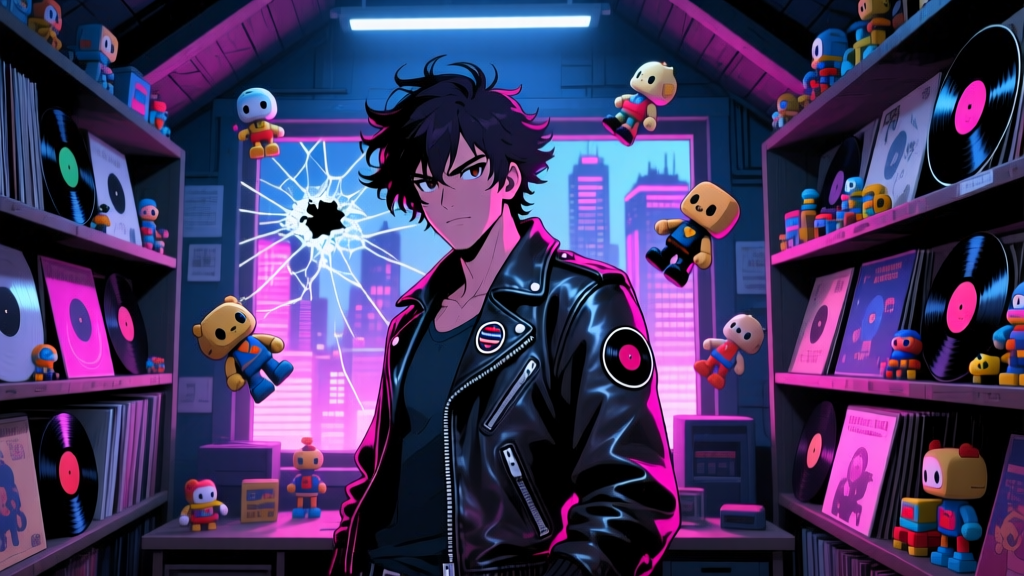
Walk into any designer toy convention in North America — DesignerCon in Pasadena, NYCC on the Javits floor, or a boutique resin drop at 3DRetro in Long Beach — and you will spot the argyle pattern before you spot the man. That diamond-knit sweater motif, rendered in neon pinks, acid greens, and midnight blues, has become Scott Tolleson's visual fingerprint. It shows up on sofubi figures, on resin shards, on Dunnys, on Labbits, and occasionally on the artist himself. It is the kind of branding that happens organically, not through marketing decks, but through twenty-plus years of a guy making things he genuinely wants to hold in his hands.
Scott Tolleson does not fit the stereotype of the precious gallery artist who dips a toe into commercial work. He is a working-class designer who spent his weekdays inside the Walt Disney Company's creative machine and his nights and weekends pouring resin into silicone molds in his home studio. That split life — corporate discipline by day, rogue toy-making by night — shaped an aesthetic that borrows equally from Saturday morning cartoons, Japanese sofubi traditions, and the gritty DIY energy of the early-2000s street art explosion.
From Atlanta Basements to the West Coast Resin Underground
Tolleson was born and raised in Atlanta, Georgia, a city not exactly known as a hub for vinyl art toys in the late 1980s. Like a lot of kids who grew up clutching Kenner Star Wars figures and bootleg Godzilla sofubi, he internalized the tactile pleasure of collectible objects early. But where most people outgrow that impulse, Tolleson doubled down. By his mid-teens he was already sketching character concepts, building crude prototypes, and thinking about form and color in ways that had less to do with fine art theory and more to do with the question: would I want to carry this thing in my backpack?
At sixteen, he relocated to the West Coast — a move that placed him within driving distance of what was then the geographic epicenter of the American designer toy scene. Southern California in the late 1990s was where stores like 3DRetro (founded by Tristan Eaton and later run by his family), Munky King, and the early Kidrobot outposts were beginning to stock vinyl figures alongside screen-printed posters and zines. The scene was small enough that an aspiring toy maker could walk into a shop, show a hand-sculpted prototype to the owner, and walk out with a consignment deal.
In 1998, Tolleson landed a job at the Walt Disney Company. He has remained there ever since — more than 27 years at the time of this writing — working in character design and consumer products. The Disney tenure is a detail that often surprises people who associate him exclusively with the independent toy world. But the two worlds have always cross-pollinated. Working inside one of the largest character-licensing operations on the planet gave Tolleson a masterclass in silhouette readability, color theory, and the engineering constraints that determine whether a 2D sketch can survive translation into a three-dimensional molded object. Those are not skills you pick up in a weekend workshop. They are skills you earn through thousands of production reviews.
"To put it simply, Scott is a toy junkie. He's obsessed with collecting, designing, and creating toys. He is happiest when he is working on multiple projects at once — the more chaotic the workbench, the better the output."
The Self-Produced Resin Catalog: Otis, Otto, and Tricycle Terror
Tolleson's earliest independent releases were hand-cast resin figures, a medium that demanded patience and a tolerance for chemical fumes. Resin work in the pre-2010 era was not the Instagram-friendly process it sometimes appears to be today. You mixed two-part polyurethane resin in a ventilated space, poured it into silicone molds you had made yourself, waited for cure times that could stretch past 24 hours, demolded the piece, sanded the seams, and hand-painted every unit in runs that typically numbered between 30 and 150 pieces.
His first notable self-produced figures included Otis and Otto, a pair of stylized characters that showcased his fondness for rounded, almost plush-like silhouettes rendered in hard resin. Otis and Otto were produced in multiple colorways — purple-and-orange editions are among the most documented — and they established a pattern Tolleson would repeat throughout his career: create a character platform, then iterate across colorways, materials, and collaborative variants.
Then came Tricycle Terror, a piece that leaned harder into the grotesque-cute tension that defines so much of the designer toy genre. The concept was straightforward — a child's tricycle reimagined as something menacing — but the execution required careful sculpting to balance menace with the whimsy that collectors expect from a Tolleson piece. Tricycle Terror appeared in resin editions and became one of the figures that introduced his name to the broader Vinyl Creep community during the genre's mid-2000s growth spurt.
Doc Von Block followed, another original character that pushed further into toy-like geometry — blocky, stackable, with the kind of simplified facial features that read well at both 3-inch and 8-inch scales. These early self-produced works were not mass-market products. They were small-batch art objects sold through convention tables, online drops, and specialty shops like Tenacious Toys, which became one of Tolleson's longest-running retail partners.
Kidrobot, Dunnys, and the Platform Toy Revolution
If self-produced resin figures built Tolleson's reputation among hardcore collectors, it was his work with Kidrobot that pushed his name into the mainstream designer toy consciousness. Kidrobot, founded by Paul Budnitz in 2002, had become the largest platform toy company in North America by the late 2000s, and their flagship product — the Dunny — was the blank canvas that every toy artist wanted to paint.
The Dunny is a 3-inch (and later 8-inch and 20-inch) vinyl rabbit figure with distinctive elongated ears. Kidrobot's model was simple and powerful: produce the Dunny in large quantities, then invite artists to create limited-edition designs on the platform. Tolleson's Dunny designs became some of the most recognizable in the catalog.
The Krak Dunny stands out as one of his most technically ambitious platform works. Inspired by his Shard resin design — a jagged, crystalline form that looks like a geological specimen crossed with a weapon — the Krak Dunny featured a transparent outer shell with an internal structure visible through the clear vinyl. The Plasma Stone Glow-in-the-Dark variant, released as a Kidrobot exclusive, added phosphorescent material to the internal elements, creating a piece that transformed under blacklight and in darkened display cases. The 8-inch version retailed at price points that reflected its complexity, and aftermarket prices on eBay and collector forums have consistently tracked above original retail for sealed editions.
The Imperial Lotus Dragon Dunny represented a different direction — dense, ornamental, and drawing on East Asian decorative traditions. The design wrapped the Dunny's form in intricate dragon and lotus patterning, with colorways that included metallic golds and deep crimsons. Artist Proofs of the Imperial Lotus Dragon have appeared through specialty channels, and the piece remains one of the most photographed Tolleson x Kidrobot collaborations on collector forums like SpankyStokes and The Toy Chronicle.
The King Howie Dunny, an 8-inch release, offered a character-driven take on the platform — less abstract than Krak, less ornamental than Imperial Lotus Dragon, and more in line with the character design sensibilities Tolleson honed at Disney. And then there was the DCon Vincent Dunny, created for DesignerCon as part of Kidrobot's artist series, which featured the convention's mascot character reinterpreted through Tolleson's visual language.
Beyond the Dunny: Pipkin Labbit and the Sofubi URN
Tolleson's Kidrobot collaborations extended to the Labbit platform as well. The Pipkin Preppy Labbit — released in a red edition limited to 200 pieces worldwide — featured the Labbit rabbit figure wearing Tolleson's signature argyle sweater pattern, complete with removable glasses. The piece is a compact example of how Tolleson treats platform toys as wearable fashion objects, not just sculptural forms.
On the sofubi side, the URN figure — a 4-inch tall sofubi set designed in collaboration with fellow artist Nathan Hamill — demonstrated Tolleson's ability to work within the Japanese soft vinyl tradition. Sofubi (short for "soft vinyl") figures are hollow, squeeze-toy-style pieces cast in flexible PVC, a medium with deep roots in Japanese toy culture dating back to the 1960s Godzilla and Ultraman figures produced by companies like Bullmark and Marusan.
The Shard: Where Resin Art Meets Collectible Design
If you want to understand Tolleson's artistic ambition beyond the platform toy ecosystem, look at the Shard. This is a free-form resin piece — not built on anyone else's platform, not constrained by a pre-existing silhouette — that Tolleson has iterated across multiple editions and colorways. The Shard takes its name from its shape: a jagged, angular form that suggests a fragment of something larger, broken off and polished into a standalone object.
The Midnight Gravy Shard, a blue-and-black marbled resin edition, debuted around NYCC 2025 and was sold through Tenacious Toys. Each Shard is cast in solid resin, making it heavier and more substantial than typical vinyl figures — a deliberate choice that reinforces the "art object" positioning. Some editions have included companion enamel pins, extending the Shard concept into adjacent product categories.
The Shard represents something important in Tolleson's catalog: the bridge between toy and sculpture. Platform toys like the Dunny will always carry the visual DNA of their base form. The Shard carries only Tolleson's DNA. It is his purest expression of form, color, and material, and its growing catalog of colorways suggests it will remain a recurring canvas for years.
| Work | Material | Collaborator | Notes |
|---|---|---|---|
| Otis & Otto | Hand-cast resin | Self-produced | Multiple colorways; early 2000s debut |
| Tricycle Terror | Resin | Self-produced | Grotesque-cute; mid-2000s release |
| Doc Von Block | Resin | Self-produced | Blocky geometry; multi-scale design |
| Krak Dunny (Plasma Stone GITD) | Vinyl, transparent shell | Kidrobot | 8-inch; glow-in-the-dark internals |
| Imperial Lotus Dragon Dunny | Vinyl | Kidrobot | Ornamental East Asian motifs; Artist Proofs available |
| King Howie Dunny | Vinyl | Kidrobot / 3DRetro | 8-inch; character-driven design |
| DCon Vincent Dunny | Vinyl | Kidrobot / DesignerCon | Convention mascot; Be@rbrick Artist Series |
| Pipkin Preppy Labbit | Vinyl | Kidrobot | Red edition; 200 pcs worldwide; argyle sweater |
| URN | Sofubi (soft vinyl PVC) | Nathan Hamill | 4-inch figure set; Japanese sofubi tradition |
| Uncle Argh NOIR Mini Qee | Vinyl | Tenacious Toys (Kickstarter) | Crowdfunded exclusive release |
| Midnight Gravy Shard | Solid resin, marbled | Tenacious Toys / Self-produced | Blue-black marbling; NYCC 2025 debut |
Gallery Shows and the Art-Toy Crossover
Tolleson's work has appeared in gallery contexts that sit at the intersection of pop surrealism, lowbrow art, and the designer toy movement. Two documented exhibitions illustrate the range: "Misrememberance" (2013) and "Heavenus" (2014). Both shows placed his resin and vinyl pieces alongside paintings, prints, and sculptural works by other artists operating in the same orbit — people like Luke Chueh, with whom Tolleson has collaborated on pieces like the "Collab Little Head" (a decapitated possessed head concept that merged both artists' visual vocabularies).
These gallery appearances matter because they represent the ongoing legitimacy question that has shadowed the designer toy movement since its inception. When Michael Lau released his Gardener series in Hong Kong in 1999 — widely cited as the first significant designer toy release — the objects existed in a gray zone between art, collectible, and product. Nearly three decades later, that gray zone has produced museum retrospectives, auction records (KAWS's "The KAWS Album" sold for $14.8 million at Sotheby's in 2019), and academic papers analyzing the cultural significance of vinyl platforms.
Tolleson occupies a specific position within this landscape. He is not chasing the fine art market in the way that KAWS or Takashi Murakami operate — producing paintings and sculptures that happen to have toy tie-ins. He is also not a pure toy designer in the Hasbro or Mattel sense of engineering mass-market playthings. Tolleson sits in the middle: producing limited-edition objects that are collectible, displayable, and affordable enough that a 25-year-old graphic designer can own one without taking out a loan. The Pipkin Preppy Labbit at 200 units worldwide is scarce, but it is not a one-of-one canvas painting priced at five figures.
This middle ground is where the designer toy movement has always been most vital. The movement's health depends on artists who produce work at multiple price points and in multiple formats — resin one-offs for serious collectors, vinyl platform figures for the broader community, prints and pins for entry-level fans. Tolleson has maintained presence across all of these tiers consistently for over two decades.
Collaborations, the Judge's Panel, and Community Standing
Beyond his own output, Tolleson has been embedded in the designer toy community's institutional infrastructure. He has served on the judging panel of the Designer Toy Awards, the annual industry recognition event that honors the best in vinyl, resin, sofubi, and art toy production across multiple categories. The DTA judging panel has included names like Luke Chueh, Mark Nagata (of Max Toy Company), and other established figures — placement on this panel signals peer recognition at the highest level of the industry.
According to Artoyz, Tolleson received Artist of the Year recognition at the Designer Toy Awards in 2016. The award reflects not just a single standout release but a body of work and a level of community engagement that extends beyond the studio.
His collaborative network reads like a cross-section of the American designer toy scene. Nathan Hamill (son of effects legend Stan Winston, and a significant toy designer in his own right) co-created the URN sofubi figure. Luke Chueh, known for his darkly cute bear characters and a painting practice that bridges lowbrow and contemporary realism, has appeared alongside Tolleson in group shows and on collaborative pieces. Tenacious Toys, the Los Angeles retailer that has championed independent toy designers since its founding, has been a consistent distribution partner — hosting Kickstarter campaigns for Tolleson exclusives like the Uncle Argh NOIR Mini Qee and stocking convention releases like the Midnight Gravy Shard.
Stylistic DNA: What Makes a Tolleson Piece Recognizable
Strip away the platform (Dunny, Labbit, Shard, or original resin) and certain visual constants persist across Tolleson's catalog:
- Argyle patterning. The diamond-knit sweater motif is Tolleson's most recognizable graphic element. It appears on figures, prints, and accessories, functioning as both decoration and signature.
- Rounded silhouettes with sharp details. His character designs tend toward soft, approachable overall shapes — rounded heads, simplified limbs — but the surface details are precise and layered. This tension between friendly form and intricate execution is central to his appeal.
- Color-first thinking. Tolleson's colorways are not afterthoughts applied to a finished sculpt. They are integral to the concept. The Plasma Stone GITD Krak Dunny is a different object from a standard opaque edition — not just in material but in experience. The glow-in-the-dark element changes how you interact with the piece, where you place it, and when you look at it.
- Cross-cultural toy vocabulary. Japanese sofubi, American vinyl platform toys, bootleg action figures, and mass-market character merchandise all feed into his design decisions. A piece like URN references the squeeze-toy tradition of 1970s Bullmark Godzilla figures. A piece like Pipkin Preppy Labbit references the character-licensing world of his day job.
- Material honesty. Resin pieces look like resin — the weight, the translucency, the marbling are all foregrounded rather than hidden under opaque paint. Vinyl pieces exploit vinyl's properties — transparency, flexibility, glow-in-the-dark additives. Tolleson does not fight his materials; he highlights them.
The Designer Toy Movement: Context and Tolleson's Place in It
Understanding Tolleson's significance requires a quick map of the designer toy movement's timeline. The commonly accepted origin point is Hong Kong in the late 1990s, where artists like Michael Lau (whose Gardener series debuted in 1999) and Bounty Hunter (a Tokyo-based retailer and label) began producing limited vinyl figures that treated the toy format as a canvas for personal artistic expression rather than corporate character licensing.
The movement migrated to North America through stores and labels like Kidrobot (founded 2002, Boulder, Colorado, later relocated to New York), 3DRetro (Long Beach, California), and Munky King (Los Angeles). By the mid-2000s, the "urban vinyl" category had enough cultural momentum to support dedicated conventions, blogs (SpankyStokes, Vinyl Creep, The Toy Chronicle), and a secondary market on eBay that occasionally drove limited pieces into the hundreds or thousands of dollars.
The 2010s brought mainstream crossover. KAWS, who started as a graffiti artist tagging bus shelters in Jersey City in the 1990s, became the designer toy movement's most commercially visible figure, with collaborations spanning Nike, Dior, and Uniqlo. Takashi Murakami's Superflat movement and his partnerships with Vans and Louis Vuitton further blurred the line between art toy and luxury good. In 2019, Sotheby's auctioned KAWS's "The KAWS Album" — a reworking of the Simpsons' couch gag — for $14.8 million, a price that made global headlines and dragged the designer toy concept into the fine art conversation whether the original community wanted it there or not.
Tolleson's career tracks this entire arc from the inside. He was producing self-released resin figures during the movement's underground phase, collaborating with Kidrobot during its growth phase, and continuing to produce work through the mainstream crossover era and into the current moment, where the market has diversified into NFTs, blind boxes (Pop Mart's 2024 global revenue exceeded $1.3 billion), and sofubi revivalism.
What distinguishes Tolleson from the headline-grabbing artists at the top of the market is consistency and accessibility. He has not chased the fine art auction circuit. He has not repositioned his work as luxury product. He continues to produce at price points and edition sizes that serve the collector community that built the movement in the first place — the people who line up at convention booths, who follow release schedules on Instagram, and who display their collections on IKEA Detolf shelves in spare bedrooms and home offices.
Frequently Asked Questions
Where is Scott Tolleson based and what does he do besides make toys?
Tolleson is based in Los Angeles, California. He has worked for the Walt Disney Company since 1998 in character design and consumer products. His toy-making career runs parallel to his Disney tenure — he designs and produces independent vinyl, resin, and sofubi figures through his own studio and through collaborations with companies like Kidrobot and Tenacious Toys.
What materials does Scott Tolleson primarily work with?
His catalog spans hand-cast polyurethane resin (used for early self-produced figures like Otis, Otto, and Tricycle Terror, as well as the Shard series), rigid vinyl (for Kidrobot platform collaborations like the Dunny and Labbit), and sofubi / soft vinyl PVC (for pieces like the URN figure set with Nathan Hamill). Each material choice is deliberate and tied to the concept of the specific piece.
What is Scott Tolleson's most recognizable visual motif?
The argyle diamond-knit sweater pattern. It appears across multiple platforms and product types — on the Pipkin Preppy Labbit, on original character figures, and in print work. It functions as his signature graphic element, similar to how KAWS uses the "X" over the eyes or how Takashi Murakami uses the smiling flower.
Has Scott Tolleson won any awards for his toy design work?
Yes. According to Artoyz and industry sources, Tolleson received Artist of the Year at the Designer Toy Awards in 2016. He has also served as a judge on the Designer Toy Awards panel alongside peers like Luke Chueh and Mark Nagata, indicating sustained peer recognition within the industry.
Where can you buy Scott Tolleson's work?
His work is available through Kidrobot (online and retail locations), Tenacious Toys (both their physical Los Angeles store and online shop, including Kickstarter-funded exclusives), specialty retailers like Artoyz, and convention drops at events like DesignerCon and NYCC. Secondary market pieces appear on eBay and collector trading forums. Limited editions — like the 200-piece Pipkin Preppy Labbit — sell out quickly and are typically available only on the aftermarket after initial release.
How does Scott Tolleson fit into the broader designer toy movement?
Tolleson represents the working-artist tier of the designer toy ecosystem — producing consistently across multiple price points and formats without chasing fine art market validation. His career spans the movement's underground phase (early resin self-releases), its platform toy growth phase (Kidrobot collaborations), and its current diversified state (sofubi revival, Kickstarter-funded exclusives, convention culture). He is both a creator and a community institution-builder through his Designer Toy Awards judging role.
Sources: Kidrobot artist profile (kidrobot.com); Vinyl Creep Wiki artist entry (vinyl-creep.net); Artoyz collection page (artoyz.com); Designer Toy Awards panel listing (designertoyawards.com); Tenacious Toys product listings (tenacioustoys.com); The Toy Chronicle coverage of DCon and Kidrobot releases; Trampt collector database (trampt.com).