Marvel / Otaku Culture
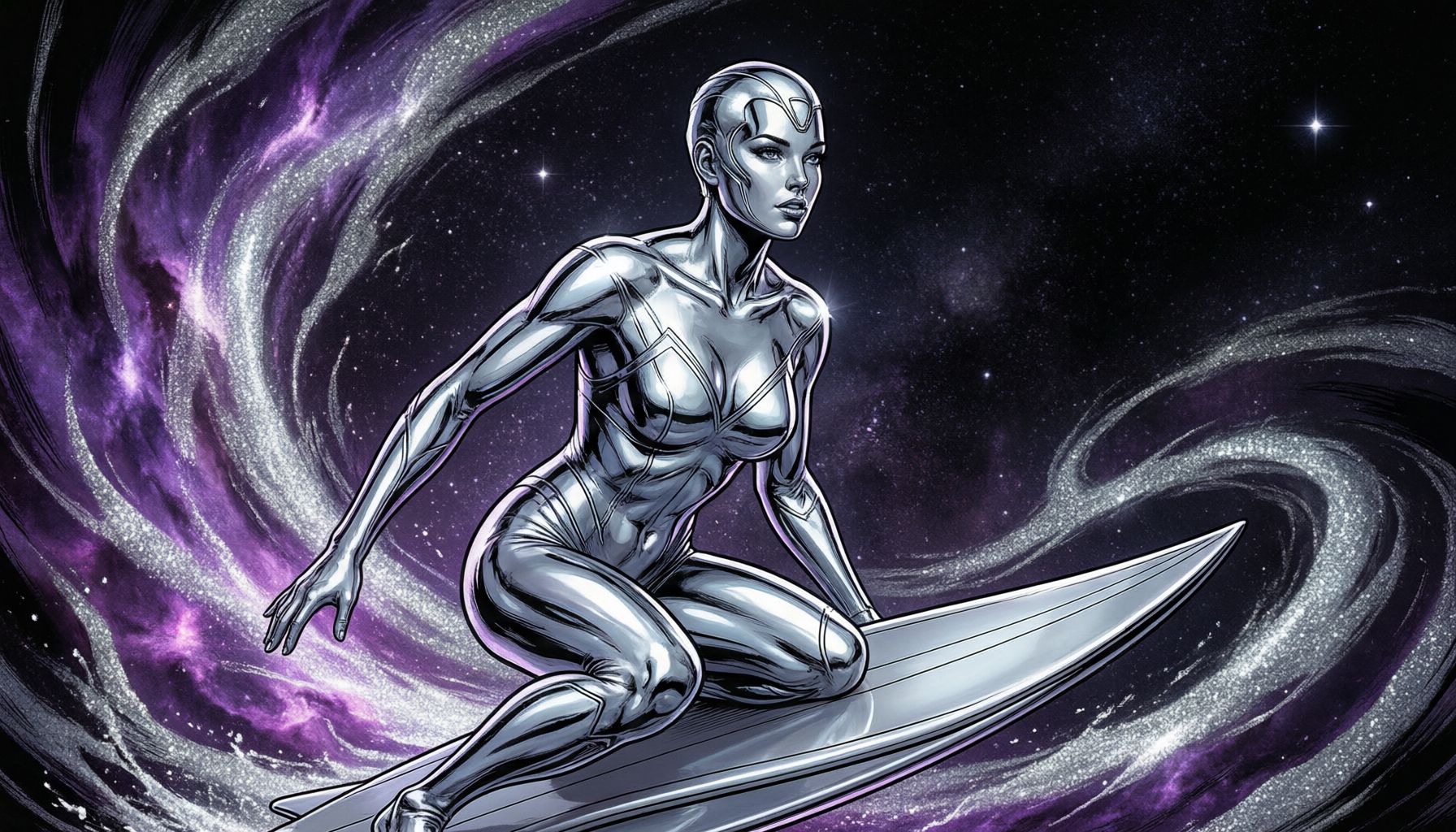
Shalla-Bal: Marvel's Female Silver Surfer Who Rides the Cosmic Tide on Her Own Terms
She started as the girl left behind on a utopian world. She became a galactic empress, a cosmic-powered herald, and one of the most compelling women in Marvel's interstellar mythos. Here's the full story of Shalla-Bal.
For decades, the Silver Surfer has been one of Marvel's most recognizable cosmic figures: a gleaming chrome figure on a surfboard, torn between duty and conscience, surfing the spaceways in eternal exile. But the character most people picture when they hear that name isn't the only one who's carried the title. Norrin Radd may have been the first Silver Surfer, but he was far from the last. And the second most important Surfer in Marvel history? She's from the same doomed paradise he came from. Her name is Shalla-Bal, and her story is arguably more emotionally complex than his.
If you've only encountered Shalla-Bal through the MCU's Fantastic Four: First Steps, where Julia Garner brings her to the big screen, you might not realize just how deep her comic history goes. She first appeared in 1968. She's ruled an entire civilization. She's watched her homeworld die. She's wielded the Power Cosmic itself. Let's get into exactly who she is and why she matters so much to Marvel's cosmic landscape.
The Girl From Zenn-La: Shalla-Bal's Origin Story
Shalla-Bal hails from Zenn-La, a planet in the Deneb system of the Milky Way galaxy. If you're not familiar with Zenn-La, think of it as Marvel's version of a perfect society: a world of philosophers, scientists, and artists who had long since moved past war, poverty, and scarcity. It sounds idyllic, and in many ways it was. But it was also stagnant. The Zenn-Lavians had become so intellectually advanced that they'd essentially stopped living. They existed in a state of perpetual contemplation, disconnected from the raw, messy experience of being alive.
Norrin Radd was one of the few Zenn-Lavians who felt the suffocation of that existence. He craved something more: adventure, risk, meaning beyond abstract thought. And Shalla-Bal loved him for it, even though it terrified her. She was grounded where he was restless, compassionate where he was driven. Their relationship is one of those rare comic book love stories that feels genuinely rooted in personality rather than plot convenience.
When Galactus arrived to consume Zenn-La, Norrin Radd made the deal that changed everything. He offered himself as Galactus's herald in exchange for sparing his homeworld. Galactus agreed, transformed Norrin into the Silver Surfer, and Zenn-La was saved. But Shalla-Bal? She was left behind. The man she loved was now a chrome-plated servant to a cosmic devourer, surfing from star to star, leading death to other worlds.
This is where most "love interest" characters would stop mattering. They'd wave goodbye in issue one, cry a little, and disappear into the background. Shalla-Bal didn't disappear. Not even close.
From Waiting to Ruling: Shalla-Bal as Empress of Zenn-La
After Norrin's exile, Shalla-Bal didn't just sit around pining. She stepped up. Zenn-La needed leadership, and she provided it, eventually ascending to the role of Empress. She governed her people through crises both cosmic and internal, proving herself to be a capable and thoughtful ruler. This wasn't a ceremonial title; she was actively shaping the future of an entire civilization.
The relationship between Shalla-Bal and Norrin Radd remained the emotional through-line of the original Silver Surfer series. Stan Lee and John Buscema introduced her in Silver Surfer #1 (August 1968), and she appeared in several subsequent issues. The tragedy of their love was central to the Surfer's character: he was a noble man trapped in service to a world-eater, haunted by the memory of the woman he'd sacrificed everything to protect. Shalla-Bal, meanwhile, carried the weight of a world she now had to lead without him.
What makes this dynamic work so well is the mutual respect between them. Shalla-Bal never resented Norrin for his choice. She understood why he did it, even as it broke her heart. And Norrin never stopped thinking of her, even as the Power Cosmic pulled him toward destinies far beyond Zenn-La. Their relationship has weathered betrayals, cosmic manipulations, and literal apocalypses, and it still stands as one of Marvel's most enduring romances.
When Paradise Burns: The Destruction of Zenn-La
Here's where Shalla-Bal's story takes a hard left turn into tragedy. In the comics, Zenn-La doesn't stay saved forever. Despite Norrin Radd's sacrifice, the planet is eventually destroyed by a being known as the Other (a cosmic entity of considerable power). The world that Norrin had given up everything to protect? Gone. The civilization Shalla-Bal had worked so hard to govern? Reduced to nothing.
This event is devastating for both characters, but it hits Shalla-Bal differently. For Norrin, Zenn-La's destruction was a retroactive gut-punch: he'd already been exiled, already lost his home in every way that mattered. But Shalla-Bal was there. She watched it happen. She experienced the full weight of an entire civilization's death in real time. The emotional toll of that is hard to overstate.
In some storylines, Shalla-Bal manages to restore Zenn-La using the Power Cosmic (more on that shortly). But the scars of its destruction never fully heal. It becomes a defining part of her character: the empress who lost her empire, the woman who watched paradise die and still found a way to keep going.
Wielding the Power Cosmic: Shalla-Bal's Abilities
Let's be clear: Shalla-Bal is not a watered-down version of the Silver Surfer. When she's infused with the Power Cosmic, she operates on the same level as Norrin Radd. The Power Cosmic is one of the most formidable energy sources in the Marvel Universe, and Shalla-Bal has demonstrated a mastery of it that rivals any herald Galactus has ever employed.
Her abilities include flight at faster-than-light speeds, energy projection and absorption, matter transmutation, force field generation, and the ability to manipulate matter at a subatomic level. She can heal others, project cosmic-level blasts, and survive unaided in the vacuum of space. In some storylines, she's demonstrated the ability to restore life to entire worlds, which is a level of power that puts her squarely in the upper tier of Marvel's cosmic hierarchy.
What distinguishes Shalla-Bal's use of the Power Cosmic from Norrin's is partly temperament. Norrin, for all his nobility, carries a deep well of guilt and self-loathing that sometimes clouds his judgment in battle. Shalla-Bal channels the Power Cosmic with a clarity of purpose that comes from her experience as a leader. She's not fighting to atone for anything. She's fighting because she's decided, in each moment, that this is what needs to be done. That makes her a different kind of combatant: more decisive, less prone to hesitation, and in some ways more dangerous.
Becoming the Silver Surfer: A Title Earned, Not Borrowed
Shalla-Bal doesn't just become "Silver Surfer" by default. She earns the mantle through her own actions, her own sacrifices, and her own willingness to carry a burden that would crush most beings in the universe. In the comics, she takes on the role of Silver Surfer after Galactus infuses her with a portion of the Power Cosmic, essentially making her a herald in the same mold as Norrin.
The significance of this shouldn't be understated. For decades, the Silver Surfer was synonymous with one character: Norrin Radd. He was the face, the figure, the icon. Having Shalla-Bal take on that same title, that same visual identity, that same cosmic responsibility, is a statement. It says the Silver Surfer isn't about one man's sacrifice. It's about the choice to put something bigger than yourself ahead of your own comfort, your own safety, your own life.
Shalla-Bal's tenure as Silver Surfer also explores a different side of what it means to serve Galactus. Norrin was driven by guilt and a desperate need for redemption. Shalla-Bal approaches the role with the pragmatism of a ruler. She understands sacrifice differently because she's already lost so much. There's a weight to her version of the character that feels distinct, even when she's doing things that Norrin has done before.
Shalla-Bal vs. Other Cosmic Beings: How Does She Stack Up?
Where does Shalla-Bal fit in the grand hierarchy of Marvel's cosmic-powered characters? Here's a direct comparison with other key figures who've held similar roles or wielded comparable power:
| Attribute | Shalla-Bal (Silver Surfer) | Norrin Radd (Silver Surfer) | Nova (Richard Rider) |
|---|---|---|---|
| First Appearance | Silver Surfer #1 (1968) | Fantastic Four #48 (1966) | Nova #1 (1976) |
| Power Source | Power Cosmic | Power Cosmic | Nova Force |
| Homeworld | Zenn-La | Zenn-La | Earth |
| Flight Speed | Faster than light | Faster than light | Faster than light |
| Matter Transmutation | Yes | Yes | Limited |
| Healing / Restoration | Planetary scale | Individual scale | Individual scale |
| Leadership Experience | Empress of Zenn-La | None (lone wanderer) | Nova Corps Centurion |
| MCU Appearance | Fantastic Four: First Steps (2025) | Not yet | Not yet |
Note: Power scaling in Marvel comics is notoriously inconsistent across eras and writers. This table reflects general portrayals in mainstream 616 continuity.
Why Fans Are Excited: Shalla-Bal in the MCU and Beyond
The announcement that Julia Garner would play Shalla-Bal in The Fantastic Four: First Steps landed like a cosmic shockwave. Garner, an Emmy-winning actor known for her magnetic and unsettling performances in Ozark and Inventing Anna, brings a level of acting credibility that signals Marvel is taking this character seriously. This isn't a cameo. This isn't a love-interest footnote. Shalla-Bal is the Silver Surfer in this film.
For longtime fans, the decision to cast Shalla-Bal rather than Norrin Radd is both surprising and refreshing. Norrin has been the Silver Surfer in every live-action adaptation to date (most notably in 2007's Fantastic Four: Rise of the Silver Surfer, where he was rendered as a CGI figure). Having Shalla-Bal take the role in the MCU's first proper Fantastic Four film accomplishes several things at once: it introduces a character who's deeply connected to the Surfer mythos without retreading familiar ground, it gives the film a different emotional dynamic, and it puts a woman in one of Marvel's most iconic cosmic roles.
The reaction from the fan community has been overwhelmingly positive, with many pointing out that Shalla-Bal's story offers richer dramatic potential for a team movie. Where Norrin Radd's narrative is fundamentally solitary, a man alone with his guilt and his surfboard, Shalla-Bal's story is inherently connected to community, leadership, and sacrifice on behalf of others. That's a better thematic fit for a film about the Fantastic Four, a team built on family and collective responsibility.
There's also the matter of representation. Marvel's cosmic tier has historically been male-dominated, and while characters like Gamora and Nebula have carved out significant space, having a woman carry the Silver Surfer mantle in the MCU's flagship cosmic film is a meaningful step. It's not tokenism; Shalla-Bal has earned this through more than five decades of comic history. She's been a queen, a cosmic warrior, and a woman who rebuilt herself after losing everything. That's a character who can anchor a film.
Essential Reading: Key Shalla-Bal Comic Appearances
If you want to dig into Shalla-Bal's comic history, here's where to start. Her appearances are scattered across several decades and series, but these are the stories that define her:
Silver Surfer #1 (1968) — Her first appearance and the origin of the Silver Surfer. Stan Lee and John Buscema establish her as Norrin Radd's beloved and the emotional heart of his sacrifice. This is where it all begins.
Silver Surfer #4 (1969) — Mephisto tries to manipulate the Surfer by exploiting his love for Shalla-Bal. This story showcases her importance to Norrin's character and introduces one of Marvel's most memorable cosmic-romantic conflicts.
Silver Surfer (vol. 3) #1-18 (1987-1989) — Steve Englehart's celebrated run redefines the Surfer's mythology and gives Shalla-Bal significantly more agency. She's no longer just the girl waiting at home; she's a political figure navigating the complexities of a planet in crisis.
Silver Surfer: Homecoming (1991) — A graphic novel that explores what happens when the Surfer finally returns to Zenn-La and confronts what Shalla-Bal has become in his absence.
Earth X (1999) — In this alternate-future storyline, Shalla-Bal takes on the Silver Surfer role herself, offering a glimpse of what she looks like wielding the full Power Cosmic as a herald.
Fantastic Four: First Foes – Shalla-Bal (2025) — A tie-in comic released alongside the MCU film, giving a fresh take on her origin and her path to becoming the Silver Surfer. A great modern entry point.
What Makes Shalla-Bal Different: Beyond the Chrome Surface
It's tempting to read Shalla-Bal as simply "the female Silver Surfer" and move on. That would be a mistake. Her character occupies a genuinely unique space in Marvel's cosmic pantheon, and the differences between her and Norrin Radd are worth examining carefully.
Norrin's story is fundamentally about guilt. He made a deal with a devil, and he's been trying to atone for it ever since. Every planet he led Galactus to, every civilization that burned because of his guidance, weighs on him. His heroism comes from that burden: he's a good man trying to balance an impossible ledger. That's a powerful narrative, and it's the reason the Silver Surfer has remained compelling for over fifty years.
Shalla-Bal's story is different. She didn't make a deal with Galactus. She didn't choose to become a herald. She was the one left behind, the one who had to pick up the pieces of a civilization that had been saved but not healed. Her journey isn't about atonement; it's about resilience. It's about what you do after the person you love makes a choice that reshapes the world around you, and you have to figure out how to live in that reshaped world without them.
That's a narrative that resonates differently. It speaks to the experience of people who don't get to be the hero of the story, who don't get to make the dramatic sacrifice, who just have to keep going when everything changes. And when Shalla-Bal eventually gains the Power Cosmic and becomes the Silver Surfer herself, it feels less like a transformation and more like a recognition of the strength she'd been carrying all along.
The Mephisto Problem: Love as a Weapon
No discussion of Shalla-Bal is complete without addressing Mephisto, Marvel's resident lord of hell and one of the most manipulative villains in the entire lineup. In the original Silver Surfer series, Mephisto recognizes that the Surfer's love for Shalla-Bal is his greatest vulnerability. What follows is a disturbing and compelling storyline where Mephisto attempts to corrupt, control, or destroy the Surfer by targeting the woman he loves.
Shalla-Bal is transported to Earth, placed in situations designed to exploit Norrin's emotions, and used as leverage in Mephisto's schemes. It's a storyline that could easily have reduced her to a helpless damsel, but the writers gave her enough agency to resist. She doesn't just suffer; she fights back. She refuses to be a pawn, even when the forces arrayed against her are literally infernal.
This arc is significant because it establishes that Shalla-Bal's strength isn't dependent on the Power Cosmic. Before she ever gained cosmic abilities, she was already formidable. She faced down a demon lord with nothing but her will and her refusal to break. That's the kind of character foundation that makes her eventual acquisition of the Power Cosmic feel earned rather than granted.
Frequently Asked Questions
Is Shalla-Bal the Silver Surfer in the MCU's Fantastic Four: First Steps?
Yes. Julia Garner plays Shalla-Bal, who takes on the role of the Silver Surfer in the MCU's Fantastic Four: First Steps. This is a deliberate departure from the comics' original Silver Surfer, Norrin Radd, and it gives the film a fresh take on the character. In the film's narrative, Shalla-Bal's connection to the Fantastic Four is central to the story rather than peripheral.
What is Shalla-Bal's relationship to Norrin Radd in the comics?
In the comics, Shalla-Bal is Norrin Radd's beloved on Zenn-La. They were together before Norrin made his deal with Galactus to become the Silver Surfer. Their relationship is one of the longest-running romantic threads in Marvel's cosmic stories, spanning decades of publication. She eventually becomes Empress of Zenn-La, and their paths cross again multiple times throughout the Silver Surfer's various series.
Does Shalla-Bal have the same powers as the original Silver Surfer?
When Shalla-Bal wields the Power Cosmic, yes. She has access to the same suite of abilities: flight at faster-than-light speeds, energy projection, matter transmutation, force fields, and cosmic-level healing. In some storylines, she's even demonstrated the ability to restore life to entire planets, which is a feat beyond what Norrin has typically been shown doing. Her power level is comparable to his, though her approach to using those powers tends to be more strategic and decisive.
Why did Marvel change the Silver Surfer to a woman for the MCU?
Marvel's decision to use Shalla-Bal instead of Norrin Radd as the Silver Surfer in Fantastic Four: First Steps serves multiple purposes. It introduces a character with deep comic roots while avoiding retreading the 2007 film's portrayal of the Surfer. It also provides a stronger thematic fit for a team movie centered on family and collective sacrifice, and it brings one of Marvel's most iconic cosmic roles into better gender balance. Shalla-Bal has over 50 years of comic history backing her up, so it's not a case of the MCU inventing a new character for diversity's sake. She's always been there.
Where should I start reading Shalla-Bal comics?
Start with Silver Surfer #1 (1968) for her first appearance and the origin story. Then move to Silver Surfer #4 for the Mephisto storyline. For a more modern and comprehensive take on her character, Steve Englehart's Silver Surfer volume 3 (1987-1989) gives her significantly more depth and agency. The Fantastic Four: First Foes – Shalla-Bal (2025) tie-in is a great contemporary entry point if you want something directly connected to the MCU adaptation.
The Surfer Who Chose Herself
Shalla-Bal's journey from the girl Norrin Radd left behind to a cosmic-powered force in her own right is one of the quiet triumphs of Marvel's long publishing history. She was never supposed to be the star. She was the love interest, the motivation, the reason the hero did what he did. That's how these stories usually work.
But Shalla-Bal refused to stay in that box. She ruled an empire. She survived the destruction of her world. She stood up to Mephisto. She wielded the Power Cosmic and proved she could carry the weight of the Silver Surfer mantle without being defined by the man who wore it first. And now, with her MCU debut, a whole new audience is about to discover what longtime fans have known for decades: Shalla-Bal isn't the female Silver Surfer. She's the Silver Surfer. Full stop.
The cosmic tide doesn't care about gender, origin, or who came first. It responds to whoever has the will to ride it. Shalla-Bal has that will. She always has.