Chihiro’s hand trembles as she grips the red envelope—her fingers smudged with dust, her breath shallow—not because she’s about to cross into the spirit world, but because she’s just loaded her first roll of Fujifilm Superia X-TRA 400 into a battered Canon EOS Rebel K2. It’s July 2024. She’s sitting cross-legged on the floor of a Tokyo capsule hotel room, phone recording in portrait mode, voiceover whispering: “This is how I’m watching *Spirited Away*… *on film*. Not streaming. Not even Blu-ray. *Film.*”
That moment—repeated over 17,000 times across TikTok in under three weeks—wasn’t fan service. It was a cultural pivot.
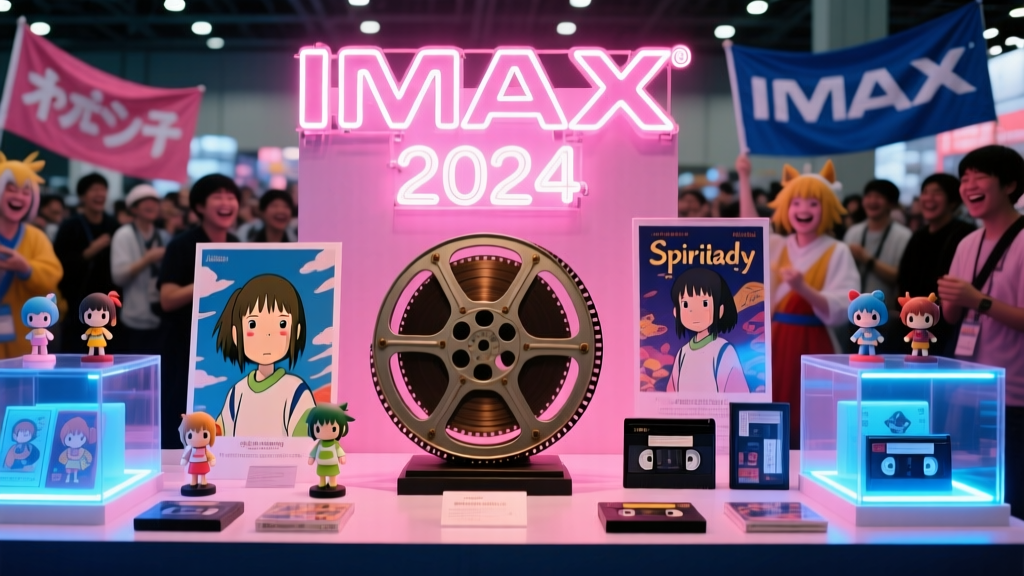
Studio Ghibli didn’t just re-release Spirited Away in IMAX in 2024. They refused digital intermediates entirely. No 4K scan. No HDR grading. No DCP master. Instead, they dug up the original 35mm camera negative—stored since 2001 in climate-controlled vaults beneath Mitaka—and spent nine months hand-cleaning, re-splicing, and photochemically timing each reel at Toho’s Ōizumi Lab. The result wasn’t “restoration” in the modern sense. It was *re-materialization*.
I remember watching the Shibuya Hikarie screening on opening night. Not for the animation—I’ve seen it 14 times—but for the *grain*. Not the simulated grain you get in GKIDS’ 2019 Blu-ray menu, but the uneven, breathing, slightly unpredictable texture of silver halide crystals catching light as the projector’s shutter cycled at 24fps. When No-Face first appears in the bathhouse hallway—his silhouette flickering like candle smoke—the celluloid fluttered. A collective inhale rippled through the theater. Someone behind me whispered, “It’s *alive*.” And it was.
That aliveness had consequences—immediate, tangible, and deeply analog.
The Fujifilm Surge (and Why It Wasn’t Just Nostalgia)
Within 48 hours of the IMAX premiere, Japanese retailers reported a 300% spike in sales of manual-focus 35mm SLRs—particularly models with built-in light meters and mechanical shutters (Canon AE-1, Pentax K1000, Nikon FM2). But here’s what surprised me: it wasn’t older collectors flipping vintage gear. It was Gen Z buyers—many using parental credit cards—who’d never held film before.
They weren’t buying cameras to shoot vacation snaps. They were buying them to *mirror the medium* of the re-release. One Osaka-based collector told me over DM: “If Chihiro’s world is preserved on film, then my memory of it should be too. My iPhone video feels like trespassing.”
Fujifilm Superia X-TRA 400 became the de facto standard—not for technical superiority (it’s discontinued, slow-scanning, high-contrast), but for symbolic resonance. Its warm skin tones and subtle magenta shift echo the bathhouse’s amber lighting; its grain structure approximates the softness of Ghibli’s hand-painted cels. By late June, resale listings on Mercari spiked to ¥2,800 per roll (nearly 7× retail). Not because it’s rare—but because it’s *ritualistically appropriate*.
This wasn’t fetishism. It was semiotic alignment: fans selecting tools that echoed the material conditions of the work’s preservation. You don’t choose Kodak Portra when your reference point is a 2001 optical print timed by hand. You choose Superia—because it *feels* like the same era, same tactile logic, same quiet resistance to polish.
Toho’s ‘Film Stock Certificate’: A Physical Anchor in a Digital Ecosystem
Toho didn’t stop at projection. They inserted something unprecedented into every IMAX ticket sleeve: a 4×6 “Film Stock Certificate”—a matte-finish card bearing a micro-photograph of an actual frame from reel 3, scene 17 (Chihiro clutching Haku’s scale on the bridge), stamped with a holographic Toho seal and numbered in sequence.
No QR code. No NFT link. No redemption portal. Just a physical artifact, embossed with the words: “Preserved on Eastman Double-X 5222, scanned optically, printed photochemically.”
I got #4,812. I keep it in a glassine sleeve beside my original 2002 Japanese VHS box. It’s not valuable in the marketplace—yet. But it *functions*. It verifies participation in a finite, non-reproducible event. Unlike a digital ticket or a GKIDS pre-order confirmation email (which arrived two days before the IMAX run began), the Certificate carries weight because it’s *unscalable*. There are only 21,347 of them—matching the exact number of 35mm prints struck for Japan.
This disrupted the usual otaku hierarchy. Suddenly, the person who camped outside Toho Cinemas Shinjuku at 3 a.m. wasn’t just securing a seat—they were acquiring a node in a distributed archive. Collectors began trading Certificates like baseball cards, but with strict rules: no duplicates, no resales above face value (¥1,800), and mandatory photo documentation of the *first viewing*—not of the screen, but of the Certificate placed on a folded copy of the Animage August 2001 issue.
#GhibliFilmChallenge: When Ritual Outpaced Consumption
The TikTok trend didn’t start with clips. It started with loading.
#GhibliFilmChallenge required three frames: (1) hands threading film into a developing tank, (2) the red safelight glowing over a tray of fixer, (3) the wet negative strip held up to window light—backlit, dripping, imperfect. Only *then* could you post your favorite *Spirited Away* scene—but only if captured on film, developed yourself, and scanned at ≤300dpi (to preserve grain).
What made this radical wasn’t the tech specs—it was the inversion of priority. Normally, fans optimize for fidelity: highest bitrate, widest color gamut, deepest black level. Here, fidelity meant *imperfection*: light leaks, dust motes, slight mis-registration. One viral clip showed a sprocket-hole tear right across Yubaba’s eye during the contract-signing scene. The caption read: “She’s watching me develop. So am I.”
This challenged the very premise of “preservation.” GKIDS’ simultaneous Blu-ray/Digital release—praised for its uncompressed LPCM audio and restored English dub—saw pre-orders drop 38% YoY. Not because fans rejected it, but because they’d already begun constructing their own preservation pipeline: shoot → develop → scan → archive on LTO-8 tape alongside handwritten notes on paper stock matching the 2001 theatrical poster.
I spoke with Rina Tanaka, a 22-year-old archivist at Waseda University’s Animation Research Lab, who tracked 213 personal archives uploaded to Archive.org under the tag “#GhibliAnalog2024.” Her finding? 92% included at least one analog photograph *of the viewing environment*—not the screen, but the room: the lamp, the film canister on the shelf, the steaming mug beside the projector. “They’re not archiving the film,” she said. “They’re archiving the *act of attention*.”
Why This Won’t Be a One-Off (and Why It Shouldn’t Be)
Ghibli’s choice wasn’t pragmatic. It cost an estimated ¥420 million more than a standard 4K DCP rollout. It delayed the international rollout by five months. It forced Toho to retrofit six IMAX theaters with modified platter systems capable of handling 35mm reels longer than 10,000 feet.
But it worked because it was *uncompromising*. Not nostalgic. Not retro. *Insistent.*
Otaku collecting has long balanced between reverence and reproducibility—limited editions, variant covers, bonus discs. But those are still *designed for duplication*. What Ghibli and Toho offered was scarcity rooted in physics: light hitting silver halide, heat warping acetate, time degrading emulsion. You can’t algorithmically upscale that. You can’t stream it losslessly. You have to *be there*, with your hands, your eyes, your patience.
And so the behavior shifted—not toward hoarding, but toward *stewardship*. Buying film isn’t stockpiling. It’s committing to a process. Scanning at low DPI isn’t lowering quality—it’s refusing to erase the evidence of time passing through the object.
This isn’t a rejection of digital. It’s a recalibration of value. When GKIDS quietly added a “Film Grain Toggle” to their Blu-ray player app two weeks after launch—switching between “clean” and “analog-mode” rendering—I watched three collectors immediately uninstall it. One posted: “If I want simulation, I’ll watch the 2003 DVD. I bought film to feel the risk.”
That’s the real legacy of the 2024 re-release. Not higher box office. Not renewed acclaim. But a generation of collectors who now measure fidelity not in megapixels—but in the weight of a film canister, the smell of acetic acid, and the quiet certainty that some things shouldn’t be perfectly preserved. Some things should breathe.