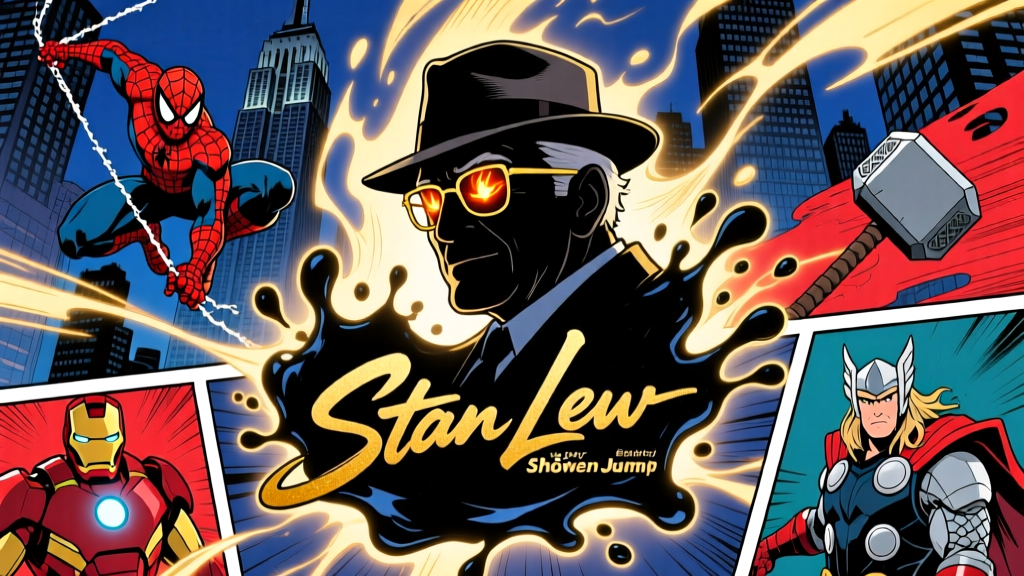
A line forms outside Hall H at San Diego Comic-Con. It stretches past three booths of Funko Pops, winds behind a life-size Wolverine cutout, and ends somewhere near the food court. At the front of the queue sits a 94-year-old man in tinted aviator glasses and a brown zip-up jacket, signing comic books as fast as his assistant can slide them across the table. He chats with every person in line. He tells the same joke to each one — and somehow makes it sound fresh every time. When a fan hands him a beat-up copy of Amazing Fantasy #15, he pauses, grins, and writes his name in blue Sharpie across the cover: Stan Lee.
That signature — two words scrawled in looping, theatrical cursive — has appeared on more comic books, convention napkins, prop shields, and collector certificates than any other autograph in the history of the comic book industry. It is, at this point, less a personal mark than a brand mark. The Stan Lee signature functions the way a Coca-Cola script or a Nike swoosh functions: instantly recognizable, emotionally loaded, commercially potent.
But unlike those corporate logos, the Stan Lee signature was always personal. He signed for hours at conventions well into his nineties. He signed comics mailed to him by fans. He signed prosthetic arms, guitar bodies, and at least one person's forehead. The signature was never gatekept behind VIP pricing or exclusivity windows. It was given freely, generously, because Stan Lee understood something most creative executives never grasp: the signature isn't just proof of identity. It's a contract between creator and reader.
A Pen Name That Became a Real Name
To understand the Stan Lee signature, you have to understand why it doesn't read "Stanley Lieber." The man born Stanley Martin Lieber on December 28, 1922, in New York City started at Timely Comics — the precursor to Marvel — as a 17-year-old assistant in 1939. His first published writing credit appeared in Captain America Comics #3 (May 1941), where he filled two pages of text under the byline "Stan Lee." He chose the pen name because he wanted to reserve his legal name for the serious literary work he fully intended to produce someday. The novel never materialized. The pen name stuck.
By the early 1960s, when Lee and artist Jack Kirby launched the Marvel Age of Comics with Fantastic Four #1 (November 1961), "Stan Lee" had become a public-facing identity. He used it in letter columns, in the Bullpen Bulletins gossip pages he wrote for every Marvel title, and in the breathless promotional copy that turned comic-book editors into minor celebrities. His column, "Stan's Soapbox," appeared in most Marvel books through the late 1960s and 1970s. Every installment ended with a sign-off: "Excelsior!"
That Latin word — meaning "ever upward" — became so tightly associated with Lee that it functioned as a secondary signature. He later told interviewers he adopted it in 1967 specifically because competitors could imitate his other catchphrases ("'Nuff said," "Face front, True Believer!") but would never get away with stealing a state motto. New York had adopted Excelsior in 1778. Stan Lee borrowed it for the funny pages.
"I used to end my columns with a different sign-off every week until I realized my competitors could copy them. So I picked a Latin word that nobody else would think to use. Excelsior! It means 'upward and onward.' Which is pretty much the story of my career." -- Stan Lee, interview with the Smithsonian Institution, 2015
He eventually changed his legal name from Stanley Lieber to Stan Lee. The pen name had consumed the person. The signature on his driver's license, his passport, and his tax returns all read the same two words he'd been scrawling on comic books since the Truman administration.
What the Signature Actually Looks Like
The Stan Lee signature went through several phases, and collectors can often date a signed item by the handwriting style alone.
The Early Cursive (1960s-1970s)
In the Silver Age of Marvel Comics, Lee's signature was a tight, disciplined cursive. The "S" in Stan featured a pronounced upper loop with a serif-like flick at the base. The "t" was crossed high and short. "Lee" was written with a flowing double-e that tapered into a thin descending tail. The whole thing tilted slightly rightward at about a 15-degree angle. This version appeared on internal Marvel correspondence, on original art boards returned to fans who mailed them back, and on the occasional convention program. It was legible, professional, and unremarkable — the signature of a working editor, not a celebrity.
The Showman's Script (1980s-2000s)
As Lee transitioned from editor-in-chief to Marvel's public ambassador — a shift that accelerated after he moved to Los Angeles in 1981 to develop television and film projects — his signature grew larger and more theatrical. The "S" expanded, opening into a wide, sweeping curve that sometimes underlined the entire first name. The "L" in Lee gained a dramatic initial stroke, often rising well above the other letters before descending into the double-e. This was the signature of a man who had become a brand. It appeared on convention posters, on licensing contracts, and on the certificates of authenticity that began accompanying signed merchandise in the 1990s.
The Late-Period Simplification (2010s)
In his final decade, as Lee aged past 90, the signature contracted. The elaborate loops gave way to a simpler, more compact mark. "Stan" became almost a single gesture — a bold "S" followed by a few quick strokes that suggested the remaining letters rather than spelling them out. "Lee" retained its recognizable double-e but lost some of the earlier flourishes. The slant increased. The overall impression was of speed and efficiency — a man who had written these two words tens of thousands of times and could now produce them almost reflexively.
Despite the simplification, authentication experts at CGC (Certified Guaranty Company) and CBCS (Comic Book Certification Service) maintained that Lee's signature remained remarkably consistent in its core letterforms across all decades. The spacing between "Stan" and "Lee," the angle of the "t" crossbar, and the characteristic loop on the final "e" were stable markers that trained graders could identify even in the late-period versions.
The Ink Color Question
Collectors debate whether blue or black Sharpie produces a more desirable Stan Lee autograph. The consensus in the grading community leans toward blue ink, which contrasts more sharply against the four-color printing on comic book covers and shows up better under CGC's UV authentication lights. Black ink, while more common, can blend with the dark areas of cover art and occasionally bleeds through thinner paper stock. Lee himself used both colors depending on what was within arm's reach at a signing table.
On the Pages: Stan Lee's Name Inside Marvel Comics
Before the autograph market turned signatures into commodities, Stan Lee's name appeared inside Marvel comics as part of the reading experience itself. The Bullpen Bulletins pages — a one-page mix of creator gossip, upcoming story teasers, and self-deprecating humor — always carried Lee's printed signature at the bottom. Millions of readers in the 1960s and 70s grew up seeing that name in every single issue they bought, which meant the Stan Lee signature was one of the most frequently encountered pieces of handwriting in American pop culture before it ever appeared on a paid autograph.
Lee also established the tradition of creator credits on the splash page of every Marvel comic. While DC Comics typically listed only the title and issue number on its interior pages, Marvel books credited the writer, penciller, inker, letterer, colorist, and editor by name — with "Stan Lee" usually at the top of the list. This practice had enormous consequences. It taught readers to associate specific names with specific creative voices, turning comic-book creators into personalities. When fans started writing letters to the editor (published in the letter columns Lee curated), they addressed them to Stan personally. The signature on the splash page was the return address.
That personal connection is why the Stan Lee signature carries emotional weight that, say, a Walt Disney autograph does not. Disney's signature is corporate royalty. Lee's is a pen pal you never met. Readers who grew up with his Bullpen Bulletins and letter-column responses felt they knew the man behind the name. When he started appearing at conventions in the 1970s and 80s, fans didn't just want an autograph — they wanted to shake the hand that had written the stories they'd argued about in schoolyards.
The Economics of Autograph Collecting
Stan Lee was, by most accounts, the most prolific living autograph signer in the entertainment industry. He appeared at dozens of conventions per year well into his eighties, and unlike many celebrities who limited their signing output or charged premium prices for personalizations, Lee typically signed anything placed in front of him. He signed comics, action figures, Funko Pops, posters, photographs, prop replicas, and at least one fan's prosthetic arm at a 2014 appearance in Los Angeles.
This accessibility created a paradox. The sheer volume of Stan Lee signed items in circulation means his autograph is not rare in the way that, for example, a Jack Kirby or Steve Ditko signature is rare. Kirby died in 1994, Ditko in 2018, and both were less enthusiastic convention signers during their lifetimes. A CGC-authenticated Ditko signature on an Amazing Fantasy #15 commands a significantly higher premium over the unsigned value than a Lee signature on the same book. The difference reflects scarcity, not stature.
That said, the Stan Lee signature still adds measurable value to graded comics. Data from CGC Signature Series sales (where the signing is witnessed by a CGC representative and authenticated on the spot) shows consistent premiums:
| Comic Title | CGC Grade | Unsigned Value (approx.) | Lee-Signed Value (approx.) | Signature Premium |
|---|---|---|---|---|
| Amazing Fantasy #15 (1962) | 9.8 | $450,000+ | $450,350+ | ~$350 |
| Amazing Spider-Man #300 (1988) | 9.8 | $2,200 | $4,000 | ~$1,800 |
| Fantastic Four #52 (1967) | 8.5 | $1,800 | $2,711 | ~$911 |
| Fantastic Four #36 (1965) | 6.0 | $900 | $1,300 | ~$400 |
| Amazing Spider-Man #300 (1988) | 9.2 | $450 | $1,100 | ~$650 |
| Spider-Man #1 (1990) | 9.8 | $120 | $430 | ~$310 |
The pattern in the data is clear: on extremely high-value books (like Amazing Fantasy #15 in top grade), the signature premium is a negligible percentage of the total value. The book is worth what it's worth regardless of who signed it. But on mid-tier keys in the $200-$2,000 range, a witnessed Stan Lee signature can add 30-80% to the market price. For modern-age books in top grade — where the unsigned copies are relatively affordable — the signature sometimes doubles or triples the value.
Authentication matters enormously. CGC's Signature Series (formerly known as the Witnessed Signature program) requires a CGC-authorized representative to be present when the signing occurs, ensuring chain of custody from pen to slab. Unsigned comics that later receive a third-party authentication label from CBCS or the now-defunct PGX carry lower premiums because the chain of custody is harder to verify.
The Posthumous Market Shift
When Stan Lee died on November 12, 2018, at Cedars-Sinai Medical Center in Los Angeles, the autograph market responded predictably. Prices for authenticated Lee signatures spiked roughly 15-25% across most categories in the six months following his death, according to sales tracking on GoCollect and eBay completed-listings data. This is standard behavior for any celebrity autograph: the supply becomes permanently finite, and collectors who had been holding off suddenly compete for a fixed pool of authenticated examples.
By 2020, prices had stabilized at a new baseline approximately 10-15% above pre-death levels. The adjustment was less dramatic than some speculators hoped — partly because Lee had signed so many items during his lifetime that the existing supply was substantial. A post-death scarcity premium exists, but it's cushioned by the sheer quantity of authenticated material already in circulation.
The Most Valuable Things Stan Lee Ever Signed
The upper end of the Stan Lee autograph market involves items where the signature is secondary to the object itself. A few standouts:
- Amazing Fantasy #15 (1962), CGC 9.6 -- The highest-graded copy of Spider-Man's first appearance sold for $3.6 million in a private transaction in September 2021. While that specific copy was unsigned, other high-grade copies with Stan Lee's witnessed signature have traded in the $450,000-$500,000 range at Heritage Auctions between 2022 and 2024.
- Fantastic Four #1 (1961), CGC 9.2 -- A Stan Lee-signed copy of the first Fantastic Four issue — the comic that launched the Marvel Age — sold at Heritage Auctions for approximately $45,000 in 2023. The unsigned market value for the same grade sits around $30,000.
- Original cover art, Amazing Spider-Man #1 (1963) -- Steve Ditko's original cover art for the first issue of Spider-Man's solo series, signed by both Ditko and Lee, sold at Heritage for $54,000 in 2022. Dual-signed Marvel art from the Silver Age is extraordinarily rare.
- Iron Man helmet prop (2008) -- A screen-used Mark III helmet from Jon Favreau's Iron Man, signed by Lee and Robert Downey Jr., was auctioned for charity in 2014 and fetched approximately $25,000.
- Personalized sketch on a napkin -- Lee occasionally drew a rough Spider-Man face (just the mask) alongside his signature on convention napkins. These informal sketches, authenticated by CGC or witnessed by reputable dealers, have sold in the $1,200-$3,500 range at auction — a remarkable return for a paper napkin.
The napkin sketches are worth dwelling on. They represent the purest form of the Stan Lee signature phenomenon: a disposable surface transformed into a collectible artifact by nothing more than a few strokes of a Sharpie and the cultural weight of the name behind them. No printing press, no editorial team, no distribution network required. Just the man, the marker, and whatever was lying on the table.
The Cameo Signature: Stan Lee's Face as a Second Autograph
In 1989, Stan Lee appeared on screen for the first time in a Marvel adaptation. His role in The Trial of the Incredible Hulk (a TV movie starring Bill Bixby) lasted approximately four seconds: he sat in a jury box, wearing a gray suit, looking vaguely annoyed. Nobody on set knew they were watching the beginning of a tradition that would outlast every other running gag in blockbuster cinema.
Lee's cameo appearances in Marvel films and television became a ritual. Between 1989 and his death in 2018, he appeared in over 35 Marvel productions — every single MCU film from Iron Man (2008) through Avengers: Endgame (2019), plus numerous non-MCU Marvel movies, TV series, and animated projects. Each cameo functioned as a visual signature: the audience's reward for paying attention, a wink from the creator embedded in the creation.
The cameos followed a loose formula. Lee appeared as an ordinary person — a bus driver, a mailman, a strip club DJ, a FedEx delivery man, a security guard — always peripheral to the main action, always recognizable. He never played a superhero. He never broke the fourth wall on screen (though the audience's recognition of him functioned as a meta-textual fourth-wall break regardless). The tradition was so consistent that audiences began scanning every scene of every Marvel film for his face, turning movie-going into a participatory scavenger hunt.
The cameos weren't vanity. They were punctuation marks. Every time Stan Lee appeared on screen as a janitor or a hot dog vendor, he was reinforcing the idea that the Marvel universe was built by working people — not gods, not billionaires, but folks who clocked in and did the job. It was the most democratic form of celebrity self-insertion in entertainment history.
After Lee's death, Marvel Studios faced a genuine creative problem. The cameos had become a structural expectation — woven into the rhythm of an MCU release the way a post-credits scene was. Director Joe Russo confirmed in interviews that the Avengers: Endgame cameo (Lee digitally de-aged, appearing as a 1970s-era driver shouting "Make love, not war!" at a military base) was always intended to be his final appearance. The film's post-credits sequence omitted the traditional cameo card, replacing it with a simple audio tribute and the sound of Lee's voice.
Marvel has not attempted to replace the tradition. No other creator, executive, or celebrity fills the cameo slot. The absence itself has become the signature.
Why the Signature Outlasts the Man
There's a reason the Stan Lee signature has become shorthand for the entire comic book industry, not just one publisher. Lee spent six decades dissolving the boundary between creator and brand. He didn't hide behind corporate anonymity the way most comic-book editors did. He didn't retreat into reclusive eccentricity the way artists like Ditko and Bill Watterson did. He made himself available — relentlessly, cheerfully, and for free — to anyone who wanted to meet the person behind the stories.
That accessibility built something more durable than a fanbase. It built a relationship. The signature is the physical residue of that relationship: proof that, at some point, the creator and the reader occupied the same physical space and acknowledged each other. In an industry built on fantasy, the autograph is the one real thing.
Several factors sustain the Stan Lee signature as an enduring cultural artifact rather than a fading relic:
- Generational transfer. The fans who met Lee at conventions in the 1970s and 80s are now in their fifties and sixties. They're passing their signed comics to children and grandchildren, embedding the signature in family histories that extend beyond collecting.
- Institutional recognition. The Smithsonian Institution has archived Lee-related materials. The Hollywood Walk of Fame awarded him a star in 2011. Cultural institutions treat the signature as a document worth preserving, not just a collectible worth trading.
- MCU audience expansion. Marvel Studios' films have grossed over $29 billion worldwide as of 2024, introducing Lee's name and image to billions of viewers who never bought a comic book. Every new Marvel fan is a potential future collector of authenticated Lee signatures.
- Finite supply ceiling. Lee's death in 2018 means no new signatures will ever enter the market. The total pool of authenticated examples is fixed. Basic economics applies.
Collectors pay for that reality. They pay for the blue Sharpie mark on a comic book cover the way art collectors pay for brushstrokes on canvas — not because the ink itself has intrinsic value, but because it represents a moment of contact between a person and their audience. Stan Lee signed an estimated hundreds of thousands of items during his lifetime, and each one of those signatures was, in its own small way, a promise: I made this. I'm glad you read it. Here's my name.
The comic book industry has produced writers with more literary ambition, artists with greater technical skill, and executives with sharper business instincts. But it has never produced another figure who understood, as completely as Stan Lee did, that the signature matters as much as the story. The ink flows in both directions. And it hasn't dried.