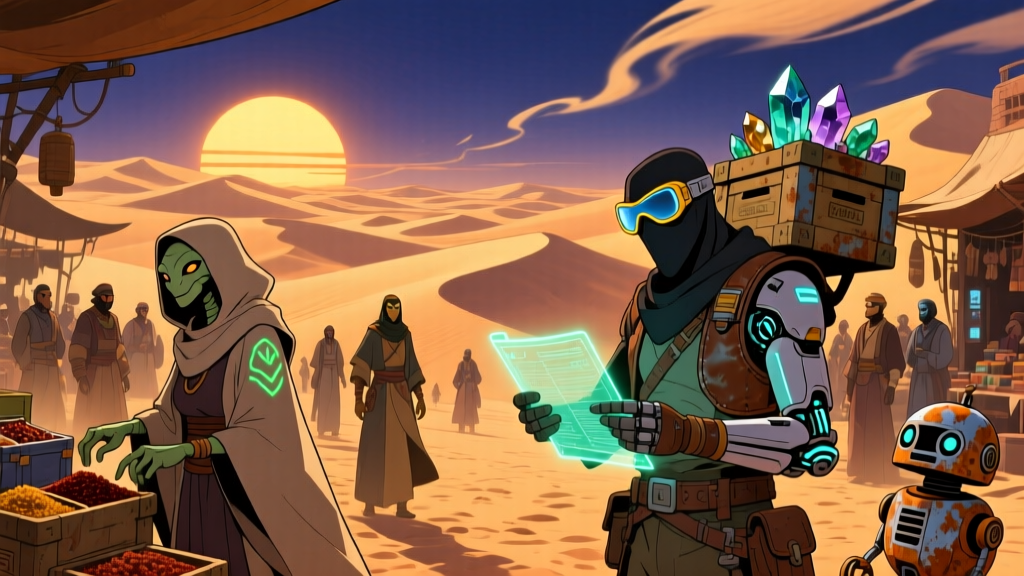
The twin suns are already brutal by mid-morning. Heat shimmers off the duracrete walls of Mos Eisley's spaceport district, and somewhere down a narrow alley, a Toydarian junk dealer is haggling over a hyperdrive motivator that probably doesn't work. This is Tatooine — a circumbinary rock orbiting two stars in the Outer Rim, where the Hutt cartel runs the underworld and commerce happens in back alleys, sandcrawlers, and dimly lit cantinas.
Tatooine traders have occupied a surprisingly large share of Star Wars storytelling across three decades of films, television, novels, and video games. From Watto's cramped junk shop in The Phantom Menace (1999) to the digital bazaars of Star Wars: The Old Republic (2011–present), the desert planet's merchant class tells you more about the galaxy's economic underbelly than any Senate hearing ever could.
Here's the thing: nobody goes to Tatooine on purpose. You end up there because your hyperdrive failed, because you're hiding from the Empire, or because your uncle bought a pair of droids that turned out to be carrying stolen Death Star schematics. And once you're stuck, you have to deal with the locals — the scavengers, the hustlers, the spice runners, and the moisture farmers who somehow keep this whole dust-choked economy running.
Watto's Junk Shop and the Toydarian Monopoly on Used Parts
Watto is the first Tatooine trader most viewers actually meet. He runs a junk shop in Mos Espa — a settlement built around the Boonta Eve Classic podracing circuit, which means his clientele is a rotating cast of gamblers, racers, and desperate pilots who need replacement parts yesterday. The shop itself is a cluttered tomb of salvaged starship components, droid servos, power converters, and things that may or may not be legal under Republic trade law.
What makes Watto interesting isn't just his inventory. It's his species. Toydarians are native to the planet Toydaria, a world in Hutt Space, and their culture revolves almost entirely around commerce. A Toydarian's word is considered binding in trade negotiations — this is explicitly established in the Star Wars: The Essential Guide to Alien Species (2001) and reinforced across Legends-era sourcebooks. Watto isn't just a random junk dealer; he's a cultural ambassador of a species that treats haggling as a sacred social contract.
The shop carries roughly what you'd expect from an Outer Rim salvage operation. Hyperdrive motivators (usually in questionable condition), repulsorlift coils, astromech restraining bolts, and a dizzying array of spare parts organized in a system only Watto himself understands. In The Phantom Menace, Qui-Gon Jinn attempts to purchase a T-14 hyperdrive generator, which Watto values at around 1,200 wuupiugs — a currency unit that tells you the Republic credit system has limited reach this far from the Core Worlds.
"No wuupiugs, no parts. That's the only language Watto speaks, and he speaks it fluently." — The Phantom Menace novelization by Terry Brooks (1999)
Watto's gambling addiction is also relevant to understanding Tatooine's merchant culture. He bets on podracing, which means his entire business model is underwritten by the racing economy. When Anakin wins the Boonta Eve Classic, Watto loses both his slave (Shmi Skywalker) and his star podrace entry fee. The junk shop survives, but barely — by the time of Attack of the Clones (2002), Watto has downsized considerably and admits the business "hasn't been the same." That line, delivered casually in a five-second scene, tells you everything about how fragile small commerce is on a world with no central banking infrastructure.
The Jawas: Nomadic Scavengers and the Sandcrawler Trade Network
If Watto represents the settled merchant class, the Jawas represent the itinerant one. Standing roughly one meter tall, wrapped head to toe in rough brown robes with glowing yellow eyes peering from deep hoods, Jawas are Tatooine's most recognizable traders — and its most misunderstood.
Jawas operate out of sandcrawlers: massive, rust-colored treaded vehicles originally designed by the Czerka Corporation for mining operations on other worlds. A single sandcrawler can house an entire Jawa clan — typically 200 to 300 individuals — along with their accumulated salvage. These vehicles travel in loops across the Jundland Wastes and the Dune Sea, stopping at moisture farms to sell droids, spare parts, and whatever else they've scavenged from crashed ships and abandoned settlements.
The Jawa trade model is fascinating because it operates on pure salvage economics. They don't manufacture anything. Every item in a Jawa sandcrawler's hold was either found, traded for, or — in certain cases — acquired from someone who wasn't going to miss it. Their reputation for selling defective droids is well-earned. In A New Hope (1977), Owen Lars purchases R2-D2 and C-3PO from a Jawa clan, and the R2 unit nearly gets away from them within hours. The fact that C-3PO's restraining bolt was clearly tampered with (a detail visible in the film's original 1977 theatrical cut) suggests the Jawas knew these droids were special and took precautions.
George Lucas filmed the Jawa scenes in Tunisia, specifically near the Chott el Djerid salt flats and the town of Nefta. The sandcrawler prop used in the original trilogy was a partial build — only the lower section was constructed physically, with the upper portions matted in post-production. This practical limitation accidentally created one of the most iconic silhouettes in all of Star Wars.
Jawa language, known as Jawaese, is a rapid-fire patois of squeaks, clicks, and truncated Basic words. The Star Wars: Galaxy Guide 7: Mos Eisley sourcebook (West End Games, 1993) established that Jawas have a complex internal clan hierarchy, with a "Jawa chief" or "nebit" serving as both tribal leader and chief negotiator during trades. When you hear "Utinni!" that's not just an exclamation — it functions as a rallying call, a trade greeting, and occasionally a warning.
Mos Eisley Cantina: Where the Real Deals Happen
Chalmun's Cantina — known to practically everyone as the Mos Eisley Cantina — isn't technically a trading post. But anyone who's watched more than two Star Wars films knows that in the Outer Rim, the line between a bar and a marketplace is basically nonexistent.
Obi-Wan Kenobi called it "a more wretched hive of scum and villainy" in one of the most quoted lines in cinema history, and that description doubles as an economic assessment. The cantina serves as an informal exchange for smugglers, bounty hunters, and independent freighter captains. Han Solo negotiated the Kessel Run delivery contract here. Greedo attempted to collect a bounty here. Luke Skywalker's journey off-world began here. Every one of these encounters is, at its core, a commercial transaction.
The cantina's owner, Chalmun, is a Wookiee who established the establishment sometime before the Galactic Civil War. According to the Mos Eisley Cantina Adventure Pack for the Star Wars Roleplaying Game (West End Games, 1997), the bar's clientele shifts depending on the season. During podracing season, you get gamblers and pit crews. During the harvest cycles of the local moisture farming communities, you get agricultural traders looking to offload surplus water condensate. And during Imperial crackdowns, the place goes quiet — everyone who has anything to hide stays away.
The band — Figrin D'an and the Modal Nodes — provides constant background entertainment, which serves a dual purpose: it drowns out conversations that shouldn't be overheard and keeps the atmosphere just chaotic enough to discourage Imperial inspections. The cantina's "no blasters" rule (enforced by the bartender Wuher with varying levels of commitment) is less about safety and more about protecting inventory. A stray blaster bolt could punch through the wall into the storeroom, where Wuher keeps everything from spotchka to whyren — some of it taxed, most of it not.
The Patron Economy: Who Trades What
Breaking down the cantina's regulars by trade specialty gives you a surprisingly complete picture of Tatooine's informal economy:
- Smugglers — Han Solo, Lando Calrissian (in his younger days), and countless unnamed freighter pilots. Primary trade goods: spice, stolen military hardware, forged transit permits.
- Bounty hunters — Boba Fett, Bossk, IG-88. They treat the cantina as an information market, buying and selling location data on targets.
- Independent merchants — The unnamed Rodian, the Sakiyan, the Duros in the corner booth. These are small-time operators running cargoes between Tatooine and neighboring systems like Ryloth and Nal Hutta.
- Fixers and information brokers — The type of character who sells docking bay numbers, Imperial patrol schedules, and hyperspace route updates.
The Moisture Farmers' Market: Where Water Is Currency
Strip away the smugglers and the Jedi and the Sith Lords, and Tatooine's actual economy runs on water. Moisture farming is the planet's only legitimate industry at scale, and the moisture farmers' market — scattered across settlements like Anchorhead, Bestine, and Tosche Station — is where the real working-class commerce happens.
A standard moisture vaporator (the kind Lars family operated on their homestead) pulls roughly 1.5 liters of atmospheric water per standard day under optimal conditions. On a planet where annual rainfall averages less than 3 centimeters, this technology is the difference between survival and desiccation. The Lars family operated approximately 18 vaporators across their property, which would yield around 27 liters daily — enough for household use with a small surplus for trade.
At Tosche Station — the infamous location where Luke whined about picking up power converters — farmers gather to sell surplus water, trade equipment, and socialize. The station functions as a combination general store, equipment depot, and community center. In the original A New Hope script, deleted scenes showed Luke's friends Biggs Darklighter and Camie Marstrap hanging out here, which would have established Tosche Station as the social hub for Tatooine's young farming community. Those scenes were cut, but the location survived in the Expanded Universe and later appeared in both the Star Wars Galaxies MMORPG (2003–2011) and various sourcebooks.
The moisture economy also explains why Tatooine has any population at all. Without water extraction technology, the planet would be uninhabitable for humans. The Dune Sea, the Jundland Wastes, the Northern Dust Plains — these aren't just scenic backdrops. They're hostile environments that actively kill anyone without a functioning vaporator or a reliable water supply line. Every settlement on Tatooine is, functionally, a cluster of moisture farms with a market at the center.
The Vaporator Supply Chain
The components required to maintain a moisture vaporator — condensate filters, power cells, intake manifolds, desiccant packs — must be imported. Tatooine has no manufacturing base to speak of. This creates a dependency on off-world supply chains that runs through the same spaceports where Watto and the Jawas operate. The price of a replacement condensate filter at Bestine Market fluctuates between 15 and 45 credits depending on shipping schedules and Hutt tariff enforcement. That's not trivia — that's the kind of economic pressure that drives farmers to deal with Jawas for cheaper (if less reliable) parts.
Old Republic Merchants: 4,000 Years Before Watto
Jump back roughly 4,000 years before the events of the films, and Tatooine is still a trading hub — just under different management. Star Wars: Knights of the Old Republic (BioWare, 2003) places the player on Tatooine during the Jedi Civil War era, and the planet's merchant infrastructure is already fully established by that point.
In KOTOR's Anchorhead settlement, you encounter several named merchants. The most notable is Czerka Corporation's regional office, which sells weapons, armor, and equipment at inflated prices that reflect their monopoly position on the planet. Czerka's presence on Tatooine during this era is significant because the corporation is one of the galaxy's oldest commercial entities — it predates the Republic itself, having been founded approximately 15,000 years before the films. Their Anchorhead branch deals primarily in mining equipment (Tatooine had brief mining booms in its early colonial history) and personal defense hardware for settlers worried about Tusken Raider attacks.
The game also features independent merchants who operate outside Czerka's shadow. Yuka, a Twi'lek merchant in Anchorhead, sells specialty items including rare swoop bike parts and upgrade components. Her inventory changes based on the player's level, which mechanically represents the informal supply network that independent traders maintain through contacts with off-world freighter captains.
KOTOR's Dreshdae spaceport on the Sith-controlled world of Korriban also connects back to Tatooine's trade routes. The same merchants running supplies to Dreshdae often pass through Tatooine's spaceports, creating a circuit of Outer Rim commerce that the Republic's tax collectors never fully mapped.
SWTOR: The Galactic Trade Commission Era
Star Wars: The Old Republic (BioWare, 2011–present) continues Tatooine's merchant tradition with the added complexity of player-driven economies. The game's Galactic Trade Network (GTN) functions as an auction house where players list items, and the NPC vendors on Tatooine itself sell faction-specific equipment that reflects the ongoing Cold War between the Republic and the Sith Empire.
Tatooine in SWTOR features several vendor types: general goods merchants near the Republic and Imperial base camps, weapons and armor specialists, and medcenter supply officers who sell healing stims and medical equipment. The planet's mission hub in the town of Mos Ila — a settlement not present in the films — includes a marketplace area where NPCs conduct trade in salvaged technology, rare desert minerals, and information about nearby Rakata ruins.
One detail worth noting: SWTOR's Tatooine includes Huttese-language signage on several merchant stalls, confirming that Hutt economic influence over the planet dates back at least to this era. The Hutts don't just run crime here — they run the regulatory framework that makes commerce possible in a place with no functioning government.
Jedi: Fallen Order and the Haxion Brood
Star Wars Jedi: Fallen Order (Respawn Entertainment, 2019) introduces a different kind of Tatooine trader through the Haxion Brood — a criminal syndicate that operates out of the planet's underbelly. While not a traditional "merchant" in the Watto sense, the Brood functions as a black market distribution network for stolen Imperial technology and contraband goods.
The Haxion Brood operates gambling parlors and fighting pits where bets are placed in credits, and the "merchandise" includes everything from confiscated lightsaber components to stolen starship manifests. This represents the darker end of Tatooine's trader spectrum — where commerce and organized crime are functionally identical.
Cal Kestis's brief time on Tatooine in Fallen Order doesn't feature traditional shopkeeping, but the Haxion Brood's presence reinforces a point the franchise has made consistently: on Tatooine, every transaction carries risk. You don't know if the part you're buying is genuine, if the information you're purchasing is current, or if the droid you just traded for is carrying a tracking beacon for someone who will come looking for it later.
Merchant Comparison: Who Sells What on Tatooine
| Merchant | Source | Primary Goods | Location | Era |
|---|---|---|---|---|
| Watto | Films (Ep. I & II) | Starship parts, droids, tools | Mos Espa | 32–22 BBY |
| Jawa clans | Films (Ep. IV) | Salvaged droids, scrap metal, misc. parts | Mobile (sandcrawlers) | 0 BBY onward |
| Chalmun's Cantina patrons | Films (Ep. IV) | Information, smuggling contracts, bounties | Mos Eisley | 0 BBY |
| Moisture farmers | Films, EU sources | Water, surplus crops, farming equipment | Tosche Station, Bestine | All eras |
| Czerka Corp. office | KOTOR (2003) | Mining equipment, weapons, armor | Anchorhead | ~3956 BBY |
| Yuka (Twi'lek trader) | KOTOR (2003) | Swoop parts, specialty items | Anchorhead | ~3956 BBY |
| Mos Ila marketplace | SWTOR (2011–) | Faction equipment, salvage, minerals | Mos Ila | ~3643 BBY |
| Haxion Brood | Jedi: Fallen Order (2019) | Contraband, stolen Imperial tech, bets | Tatooine underground | 14 BBY |
| BBY = Before the Battle of Yavin (Ep. IV). All dates approximate per canon/Legends sources. | ||||
The Spice Routes and Jabba's Merchant Empire
No discussion of Tatooine traders is complete without Jabba the Hutt. Jabba's Palace, located in the desert outside Mos Eisley, functions as the nerve center for the largest criminal trading network in the Arkanis sector. Under Jabba's control, spice (primarily glitterstim from Kessel) flows through Tatooine's spaceports and onward to markets across the Outer Rim.
Jabba's operation employs hundreds of beings in support roles: accountants, cargo inspectors, warehouse managers, and fixers who handle disputes between subordinate criminal crews. In Return of the Jedi (1983), we see Bib Fortuna functioning as Jabba's majordomo — essentially a chief operating officer for the entire trading syndicate. The Max Rebo Band provides entertainment, but even they are employees with a contract. Max Rebo himself is a Ortolan musician who signed a lifetime contract with Jabba in exchange for "unlimited food" — a deal that sounds generous until you remember that Jabba can kill you for any reason and the contract doesn't include dental.
The Hutt Cartel's influence extends beyond Jabba's personal operation. Gardulla the Hutt maintained a competing presence on Tatooine, and the Desilijic kajidic (Jabba's clan) had economic interests that stretched from Tatooine to Nal Hutta, the Hutt homeworld. This means Tatooine's "local" merchant economy is actually a subsidiary of a multi-system criminal conglomerate — a detail that the films hint at but the expanded materials make explicit.
The spice trade itself is worth examining. Glitterstim, the most common variety, is mined by spider-like creatures in the spice mines of Kessel. It's processed, packaged, and shipped through Tatooine as a transit point because the planet sits at the intersection of several hyperlanes: the Corellian Trade Spine, the Ootmian Pabol (the Hutt hyperspace route), and various smaller routes connecting to the Arkanis and Seswenna sectors. Geography — or rather, astrogation — is what makes Tatooine a trading hub despite being an ecological disaster zone.
Extended Universe and Canon Merchants Worth Noting
Several Tatooine traders from the expanded materials deserve specific mention. The Star Wars: Galaxies MMORPG featured a robust player-driven economy on Tatooine, with NPC merchants like Tekil Barje (a weapons dealer in Mos Eisley) and various Jawa clan traders who offered randomized loot tables. The game's crafting system meant that many of the best items on Tatooine were actually produced by player characters who set up shops in Bestine and Mos Eisley, creating a hybrid economy that mirrored the planet's canon status as a trade crossroads.
In the canon-era novel Aftermath: Life Debt by Chuck Wendig (2016), Tatooine's post-Imperial economy is shown struggling to adapt to the New Republic's governance. The power vacuum left by Jabba's death (in Return of the Jedi) created opportunities for smaller criminal traders to fill the gap, leading to a period of chaotic free-market competition between former Hutt lieutenants, independent smugglers, and legitimate merchants who'd been suppressed under Hutt rule.
The animated series Star Wars: The Clone Wars (2008–2020) introduced the concept of Tatooine's podrace economy in greater detail. The Boonta Eve Classic isn't just entertainment — it's a massive commercial event that drives trade across the entire Mos Espa region. Vendors set up temporary stalls, parts dealers see annual sales spikes, and the race's entry fees fund a significant portion of the local settlement's infrastructure maintenance. It's essentially Tatooine's version of the Super Bowl, with all the attendant economic activity.
Frequently Asked Questions
What currency do Tatooine traders use?
Tatooine traders use multiple currencies depending on the era and the merchant. During the Republic era, Watto accepts wuupiugs, a localized currency with limited exchange value outside the Outer Rim. Republic credits are technically valid but not always honored — Watto explicitly refuses Qui-Gon's Republic credits in The Phantom Menace, calling them "no good here." By the Imperial era, Imperial credits are the standard, though Hutt-issued currency and barter arrangements remain common in informal markets. The Jawa preference for physical trade (droids for parts, parts for water) suggests they operate largely outside formal currency systems altogether.
Are Jawas the same species as the Sand People?
No. Jawas and Tusken Raiders (commonly called Sand People) are two distinct species that both evolved on Tatooine. Jawas are approximately one meter tall, wear brown robes, and function as nomadic traders and scavengers. Tusken Raiders are taller, wear wrapped face coverings and tan-colored garments, and live as tribal warriors in the Jundland Wastes. The two groups have a complicated relationship — they trade with each other occasionally, but Tuskens also raid Jawa sandcrawlers. In The Book of Boba Fett (2021–2022), we see hints of cooperation between Tuskens and off-worlders, but historically the two native species have maintained separate cultures with very different approaches to commerce.
Which Star Wars game has the best Tatooine merchant experience?
This depends on what you're looking for. Knights of the Old Republic (2003) offers the most narrative-rich merchant interactions, with named vendors who have dialogue trees and quest connections. Star Wars Galaxies (2003–2011) provided the deepest economic simulation, with player-run shops and a crafting system that made Tatooine's markets feel genuinely alive. SWTOR (2011–present) has competent NPC vendors but its Tatooine content is less distinctive. Jedi: Fallen Order (2019) barely features traditional merchants, focusing instead on combat encounters with the Haxion Brood. For pure merchant immersion, KOTOR and Galaxies remain the gold standard.
Why is Tatooine such a central trading location despite being a desert?
Three factors. First, hyperspace positioning — Tatooine sits at the junction of multiple trade routes including the Corellian Trade Spine and the Ootmian Pabol. Second, Hutt investment — the Hutt Cartel developed Tatooine's spaceports as transit points for spice trafficking, which created infrastructure that legitimate traders also use. Third, low regulation — as an Outer Rim world with no effective central government, Tatooine attracts merchants who want to avoid Republic or Imperial trade restrictions. The desert is irrelevant to the economy; the spaceports and the hyperlanes are what matter.
Does Tatooine appear in The Mandalorian with any new merchants?
Yes. The Mandalorian and The Book of Boba Fett both feature Tatooine merchants, though most are unnamed or minor characters. Mos Eisley appears in both series, and the spaceport is shown to have evolved significantly since the original trilogy era. The most significant "trader" figure in these shows is Boba Fett himself, who transitions from bounty hunter to de facto crime lord controlling Tatooine's trade routes. TheMods — cyborg street urchins who operate as informal guides and scavengers — represent a new class of micro-entrepreneurs in the post-Imperial economy.
Sand, Sweat, and Supply Chains
Tatooine's economy works the way all frontier economies work: through a patchwork of formal and informal trade, held together by individuals who see opportunity in places that institutions have written off. Watto's junk shop isn't glamorous. The Jawas' sandcrawler smells like burned-out servos and recycled air. Chalmun's Cantina has a no-droids policy and a pest problem. And the moisture farmers are just trying to keep their vaporators running long enough to sell another liter of water before the next dust storm.
But that's the texture that makes Tatooine traders compelling. They're not Jedi or Sith. They're not heroes or villains in any grand narrative sense. They're people — and aliens — trying to make a living on a planet that actively wants them dead. Every transaction on Tatooine carries a survival calculation behind it: is this part worth the price? Can I trust this seller? Will this droid actually work, or will it blow a restraining bolt and run off into the desert?
From Watto's wuupiug-based haggling in Mos Espa to the Haxion Brood's underground fighting pits, from Czerka's corporate storefronts in KOTOR to the player-run bazaars of Star Wars Galaxies, Tatooine's merchants have always been one of the franchise's most grounded and relatable elements. The twin suns set every evening over the Dune Sea, and somewhere in Mos Eisley, a deal is being made that nobody will ever hear about. That's Tatooine commerce. And it's been running quietly for over four decades of storytelling.