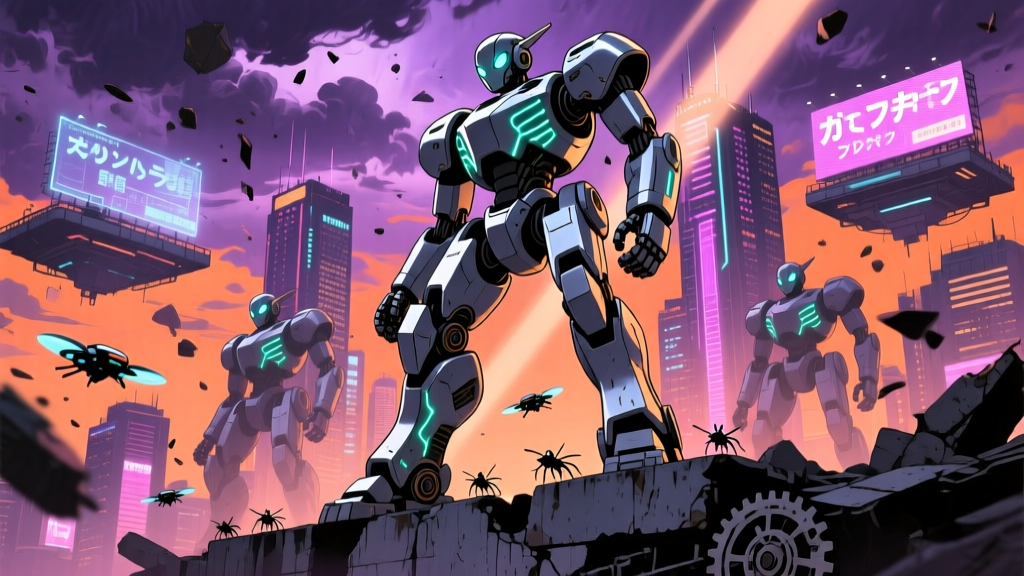
Picture this. A 79-meter steel frame rises from churning black ocean. Rain hammers down on armor plating that weighs nearly two thousand metric tons. Inside the cockpit, two pilots share every thought, every memory, every fear — their nervous systems fused through a neural bridge called the Drift. The Jaeger’s eyes ignite. A Kaiju screams from the darkness ahead. And then they collide with the force of a freight train made of tungsten.
That’s the opening of Pacific Rim, and it captures something that every mecha fan understands at a cellular level: the moment a big bot appears on screen, the rest of the world goes quiet. Your eyes widen. Your pulse quickens. You’re eight years old again, and nothing else matters.
But this obsession didn’t start with Guillermo del Toro’s love letter to Japanese mecha. It stretches back decades — across Pacific oceans, through toy aisles, into the hearts of millions who grew up believing that somewhere, somehow, a giant robot was waiting for them to climb inside.
The Day Toys Became Legends
September 1984. A Saturday morning cartoon hit American television screens with a premise so absurd it should have died in a pitch meeting: alien robots that disguise themselves as cars and trucks, locked in an eternal war across the stars. The Transformers wasn’t the first giant robot show — Japan had been producing them since the 1960s — but it was the first to plant a flag in Western pop culture and refuse to let go.
The original animated series ran for four seasons across 98 episodes, and it spawned what would become one of the most commercially successful entertainment franchises in history. By the time Hasbro’s revenue reports rolled in for 1985, Transformers toy sales had exceeded $300 million in the United States alone. That’s roughly $870 million in 2025 dollars, adjusted for inflation.
Here’s what most people forget: the show was essentially a 22-minute toy commercial. Every new character introduction, every vehicle mode showcase, every “roll out” sequence existed to move product off shelves. Yet the emotional resonance went far deeper than commerce. When Optimus Prime died in The Transformers: The Movie (1986), children wept in theaters. The Los Angeles Times reported that parents called the studio to complain about traumatized kids. The character’s death was so impactful that it became a defining cultural moment for an entire generation — the Bambi’s-mother moment of the 1980s.
“Freedom is the right of all sentient beings.” — Optimus Prime. Three sentences that taught more kids about moral philosophy than any textbook ever could.
Peter Cullen, the voice behind Optimus, based the character’s gravitas on his brother Larry — a Marine Corps veteran who told him to “be strong enough to be gentle.” That philosophy seeped into every line reading, every battlefield speech, every quiet moment of leadership. It gave Optimus Prime something that no amount of CGI could replicate: weight. Not the physical weight of a 10-meter-tall alien robot, but the moral weight of a leader who carried the survival of two species on his chrome-plated shoulders.
Megatron: The Villain Who Made Sense
And then there was Megatron. Frank Welker’s snarling baritone turned the Decepticon leader into one of animation’s most memorable antagonists. But Megatron wasn’t a simple monster. In the IDW Publishing comic run (2005–2018), which spanned over 120 issues and multiple miniseries, Megatron’s origin was fleshed out as a former miner and gladiator who rose against Cybertron’s corrupt caste system. His revolution started with legitimate grievances. His descent into tyranny felt almost Shakespearean — the liberator who became the oppressor, the idealist who couldn’t see the cage he’d built around himself.
The Transformers franchise stumbled through the 1990s with Beast Wars (a critical darling that ran for three seasons and 52 episodes, pioneering CGI animation in television), various animated reboots, and declining toy sales. Then Michael Bay’s 2007 live-action film grossed $709.7 million worldwide and reignited the franchise like a spark hitting an energon cube. Five sequels followed, collectively grossing over $4.8 billion at the global box office according to Box Office Mojo.
But numbers only tell part of the story. The real legacy is cultural. When you see an Autobot insignia on a backpack, a bumper sticker, a tattoo — and people do, constantly — you’re looking at a symbol that carries forty years of accumulated meaning. Optimus Prime represents a specific kind of heroism: reluctant, burdened, principled to the point of self-destruction. Megatron represents what happens when the desire for power outpaces the wisdom to wield it.
Starscream’s perpetual betrayal of Megatron, meanwhile, became one of the franchise’s great running gags — ambition perpetually foiled, a cautionary tale wrapped in dark comedy. The Decepticons weren’t just villains; they were a dysfunctional family with plasma cannons, and that dysfunction made them endlessly watchable.
A Marshmallow with a Heart of Steel
Now pivot hard. Forget the war machines. Forget the plasma rifles and the interstellar conquest. In 2014, Disney Animation asked a question that nobody in the mecha genre had seriously explored: what if a big bot was built not to fight, but to heal?
Baymax stands roughly 3 meters tall, is mostly inflatable vinyl, and was designed by a 13-year-old prodigy named Tadashi Hamada in the fictional city of San Fransokyo. His sole directive: provide healthcare. He scans your vitals, diagnoses your condition, and asks if you’re satisfied with your care. He is, by any objective measure, the least intimidating giant robot ever committed to film.
And yet Big Hero 6 became one of the most emotionally devastating animated films of the decade. It grossed $657.8 million worldwide against a production budget of $165 million, and won the Academy Award for Best Animated Feature in 2015. It also made audiences sob uncontrollably in theaters, which is a neat trick for a movie about a robot nurse.
The secret was Hiro. A 14-year-old boy who loses his older brother Tadashi in a university fire, and who channels his grief into weaponizing Baymax — strapping carbon-fiber armor and a combat chip onto a machine designed to do no harm. The tension is built into the premise. Every time Baymax intones “I am satisfied with my care” while standing in the wreckage of a battle, you feel the dissonance. This machine was not built for this. And yet here it is, protecting the boy who needs it most, because protecting is its own form of healing.
The Disney design team, led by director Don Hall, spent months researching robotics at Carnegie Mellon University’s Robotics Institute before finalizing Baymax’s design. They studied soft robotics — a real and growing field where compliant, inflatable materials replace rigid metal frames. Baymax’s huggable physique wasn’t just a cute creative choice; it was grounded in actual engineering research happening in Pittsburgh labs.
The original Baymax, from the 2008 Marvel Comics series Sunfire & Big Hero 6 by Steven T. Seagle and Duncan Rouleau, looked nothing like the film version. The comic Baymax was a dragon-like battle mech, and the San Fransokyo setting itself was a deliberate fusion — Japanese aesthetic sensibilities layered over a reimagined San Francisco. The result felt culturally hybrid in a way that honored both traditions.
Baymax proved something important to the genre: a big bot doesn’t need to be a weapon to matter. Sometimes the most powerful robot in the room is the one that asks how you’re feeling and actually waits for an answer.
Sixty Years of Steel in the Land of the Rising Sun
Japanese anime has been obsessed with giant robots for longer than most of its current audience has been alive. The lineage stretches back to 1956, when Mitsuteru Yokoyama published a manga about a boy who controls a massive remote-operated robot. That manga became Tetsujin 28-go in 1963 — one of the earliest anime series ever produced, running for 83 episodes on Japanese television. The robot itself was 10.2 meters tall and weighed 30 tons, piloted not from inside but via a remote control box. It was a national sensation.
Then Go Nagai changed everything. In 1972, Mazinger Z introduced a concept that seems obvious now but was genuinely revolutionary at the time: the pilot sits inside the robot. Koji Kabuto didn’t direct Mazinger Z from a safe distance — he climbed into its head and became its brain. This shifted the entire emotional dynamic. The robot was no longer a tool; it was an extension of the pilot’s body and will. Damage to the machine felt personal. Defeat felt embodied.
The “super robot” era that followed treated giant robots as essentially superhero figures. They had signature attacks, dramatic transformation sequences, and clear moral universes. Entertainment, yes, but rarely challenging. Key entries from this period:
- Getter Robo (1974) — Three jets combine into one robot. First major “combining mecha” concept, later inspiring everything from Gurren Lagann to Shin Getter Robo vs Neo Getter Robo.
- Combattler V (1976) — Five machines combine. First super robot anime to require a full team of pilots, not just one hero.
- Voltron (1984) — Five lion-shaped mechs form one giant robot. Edited from two separate Japanese series (Beast King GoLion and Dairugger XV). Became the highest-rated syndicated children’s show in American television at its peak.
- Dancougar (1985) — Four mechs combine, notable for a more serialized narrative and ongoing character arcs across its 38 episodes.
Gundam: When the Robot Became a Weapon
Then Mobile Suit Gundam aired in 1979 and shattered every assumption about what a mecha show could be.
Yoshiyuki Tomino’s creation did something radical: it treated giant robots as military hardware. The RX-78-2 Gundam — standing 18 meters tall, weighing 43.4 metric tons in its standard configuration — wasn’t a superhero. It was a prototype weapon of war, and its pilot Amuro Ray was a 15-year-old civilian thrust into a cockpit during an active military assault on his colony. The series didn’t glorify combat; it showed the psychological corrosion of war from both sides of the battlefield. Soldiers on the Zeon side had families, doubts, and legitimate grievances. The Federation wasn’t morally pure either.
The show was initially a ratings disaster — canceled after 39 of its planned 52 episodes due to low viewership and sponsor pressure. But reruns on satellite television ignited a grassroots fan movement that changed the industry. By the mid-1980s, Gundam had become a cultural juggernaut. The franchise now generates over ¥80 billion in annual revenue across media, merchandise, and licensing, according to Bandai Namco’s fiscal reports.
Gunpla — Gundam plastic model kits — became a phenomenon of their own. Since Bandai released the first kit in 1980, over 700 million units have been sold worldwide. The kits are organized into graded tiers, each one demanding more patience and skill than the last:
- High Grade (HG) — 1/144 scale, beginner-friendly. Around 100–150 parts. Assembly in 1–2 hours. Where most builders start.
- Real Grade (RG) — 1/144 scale but with internal skeleton frames. 200–300 parts. The detail of Master Grade packed into a smaller frame.
- Master Grade (MG) — 1/100 scale, intermediate. 300–500 parts with full inner frame mechanics. A satisfying weekend project.
- Perfect Grade (PG) — 1/60 scale, expert. 800–1,200+ parts. LED wiring, full skeletal articulation, and a price tag that makes your wallet flinch. This is where Gunpla stops being a hobby and starts being a commitment.
The two Gundam-themed stores in Japan — Gundam Base Tokyo in Odaiba and Gundam Base Fukuoka — draw hundreds of thousands of visitors annually, functioning as pilgrimage sites for model builders.
In Yokohama, a life-size RX-78-2 Gundam stood 18 meters tall at the Gundam Factory. It could move its arms, head, fingers, and even walk short distances on hydraulic actuators — a genuine engineering marvel that blurred the line between fiction and reality until its closure in March 2024. Thousands gathered to watch it move one final time.
Evangelion: The Big Bot That Broke Its Pilot
If Gundam deconstructed the military mecha, Neon Genesis Evangelion (1995) took a sledgehammer to the entire genre’s emotional foundations.
Hideaki Anno’s masterwork looked, at first glance, like another mecha show. Teenagers pilot giant bio-machines called Evangelions to fight mysterious beings known as Angels. Standard setup. But within a few episodes, the cracks began showing. The Evangelions weren’t really machines — they were biological entities constrained by armor plating, prone to berserker rages that terrified even their handlers. And the pilots weren’t heroes. They were traumatized children conscripted into a war they didn’t understand by adults who viewed them as expendable assets.
Shinji Ikari is arguably the most psychologically complex protagonist in anime history. He’s not brave. He’s not noble. He’s a boy desperate for his father’s approval, terrified of human connection, and slowly disintegrating under the weight of being humanity’s last line of defense. The series tackled depression, abandonment, and the hedgehog’s dilemma with a rawness that felt closer to therapy sessions than Saturday morning entertainment.
The final two episodes (25 and 26) abandoned conventional narrative entirely for abstract psychoanalysis — Shinji sitting in a void, interrogating his own existence while the audience watches uncomfortably. Fans were furious. The backlash was intense enough that Studio Gainax produced The End of Evangelion (1997), a theatrical conclusion that provided a more traditional — and arguably more devastating — resolution.
The four-film Rebuild of Evangelion series (2007–2021) reimagined the entire narrative with theatrical budgets and massive scale. The final film, Evangelion: 3.0+1.0 Thrice Upon a Time, became Japan’s highest-grossing domestic film of 2021, pulling in ¥10.2 billion at the box office. Twenty-six years after the original series aired, audiences still cared. Deeply.
Evangelion’s influence on subsequent anime is difficult to overstate. It created a template where mechs carry metaphorical weight — where the robot is never just a robot. Shows like Darling in the Franxx (2018), SSSS.Gridman (2018), and RahXephon (2002) all carry its DNA. The genre proved that big bots could be vehicles for exploring identity, trauma, and what it means to be human.
Hollywood’s Love Letter to Mecha
Guillermo del Toro didn’t just watch mecha anime — he devoured them. When he pitched Pacific Rim (2013), he described it as “Tetsujin 28-go meets H.P. Lovecraft by way of a monster movie marathon.” The result was a film where every frame pulsed with genuine reverence for the genre.
The Jaegers were massive. Gipsy Danger stood at 79 meters and weighed approximately 1,980 tons — far larger than Optimus Prime (roughly 8.5 meters in most continuities) or even the RX-78-2 Gundam (18 meters). They were designed with an industrial grit that felt authentic: exposed hydraulic lines, welded armor patches, control interfaces that looked like they’d been built by defense contractors rather than Apple. Each Jaeger had a national design philosophy baked into its frame — the Chinese Crimson Typhoon featured three arms and a rotating torso, the Russian Cherno Alpha was a walking nuclear reactor with the most brutalist design imaginable, and the Australian Striker Eureka carried missile batteries on its shoulders like a walking arsenal.
What separated the Jaegers from other big bots on screen was their human cost. The Drift — the neural bridge connecting two pilots — meant that every fight required complete psychological vulnerability between the people in the cockpit. You couldn’t hide from your co-pilot. Every memory, every shame, every unspoken fear was laid bare. The spectacle wasn’t just “giant robot punches giant monster through a skyscraper” (though that was undeniably spectacular). It was that the people inside those robots were sacrificing pieces of their private selves with every engagement.
Del Toro insisted on practical design wherever possible. The Jaeger cockpits were built as massive physical sets, allowing the actors to feel genuinely enclosed in a war machine. ILM (Industrial Light & Magic) handled the visual effects, with each fight sequence choreographed to emphasize weight and consequence. When Gipsy Danger throws a punch, you feel the thousands of tons of metal behind it. Every footfall cracks pavement. Every movement takes effort. This was deliberate — the opposite of the weightless CGI that plagues so many blockbusters.
Pacific Rim grossed $411 million worldwide, with particularly strong performance in China, South Korea, and Southeast Asia where the mecha genre already had deep cultural roots. The sequel, Pacific Rim: Uprising (2018), earned $290 million but failed to capture the original’s handcrafted magic — lighter Jaegers, thinner choreography, less emotional investment in the pilots.
The Psychology of Piloting Something That Blocks Out the Sun
So here’s the question that keeps coming back, like a Jaeger rising from the deep: why do giant robots hit so hard across so many cultures and generations?
Part of it is pure scale fantasy. Every child has stood next to something enormous — a redwood tree, a cathedral, a container ship — and felt the peculiar cocktail of awe and insignificance. Giant robots tap into that feeling and invert it. Instead of being small next to something big, you control something big. You become the mountain. For audiences who feel powerless — teenagers navigating high school hierarchies, adults navigating economic precarity, anyone navigating a world that often feels indifferent — that fantasy cuts deep.
There’s also the merger between human intention and machine capability. Mecha stories almost always explore the boundary between flesh and metal. When Shinji syncs with Evangelion Unit-01, when Raleigh Becket drifts into Gipsy Danger, when Amuro Ray boots up the Gundam’s operating system — they’re performing a ritual that mirrors our own relationship with technology. We merge with our phones, our algorithms, our machines every day. Mecha makes that merger literal, visible, and dramatic. It externalizes something we already feel but rarely examine.
Japan’s relationship with robotics carries unique cultural weight. The concept of kokoro (heart/spirit) extends to objects in Shinto tradition — tools and machines can possess spirit. This philosophical framework makes giant robots feel less like cold engineering and more like partners with souls. It’s why mecha resonates so differently in Tokyo than it does in Los Angeles.
The mask-like faces of most big bots deserve attention too. Optimus Prime’s faceplate, the Gundam’s V-fin visor, Evangelion’s horned helmet — these designs trigger the same psychological response as theatrical masks, religious icons, and motorcycle helmets. A face that is almost human but not quite hits the uncanny valley in a way that creates fascination rather than revulsion. You project emotions onto it because the design leaves just enough space for your imagination to fill in the blanks.
And then there’s the geopolitical dimension, particularly in Japanese mecha. Post-war Japan rebuilt itself through technological innovation, transforming from a devastated nation into a global electronics and automotive powerhouse within three decades. Giant robots in Japanese media often carry this duality — technology as both destroyer and savior. The same scientific brilliance that can build a weapon of mass destruction can build the machine that saves everyone. Godzilla explored the destructive side; Gundam and Evangelion explored the redemptive one.
The economic reality matches the cultural obsession. The global anime industry generated approximately $28.6 billion in revenue in 2023, according to the Association of Japanese Animations’ annual industry report. Mecha franchises — Gundam, Evangelion, Transformers, Neon Genesis merchandise alone — represent a multi-billion-dollar segment spanning model kits, video games, apparel, arcade games, and theme park attractions.
Big bots, it turns out, are extraordinarily good at building franchises. There’s a reason for that: a giant robot is simultaneously a character, a vehicle, a weapon, and a toy. It’s a storytelling engine and a merchandise engine wrapped in the same steel shell. Every big bot franchise is really four franchises in a trenchcoat — anime or film, model kits, video games, and live events. That’s a business model as elegant as any Gundam frame.
By the Numbers: How the Biggest Bots Stack Up
Before you argue about which big bot would win in a fight (and you will, because this is the internet), here’s the data that matters. Height, weight, franchise, debut year, and pilot configuration — the specs that settle bar arguments.
| Big Bot | Franchise | Height | Weight | Debut | Pilot Config |
|---|---|---|---|---|---|
| Optimus Prime | Transformers | ~8.5 m | ~4.3 t | 1984 | Autonomous (AI consciousness) |
| Megatron | Transformers | ~10 m | ~6 t | 1984 | Autonomous (AI consciousness) |
| Baymax | Big Hero 6 | ~3 m | ~0.1 t | 2014 | AI with healthcare chip |
| RX-78-2 Gundam | Mobile Suit Gundam | 18 m | 43.4 t | 1979 | Single pilot (cockpit) |
| Evangelion Unit-01 | Neon Genesis Evangelion | ~40 m | ~700 t | 1995 | Neural-linked single pilot |
| Gipsy Danger | Pacific Rim | 79 m | 1,980 t | 2013 | Dual pilot (Drift bridge) |
| Mazinger Z | Mazinger Z | 18 m | 20 t | 1972 | Single pilot (hover pilder) |
| Crimson Typhoon | Pacific Rim | 76 m | 1,722 t | 2013 | Triple pilot (Drift bridge) |
| Note: Heights and weights vary across continuities, timelines, and official sources. Values listed represent the most commonly cited figures from primary franchise materials. | |||||
A few things jump out from this data. First, the scale gap between Transformers and Jaegers is enormous — Optimus Prime would barely reach Gipsy Danger’s ankle. Second, Baymax is laughably small by mecha standards, but that’s precisely the point. Third, the pilot configurations tell their own story: from Mazinger Z’s simple cockpit to the Drift’s forced intimacy, each approach reflects what the franchise values most about the human-machine relationship.
Questions That Come Up at Every Convention
What was the first giant robot in anime?
Tetsujin 28-go (1963), based on Mitsuteru Yokoyama’s 1956 manga. The robot was controlled remotely rather than piloted from inside — the cockpit-inside concept didn’t arrive until Go Nagai’s Mazinger Z in 1972. A life-sized bronze statue of Tetsujin 28-go stands in Kobe, Japan, erected in 2009 as part of the city’s post-earthquake revitalization project.
Is Baymax technically a “big bot”?
At roughly 3 meters, Baymax is small by mecha standards but large enough to qualify as a big bot in the broader cultural sense. What matters more is his role: he’s a large-scale autonomous robot with significant physical capability. The genre has always been flexible about size. The real definition of a big bot is less about meters and more about presence — does the robot command the scene when it enters?
Why did Evangelion end so strangely?
Studio Gainax ran critically low on budget and schedule during production of the final episodes. Director Hideaki Anno also experienced severe depression during the series’ run, which directly shaped the increasingly introspective direction of the narrative. The result was Episodes 25 and 26, which abandoned external plot for internal psychoanalysis. The fan backlash was intense enough that the theatrical film The End of Evangelion (1997) was produced as an alternative ending.
How tall is Optimus Prime compared to Gipsy Danger?
Optimus Prime stands approximately 8.5–10 meters depending on the continuity (the Michael Bay films made him closer to 10 meters). Gipsy Danger towers at 79 meters. In other words, you could stack roughly eight Optimus Primes on top of each other before reaching Gipsy Danger’s head. Scale differences between franchises are staggering when you line them up.
What makes Gundam different from other mecha anime?
Mobile Suit Gundam (1979) pioneered the “real robot” subgenre. Before Gundam, most mecha shows treated robots as superhero figures with special attacks and moral clarity. Gundam repositioned them as military tools deployed in morally gray conflicts. Both sides of the war had legitimate motivations, soldiers died without fanfare, and the psychological toll of combat was central to the narrative. This approach influenced virtually every serious mecha series that followed.
Why is the Drift in Pacific Rim such a big deal?
The Drift is a neural bridge that requires two pilots to share memories, emotions, and consciousness in real time. It’s significant because it turns piloting a Jaeger into an act of radical vulnerability. You can’t hide from your co-pilot. The mechanic adds emotional stakes to every battle — the cost of fighting isn’t just physical danger, it’s the complete exposure of your inner self to another person. It’s one of the most inventive pilot mechanisms in the entire mecha genre.
The Roll-Out Never Really Ends
From a remote-controlled metal giant on Japanese television in 1963 to a 79-meter Jaeger punching a Kaiju through a Hong Kong skyline in 2013, big bots have remained one of pop culture’s most durable obsessions. They evolve with the times — Transformers shifted from cel animation to photoreal CGI, Gundam expanded into dozens of alternate timelines and sequel series, and Evangelion rebuilt itself across four theatrical films over fourteen years.
But the core appeal hasn’t shifted an inch. Stand in front of the Gundam statue in Tokyo (the RX-78F00 replaced the original in Yokohama’s Gundam Factory district through 2024). Watch Optimus Prime transform for the first time in the 1986 movie. Feel the Drift sequence in Pacific Rim when Raleigh and Mako sync for the first time and every memory flashes across the screen in seconds. That charge in your chest? That’s not nostalgia. That’s something older and more primal than that.
It’s the feeling of seeing something vast and deciding, against all reason, that you could be vast too. That you could step inside the cockpit, close the hatch, and become something the world can’t ignore. The big bot doesn’t just fight monsters. It tells us that we’re bigger than we think. And sixty years later, we still believe it.
Transformers Big Hero 6 Gundam Evangelion Pacific Rim Mecha Big Bot Otaku Culture