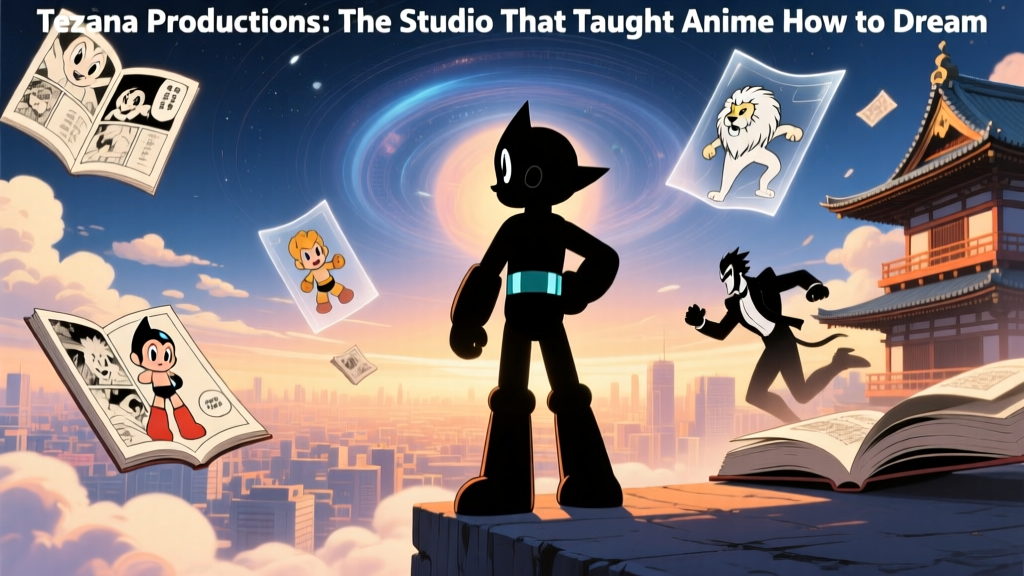
On New Year's Day 1963, Japanese television screens flickered to life with something nobody had ever seen before: a weekly half-hour animated series about a robot boy, broadcast not in a cinema but straight into living rooms. Tetsuwan Atom — known in the West as Astro Boy — didn't just premiere that morning. It detonated. Within weeks, roughly 40 percent of Japanese households with televisions were tuning in, and the small animation studio behind it, Mushi Production, couldn't keep up with the demand for merchandise, tie-in manga, or international licensing calls. That studio's founder, a chain-smoking medical doctor turned cartoonist named Osamu Tezuka, had just invented the business model for the entire anime industry — almost by accident.
The company we now call Tezuka Productions is the direct descendant of that chaotic, brilliant enterprise. It has survived bankruptcy, rebranding, the death of its founder, and multiple industry upheavals. More than six decades later, it still manages the intellectual property portfolio that arguably constitutes the most important single body of work in Japanese animation history. If you collect anime memorabilia, study manga history, or simply want to understand why the medium looks and feels the way it does, you need to understand this studio.
From a Doctor's Sketchbook to Mushi Production
Tezuka was already Japan's most famous manga artist by the time he founded Mushi Production in 1961. He'd been publishing serialized comics since 1946 — Shin Takarajima (New Treasure Island) sold roughly 400,000 copies, an extraordinary number for a postwar economy still rationing paper. His serialized works like Jungle Taitei (Kimba the White Lion) and Ribbon no Kishi (Princess Knight) were running in Kodansha and Shogakukan magazines simultaneously. He was, by his own account in a 1981 NHK interview, drawing around 300 pages of manga per month while maintaining his medical license.
The decision to start an animation studio was reckless by any standard. Tezuka essentially funded Mushi Production out of his manga royalties, renting a cramped facility in Nerima, Tokyo, and staffing it with a rotating cast of young animators who worked around the clock. The name "Mushi" (insect) was deliberate — Tezuka was a lifelong entomology enthusiast, and he liked the metaphor of small creatures producing outsized results.
The economics of producing Astro Boy for television were punishing. To hit the weekly broadcast schedule, Tezuka pioneered what animators call limited animation — a technique that reduced the number of drawings per second from the Disney standard of 24 to as few as 8, relying on held poses, repeated cycles, and clever camera pans to fill screen time. This wasn't laziness; it was triage. The budget per episode was roughly 500,000 yen (about $1,400 USD at the time), nowhere near enough for full animation. The aesthetic that emerged — big expressive eyes, simplified bodies, dramatic still frames with speed lines — became the visual grammar of all anime that followed.
"Tezuka didn't set out to create a style. He set out to meet a deadline. But the shortcuts he invented — the limited frame counts, the symbolic expressions, the cinematic cutting within a static frame — those became the language. Every anime studio working today owes a debt to the compromises Mushi Production was forced to make."
— Frederik L. Schodt, The Astro Boy Essays (Stone Bridge Press, 2007)
Mushi's output during the 1960s was staggering. Between 1963 and 1969, the studio produced or co-produced Astro Boy (193 episodes), Kimba the White Lion (52 episodes), Princess Knight (52 episodes), and Dororo (26 episodes), plus a series of experimental feature films called Animerama aimed at adult audiences — A Thousand and One Nights (1969) and Cleopatra (1970) among them. The Animerama films were commercial failures but artistic gambles that showed animation could handle eroticism, psychological complexity, and visual abstraction.
The financial strain was unsustainable. Tezuka was personally guaranteeing debts, and the studio's cash flow depended on licensing deals that often paid months after air dates. In 1973, Mushi Production filed for bankruptcy. Tezuka, devastated but unwilling to stop working, had already established a separate entity the year before.
The Rebirth: Tezuka Productions Takes Shape
Tezuka Productions Co., Ltd. was incorporated in 1968 — five years before Mushi collapsed — as a vehicle to manage Tezuka's growing intellectual property catalog and to produce new animation projects under more sustainable financial terms. When Mushi went under, Tezuka Productions absorbed key staff members and, crucially, retained the rights to Tezuka's manga library. That distinction mattered enormously in the decades that followed.
The studio's first major project under the new banner was Marvelous Melmo (1971), a quirky series about a girl who could age up or down using magic candies. It wasn't a blockbuster, but it proved the company could deliver a television series without imploding. Throughout the 1970s, Tezuka Productions operated more as a licensing and production-coordination house than a full animation factory. It partnered with larger studios — Sunrise, Nippon Animation, Toei — to bring Tezuka's manga to screen while the man himself continued to draw at a pace that bordered on the superhuman.
The 1980s brought a creative renaissance. Black Jack, Tezuka's dark medical drama about an unlicensed surgeon who charges extortionate fees, had been running in manga since 1973. Its 1980 anime adaptation (and subsequent OVA series) became one of the studio's signature properties — a show that tackled organ trafficking, medical ethics, and the economics of healthcare with a bluntness that made broadcasters nervous. Tezuka, who held a medical degree from Osaka University, drew on real surgical case studies. The character's scarred face and split-tinted hair became instantly recognizable iconography.
Then came the gut punch. Osamu Tezuka died of stomach cancer on February 9, 1989, at the age of 60. He left behind roughly 150,000 pages of manga, over 500 distinct characters, and a company that had to figure out how to exist without its creator.
Surviving the Founder: 1990s Through the 2000s
Most studios founded by a single visionary collapse within a few years of that person's death. Tezuka Productions didn't, and the reasons are worth examining. First, the IP portfolio was genuinely diversified — Astro Boy appealed to children's merchandise markets, Black Jack to adult drama audiences, Princess Knight to the shojo demographic, and Kimba to international nature-adventure fans. No single property carried the company's revenue. Second, Tezuka's son, Macoto Tezka, became involved in the company's creative direction, providing a familial continuity that outside management couldn't replicate.
The 1990s saw the studio navigate the OVA boom and the early digital transition. A 1993 Black Jack OVA series, produced with Akio Sugino handling character designs, was a critical success — its 10 episodes adapted some of Tezuka's most complex medical-ethics stories with unflinching fidelity. The 1997 theatrical film Jungle Emperor Leo (a reimagining of Kimba) was the studio's biggest production of the decade, earning approximately 1.5 billion yen at the Japanese box office.
The studio also faced the recurring controversy over Disney's The Lion King (1994), which bore striking narrative and visual similarities to Kimba the White Lion. Tezuka Productions and the Tezuka family chose not to pursue litigation, a decision Macoto Tezka later explained in interviews as a desire to avoid a spectacle that would overshadow his father's work. Whether that was strategic wisdom or a missed opportunity remains debated in fan communities to this day.
In 2003, Tezuka Productions mounted a major event: the Astro Boy franchise turned 40 (counting from the 1963 anime premiere). A new CGI series, Astro Boy: Tetsuwan Atom, was co-produced with Sony Pictures Entertainment Japan and aired on Fuji TV. The series ran for 50 episodes and was explicitly designed to reintroduce the character to a generation raised on Pokemon and Digimon. Merchandise sales that year pushed Tezuka Productions' annual revenue past 3 billion yen, according to industry reports in Animage magazine.
The Essential Tezuka Productions Catalog
The following table covers major productions directly managed or co-produced by the studio across its various incarnations. This isn't exhaustive — Tezuka's manga were adapted by dozens of outside studios — but it represents the core canon.
| Title | Era | Episodes | Significance |
|---|---|---|---|
| Astro Boy | 1963-1966 | 193 | First serialized anime on Japanese TV; established limited-animation techniques and the TV anime business model |
| Kimba the White Lion | 1965-1966 | 52 | First color TV anime series from Mushi; ecological themes decades ahead of their time |
| Princess Knight | 1967-1968 | 52 | Pioneered gender-fluid protagonist in mainstream anime; foundational shojo text |
| Dororo | 1969 | 26 | Dark fantasy; cancelled mid-run but became a cult touchstone for mature anime storytelling |
| Black Jack (OVA) | 1993-2000 | 10+ | Critically acclaimed OVA series; adapted complex medical-ethics manga with fidelity |
| Jungle Emperor Leo (film) | 1997 | Film | Theatrical reimagining of Kimba; 1.5 billion yen box office |
| Astro Boy: Tetsuwan Atom | 2003-2004 | 50 | CGI revival co-produced with Sony; franchise's 40th-anniversary flagship |
| Young Black Jack | 2015 | 12 | Prequel series; introduced the character to streaming-era audiences via Crunchyroll |
| Dagashiya no Ko to Dokuyaku no Ko | 2023+ | Ongoing | Part of studio's strategy to develop new IP alongside legacy character management |
How Tezuka Productions Rewired the Anime Industry
Strip away the individual shows and look at the structural innovations. Tezuka Productions — through both its Mushi and post-Mushi incarnations — is responsible for at least four foundational practices that define how anime is made, sold, and consumed.
Limited Animation as an Art Form
Disney animators in the 1940s and 1950s averaged 18-24 drawings per second of screen time. Mushi Production's Astro Boy operated at 3-8 drawings per second for most scenes, occasionally dropping to held cels with only the mouth moving. This wasn't just a cost-cutting measure — it forced animators to become inventive with composition, timing, and sound design. The dramatic zoom onto a character's face during an emotional beat, held for three or four seconds while the score swells? That's a Mushi Production trick. Every anime studio from Gainax to Kyoto Animation inherited this visual vocabulary.
The Character-Licensing Model
Before Astro Boy, Japanese animation existed primarily as theatrical shorts or feature films. Tezuka's insight — partly borrowed from Walt Disney's own merchandising operation but adapted for Japan's postwar consumer economy — was that a weekly TV character could drive sales of toys, candy, stationery, and clothing in a continuous revenue loop. Astro Boy's image appeared on over 200 licensed product categories within the first two years of broadcast. This is the same model that later powered Pokemon, Hello Kitty, and virtually every commercially successful anime franchise.
Manga-to-Anime Pipeline
Tezuka was both the original manga creator and the animation producer — a vertical integration that didn't exist before. The pipeline of manga serialization feeding into anime adaptation, which in turn drives manga sales, was essentially invented by this one man operating across both mediums simultaneously. Today's production committees, where publishers, broadcasters, and toy companies share risk and reward on anime adaptations, are institutionalized versions of what Tezuka was doing on instinct.
Genre Diversity as Brand Strategy
Most animation studios in the 1960s specialized: Hanna-Barbera did comedy, Toei did action, Tatsunoko did superheroes. Tezuka's catalog bounced between children's sci-fi (Astro Boy), ecological drama (Kimba), gender-bending adventure (Princess Knight), horror-tinged medical fiction (Black Jack), and experimental adult films (Animerama). This breadth meant that Tezuka Productions never became trapped in a single demographic — a strategic advantage that allowed it to survive market shifts that destroyed more narrowly focused competitors.
The Collectible Market: Owning a Piece of the God of Manga
For collectors, Tezuka Productions material occupies a fascinating niche. Unlike mainstream shonen properties where mass-market figures and Funko Pops dominate, Tezuka collectibles skew toward vintage items, art prints, and high-end resin statues — the kind of pieces that appeal to buyers who also collect original manga pages and animation cels.
Original production cels from the 1963 Astro Boy series are exceptionally rare. Mushi Production's financial chaos meant that materials were often discarded, reused, or simply lost during the studio's bankruptcy proceedings. A surviving Astro Boy cel in good condition sold at Heritage Auctions in 2019 for $14,400 — and prices have only climbed since. Cels from Kimba the White Lion are slightly more available (the color palette makes them visually striking), typically trading in the $3,000-$8,000 range depending on character composition and condition.
Manga first editions represent another frontier. A first-printing copy of Shin Takarajima (1947) in acceptable condition now commands north of 2 million yen (roughly $13,000-$15,000 USD) at Japanese auction houses. First editions of Tetsuwan Atom manga volumes from the early 1950s are similarly scarce. Tezuka's manga output was enormous, but wartime and postwar paper shortages, combined with the disposable nature of children's magazines, mean that surviving copies in any condition are uncommon.
Modern Tezuka Productions merchandise tends to fall into two tiers:
- Mass market: T-shirts, enamel pins, tote bags featuring iconic character designs — typically priced between $15-$45, available through the official Tezuka Productions web shop and select anime retailers like Animate and Mandarake.
- Premium collector: Limited-edition giclée art prints (often reproducing original Tezuka manga pages with archival inks), high-detail PVC and resin statues, and collaborative releases with fashion brands. The 2019 Uniqlo x Tezuka Productions UT collection sold out within days in Japan and now trades at 2-3x retail on resale platforms.
The Osamu Tezuka Manga Museum in Takarazuka, Hyogo Prefecture, operates under Tezuka Productions oversight and offers exclusive merchandise unavailable elsewhere. For serious collectors, the museum shop is worth a visit — or at minimum, a proxy-buying arrangement.
Tezuka Productions in the Streaming Age
The company's current strategy rests on a tension that every legacy IP holder faces: how do you keep characters relevant without diluting what made them iconic? Tezuka Productions has pursued several paths simultaneously.
The 2019 Netflix CGI Astro Boy series, co-produced with France's Shibuya Productions, was a deliberate attempt to reach Western streaming audiences. Reception was mixed — longtime fans found the CGI stiff, and the show's 8-episode first season struggled to find narrative momentum. But it introduced the character to viewers who had never encountered the franchise, and Netflix's internal metrics (never publicly released, but hinted at in investor presentations) suggested solid completion rates in Latin American and Southeast Asian markets.
More successful, critically speaking, was the 2019 Dororo anime, produced by MAPPA and Tezuka Productions. This adaptation leaned hard into the dark-fantasy elements of the original manga, with fluid animation and a screenplay that expanded on Tezuka's themes of disability, exploitation, and moral ambiguity. It streamed on Amazon Prime Video and received strong reviews — a 7.8 average on MyAnimeList and an 89% audience score on Rotten Tomatoes.
The studio has also invested in digital archiving. Since 2016, Tezuka Productions has been systematically scanning and digitizing Tezuka's original manga pages, production materials, and personal notes. The Tezuka Osamu Complete Works digital collection — available in Japanese through major e-book platforms — encompasses over 400 volumes and represents one of the most ambitious archival projects in manga history. For researchers and devoted fans, this is an invaluable resource. For the company, it's a way to monetize the back catalog without physical-printing costs.
On the new-IP front, the studio has been cautious but not dormant. It has co-produced a handful of original-concept series and continues to license Tezuka characters for video games, pachinko machines, and theme-park attractions. The economics here are straightforward: a Black Jack pachinko machine installation generates recurring licensing revenue that requires no new animation production. It's unglamorous but it keeps the lights on.
Questions Collectors and Fans Actually Ask
Is Tezuka Productions still making anime?
Yes, though often as a co-production partner rather than a lead studio. Recent projects include the Young Black Jack series (2015) and collaborations with MAPPA on Dororo (2019). The company's primary function remains IP management, licensing, and archival — but it greenlights new animation projects when the right creative team and financing align.
What's the relationship between Mushi Production and Tezuka Productions?
Mushi Production was Tezuka's first studio, founded in 1961 and bankrupt in 1973. Tezuka Productions was established in 1968 as a separate entity. When Mushi collapsed, key staff and IP rights migrated to Tezuka Productions. A separate company called Mushi Production Co., Ltd. was later re-established by former Mushi employees and still operates independently — but it does not hold rights to Tezuka's major characters. The naming overlap causes persistent confusion.
Where can I buy official Tezuka Productions merchandise outside Japan?
The official Tezuka Productions online store ships internationally, though shipping costs from Japan can be steep. Retailers like Mandarake (which has a US storefront) and occasionally RightStuf / Crunchyroll Store carry Tezuka items. For vintage collectibles — cels, first-edition manga, production materials — your best options are Heritage Auctions, Mandarake's auction service, and Yahoo Auctions Japan (via proxy services like Buyee or FromJapan).
Did Tezuka really create the "big eyes" anime style?
Not exactly. Tezuka was heavily influenced by Disney animation — particularly the large, expressive eyes of characters like Bambi and Mickey Mouse — and by the Takarazuka Revue, an all-female Japanese musical theater troupe known for dramatic, wide-eyed stage makeup. He adapted these influences into his manga art, and because Astro Boy was the first anime to reach mass audiences, the style became associated with the medium as a whole. Tezuka didn't invent the big-eyes look from nothing, but he codified it and transmitted it to an entire generation of animators who trained at Mushi Production before founding their own studios.
What Tezuka collectibles are worth the most?
Original 1960s Astro Boy and Kimba production cels top the market, regularly selling for $5,000-$15,000+. First-edition manga volumes from the late 1940s and early 1950s are comparably valued. Signed Tezuka artwork (he frequently signed manga for fans and colleagues) appears at auction periodically, with prices varying widely based on the piece's size, condition, and character depicted. The highest publicly reported sale for a Tezuka-signed piece exceeded $30,000 at a 2021 Tokyo auction.
The Studio That Refuses to Become a Museum
There's an irony at the heart of Tezuka Productions. It exists to steward the legacy of a man who was obsessed with the future — with robots, space travel, genetic engineering, and the ethical dilemmas that accompany progress. Tezuka died before the internet became mainstream, before CGI animation, before streaming. Yet the company bearing his name has to operate in exactly that world.
So far, it's managed the balancing act better than most legacy studios. The IP catalog remains active. The archive project preserves materials that would otherwise deteriorate. New adaptations, even when imperfect, keep the characters in front of fresh audiences. And the collectible market — those rare cels, those fragile first-edition manga pages — serves as a tangible link to a moment when one doctor with a pen and a reckless business plan changed the course of visual culture.
If you walk through the Tezuka Osamu Manga Museum in Takarazuka, there's a display near the exit: a glass case holding Tezuka's favorite fountain pen, a pair of reading glasses, and a half-finished manga page. The pen is ordinary. The glasses are scuffed. The page shows a character mid-stride, caught between one frame and the next. It's a reminder that behind every studio, behind every franchise, behind every collectible that trades for thousands of dollars at auction, there was a person at a desk, trying to finish the next page before the deadline hit.
That's what Tezuka Productions preserves. Not just characters. The work ethic that made them matter.