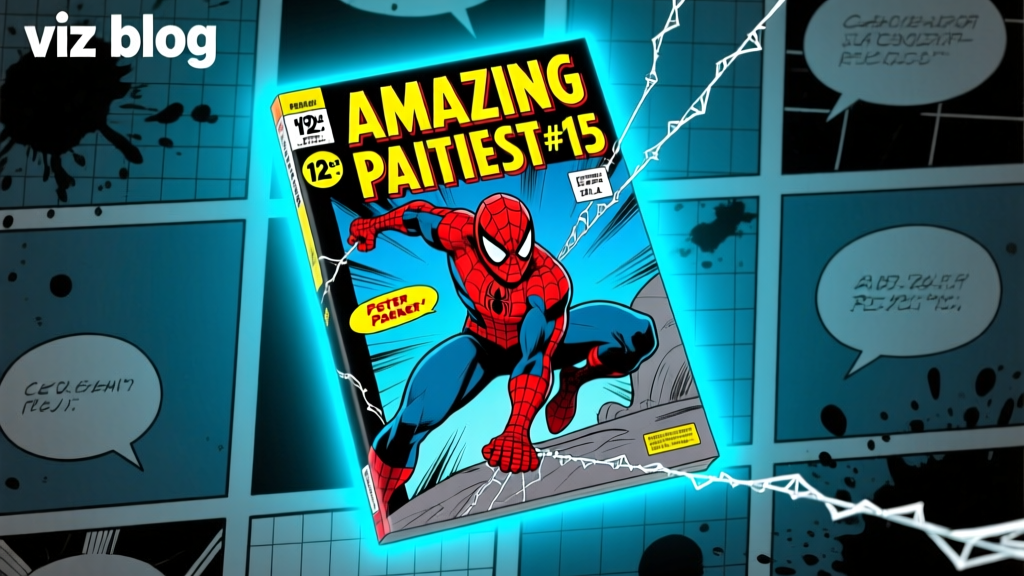
A kid walks into a candy shop in August 1962, drops twelve cents on the counter, and picks up a comic book from the spinner rack. The cover shows a wiry figure in a red-and-blue suit, one arm extended, web line trailing upward, carrying a green-costumed villain under the other. The title across the top reads Amazing Fantasy. The kid doesn't know it yet, but he's holding the single most consequential twelve-cent investment in American pop culture history.
That comic was Amazing Fantasy #15. Sixty-four years later, a near-mint copy will cost you more than a house in most American cities. The story behind that cover — how it got made, why it nearly didn't happen, and how it reshaped an entire industry — deserves its own origin story.
The Last Issue Nobody Wanted
By mid-1962, Amazing Fantasy was dying. The series had limped through several name changes — starting as Amazing Adventures in 1961, then pivoting to Amazing Adult Fantasy with the tagline "The magazine that respects your intelligence." It was an anthology book: science fiction tales, twist-ending stories, monster-of-the-month fare. Readers weren't exactly lining up.
Stan Lee, then editor-in-chief and head writer at Marvel Comics (still operating under the Atlas Comics distribution umbrella), knew the book was getting cancelled. Issue #15 would be the final one. That fact, oddly liberating, gave Lee permission to experiment. If the ship was going down, he might as well fire a cannon from the deck.
The concept he'd been nursing was a teenage superhero. Not a sidekick, not a junior version of an adult hero — a teenager who was the hero, with all the acne, anxiety, and social humiliation that came with it. Lee had seen something in the market gap: every superhero comic starred square-jawed, confident adults. Nobody was writing for the kid who got picked last in gym class.
Jack Kirby Drew the Cover. Steve Ditko Drew Everything Else.
The creative history of Amazing Fantasy #15 involves a quiet backstage drama that comics historians still debate. Lee initially assigned Jack Kirby to design the character. Kirby, the powerhouse penciller who co-created the Fantastic Four, the Hulk, and Thor, turned in a version of Spider-Man that Lee found too heroic — too broad-shouldered, too confident, too much like a miniature Captain America.
Lee then turned to Steve Ditko, an artist known for his angular, atmospheric work on horror and mystery stories. Ditko's Spider-Man was different: gangly, awkward, almost spider-like in his proportions. The mask hid any trace of handsomeness. The costume clung to a frame that looked like it had never seen the inside of a weight room. This was Peter Parker made visible — a nerd in tights.
"I wanted the reader to feel that this kid could be them. Not Superman. Not a god. Just a guy who happened to get bitten by a spider and had no idea what to do next."
— Stan Lee, interviewed in The Comic Book Makers (Eastman, 1992)
But here's the part that confuses casual fans: Kirby still drew the cover. Lee had Ditko handle the interior story art — all 11 pages of "Spider-Man," plus the origin tale — but assigned the cover to Kirby, likely because Kirby's bold, dynamic compositions sold better on the newsstand. The result is a fascinating split: the cover promises a Kirby-style action hero, while the pages inside deliver Ditko's nervier, more psychologically textured vision.
What Kirby's Cover Actually Shows
The Amazing Fantasy #15 cover depicts Spider-Man mid-swing, one web line attached to something above the panel frame, his body twisted in a dynamic Kirby pose that makes the character look more muscular than Ditko's interior version. Under his arm, he carries the Burglar — the unnamed criminal who killed Uncle Ben. A crowd of onlookers fills the background, their faces a mix of fear and confusion.
The color palette is pure Silver Age: bold primaries, flat fills, Ben-Day dots visible if you look closely. Spider-Man's red is a warm cadmium, his blue closer to navy than cobalt. The green of the Burglar's costume provides the complementary contrast that makes the whole composition pop. It's not subtle, but it doesn't need to be. It's a carnival barker of an image, screaming look at this.
One detail modern readers often miss: the cover copy at the top includes the line "The most amazing magazine ever created!" — marketing hyperbole that turned out to be less of a lie than the person who wrote it probably intended.
Eleven Pages That Rewrote the Rules
The interior story — written by Lee, pencilled and inked by Ditko, lettered by Artie Simek — crams an astonishing amount of narrative into eleven pages. Modern comic book origin stories take six issues and a trade paperback collection. Ditko and Lee did it in less space than a current Marvel comic devotes to recap pages and ads.
The beats are now mythological: Peter Parker, bookish high school student, is bitten by a radioactive spider during a public science demonstration. He discovers he has proportionate strength, speed, and agility — plus the ability to cling to walls. He builds web-shooters (the story never fully explains how a teenager engineered pressurized adhesive dispensers, but nobody's complaining). He debuts as a novelty act, appearing on television. He lets a Burglar escape from a pursuing police officer out of pure selfishness. That same Burglar later kills his Uncle Ben. Peter catches the killer and discovers, in the story's gut-punch reveal, that this is the man he could have stopped.
The closing narration panel delivers the line that has since been carved into the bedrock of American mythology: "With great power there must also come great responsibility."
It's worth noting that this line doesn't appear in the dialogue. It's in the narrative caption box on the final page. Some scholars trace the sentiment to a 19th-century French aphorism; others point to similar phrasing in British parliamentary debates. Lee himself gave different accounts of its origin in different interviews. What's indisputable is that the phrase, paired with Ditko's image of Peter walking alone into a dark street, became the moral axis around which sixty years of Spider-Man stories would orbit.
From Cancellation to the Best-Selling Comic in Marvel History
Here's the irony that still makes comics historians grin: Amazing Fantasy #15 was technically a failure. The series was cancelled. The book was done.
Except it wasn't. Sales figures told a different story. Spider-Man's debut issue was one of the highest-selling comics Marvel published that year, and reader mail poured in demanding more. Within months, Lee greenlit The Amazing Spider-Man #1, cover-dated March 1963, and the character never looked back.
The trajectory from cancelled anthology feature to flagship title took roughly seven months. That speed tells you everything about how immediately the character connected with readers. Superman had taken years to get his own solo title after his 1938 debut in Action Comics #1 (though he appeared from the start, the industry structure was different). Spider-Man went from afterthought to anchor almost overnight.
Sales and Print Run Context
Exact print run figures for Marvel comics of this era are notoriously unreliable — the company didn't begin systematically archiving circulation data until later in the decade. Industry estimates place the print run of Amazing Fantasy #15 between 250,000 and 350,000 copies, a middling number for the period. Most of those copies were read, re-read, traded, folded into back pockets, left on school buses, or thrown away by parents who didn't see the point. Survival rates for newsstand comics of this era are estimated at less than 1% in any condition, and high-grade survivors are vanishingly rare.
The Collector Market: When Twelve Cents Becomes a Million Dollars
If you want to understand why Amazing Fantasy #15 occupies a near-religious status in comic collecting, you need to understand the grading system. The Certified Guaranty Company (CGC), founded in 2000, grades comics on a 10-point scale. A 9.8 is essentially a copy that looks like it was printed yesterday. A 9.6 is a hair below that. For a 60-year-old newsprint comic that cost twelve cents and was treated as disposable entertainment, finding a 9.8 is roughly as likely as finding a living T. rex.
The sales record for Amazing Fantasy #15 is a moving target, but the milestones tell the story of a market in full acceleration:
| Grade | Sale Price | Year | Venue / Notes |
|---|---|---|---|
| CGC 9.6 | $1,100,000 | 2011 | Anonymous private sale; at the time, the highest price ever paid for a Marvel comic |
| CGC 9.4 | $454,000 | 2018 | Heritage Auctions; one of only a handful at this grade level |
| CGC 9.0 | $336,000 | 2021 | Heritage Auctions; market surge during pandemic-era collecting boom |
| CGC 9.0 | $795,000 | 2024 | Heritage Auctions; redefined the market ceiling for Silver Age keys |
| CGC 7.0 (VF) | $120,000–$160,000 | 2023–2025 | Typical range for mid-grade copies; most collectors' ceiling |
| CGC 4.0 (VG) | $45,000–$70,000 | 2024–2026 | Reading copies with significant wear; still six-figure territory in some auctions |
The CGC census — the database tracking every graded copy — lists fewer than 4,500 total submissions of Amazing Fantasy #15 as of early 2026. Of those, only two copies have achieved a 9.6 grade, and zero have hit 9.8. For context, there are more surviving copies of the Gutenberg Bible (49 known) in institutional collections than there are CGC 9.6 copies of this comic in private hands.
Why This Issue Outperforms Other Silver Age Keys
The collector market has its own internal logic, and several factors converge to make Amazing Fantasy #15 uniquely valuable:
- First appearance of a cultural icon. Spider-Man is arguably the most recognizable superhero on Earth. Not just in comics — in film, television, toys, lunchboxes, pajamas, theme parks. The character's global brand licensing revenue exceeds $1.5 billion annually (Disney/Marvel SEC filings, 2023). This issue is where it started.
- One-and-done appearance. Unlike Action Comics #1 (Superman's debut, which cost 10 cents and had a large print run in 1938), Amazing Fantasy #15 was a single issue in a cancelled series. There's no "second printing" or "also appears in." This is the only origin appearance.
- Silver Age scarcity. Comics from the early 1960s were printed on cheap newsprint, sold at newsstands, and treated as disposable. Unlike Golden Age books, which sometimes survived in warehouse stock, Silver Age Marvels have almost no surviving high-grade copies.
- Cross-generational demand. Baby boomers who read it on the rack, Gen-X collectors who grew up with the '90s animated series, millennials drawn in by the Raimi and Webb films, and Gen Z fans of the MCU's Tom Holland — all competing for the same finite pool of copies.
The Case for Most Important Comic Cover in Marvel History
Arguing about "the most important" anything in comics is a fool's errand. Someone will always bring up Action Comics #1, or Detective Comics #27, or Fantastic Four #1. Fair points, all of them. But here's the argument for Amazing Fantasy #15, and it rests on three pillars.
First: It changed who comics were for. Before Spider-Man, superhero comics were aimed at children or nostalgic adults. Peter Parker was a teenager, and not a teenager the way Archie Andrews was a teenager — Peter had real problems. He got bullied. He was poor. He worried about his aunt's health. He struggled to pay rent. This wasn't escapism; it was recognition. Readers saw themselves in the mask, and that identification transformed the audience from kids-who-read-comics into fans-who-collected-comics. The direct market — the entire infrastructure of comic shops, pull lists, and collector culture — has roots in the audience Spider-Man created.
Second: It proved the Marvel model. Fantastic Four #1 (November 1961) launched the Marvel Age, but it was still an ensemble book, still figuring out what Marvel would be. Amazing Fantasy #15 demonstrated that the Marvel formula — flawed heroes, real-world problems, interlocking continuity — could work with a solo character aimed at younger readers. The entire subsequent Marvel library (Daredevil, Iron Man, the X-Men) follows the template that Spider-Man perfected.
Third: It created the most durable character IP in comics. Six decades later, Spider-Man remains Marvel's top-selling character in merchandise, licensing, and international brand recognition. He has appeared in more video games than any other Marvel hero. The 2018 film Spider-Man: Into the Spider-Verse won an Academy Award. The 2017 game Marvel's Spider-Man sold over 20 million copies (Sony Interactive Entertainment, 2022). Every one of those revenue streams, every adaptation, every Halloween costume, traces back to a twelve-cent comic with Jack Kirby's pencils on the cover and Steve Ditko's vision on the inside pages.
"Spider-Man is the closest thing comics has to a universal myth. Every generation discovers him, and every generation thinks he was invented for them. In a way, he was."
— Sean Howe, Marvel Comics: The Untold Story (Harper, 2012)
What Happened to the Creators
The aftermath of Amazing Fantasy #15 is one of the more bittersweet chapters in comics history. Steve Ditko, who defined Spider-Man's visual identity, left Marvel after Amazing Spider-Man #38 (July 1966), reportedly over creative and philosophical disagreements tied to his Objectivist beliefs. He never publicly discussed his Spider-Man work in any detail for the rest of his life. He passed away in 2018 at age 90, found alone in his Manhattan studio.
Jack Kirby, who drew the cover but had minimal creative input on the character's final design, went on to co-create much of the Marvel Universe as we know it before departing for DC Comics in 1970, where he created the Fourth World saga. He died in 1994. Both Ditko and Kirby spent decades without meaningful royalties from characters that generate billions in revenue.
Stan Lee, the writer and editor, became the public face of Marvel, appearing in cameos in nearly every Marvel film until his death in 2018. He was more generous than most about crediting his collaborators, though the question of who "really created" Spider-Man remains one of the most debated topics in comics scholarship.
The Cover Art Through a Collector's Loupe
If you're fortunate enough to examine an original copy — or even a high-resolution scan — certain details emerge that distinguish this cover from other Silver Age work:
- The web pattern. Kirby's web lines on the costume are thicker and more geometric than Ditko's interior version. Ditko used finer, more organic web patterns that became the standard in subsequent issues.
- Spider emblem. The chest spider on the cover is slightly different from the Ditko interior emblem — wider, with shorter legs. This discrepancy is a useful authentication marker for graders.
- Color registration. Original newsstand copies show typical Silver Age color registration issues, with the red and blue occasionally bleeding outside the black line art. High-grade copies with clean registration command a premium.
- Price and date block. The upper-left corner shows "12¢" and "AUG" along with the Comics Code Authority seal. Copies with a crisp, readable price stamp are significantly more desirable.
- Spine stress. The most common defect on surviving copies is spine stress — white creases along the stapled binding. Even CGC 8.0 copies typically show some spine wear.
A Living Document
Sixty-four years after it hit the newsstands, Amazing Fantasy #15 continues to generate new stories. In 2022, Marvel celebrated the 60th anniversary with variant covers, special editions, and retrospectives. The character has been reimagined as Miles Morales (2011), Spider-Gwen (2014), and countless multiverse variants. The PlayStation game franchise continues to break sales records. Each new adaptation sends a fresh wave of collectors to the market, competing for a static and shrinking supply of original copies.
There's something almost poetic about the economics: a story about a kid who learns that nothing of value comes without cost has itself become an object defined by cost. But that's maybe too neat a reading. What the cover actually represents, stripped of market analysis and investment thesis, is a moment when three guys in a cramped Manhattan office decided to try something different on a book nobody cared about. Stan Lee had a character he believed in. Jack Kirby had a cover that grabbed you by the collar. Steve Ditko had an interior vision that made the impossible feel personal. And a twelve-cent comic book became, against all odds, one of the most important artifacts in American popular culture.
Questions People Actually Ask
Who drew the Amazing Fantasy #15 cover?
Jack Kirby pencilled the cover, with inks likely by Dick Ayers. Steve Ditko handled all interior art for the Spider-Man origin story. This split between cover and interior artists was standard practice at Marvel in the early 1960s, where covers were treated as marketing assets separate from the story content.
How much is an Amazing Fantasy #15 worth today?
Values range from roughly $15,000–$25,000 for a low-grade (CGC 1.0–2.0) copy to over $1 million for the two known CGC 9.6 copies. Mid-grade copies (CGC 5.0–7.0) typically trade between $80,000 and $200,000 depending on market conditions and eye appeal. A CGC 9.0 sold for $795,000 at Heritage Auctions in 2024.
Why is Amazing Fantasy #15 so much more valuable than other first-appearance comics?
Three factors converge: Spider-Man's unmatched global recognition, the book's scarcity in high grade (fewer than 4,500 total CGC submissions, only two at 9.6), and the fact that this was a one-shot appearance in a cancelled series — there's no other comic that serves as Spider-Man's debut. By contrast, Superman appeared across multiple early publications, and Batman's Detective Comics #27 had a larger surviving population relative to demand.
Did Stan Lee write the "with great power" line specifically for this comic?
The origin of the phrase is disputed. Lee attributed it to various sources over the years, including a childhood memory of a speech by a public figure. The sentiment appears in similar form in writings dating back to the French Revolution and British parliamentary debates of the 18th century. What's certain is that Lee placed it in the final narrative caption of Amazing Fantasy #15, and the Spider-Man franchise made it immortal.
Is Amazing Fantasy #15 a good investment?
As a pure financial instrument, high-grade Silver Age keys have appreciated significantly over the past two decades, often outperforming traditional asset classes. But the market is illiquid, transaction costs are high (auction house premiums of 15–25%), and values can be volatile during economic downturns. Most serious collectors advise buying what you love and treating appreciation as a bonus rather than a guarantee.