In 1938, a lanky cartoonist from Westfield, New Jersey, sold a single-panel drawing to The New Yorker. It showed a dour woman standing in front of a crumbling mansion, beckoning two Girl Scouts with a sentence that read something like: "They're either ringing the doorbell or they're on fire." The magazine's editors didn't know what to make of Charles Samuel Addams. His humor was pitch-black, his characters looked like they'd been exhumed rather than born, and the mansion in the background had more cobwebs than architecture. Fifty years and roughly 1,300 cartoons later, the family he never formally named had become one of the most photographed, filmed, costumed, merchandised, and parodied clans in American pop culture.
This is the story of the Addams Family portrait — not one single image, but an evolving visual record that spans ink-on-board cartoons, a black-and-white television cast photo, a big-budget Hollywood ensemble, a branching family tree, and an aftermarket of collectibles that would fill a real haunted house. Every era reimagined what "the family" looked like, and every version tells you more about the decade that produced it than about Charles Addams' original pen strokes.
The New Yorker Cartoons: Where the Ink Started (1938–1988)
Charles Addams drew for The New Yorker for exactly fifty years, from his first sale in 1938 to a cartoon published shortly before his death on September 29, 1988. During that half-century, he produced over 1,300 published cartoons, and a significant fraction of them featured the unnamed macabre family that would eventually bear his surname. The early panels didn't depict a "family" in any organized sense. They showed isolated ghoulish figures — a pale woman in a black dress, a bearded man who resembled a mortician, two unsettling children — appearing one at a time in different contexts, sometimes with different names or no names at all.
The visual language of those early cartoons was spare and deliberately ugly. Addams worked in pen and ink on Bristol board, using a crosshatching style that owed more to Edward Gorey than to any mainstream cartoonist of the era. His backgrounds were dense with Gothic architectural detail — pointed arches, crumbling gargoyles, wrought-iron fences, curtains that looked like they smelled of mildew. The characters had sharp angles where you'd expect soft curves: Morticia's cheekbones could cut glass, Gomez's mustache was a pair of scimitars, and the children (who eventually settled into the identities of Wednesday and Pugsley) had the hollow-eyed stares of Victorian mourning portraits.
What made these cartoons distinctive wasn't just the morbid content. It was the juxtaposition. Addams placed his ghouls in perfectly ordinary American situations — hosting dinner parties, dealing with door-to-door salesmen, tending a garden, sitting around watching television — and let the comedy emerge from the collision. The mansion was always the backdrop, a three-story heap with a tower, a conservatory, and what appeared to be a cemetery in the side yard. Addams drew the house dozens of times, and each iteration added details: a crooked chimney, a window bricked up for no reason, a vine strangling the front porch. By the mid-1950s, the house had become a character in its own right, and fans began writing to the magazine asking if the family had a name.
They didn't, not officially. Addams referred to them as "the family" in conversation. When the 1964 television series required a surname, the producers simply borrowed the cartoonist's own. Charles Addams reportedly found this funny. In a 1981 interview with The New York Times, he said: "I suppose they could have called them the Smiths, but Addams has a certain ring to it, doesn't it? Like a coffin lid closing."
"I never sat down and said, 'Today I shall create a family.' They just sort of appeared, one at a time, like unwelcome relatives at a funeral. And then one day I looked at them and thought, well, I suppose they live together."
The original cartoons remain the visual DNA of everything that followed. Every subsequent adaptation — television, film, animation, merchandise — has to contend with Addams' pen-and-ink aesthetic. The characters can be reinterpreted, recast, and re-rendered, but they can never fully escape those first brushstrokes: the angular faces, the funereal clothing, the sense that everyone in the frame is having a wonderful time at someone else's expense.
The 1964 Television Cast Photo: Black-and-White Perfection
When ABC greenlit The Addams Family television series in 1964, producer Nat Perrin and head writer Hannibal Coons faced a problem that would recur in every adaptation: how do you translate static single-panel cartoons into a living, breathing ensemble? Charles Addams provided character sketches and notes — he gave Gomez a passionate, sword-fighting temperament; Morticia a serene, almost maternal warmth for the macabre; Uncle Fester a round, bald, lightbulb-in-mouth strangeness; and Lurch a towering, Frankenstein-monster-butler demeanor. But the casting decisions ultimately defined the visual portrait more than any cartoon ever could.
John Astin as Gomez was the first anchor. Astin was a Juilliard-trained actor with a background in Broadway comedy, and he brought a manic, googly-eyed energy that the cartoons never had. Gomez on the page was a quiet, somewhat sinister figure — a thin man in a pinstripe suit smoking a cigar. Astin made him a Latin-lover-meets-madman, always grinning, always lunging for his wife. Carolyn Jones as Morticia was the opposite: still, glacial, her voice a low purr. Jones had appeared in John Ford's The Man Who Shot Liberty Valance and on dozens of television shows, but nothing prepared audiences for the sight of her in that skintight black gown with the octopus-hem tentacles, moving through the Addams mansion like smoke through a crypt.
Jackie Coogan as Uncle Fester completed the trio of adults. Coogan was a former child star — he'd played opposite Charlie Chaplin in The Kid (1921) — and his career had been marked by one of Hollywood's most notorious financial exploitation cases. By 1964, he was a working character actor, and the Fester role gave him a second act. His shaved head, prosthetic nose, and bulging eyes made Fester look like an overgrown mushroom, and his ability to light a lightbulb by holding it in his mouth became one of the show's most imitated gags.
Ted Cassidy as Lurch stood six-foot-nine and spoke in a bass register that rattled television speakers. His "You rang?" became a cultural catchphrase within weeks of the premiere. Lisa Loring and Ken Weatherwax played Wednesday and Pugsley, respectively, and their portrayals locked in the visual template for the children that persisted for nearly thirty years: Wednesday with her twin braids and deadpan expression, Pugsley in his striped shirt and propeller beanie. Blossom Rock as Grandmama and the uncredited performer inside the Thing prop (usually a crew member's hand poking out of a box) rounded out the ensemble.
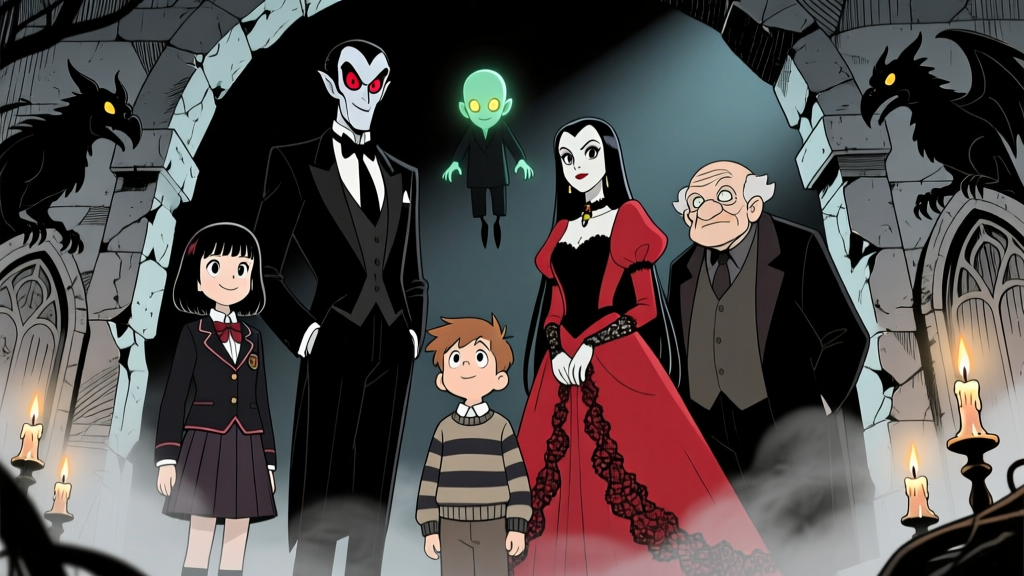
The official cast photo from 1964 is one of the most reproduced images in television history. The family is arranged in a formal group portrait in front of the mansion's front door — a deliberate parody of wholesome family portraits of the era. Gomez stands center with his arm around Morticia, who holds a rose (with the stem but no bloom, naturally). Fester grins beside them, bald head gleaming under the studio lights. Lurch looms behind everyone. The children stand in front, looking like they'd rather be somewhere else — which is, of course, exactly the joke. The photo's composition mirrors a Victorian family carte-de-visite, right down to the stiff poses and formal arrangement, but every detail is inverted. Where a conventional family portrait radiates warmth and normalcy, the Addams portrait radiates a kind of cheerful doom.
The show ran for two seasons on ABC — 64 episodes in total — and was cancelled in 1966, partly due to competition from the competing monster-family sitcom The Munsters on CBS. But the cast photo outlived the series by decades, becoming the default reference image for every subsequent adaptation. When people think "Addams Family," they see the 1964 lineup, even if the version they're remembering has been filtered through three movies, two animated films, a Broadway musical, and a Netflix series.
The 1991 Movie Ensemble: Hollywood Goes Gothic
Barry Sonnenfeld's The Addams Family (1991) was the first film to attempt a direct translation of Charles Addams' visual aesthetic to the big screen, and it did so with a production budget of $30 million and a cast that read like a who's-who of character acting. The ensemble portrait from this film is a different animal entirely from the 1964 TV photo — darker, richer, more painterly in its composition, and steeped in a deliberate visual homage to German Expressionist cinema.
Production designer Richard James Weyand built the Addams mansion interior as a physical set on a soundstage in Los Angeles, and he filled it with references to Addams' original cartoons: cobwebbed chandeliers, a staircase that led nowhere, a library stocked with books bound in materials best left unspecified. Cinematographer Owen Roizman, who had been nominated for an Academy Award for The French Connection, lit the set with a technique he described as "beautiful ugly" — using warm amber key lights against deep shadow backgrounds to create a look that felt simultaneously inviting and menacing. The result was a film that looked like a Charles Addams cartoon had been painted by Caravaggio.
Raul Julia as Gomez was the casting decision that defined the film. Julia was a classically trained stage actor with Puerto Rican heritage and a resume that included Shakespeare in the Park and a Tony nomination for Where's Charley? He brought to Gomez a theatrical intensity that Astin's sitcom version never attempted. His Gomez was a man in love with danger, with Morticia, and with the sheer operatic excess of his own existence. The sword-fight scene with Fester, set to a mambo score, remains one of the most perfectly choreographed comic sequences in 1990s cinema.
Anjelica Huston as Morticia was a revelation. Where Carolyn Jones had played Morticia as warm beneath the ice, Huston played her as ice all the way down — but ice with a sense of humor. Her Morticia moved through the mansion like a wraith, her custom-designed gown by Ruth Myers trailing behind her in those signature tentacle-hem tendrils. Huston's pale skin and sharp features were a near-perfect match for Addams' original ink drawings, and the film's makeup department, led by Fern Buchner, enhanced her natural bone structure with contouring that made her look like she'd been carved from marble.
Christopher Lloyd as Fester was a controversial choice — Lloyd was best known as Doc Brown from Back to the Future, and his Fester was more manic and less melancholy than Coogan's version. But Lloyd's physical commitment to the role was extraordinary: he shaved his head, wore prosthetics that widened his eyes, and performed the lightbulb-in-mouth gag himself using a specially rigged prop. Christina Ricci, then eleven years old, played Wednesday with a stillness that was unnerving in a child actor. Her deadpan delivery and unblinking stare became the definitive Wednesday for an entire generation, and the portrait of her sitting in the family group — small, pale, dressed entirely in black — became one of the most iconic images of 1990s pop culture.
The film's ensemble portrait shot — used in posters, lobby cards, and the VHS cover — arranged the cast in a tableau that directly referenced the 1964 photo but updated it with cinematic grandeur. The family stands in the mansion's foyer, Gomez and Morticia center, Fester and Grandmama (Judith Malina) flanking them, the children in front, Lurch (Carel Struycken, a Dutch actor standing seven feet tall) behind. The lighting falls from above in shafts, catching dust motes and cobweb strands. It looks like a family that has been waiting in that foyer for a hundred years and plans to wait for a hundred more.
The sequel, Addams Family Values (1993), directed again by Sonnenfeld, deepened the visual palette with richer costumes and more elaborate set pieces, including the legendary Thanksgiving play scene that remains one of the sharpest pieces of satirical comedy ever committed to film. Joan Cusack's addition as Debbie Jellinsky, the "Black Widow" who marries and attempts to murder Fester, introduced a new visual element to the family dynamic — a character who looked normal but was, in fact, the most monstrous person in the room. It was a pointed inversion of the family's own visual identity, and it worked precisely because the audience had been trained by decades of Addams imagery to equate "scary-looking" with "actually scary."
The Addams Family Tree: Who's Who in the Crypt
One of the most confusing aspects of the Addams Family portrait is that the cast has never been entirely stable. Charles Addams himself was inconsistent about which characters belonged to "the family," and different adaptations have included, excluded, renamed, or reinvented various members depending on the needs of the story. Here is a breakdown of the core lineage and the peripheral figures who drift in and out of the mansion's orbit.
The Core Household
Gomez Addams — Patriarch. A wealthy, eccentric aristocrat of ambiguous ethnicity (variously described as Castilian, Italian, or simply "foreign"). His primary occupations appear to be spending money, practicing swordplay, and being desperately in love with his wife. In the original cartoons, he was thinner, quieter, and more sinister. Every subsequent version has made him more exuberant.
Morticia Addams (nee Frump) — Matriarch. Her maiden name, Frump, was established in the 1964 series and has persisted across most continuities. She tends carnivorous plants, plays the shamisen, and speaks in a calm, measured tone regardless of how chaotic the situation becomes. Her visual signature is the long black gown with tentacle-like tendrils at the hem.
Wednesday Addams — Daughter. Named after the nursery rhyme line "Wednesday's child is full of woe." Her personality varies enormously across adaptations: in the 1964 series she's a relatively normal (if odd) child; in the 1991 film she's a morbid, deadpan intellectual; in the Netflix series Wednesday (2022) she's a fully realized gothic heroine with martial arts skills and a detective's instincts.
Pugsley Addams — Son. Named for a character in a different Charles Addams cartoon who wasn't related to the family at all. He's generally portrayed as more physically aggressive and less verbal than Wednesday, with a fondness for explosives, guillotines, and other mechanical mayhem.
Uncle Fester — Gomez's older brother (or, in some versions, Morticia's uncle). Bald, bug-eyed, able to generate electricity. His defining visual trait is the lightbulb-in-mouth trick. In the 1991 film, the plot revolves around Fester's disappearance and return, with Christopher Lloyd's performance anchoring the emotional arc.
Grandmama — A witch who lives with the family. Her relationship to the rest of the clan shifts: sometimes she's Gomez's mother, sometimes Morticia's. She brews potions, reads fortunes, and generally lurks in the kitchen.
Lurch — The butler. Modeled on Frankenstein's monster in both stature and grunting speech patterns. His signature line, "You rang?" delivered in a bass monotone, is one of television's most durable catchphrases.
Thing — A disembodied hand that serves as the family's pet and helper. In the original cartoons, Thing was simply drawn as a hand reaching out of various surfaces. The 1991 film gave Thing a starring role, with magician John Willoughby performing the hand's movements on set.
Cousin Itt — A figure completely covered in long hair, speaking in an incomprehensible high-pitched gibberish that the family understands perfectly. Created specifically for the 1964 TV series by producer Nat Perrin, not by Charles Addams.
Peripheral and Expanded Characters
Over the decades, the family has accumulated a supporting cast that sometimes threatens to outnumber the core members. Cousin Itt has already been mentioned. There's also Puberty Addams, a character introduced in the 1991 film as a newborn and later renamed Pubert in Addams Family Values; Cousin Ophelia, who appeared in the 1964 series played by Margaret Hamilton (the Wicked Witch from The Wizard of Oz); and Debbie Jellinsky, the homicidal nanny from Addams Family Values. The animated films of 2019 and 2021 introduced additional relatives, and the Netflix series Wednesday expanded the Addams lore to include an entire ancestral history tied to Nevermore Academy.
| Character | New Yorker Cartoons | 1964 TV Series | 1991/1993 Films | Netflix Wednesday (2022) |
|---|---|---|---|---|
| Gomez | Thin, quiet, sinister | John Astin — manic, googly-eyed | Raul Julia — theatrical, passionate | Luis Guzman — grounded, warm |
| Morticia | Pale, angular, black dress | Carolyn Jones — warm beneath ice | Anjelica Huston — marble-cold elegance | Catherine Zeta-Jones — glamorous, fierce |
| Wednesday | Hollow-eyed, braids | Lisa Loring — sweet but odd | Christina Ricci — deadpan, morbid | Jenna Ortega — gothic heroine |
| Pugsley | Rough, unnamed | Ken Weatherwax — propeller beanie | Jimmy Workman — pudgy, explosive | Isaac Ordonez — loyal, inventive |
| Uncle Fester | Bearded, round | Jackie Coogan — bald, bulb trick | Christopher Lloyd — manic energy | Fred Armisen — comedic, warm |
| Grandmama | Appears sporadically | Blossom Rock — standard witch | Judith Malina — gruff, funny | Joanna Lumley — glamorous witch |
| Lurch | Large butler figure | Ted Cassidy — 6'9", "You rang?" | Carel Struycken — 7'0", silent | George Burcea — younger, active |
| Thing | Hand from surfaces | Crew hand from box | John Willoughby — magician | Victor Dorobantu — full arm, physical |
The Portrait as Visual Motif: Why the Group Shot Matters
There's a reason the Addams Family keeps getting photographed as a group. The portrait is central to the franchise's identity in a way that isn't true for most fictional families. The Simpsons don't need a formal group portrait to be recognized — you know them by individual silhouettes. The Skywalkers don't pose for family photos. But the Addams Family requires the ensemble shot because the comedy has always been about the collective, not the individual.
Charles Addams understood this instinctively. His most effective cartoons showed the entire family in a single panel, each member engaged in their own particular brand of strangeness, creating a tableau that overwhelmed the viewer with cumulative weirdness. A single Addams character is amusing. The whole family in one frame is an event. This principle carried over into every adaptation: the 1964 show's opening credits ended with a family group shot, the 1991 film's poster was an ensemble portrait, the Broadway musical's poster featured the full cast in a line, and the Netflix series' marketing leaned heavily on Wednesday standing alone — which was itself a pointed subversion of the franchise's tradition.
The group portrait also serves a practical marketing function. It establishes the full cast of characters in a single image, which is essential for merchandising. A toy line needs the whole family. A poster needs the whole family. A video game box art needs the whole family. The Addams Family portrait is, in commercial terms, a product catalog. Every character in the frame is a potential action figure, a potential costume, a potential lunchbox illustration.
This duality — the portrait as both Gothic art object and marketing tool — is one of the franchise's most interesting tensions. The Addams Family's entire identity is built on the rejection of mainstream American consumer culture, and yet the franchise itself is one of the most aggressively merchandised properties in entertainment history. The family would find this hilarious, which is probably the point.
Collectibles and Memorabilia: The Aftermarket of the Macabre
The Addams Family has generated a collectibles market that rivals properties ten times its age in scope and value. Original Charles Addams artwork has been auctioned at Christie's and Sotheby's, with individual cartoon boards selling for tens of thousands of dollars. A 1956 cartoon depicting the family at dinner sold at Christie's in 2014 for $38,400. The Tee & Charles Addams Foundation, which manages the artist's estate, has catalogued and preserved over 2,000 original drawings, and limited-edition prints authorized by the foundation sell for $500 to $2,500 depending on the edition size and the image's popularity.
Original Artwork and Prints
Collecting original Addams cartoons is a pursuit for the well-funded. The market is thin — most of Charles Addams' originals are held in institutional collections (the Library of Congress has a significant holding) or in the foundation's archive. When pieces surface at auction, they attract attention from cartoon art collectors, horror memorabilia specialists, and New Yorker cartoon enthusiasts, three overlapping but distinct buyer pools that drive prices upward. Unsigned or poorly provenanced pieces sometimes appear on eBay in the $200–$800 range, but authentication is a persistent problem. The foundation has issued certificates of authenticity for verified pieces, and collectors are advised to demand one before committing to a purchase above $1,000.
The 1964 TV Memorabilia
Memorabilia from the original ABC series occupies a curious space in the collectibles market. The show was produced during an era when television props and costumes were routinely discarded, destroyed, or taken home by crew members. As a result, authenticated screen-used items from the 1964 series are extremely rare. A Morticia gown worn by Carolyn Jones, authenticated by the costume department's records, sold at Heritage Auctions in 2019 for $42,500. More accessible items include original scripts (typically $150–$400), lobby cards from the show's syndication releases ($30–$80), and promotional photographs signed by cast members ($200–$600 for authenticated signatures).
The Ideal Toy Company produced a line of Addams Family dolls and figures during the show's original run, and these have become grail items for collectors. The 1965 Ideal "Uncle Fester" figure, complete with the original box and the lightbulb accessory, has sold for over $1,500 in mint condition. The "Thing" hand puppet from the same line, a simple rubber hand on a stick, commands $300–$500 in good condition with the original packaging.
1991 Film and Beyond
The 1991 film spawned a much larger merchandise wave than the 1964 series ever did. Playmates Toys produced a full line of action figures, a playset of the Addams mansion, and a series of "role-play" accessories including a plastic Thing hand and a toy sword. These items were mass-produced and remain common on the secondary market — a complete set of the original Playmates figures in packaging can be assembled for under $200 with patience. The exception is the "Lurch" figure, which had a shorter production run and now sells for $60–$90 on its own.
The pinball machine market has been particularly strong for the Addams Family. Bally/Midway's The Addams Family pinball machine, released in 1992, is one of the best-selling pinball machines in history, with over 20,000 units produced. A well-maintained original machine sells for $4,000–$8,000 depending on condition, and the special-edition "Gold" version, produced in a limited run of 1,000 units with gold-plated trim, regularly sells for $12,000–$18,000. The machine's popularity spawned a spiritual successor, Theatre of Magic (1995), which borrowed heavily from the Addams aesthetic without securing the license.
In recent years, the Netflix series Wednesday has generated a fresh wave of collectibles. Funko Pop! figures based on the show's characters are widely available, and a limited-edition "Wednesday Dance" figure released exclusively at Hot Topic in 2023 sold out within hours and now resells for $80–$120. NECA (National Entertainment Collectibles Association) has produced high-quality 7-inch action figures of Wednesday and Thing based on the Netflix series, and McFarlane Toys has entered the market with a line of Addams Family construction sets that build miniature versions of the mansion's rooms.
The most unusual corner of the Addams collectibles market is the cottage industry of custom and artist-made pieces. Independent sculptors on Etsy and Instagram produce hand-painted resin busts of the family members, typically priced at $150–$500. Several artists have gained followings for their miniature Addams mansion dioramas, which range from simple dollhouse-scale replicas to fully wired models with functioning lights, a motorized Thing hand, and a miniature pipe organ that actually plays the show's theme. One particularly elaborate build by a Portland-based artist sold for $7,800 at a specialty auction in 2022, featuring a working elevator, a removable roof that revealed fully furnished interiors, and hand-painted wallpaper with custom patterns based on Charles Addams' original cartoon backgrounds.
The Portrait That Never Stops Changing
Eighty-eight years after Charles Addams first sold a ghoul cartoon to The New Yorker, the Addams Family portrait is still being redrawn. The Netflix series Wednesday became one of the platform's most-watched English-language shows, and Jenna Ortega's portrayal has introduced the family to a generation that grew up with TikTok and A24 horror rather than Saturday morning sitcoms. The show's visual language is darker, more contemporary, and more psychologically complex than anything Charles Addams ever drew, but the core DNA remains: angular faces, black clothing, a family that loves each other fiercely and expresses that love through acts of creative morbidity.
What makes the Addams Family portrait endure isn't nostalgia, though nostalgia plays a role. It's the family's function as a mirror. Every era looks at the Addams and sees a reflection of its own anxieties about normalcy, conformity, and what it means to be a family. In the 1960s, they were a parody of the suburban sitcom ideal. In the 1990s, they were a celebration of outsider identity in a decade obsessed with political correctness. In the 2020s, they've become a symbol of neurodivergent self-acceptance, with Wednesday Addams reframed not as a weirdo but as a young woman who simply refuses to perform normalcy for anyone's comfort.
Charles Addams died at a rest stop on the New Jersey Turnpike in 1988, reportedly on his way home from a lunch with friends. He was 76. His obituary in The New Yorker noted that he had "made millions of people uncomfortable in the best possible way." The family he drew, the family he never named, the family that bears his name — they're still making people uncomfortable. And that's exactly how they'd want it.
Frequently Asked Questions
Did Charles Addams name the Addams Family characters himself?
Only partially. Addams referred to them collectively as "the family" and gave some characters informal names in private correspondence, but the definitive names came from the 1964 television series' writers and producers. Morticia was named by Addams' editor at The New Yorker in casual conversation; Gomez and Fester were named by the TV show's staff; Wednesday was named by Addams himself, drawn from the nursery rhyme "Monday's Child." Pugsley was borrowed from an unrelated Addams cartoon character. The surname "Addams" was adopted for the show because the producers couldn't agree on a fictional alternative.
How many original Charles Addams cartoons feature the family?
Out of roughly 1,300 published cartoons by Charles Addams in The New Yorker, approximately 200–250 feature recognizable members of the Addams family. The exact count is debated because many early panels depict individual characters before they were consolidated into a single family unit, and some cartoons include minor recurring figures whose relationship to the core family is ambiguous. The Tee & Charles Addams Foundation has the most authoritative catalogue, and their count places the "definitive family" cartoons at around 175, with an additional 50–75 panels featuring individual members in isolation.
What is the most valuable Addams Family collectible ever sold?
The highest publicly reported sale is an original Charles Addams cartoon board depicting the entire family gathered in their living room, which sold at Christie's in 2014 for $144,000. The piece, dated 1963, was one of the few cartoons to feature every core family member in a single panel and had been in a private collection since the 1970s. Among non-artwork collectibles, a screen-used Morticia gown from the 1964 series holds the record for television memorabilia at $42,500 (Heritage Auctions, 2019), while a limited-edition gold-trim Addams Family pinball machine (number 3 of 1,000) sold privately in 2021 for approximately $22,000.
Is the Addams mansion a real building?
No single real building has served as the Addams mansion across all adaptations. Charles Addams' cartoon house was drawn from imagination, though architectural historians have noted its resemblance to Second Empire and Gothic Revival houses common in the northeastern United States during the late 19th century. The 1964 TV series used a combination of a matte painting for exterior shots and studio sets for interiors. The 1991 film built elaborate interior sets on a Los Angeles soundstage but used a digital matte painting for the exterior. The Netflix series Wednesday filmed exterior scenes at Cantacuzino Castle in Busteni, Romania, which has become a popular tourist destination for fans since the show's premiere. A house in Westfield, New Jersey — Charles Addams' hometown — is sometimes referred to locally as the "Addams house" because the cartoonist reportedly used it as a childhood inspiration, but it has no official connection to the franchise.
How has the Wednesday character changed across adaptations?
Dramatically. In the 1964 series, Lisa Loring's Wednesday was a relatively cheerful child who happened to enjoy macabre hobbies — she smiled, hugged her parents, and got into scrapes like any sitcom kid, just with a guillotine instead of a bicycle. Christina Ricci's 1991 portrayal was the turning point: her Wednesday was genuinely unsettling, with a flat affect, an obsession with death, and a relationship with her brother Pugsley that oscillated between protective and homicidal. The Broadway musical (2010) softened her slightly for theatrical audiences, casting her as a teenager in love. Jenna Ortega's Netflix portrayal synthesizes all previous versions while adding layers the franchise had never explored: Wednesday as a neurodivergent-coded protagonist navigating a world that demands emotional performance she can't or won't provide. Ortega's version dances, investigates murders, and maintains a friendship with the cheerful Enid that functions as the show's emotional core — a dynamic that would have been inconceivable in any prior iteration.