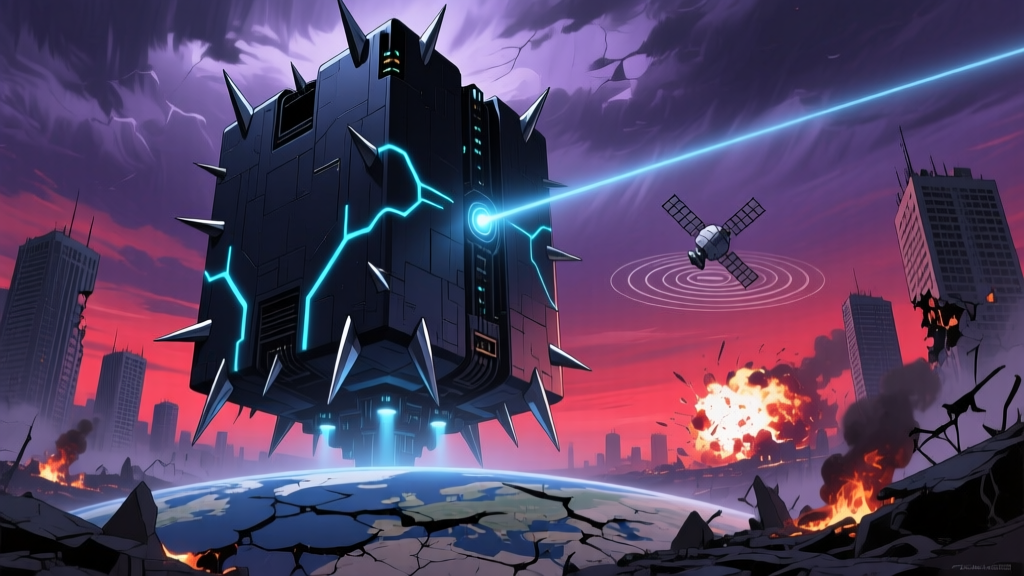
The first time you see it, you don't understand what you're looking at. There are no engine nacelles. No bridge module. No windows running along the hull in orderly rows. Just a cube — each side measuring 3.04 kilometers — hanging in the void like a geometric obscenity. It doesn't rotate. It doesn't broadcast. It simply exists, and every sensor reading your ship can muster comes back wrong.
That was 1989. The episode was "Q Who," the sixteenth installment of Star Trek: The Next Generation's second season, written by Maurice Hurley. The Enterprise-D had been flung 7,000 light-years from Federation space by the entity Q, dropped into the J-25 system like a toddler tossed into a shark tank. And the shark was waiting.
The Borg Cube didn't announce itself. It didn't fire a warning shot. It simply appeared on long-range sensors as an object that shouldn't exist in uncharted space, and when the Enterprise approached, the crew realized something that would reshape the next two decades of Star Trek storytelling: the galaxy had a predator, and it didn't negotiate.
Data's analysis was clinical, as always. The vessel was approximately 3.04 kilometers per side. Its power output exceeded anything in Starfleet's database. Its hull showed no recognizable propulsion or weapons arrays. When the Cube finally engaged, it stripped the Enterprise-D's shields like peeling bark from a dead tree — methodical, unhurried, indifferent.
"They are the ultimate users. They don't want your territory, your resources, your culture. They want you. Your knowledge, your biology, your identity — absorbed into the Collective, gone forever."
— Guinan to Jean-Luc Picard, Star Trek: TNG "Q Who" (1989)
Since that moment, Borg ships have occupied a position in science fiction that few vessels have ever achieved. They aren't merely warships. They aren't exploration platforms that happen to carry weapons. They are assimilation engines — mobile extensions of a hive mind that converts civilizations into raw material. And the engineering behind them is as cold and deliberate as the purpose they serve.
Borg Engineering Philosophy: Form Surrenders to Function
Every starship in the Star Trek universe reflects the culture that built it. The Federation's Constitution-class vessels, with their saucer-and-nacelle silhouette, communicate exploration and elegance. Klingon Bird of Prey designs are predatory, wings folded like a raptor about to strike. Romulan warbirds are vast and ornate, projecting imperial authority. These ships are cultural statements as much as they are military hardware.
The Borg discarded that entire framework.
A Borg ship looks the way it does because the Collective has no concept of aesthetics. There are no cultural traditions to honor, no design heritage to preserve, no individual preferences to accommodate. Every surface, every conduit, every cubic meter of interior space serves one purpose: advancing the mission of the Collective. The result is architecture that looks less like a starship and more like a machine for processing civilizations into components.
The Cube's internal layout confirms this. There are no decks in the traditional sense, no corridors organized by department, no mess halls or recreation areas. The interior is a dense three-dimensional lattice of power conduits, processing nodes, and regeneration alcoves. A typical Cube houses approximately 5,001 drones (though the exact number varies by mission configuration), each one networked into the collective consciousness through cortical implants and subspace transceivers embedded in their cranial structures.
The central power core sits at the geometric center of the vessel, surrounded by layers of drone maturation chambers, tactical processing nodes, and structural integrity subsystems. The design doesn't care about crew comfort. There are no escape pods because drones don't evacuate. There are no designated "up" or "down" orientations because the Collective recognizes no gravitational preference. Every direction is functionally equivalent.
The exterior is no less unsettling. Visual scans of a Cube's surface reveal a fractal nightmare of pipes, conduits, and geometric protrusions that extend inward to an unknown depth. Production designer Dan Curry and visual effects supervisor Robert Legato developed the Cube's look for "Q Who" by combining model work with what Legato described as an approach where the surface seemed to repeat endlessly at every magnification level — a visual metaphor for the Collective's infinite, recursive nature. The effect is that the Cube looks like a piece of industrial infrastructure multiplied to infinity, a machine that grew rather than was built.
The Fleet Beyond the Cube: Every Borg Vessel Class on Record
The Cube gets all the attention, and deservedly so. It's the icon. But Starfleet Intelligence, combined with Voyager's seven years of direct encounters in the Delta Quadrant, catalogued a far broader Borg fleet than most viewers realize. Each vessel type serves a distinct operational role within the Collective's hierarchy, and the variety reveals a military doctrine far more sophisticated than "send a big cube and hope for the best."
Borg Sphere — The Surgical Instrument
Approximately 600 meters in diameter, the Borg Sphere first appeared in Star Trek: First Contact (1996) in the most dramatic fashion possible: it launched from the interior of a Cube that the Enterprise-E had just destroyed, carrying a contingent of drones back through a temporal vortex to the year 2063. Its mission was surgical — prevent Zefram Cochrane's historic first contact with the Vulcans, thereby preventing the formation of the United Federation of Planets before it began.
The Sphere's design language differs radically from the Cube. Where the Cube is brutalist geometry, the Sphere has a kind of terrible elegance — a smooth, dark surface punctuated by the same green-lit conduit patterns that mark all Borg technology. It's faster in atmosphere than a Cube, more maneuverable in close quarters, and carries enough drones (approximately 500) to accomplish targeted missions without the logistical overhead of a full Cube deployment. Voyager encountered Spheres repeatedly during its journey, particularly in the transwarp corridor network that crisscrossed the Delta Quadrant.
Borg Diamond — The Industrial Predator
Less frequently discussed but no less important to understanding Borg operational scope, the Borg Diamond appeared in Voyager's Delta Quadrant encounters as a specialized resource-extraction platform. Its primary function wasn't assimilation of species — it was mining and planetary drilling operations. The diamond-shaped hull provided structural advantages for withstanding the tremendous stresses of atmospheric entry and planetary surface operations.
The Diamond represents something the Cube doesn't: the Borg as industrial power rather than purely military threat. They don't just assimilate civilizations. They strip worlds of resources, process raw materials through automated facilities, and feed the output back into the Collective's expansion. The Diamond is, essentially, a strip-mining operation in starship form — a reminder that the Borg economy of conquest extends far beyond the acquisition of biological and technological distinctiveness.
Tactical Cube and Scout Ship — War Adaptations
When the Borg encountered Species 8472 in Voyager's fourth season, they did something unprecedented: they built a specialized warship. The Tactical Cube was a modified Cube design with significantly enhanced weapons arrays, reinforced hull plating, and additional shield generators. It was the Collective's acknowledgment — however implicit — that they had met an opponent whose biologically-derived weapons could overwhelm standard Cube defenses.
At the opposite end of the spectrum, the Borg Scout Ship measured only about 25 meters across and carried a complement of roughly 10 to 15 drones. Scout ships appeared in the Voyager episode "Dark Frontier" (1999) as reconnaissance and infiltration platforms. They weren't designed for combat. They were designed to find targets, assess defenses, and transmit coordinates back to the nearest unimatrix — after which the Cubes would arrive.
The Technology That Makes Resistance Futile
You can study Borg ship design for years and still miss what actually makes them terrifying. It isn't the weapons arrays or the hull thickness or even the sheer size. It's the support systems — the technologies that allow a Borg vessel to operate outside every constraint that governs conventional starships. A Federation starship needs supply lines, maintenance crews, shore leave for its personnel, and a chain of command to make decisions. A Borg ship needs none of these things.
Transwarp: The Network That Swallowed the Galaxy
Conventional warp drive has a speed limit. Even at warp 9.9 — the maximum sustainable velocity for a Sovereign-class starship — crossing the Milky Way would take roughly 75 years. The Borg solved this problem not by building faster engines but by building infrastructure.
The Borg transwarp network consists of fixed conduits through subspace, anchored at one end by massive transwarp hubs and accessible to any Borg vessel equipped with a transwarp coil. A ship entering a conduit could traverse distances that would take Federation vessels decades in a matter of minutes. At its peak, the network spanned the galaxy — six major hubs connected by thousands of secondary and tertiary apertures, creating what amounted to an interstellar highway system owned and operated exclusively by the Collective.
The strategic implications are difficult to overstate. A Federation task force might spend months traveling to respond to a Borg incursion. The Borg could redeploy an entire Cube fleet to the same coordinates in hours. When Voyager's crew destroyed the transwarp hub network in the series finale "Endgame" (2001), they effectively crippled the Collective's ability to project power across galactic distances — an act that Star Trek: Picard later depicted as triggering a catastrophic collapse of Borg operational capacity by the early 25th century.
Regenerative Hull: Ships That Heal
Strike a conventional starship hard enough and it stays damaged until a repair crew patches the hull. Strike a Borg ship and the damage begins healing almost immediately.
Borg hull structures incorporate billions of nanoprobes — microscopic machines that function as an immune system for the vessel itself. When a weapons impact breaches the hull, nanoprobes swarm the damaged area, reconstructing plating, reconnecting severed conduits, and reinforcing the structure against whatever energy signature caused the breach. The repair speed varies depending on damage severity, but minor penetrations have been observed sealing within seconds of impact.
This regenerative capability means that a Borg ship effectively becomes more resistant to your weapons the longer you fire at it. The same phaser frequency that punched through the hull on the first shot might find itself absorbed by adapted hull plating on the fifth. Voyager encountered this problem repeatedly: weapons that worked brilliantly in initial engagements became nearly useless within minutes as the targeted Borg vessel analyzed, adapted, and regenerated.
Adaptive Shielding: The Learning Defense
Perhaps the most psychologically devastating technology in the Borg arsenal, adaptive shielding works on a principle that turns every engagement into a race against time. Borg shields analyze incoming energy signatures and recalibrate to resist them. The first phaser blast hits at full effectiveness. The second might penetrate at 80 percent. By the fifth or sixth, you're watching your beams dissipate against a shield that learned your frequency faster than you could change it.
This technology forced Starfleet tactical officers into a nightmare scenario: you had to keep inventing new ways to hurt the enemy during combat, because the enemy was simultaneously inventing new ways to ignore you. Captain Janeway of the USS Voyager spent much of her Delta Quadrant campaign developing creative weapons modifications — modulating shield frequencies, deploying improvised EMP bursts, even resorting to physical ramming — because conventional tactics degraded against Borg targets with terrifying speed.
The Encounters That Defined a Generation of Fear
Borg ships didn't arrive in the Star Trek universe as background villains. They arrived as extinction-level events. Each major appearance escalated the threat, expanded the lore, and burned specific images into the memories of viewers who watched them air in real time.
"Q Who" and "The Best of Both Worlds" — The Introduction That Shattered Confidence
In "Q Who," the Enterprise-D never fires a shot in anger. The Cube swats the ship aside, cuts a chunk out of its hull, and withdraws when Q decides the lesson has been taught. The horror is in the helplessness. Picard — the most diplomatic, curious, and resourceful captain in Starfleet — sits in his chair and watches his ship get dismantled by an opponent that doesn't even consider him a threat worth acknowledging.
"The Best of Both Worlds" (1990) took the dread and weaponized it. A single Cube, crew complement approximately 5,000 drones, destroyed 40 Starfleet vessels at the Battle of Wolf 359 before continuing toward Earth. Forty ships. The pride of Starfleet's defensive fleet, assembled in desperation, reduced to debris scattered across a single star system. And at the Cube's center stood Locutus — Jean-Luc Picard, assimilated, speaking for the Collective with the calm detachment of a surgeon describing an amputation.
The Cube wasn't just a warship in this context. It was a statement: your civilization's military capacity is irrelevant. We will take your champion, hollow him out, and use his voice to announce your end. The Battle of Wolf 359 became one of the most referenced events in Star Trek lore, casting a shadow that extended into Deep Space Nine's premiere episode and beyond.
First Contact — The Sphere and the Birth of the Queen
Star Trek: First Contact (1996) gave audiences the Borg Sphere in the most dramatic context possible: emerging from the wreckage of a Cube destroyed in Earth orbit, riding a temporal vortex into the past, and attempting to rewrite human history at its most pivotal moment. The Sphere's mission was precise. Prevent Zefram Cochrane's first warp flight on April 5, 2063. Prevent the Vulcan survey ship from detecting Cochrane's signature. Prevent first contact. Prevent the Federation.
The film also introduced the Borg Queen — a figure who emerged from the Sphere's interior like a spider descending from the ceiling of her web. Played by Alice Krige with a combination of menace and unsettling intimacy, the Queen represented a paradox within the Collective: she spoke as an individual while claiming to embody the Collective's unified will. "I am the Collective," she told Data, in a line that managed to be both a declaration and a contradiction. Her presence aboard the Sphere transformed the vessel from a mere transport into something closer to a throne room — the seat of whatever passed for individual consciousness within the hive mind.
Voyager's Seven-Year War — A Different Kind of Engagement
Where The Next Generation treated the Borg as an apocalyptic event — rare, overwhelming, civilization-threatening — Voyager was forced to live with them as a constant environmental hazard. The ship was stranded in the Delta Quadrant, which happened to be the heart of Borg territory. Every encounter wasn't a special event; it was Tuesday.
This forced a different kind of storytelling. Voyager showed us the Borg from the inside, literally — through the eyes of Seven of Nine, a former drone severed from the Collective in the episode "Scorpion" (1997). Through Seven's memories and expertise, the audience learned the internal architecture of Borg vessels in granular detail: the unimatrix command structure, the transwarp corridor network, the Queen's relationship to her drones, the protocols for Cube activation and deactivation.
Some of Voyager's most tense sequences involved boarding Borg ships rather than fighting them. In "Dark Frontier" (1999), Captain Janeway led a team onto a Borg vessel to steal a transwarp coil — essentially breaking into a sleeping giant's house to steal its car keys. The sequence worked because the show had spent years establishing that a Borg ship, even one in dormant standby mode, was a place where every corridor could wake up and kill you. Every surface was monitored. Every drone was a sensor. The ship itself was conscious, and it was always listening.
Fleet Comparison: Every Borg Vessel at a Glance
Starfleet's encounters across TNG, Voyager, and the feature films produced the most detailed intelligence dossier on Borg naval capabilities in the Star Trek canon. The table below compiles data from canonical sources, including technical readouts from Star Trek: The Next Generation Technical Manual (Sternbach & Okuda, 1991) and subsequent reference materials.
| Vessel Class | Dimensions | Crew / Drones | Primary Role | Key Appearance |
|---|---|---|---|---|
| Cube | 3.04 km per side | ~5,001 | Assault, assimilation | TNG, First Contact, Picard |
| Tactical Cube | 3.04 km per side | ~8,000 | Heavy assault | Voyager "Scorpion" |
| Sphere | ~600 m diameter | ~500 | Precision strike, temporal ops | First Contact, Voyager |
| Diamond | ~700 m length | ~200 | Mining, resource extraction | Voyager (Delta Quadrant) |
| Scout Ship | ~25 m length | ~10–15 | Reconnaissance | Voyager "Dark Frontier" |
| Transwarp Hub | ~600 m span | Automated | Network relay, conduit anchor | Voyager "Endgame" |
| Unicomplex | Planetary scale | Millions | Capital, command center | Voyager "Dark Frontier" |
The diversity here matters. The Borg didn't build one ship and scale it up. They built an entire fleet architecture, with specialized platforms for every operational requirement — from the Scout Ship's covert reconnaissance to the Unicomplex's role as the nerve center of a galactic-scale civilization. This is what separates the Borg from a simple monster-of-the-week villain. They are a functioning military-industrial complex, and their ship designs reflect thousands of years of accumulated tactical knowledge from assimilated species across two quadrants of the galaxy.
What Makes a Borg Ship the Most Terrifying Vessel in Science Fiction
Plenty of science fiction franchises have built intimidating ships. Star Wars gave us the Death Star — a moon-sized battle station capable of destroying planets. Battlestar Galactica gave us the Cylon Basestar — an autonomous warship with nuclear armaments and a regeneration capacity. Warhammer 40K has Hive Fleet Leviathan, a biological armada that consumes entire star systems. Each of these is terrifying in its own context. But the Borg ship occupies a unique psychological space that none of them quite reach.
The first reason is the nature of the threat. A Death Star kills you. A Borg ship erases you. The distinction matters more than most people realize. Death is final, but it preserves identity — you died as yourself, with your memories and your values intact. Assimilation destroys the self. Your body continues to function, your skills remain accessible, and your knowledge feeds the enemy's strategic calculations. But you are gone. Replaced by a drone, a node in the network, a component in a machine that will use everything you were against everything you loved.
The second reason is scale. When the Borg Queen told Picard in First Contact that the Collective had absorbed tens of thousands of species, the statement carried weight because the audience had already seen what a single Cube could do to a Federation fleet. Forty ships destroyed at Wolf 359. Eleven thousand dead. And that was one Cube, operating alone, in a single engagement. The full Borg fleet, operating through the transwarp network, represented a military capacity that made the Federation's entire Starfleet look like a coast guard.
"The Borg are the most interesting adversary in Star Trek because they represent the antithesis of everything the Federation stands for. The Federation is about cooperation between individuals who choose to work together. The Borg is cooperation without choice — efficiency at the cost of identity, unity at the cost of self."
— Brannon Braga, co-writer of Star Trek: First Contact and executive producer of Voyager
The third reason — and perhaps the one that lingers longest after the credits roll — is the uncomfortable reflection. Borg ships mirror something in our own civilization that we'd rather not examine too closely. We build networks. We optimize for efficiency. We connect ourselves to systems that monitor our behavior, predict our choices, and nudge us toward decisions we might not have made independently. The Borg Collective is a nightmare version of our own aspirations toward connectivity — a world where the network doesn't serve the individual but absorbs it entirely.
The Cube is terrifying not because it's impossible. It's terrifying because its underlying philosophy isn't as alien as we'd like to believe. Every system we build that prioritizes collective efficiency over individual autonomy moves us one small step closer to the Borg's design principles. That's why the ship haunts you. Not because it's fantasy, but because it's a mirror held at an angle you didn't choose to look from.
Borg Ship Questions Viewers Actually Ask
What is the largest Borg ship ever shown on screen?
The largest individual Borg vessel is the Borg Cube, at 3.04 kilometers per side — roughly 28.1 cubic kilometers of internal volume. However, the Unicomplex in Unimatrix 01 functions as a planetary-scale installation, dwarfing any individual ship. In Voyager's depiction, the Unicomplex extends across an entire world, with surface structures visible from orbit. It serves as the Collective's capital and the Borg Queen's primary seat of power, making it less a ship and more a fortified world.
Can a Borg Cube be destroyed by conventional Starfleet weapons?
Yes — but the cost is enormous. At the Battle of Wolf 359, a single Cube destroyed 40 Starfleet ships before continuing to Earth. It was eventually stopped by a combination of Data's intervention (he infiltrated the Cube and fed a feedback command through Locutus) and concentrated fleet fire. In First Contact, the Enterprise-E and supporting Starfleet vessels destroyed a Cube in Earth orbit, though it took the combined firepower of multiple ships and a precise tactical approach targeting the Cube's central power matrix. A single starship engaging a Cube alone faces near-certain defeat.
Do Borg ships have individual names or designations?
The Borg designate their vessels using a tactical classification system rather than personal names. A Cube operating in a specific region is identified by its unimatrix and grid coordinates — for example, "Vessel 427 of Unimatrix 01." This reflects the Collective's philosophy: ships are components, not individuals. They don't earn names through service or develop personalities through crew culture. They are numbered, tracked, and replaced when destroyed — exactly like the drones that crew them.
How do Borg drones operate a ship without a captain or crew hierarchy?
There is no captain on a Borg ship. There are no officers, no departments, no shifts. Every drone aboard is connected to the collective consciousness through cortical implants that function as both neural interfaces and subspace transceivers. The ship is operated by the collective mind of all drones simultaneously — a distributed intelligence that makes decisions through parallel processing rather than chain-of-command deliberation. Tactical decisions propagate through the network in milliseconds. Damage to one section triggers an automatic redistribution of processing capacity to remaining systems. The ship doesn't have a crew. The ship is the crew.
What happened to the Borg fleet after Voyager destroyed the transwarp hubs?
The destruction of the transwarp hub network in Voyager's finale "Endgame" (2001) effectively severed the Collective's ability to rapidly redeploy ships across galactic distances. Individual vessels retained transwarp capability through their onboard coils, but without the hub infrastructure, long-range coordination became far more difficult. Star Trek: Picard later established that the Borg suffered a catastrophic decline in the decades following this event, with the Collective fragmenting and losing coherence — a process accelerated by the removal of the transwarp network that had served as both a transportation and communication backbone for the entire hive mind.
How does Borg ship shielding adapt to different weapon types?
Borg adaptive shielding operates through a real-time analysis-and-recalibration cycle. When an energy weapon strikes the shields, onboard sensors analyze the beam's frequency, amplitude, and modulation pattern. Within seconds, the shield generators recalibrate to create destructive interference at that specific frequency, dramatically reducing the weapon's penetration. This is why Starfleet officers in multiple Star Trek episodes observe their phasers losing effectiveness over the course of an engagement — the Borg are literally learning your weapons in real time and adjusting. The only reliable countermeasure is to continuously modulate your own weapon frequencies, staying one adaptation ahead of the Collective's analysis.
Resistance is futile. But reading about it? That's always productive. — SenpaiSite Staff