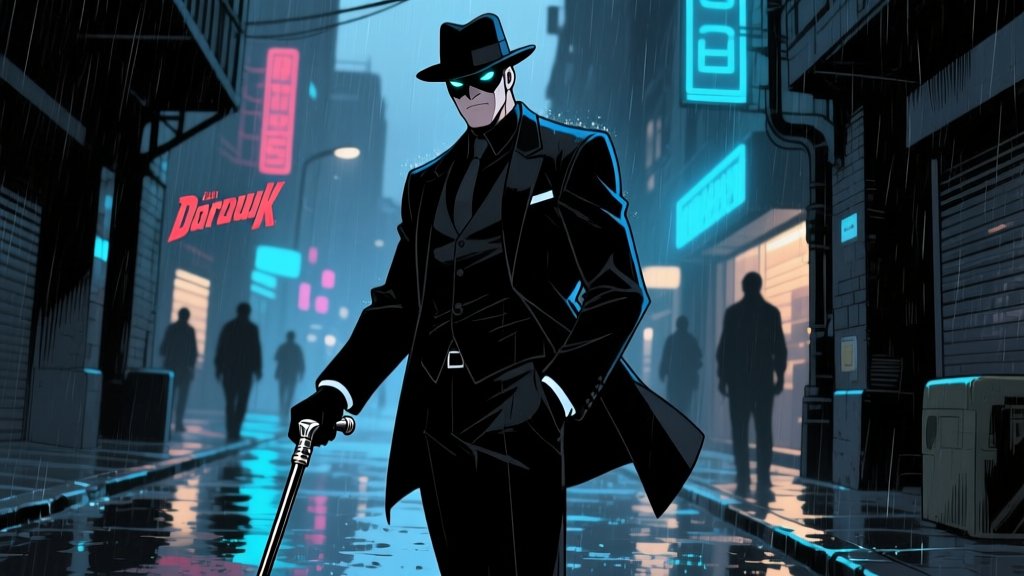
Picture the scene: a blind lawyer steps out of a Hell's Kitchen brownstone at dusk, tapping a white cane along the sidewalk. He looks harmless. Neighbors wave. A kid on a bike weaves around him. Then the lawyer turns into an alley, presses a hidden release, and that same cane splits open into two steel fighting sticks connected by a high-tensile cable. The tap-tap-tap of the blind man's cane becomes the crack of composite polymer against a mugger's jaw. That is the trick at the heart of Matt Murdock's walking stick—the most deceptively simple weapon in the Marvel universe.
Since Daredevil #1 hit newsstands in April 1964, that cane has been Murdock's disguise, his weapon, and his symbol. It sits at the crossroads of two identities that should not coexist: the careful, restrained attorney who believes in due process, and the rooftop-swinging vigilante who beats confessions out of criminals the law cannot touch. This article traces the walking stick's evolution across sixty years of comics, three seasons of Netflix television, a growing MCU presence, and a cottage industry of collector replicas—and asks why a piece of assistive medical equipment became one of the most iconic props in superhero history.
Origin Story: A Cane in a Four-Color Panel
Stan Lee and Bill Everett introduced Matt Murdock in Daredevil #1 (cover-dated April 1964) as a blind lawyer who moonlighted as a costumed crimefighter. The cane appeared from the very first issue—not as a weapon, but as cover. Murdock needed a reason to carry a stick in his civilian identity, and a white cane signaling visual impairment was the obvious, practical choice. Lee's scripts treated the cane largely as a prop to sell the blind-lawyer act to bystanders within the story.
But the billy club—the fighting-stick form of the cane—also appeared in issue #1, suggesting the dual-function concept was baked into the character from the start. Early issues showed Murdock pressing a concealed catch to separate the cane into two shorter batons, sometimes with a cable or rope running between them. The mechanism was vague; four-color printing and tight deadlines meant artists drew whatever looked dynamic on the page, and continuity took a back seat to action choreography.
The Wallace Wood Redesign
When Wallace Wood took over art duties with Daredevil #5 (December 1964), he refined the character's visual language significantly. Wood's Daredevil costume moved away from the original yellow-and-black scheme to the now-iconic all-red suit, and his handling of the billy club became more consistent. Wood drew the weapon as two cylindrical batons, each roughly 12 inches long, that locked together end-to-end to form the single longer shaft of the cane. The cable-and-grappling-hook function—which allowed Daredevil to swing between rooftops like a low-budget Spider-Man—became more prominent under Wood's pen, cementing the cane's role as a multi-tool rather than a mere bludgeon.
"In day to day life, D.D.'s cane conceals a hook-and-cable device that enables him to swing across the rooftops of Hell's Kitchen. It is the most versatile weapon in his arsenal—part mobility aid, part grappling hook, part blunt instrument." — Marvel bonus page, Daredevil run (Frank Miller era, c. 1980)
Frank Miller and the Weapon That Earned Its Name
Frank Miller's landmark run on Daredevil (issues #158–191, 1979–1983) did more than redefine the character's tone—it gave the billy club a philosophical weight it had never carried before. Miller's Murdock was a man stretched between Catholic guilt, legal idealism, and violent compulsion, and the cane became the physical manifestation of that tension. In Miller's panels, you see Murdock gripping the cane in his civilian clothes with white-knuckle restraint—the same hands that, hours later, snap it apart and use it to break a drug dealer's collarbone.
Miller also tightened the mechanics. His billy clubs were drawn as solid, unglamorous fighting sticks—closer to Filipino escrima sticks than to fantasy weapons. The grappling-hook function remained, but Miller emphasized the clubs as impact weapons first, used with the precise, technical striking of a trained martial artist. The cable was sometimes depicted as a thin steel wire wound on a spring-loaded spool inside one of the baton halves, a detail that later comic runs and the Netflix series would pick up and refine.
Post-Miller: The Club Keeps Evolving
After Miller, various creative teams tweaked the billy club's design. In the 1990s, some artists gave it a more stylized, angular look; in Kevin Smith's Guardian Devil storyline (1998), the club returned to a simpler, more grounded design that matched Smith's back-to-basics narrative approach. Joe Quesada's art in the same arc depicted the cane as a sleek, matte-black cylinder with a subtle red stripe—a visual nod to the red-white cane used by real-world visually impaired people, though recolored to match Daredevil's palette.
Ed Brubaker and Michael Lark's 2006–2009 run leaned harder into realism. Their Murdock was in prison for long stretches, and the cane was often absent entirely—which made its return feel more meaningful. When Murdock finally suited up again, Lark drew the billy clubs with visible wear: scuffed grips, dented ends. These were tools that had been used hard and often.
How It Actually Works: The Dual-Function Design
The walking stick's genius is its simplicity. Here is a breakdown of the core functions as depicted across most continuities:
| Function | Comics Depiction | Netflix Series (2015–2018) | MCU / Born Again (2025) |
|---|---|---|---|
| Mobility aid / disguise | White or red-striped cane; signals blindness to civilians | Dark wood/metal cane with subtle red tip; used daily by Murdock | Updated design with magnetic release; more polished finish |
| Single billy club | Cane separates into one or two batons, depending on issue | Cane splits into two escrima-style sticks (~12 in. each) | Retains two-stick configuration with redesigned coupling |
| Grappling hook & cable | Spring-loaded hook fires from one end; steel cable on internal spool | Hook fires from one baton; cable used for swinging and binding enemies | Cable mechanism present; used for traversal and combat entanglement |
| Throwing weapon | Occasionally hurled like a ricochet projectile (Miller era) | Thrown and recalled via cable in several key fight scenes | Featured in Born Again action sequences |
| Blunt-force impact | Primary use; used for strikes, blocks, and joint locks | Core combat tool; choreography based on escrima and kali | Combat style blends escrima with street-fighting improvisation |
The Netflix adaptation deserves specific credit for making the mechanical transformation feel tangible. In Season 1, the prop department designed the cane with a visible twist-and-release coupling near the handle. When Murdock (Charlie Cox) grips the cane at a specific point and twists, the two halves separate with an audible click. The show's sound designers added a metallic snick to every transformation, turning the cane-to-billy-club conversion into a signature audio cue—the way Wolverine's claws have their own sound, or Captain America's shield has its ricochet ping.
Across the Screen: The Cane in Live Action
The Netflix Era (2015–2018)
The Netflix Daredevil series, which premiered in April 2015, was the first time audiences saw the cane's transformation depicted with physical, practical-effect realism. Prop master Matthew Twyford and his team built multiple versions of the cane for different shooting requirements: a hero prop with working separation mechanics for close-ups, a lightweight rubber version for stunt work, and a reinforced steel-core version for contact fighting. Charlie Cox trained with escrima sticks for months before filming to make the fighting sequences look second-nature.
Across three seasons, the cane appeared in virtually every episode. Its most memorable moments include the hallway fight in Season 1, Episode 2 ("Cut Man"), where Murdock uses a single baton in a confined space, and the prison riot sequence in Season 2, where the billy clubs are used in brutal close-quarters combat that pushed the show's TV-MA rating to its limit. The Season 3 premiere showed Murdock rebuilding his cane from scratch after the events of The Defenders crossover—a scene that doubled as a metaphor for the character rebuilding himself.
Charlie Cox reportedly stole one of the hero billy club props from the set after filming wrapped on Season 3, a fact he later confirmed in interviews. "I just put it in my bag one day and walked out," he told CBR in 2022. The production team, apparently, let it slide.
MCU Appearances: She-Hulk, Echo, and Born Again
Matt Murdock's cane appeared briefly but memorably in She-Hulk: Attorney at Law (2022), where Murdock reprised his role as a lawyer—this time representing Jennifer Walters. The cane in that series was a polished, darker wood finish, closer to a gentleman's walking stick than a utilitarian mobility aid. The show gave audiences only a glimpse of Murdock's vigilante side, but a mid-credits scene confirmed the billy club was still very much part of his arsenal.
In Echo (2024), Murdock appeared in a supporting capacity, and the cane was shown with a slightly updated design: a matte-black shaft with a dark-red band near the grip, bridging the Netflix aesthetic with the MCU's cleaner production values. The Echo appearance was notable because it marked the first time the cane appeared in a project explicitly connected to the wider MCU timeline rather than the standalone Netflix continuity.
With Daredevil: Born Again (premiering March 2025 on Disney+), the cane received its most significant on-screen redesign yet. The Born Again billy clubs feature a more modular coupling system—the two halves connect via what appears to be a magnetic lock rather than the twist-release of the Netflix era. The cable-and-hook mechanism is more prominently featured in the show's action choreography, with several sequences showing Murdock using the cable to disarm opponents at range, a capability that comics readers will recognize from Miller's and Bendis's runs.
Collectible Replicas: Owning the Devil's Cane
The walking stick's iconic status has spawned a healthy market for replicas and collectibles, spanning mass-produced toys to artisan-crafted props.
- Hasbro Marvel Legends — The 6-inch scale Daredevil figure released in the Born Again wave includes a removable billy club accessory and the iconic red mask. A separate "mask and billy club" accessory pack retailed for approximately $24.99 at launch in 2025. The billy club in this line can transform between its cane configuration and the two-stick fighting form, a detail that fans praised on collector forums.
- Hot Toys 1/6 Scale — Hot Toys released a 1/6 scale Daredevil figure based on the Netflix series (approximately $280–$320 retail), which included the billy club in both cane and separated forms, along with a cable accessory and a display base replicating a Hell's Kitchen rooftop. A Born Again variant was announced for 2025–2026 with updated sculpting and paint.
- Artisan / Fan-Made Replicas — The maker community has produced remarkably detailed replicas. Builders on YouTube and Patreon have documented CNC-machined aluminum billy clubs with working twist-release mechanisms, spring-loaded grappling hooks, and even LED-lit cable channels. A well-known maker going by SchizmWorks documented a full scratch-build process that accumulated over 2 million views.
- 3D-Printed Versions — Printable STL files for Born Again-style billy clubs have circulated on platforms like Patreon and Thingiverse, allowing cosplayers to produce their own replicas at a fraction of the cost of commercial options. Some designs include functional separation mechanisms using embedded magnets.
The Deeper Meaning: Why the Cane Matters
Strip away the grappling hooks and the escrima choreography, and the walking stick is, at its core, a lie. It is the physical embodiment of Matt Murdock's central deception: that he is a disabled man who needs help crossing the street. Every time Murdock grips that cane in his civilian identity, he is performing blindness for an audience that does not know his senses are sharper than any sighted person alive.
This is not a trivial narrative choice. Disability representation in comics has a long, complicated history, and Daredevil occupies an unusual position. Murdock is not actually dependent on the cane—he uses it to maintain his cover. This has drawn criticism from disability advocates who point out that the character reinforces the trope of disability as a mask or trick rather than a lived experience. At the same time, Murdock is one of the most prominent disabled characters in mainstream comics, and his cane—even as a deception—is one of the most visible pieces of assistive-technology iconography in pop culture.
The cane also functions as a threshold object—a literal boundary between identities. The moment Murdock separates the cane into billy clubs, he crosses from Matthew Murdock, Esq., into Daredevil. It is a transformation sequence compressed into a single gesture: twist, pull, fight. In the Netflix series, the directors understood this intuitively. The cane-separation shot is almost always framed as a close-up, given a beat of silence, and scored with a low, tense drone. It is the show's version of a superhero suit-up moment, stripped of CGI and spectacle.
A Symbol of Restraint
There is a subtler reading worth considering. The cane, in its walking-stick form, is a tool of restraint. Murdock carries it as a reminder that he is supposed to be the lawyer, not the vigilante. It is the weapon he does not use—the form it takes when Murdock is choosing to operate within the rules. Every time a villain knocks the cane out of his hand, or every time Murdock deliberately splits it apart, the audience witnesses a choice being made. The cane is the visible sign of a man constantly deciding whether to be civil or violent, and the fact that it contains violence inside its polite exterior is the whole point.
Frank Miller understood this better than anyone. In Daredevil: The Man Without Fear (1993), the five-issue miniseries that retold Murdock's origin, Miller showed a young Matt practicing with the cane his father Jack gave him—before he ever put on a mask. The cane was Jack Murdock's idea, a tool to help his blind son navigate the world. That Matt would later turn his father's gift into a weapon says everything about the character: love and violence, protection and punishment, wrapped around the same length of metal.
Comparing the Cane Across Adaptations
Not every version of the billy club is created equal. The design has shifted significantly depending on the medium, the era, and the creative team's philosophy about how grounded or fantastical Daredevil should be.
- Silver Age comics (1964–1979) — The cane was drawn inconsistently, often changing length and proportions between panels. The grappling hook was sometimes comically oversized. Artists treated it as a generic adventure gadget rather than a thoughtfully designed tool.
- Frank Miller era (1979–1986) — The club became leaner, more practical. Miller drew it closer to real escrima sticks, roughly 28 inches total in cane form and 12 inches per baton. The grappling hook was scaled down and depicted as a serious tactical tool.
- Modern comics (2000s–present) — Artists like Alex Maleev, Michael Lark, and Marco Checchetto have kept the design grounded, with matte finishes and visible wear. The cane is typically black or dark brown with a red accent, matching the modern costume.
- Netflix series (2015–2018) — The most physically realized version. Dark wood-and-metal construction, practical twist-release coupling, approximately 34 inches in cane form. The billy clubs have a subtle hexagonal cross-section for grip.
- MCU / Born Again (2025–) — Sleeker, more modular design with an apparent magnetic locking mechanism. The finish is a matte black with a dark-red band. Slightly longer than the Netflix version, closer to 36 inches in cane form.
The trend across sixty years is clear: the cane has moved from a generic comic-book gadget toward something that looks like it could actually be machined in a real workshop. Each adaptation has pulled the design closer to reality, which is fitting for a character whose appeal has always been his grounded, street-level sensibility. Daredevil doesn't fly. He doesn't shoot lasers. He swings from fire escapes and hits people with sticks. The cane is the perfect weapon for a hero who is, in the end, just a man.
The Billy Club, Clarified
Is Matt Murdock's cane a real mobility aid or just a weapon?
Within the story, it functions as both. In his civilian identity, Murdock uses the cane as a conventional white cane to navigate as a blind person. The cane's true purpose, however, is to conceal the billy clubs hidden inside it. In real-world terms, the cane is a prop designed to sell Murdock's cover. He does not need it for mobility—his radar sense and heightened remaining senses make physical navigation trivial for him.
What is the billy club made of?
The material varies by continuity. In most comic depictions, the billy clubs are described as a high-density metal alloy, sometimes specified as a fictional Marvel-universe material. The Netflix series used practical props made from machined aluminum and steel for hero shots, with rubber and foam versions for stunts. Fan builders typically use aluminum tubing, stainless steel, or high-impact polymers for replicas.
Can the billy club shoot a grappling hook?
Yes. In most continuities, one of the two baton halves contains a spring-loaded grappling hook attached to a high-tensile cable wound around an internal spool. Murdock uses this to swing between buildings, rappel down walls, and occasionally entangle or disarm enemies at range. The cable's length is inconsistently depicted—anywhere from 20 feet to over 100 feet depending on the writer and the needs of the scene.
Did Charlie Cox keep a billy club from the Daredevil set?
Yes. Cox confirmed in a 2022 interview with CBR that he took one of the hero billy club props home after the Netflix series wrapped. He described it as simply putting it in his bag and walking out, and the production team apparently did not object. The story has become a well-known piece of Daredevil trivia among fans.
How has the billy club changed in Daredevil: Born Again?
The Born Again version features a redesigned coupling system that appears to use a magnetic lock rather than the mechanical twist-release of the Netflix era. The overall aesthetic is slightly sleeker, with a matte-black finish and a dark-red accent band near the grip. The cable-and-hook mechanism has a more prominent role in the show's action choreography compared to the Netflix series.
Why does Daredevil use a billy club instead of a sword or gun?
The choice is rooted in character. Murdock is a Catholic who struggles with the morality of violence; using a blunt instrument rather than a blade or firearm reflects his (imperfect) attempt to limit the harm he causes. A billy club can incapacitate without killing. It also connects to his martial arts training—the stick-fighting disciplines of escrima and kali, which emphasize precision, speed, and leverage over brute force. And on a practical storytelling level, a blind man with a cane is a more compelling visual than a blind man with a gun.
Matt Murdock first appeared in Daredevil #1 (Marvel Comics, April 1964), created by Stan Lee and Bill Everett. The Netflix series Daredevil ran for three seasons from 2015 to 2018. Daredevil: Born Again premiered on Disney+ in March 2025. All character and franchise details referenced from Marvel Comics publications and Marvel Studios productions.