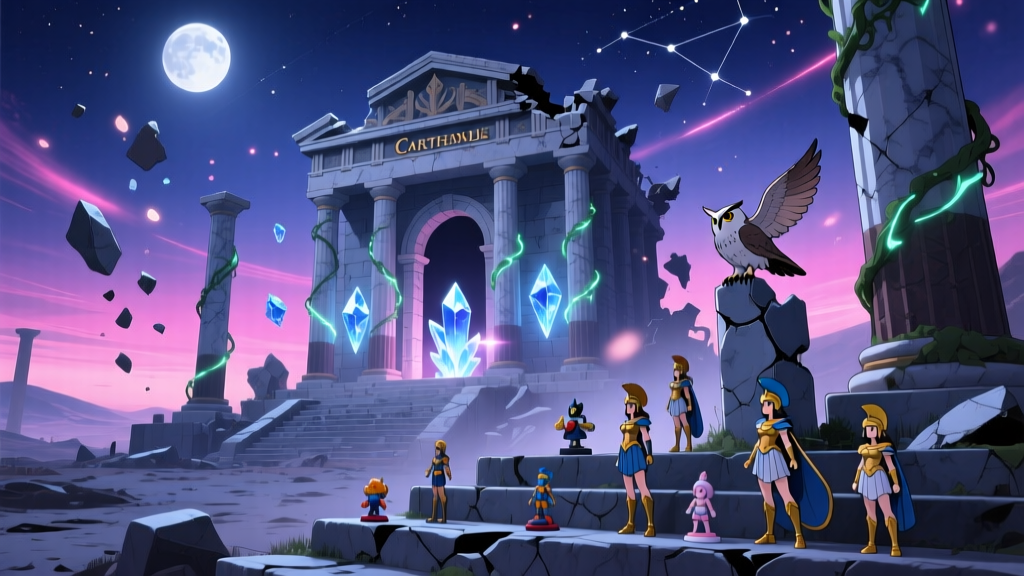
Picture this: you're twelve years old, watching Percy Jackson sprint across a glowing marble courtyard while a CGI Athena materializes above a pediment dripping with golden light. That building behind the action? The Carthenon temple — or more properly, the Parthenon — and it has been Hollywood's shorthand for "ancient power" for over seven decades. But if you think its fame stops at the box office, you haven't walked through a Tokyo hobby shop lately.
From 1:200 scale resin model kits in Akihabara display cases to Assassin's Creed: Odyssey's painstaking digital reconstruction, the Parthenon has escaped the archaeology textbook and colonized otaku culture in ways that would baffle Pericles himself. This is the story of how a 2,500-year-old temple became one of the most reproduced, referenced, and romanticized structures in modern visual media — and why collectors are paying serious yen to put miniature versions on their shelves.
Athens, 438 BC: The Blueprint That Started It All
The architects Iktinos and Kallikrates didn't just stack marble blocks on the Acropolis. They engineered an optical illusion in stone. The Parthenon's columns bulge slightly outward at the center — a technique called entasis — making them appear perfectly straight from a distance. The stylobate (the platform the columns sit on) curves upward by about 60 millimeters at its center. To the naked eye, every line reads as dead level. In reality, almost nothing on the building is truly straight.
This was intentional. The Athenians understood that human perception distorts geometry at scale, so they pre-distorted the geometry to compensate. It's the same principle your favorite anime studio uses when they draw character proportions slightly off-model so they "read" correctly in motion. Form follows perception.
The numbers tell the story of an obsession with proportion. The temple measures 69.5 by 30.9 meters at the stylobate level, with 46 outer columns (Doric order, 10.4 meters tall) and 23 inner columns (Ionic order). The width-to-length ratio approximates 4:9, a proportion the Greeks considered visually harmonious — and one that modern designers still use when laying out poster compositions and UI grids.
"The Parthenon is the only building in the world where you can stand at any corner, look along its facade, and feel that every element is exactly where it should be. That feeling was manufactured, millimeter by millimeter." — Mary Beard, The Parthenon (Harvard University Press, 2003)
The temple originally housed a 12-meter chryselephantine statue of Athena Parthenos, sculpted by Pheidias from gold and ivory plates mounted on a wooden armature. Ancient accounts describe the statue's gold components as removable — essentially, the Athenians stored their treasury inside their deity. When you see replicas of this statue in museums or as collector figures today, you're looking at a recreation of what was simultaneously a religious icon and a bank vault.
Athena's Mythological Resume: Why the Parthenon Matters to Storytellers
The Parthenon was dedicated to Athena Parthenos — "Athena the Virgin" — patron deity of Athens, goddess of wisdom, strategic warfare, and crafts. Unlike Ares, who represented the chaos and bloodlust of battle, Athena embodied discipline, planning, and the kind of calculated courage that wins wars before the first spear is thrown.
For modern storytellers, Athena is a gift. She sprang fully armored from Zeus's skull (literally — Hephaestus cracked his head open with an axe, and out she came). She turned Medusa's hair into snakes as punishment. She helped Odysseus navigate his decade-long journey home. She wove better than any mortal, which she proved by turning the boastful Arachne into a spider. Every one of these myths carries visual drama, moral ambiguity, and a character arc that writes itself.
The Parthenon's east pediment depicted Athena's birth; the west pediment showed her contest with Poseidon for patronage of Athens (she offered the olive tree, he offered a saltwater spring — the citizens chose olives, wisely). These sculptural programs by Pheidias established a visual vocabulary that Western art has drawn on for two millennia. When a concept artist today paints a "temple of wisdom" in a fantasy game, they're almost always pulling from this exact iconographic playbook.
The Elgin Marbles Controversy: A Story That Keeps Giving
No discussion of the Parthenon's cultural footprint is complete without mentioning the Elgin Marbles — or, more precisely, the Parthenon Sculptures. Between 1801 and 1812, Thomas Bruce, 7th Earl of Elgin, removed roughly half of the surviving sculptural decorations from the Parthenon and shipped them to Britain. They've sat in the British Museum since 1816, and Greece has been demanding their return ever since.
This dispute has generated at least three documentary films, a 2023 legal opinion from human rights lawyer Amal Clooney, and enough internet discourse to fill a library. For pop culture, the Marbles controversy adds a layer of real-world tension to any story set in or around the Parthenon. It's heritage as drama, and drama is what sells.
From Nashville to Olympus: The Parthenon on Screen and in Print
Hollywood discovered the Parthenon early. Cecil B. DeMille used matte paintings of the Acropolis in The Ten Commandments (1923) as background atmosphere, establishing the temple as visual code for "the ancient world at its peak." Since then, the building has appeared — sometimes accurately, sometimes hilariously not — in hundreds of productions.
Film and Television
The Percy Jackson franchise (both the film series and the 2023 Disney+ adaptation) leans heavily on Greek mythological architecture. In Rick Riordan's universe, Mount Olympus exists above the Empire State Building, but the visual language of the books draws directly from the Parthenon — marble halls, golden thrones, divine light filtering through columns. The Disney+ series' production designer, Dan Bishop, cited the Parthenon's east pediment as a direct reference for the throne room sequences.
In Clash of the Titans (both the 1981 original and the 2010 remake), the Parthenon appears as a stand-in for Olympus's architecture. The 2010 version spent an estimated $2.4 million on digital Acropolis environments alone, according to production notes published in Cinefex magazine (Issue 121, 2010).
Lesser-known but equally fascinating: the anime film Thermae Romae (2012) includes a sequence where the protagonist, a Roman bath architect, time-travels to modern Athens and weeps at the sight of the Parthenon's surviving columns. It's played for comedy, but the reverence is unmistakable.
Video Games
Assassin's Creed: Odyssey (Ubisoft, 2018) contains what is arguably the most detailed digital reconstruction of the Parthenon ever created for entertainment. Ubisoft's historical research team, led by historian Maxime Durand, worked with archaeologists to rebuild the temple as it would have appeared in 431 BC — polychrome paint on every surface (the ancient Greeks painted their temples in vivid reds, blues, and golds; the bare white marble we see today is the result of millennia of weathering), the full Athena Parthenos statue inside the cella, and the complete sculptural programs on both pediments.
The game sold over 10 million copies worldwide (per Ubisoft's fiscal year 2019 report), meaning millions of players have walked through a more complete version of the Parthenon than any living person has seen in reality. That's a strange sentence to write, but it's true.
Other notable game appearances:
- Age of Mythology (Ensemble Studios, 2002) — The Parthenon appears as a wonder-class building for the Greek civilization, granting the "Eyes of Argus" god power that reveals the entire map.
- Civilization VI (Firaxis, 2016) — Available as a wonder that provides +25% tourism to the city that builds it, reflecting the building's real-world cultural pull.
- God of War series (Santa Monica Studio) — While the games take liberties with Greek geography, the Parthenon's visual language permeates the franchise's architectural design. The 2007 God of War II features a climb up the Acropolis that mirrors the actual site's layout.
- Fate/Grand Order (Type-Moon/Lasengle) — Athena appears as a servant character whose Noble Phantasm animation includes a spectral Parthenon rising behind her. The animation frames reference the west pediment's composition.
Manga and Anime
In Saint Seiya (Masami Kurumada, 1986–1990), the Sanctuary — headquarters of Athena's Saints — is modeled on the Acropolis, with the twelve zodiac temples arranged like an ascending sacred precinct. The Parthenon itself appears as Athena's throne room, complete with a simplified but recognizable column arrangement. Kurumada was reportedly obsessed with Greek architecture as a teenager and visited Athens in 1984 specifically to sketch the site.
The Fate franchise's treatment of Greek mythology has been a gateway for millions of younger fans. While Fate/Grand Order takes enormous creative liberties with historical figures, its architectural environments are often researched with surprising rigor. The Parthenon-themed environments in the "Lostbelt" storylines incorporate actual pediment sculpture compositions, reimagined as magical barriers.
On the Shelf: Parthenon Collectibles and Model Kits
If you've ever wandered through Yodobashi Camera's hobby floor in Akihabara or browsed AmiAmi's architectural model section, you've probably seen Parthenon kits. The building's clean geometry and iconic silhouette make it ideal for scale reproduction — and the collector market has responded.
Here's a snapshot of what's available across the hobby landscape:
| Product | Manufacturer | Scale | Material | Price Range |
|---|---|---|---|---|
| Parthenon Acropolis Diorama | Woody Joe (Japan) | 1:200 | Laser-cut wood + resin | ¥18,000–24,000 |
| Parthenon Temple Kit (Deluxe) | Ugear / Robotime | 1:150 | Laser-cut plywood, 340+ pieces | $45–65 USD |
| Ancient Athens 3D Puzzle | CubicFun | N/A (display) | EPS foam board | $20–30 USD |
| Athena Parthenos Figure | Kaiyodo (Wonder Festival exclusive) | 1:8 | PVC + ABS | ¥28,000–35,000 (secondary market) |
| LEGO Ideas: Parthenon (fan concept) | LEGO Ideas submission | Minifig scale | ABS plastic, ~2,100 pieces | Not commercially released |
| Fate/Grand Order Athena Nendoroid | Good Smile Company | Nendoroid (chibi) | ABS + PVC | ¥5,500–7,000 |
The Woody Joe kit deserves special mention. Based in Shizuoka, Japan, Woody Joe specializes in laser-cut wooden models of world heritage sites, and their Parthenon is their longest-running product — first released in 1998 and updated in 2019 with improved column detailing and a reconstructed (rather than ruined) option, letting builders choose between the building as it stands today or as it appeared in antiquity. That "restored vs. ruined" choice is itself a fascinating design decision, one that reflects how we culturally process the passage of time through architecture.
On the higher end, custom brass and marble dust castings of the Parthenon sell in museum gift shops across Europe for 200 to 400 EUR. The Acropolis Museum in Athens moved approximately 8,000 architectural replica units across all product lines in 2023, with the Parthenon-specific models accounting for roughly 40% of architectural replica revenue (per the museum's 2023 annual retail report).
Columns Everywhere: The Parthenon's Ghost in Visual Design
Walk into any government building in Washington D.C., London, Paris, or Vienna, and you're standing inside a building that was designed to evoke the Parthenon — or at least the architectural vocabulary it popularized. Neoclassical architecture, which dominated Western civic design from roughly 1750 to 1900, was essentially a centuries-long love letter to Athenian temple design.
But the Parthenon's influence extends far beyond courthouse facades. In graphic design, the building's proportional system (the 4:9 ratio, the entasis curves, the column spacing) has been studied and borrowed by typographers and layout designers. Jan Tschichold, one of the 20th century's most influential typographers, referenced Greek temple proportions in his canonical page layout system. The grid systems that underpin modern web design — CSS Grid, the 12-column Bootstrap framework — are distant descendants of the same proportional thinking that shaped the Parthenon's floor plan.
In anime and manga, the Parthenon's visual signature shows up in unexpected places. The concept of a sacred precinct — an elevated, columned space set apart from the ordinary world — is a foundational trope in fantasy worldbuilding. The Soul Society in Bleach, the Holy Church headquarters in Trinity Seven, the Celestial realm in Dragon Ball Super — all draw, consciously or not, on the architectural template that the Parthenon established: elevated platform, columned entrance, inner sanctum, divine light.
Even in UI design, the Parthenon makes cameos. Apple's early "Skeuomorphism" era (iOS 6 and earlier) included marble textures and column motifs in apps like iBooks and Stocks. The Parthenon's association with permanence and authority made it a default visual metaphor for financial and institutional interfaces. Google's Material Design documentation (2014) explicitly referenced classical architectural hierarchy — base, shaft, capital — when explaining its elevation and shadow system.
The Parthenon in Brand Identity
Brands have borrowed the Parthenon's authority for over a century. Monarch Records used a simplified Parthenon as their logo from 1948 to 1972. The city of Nashville, Tennessee — nicknamed "Athens of the South" — built a full-scale replica of the Parthenon in Centennial Park in 1897, reconstructed it in concrete between 1920 and 1931, and added a 12.75-meter gold-leafed Athena statue in 1990 (sculptor Alan LeQuire spent eight years on it). That replica now appears on Nashville tourism branding, craft beer labels, and more Instagram posts than anyone has counted.
In the otaku sphere, the doujinshi circle "Parthenon Works" (active 2008–2016) used the temple's silhouette as their logo, and the visual novel Eiyuu Senki (Tenco, 2012) features a Parthenon-inspired world map screen where each civilization is represented by its most iconic structure, with Greece naturally defaulting to the temple on the Acropolis.
Why the Carthenon Temple Still Resonates
Strip away the marble, the gold, and the millennia of cultural accumulation, and the Parthenon is a building about a very specific idea: that a civilization can manifest its values in stone. The Athenians built it during their golden age, funded by silver mines at Laurion and tribute from the Delian League. It was simultaneously a temple, a treasury, a propaganda piece, and a flex — a declaration that Athens was the center of the Hellenic world.
That combination of beauty and audacity is exactly what draws storytellers, game designers, and collectors to it today. When Fate/Grand Order places Athena in a Parthenon-themed environment, they're borrowing that audacity. When a model kit builder in Osaka spends forty hours assembling a 1:200 scale Acropolis, they're engaging with the same proportional system that Iktinos calculated by hand in 447 BC. When a concept artist paints columns with entasis curves, they're using a visual trick that's been fooling human eyes for twenty-five centuries.
The Parthenon endures not because it's old, but because it was built to look perfect — and that illusion of perfection still works. Every time a new generation encounters it through a game, a manga panel, or a resin model kit, the trick fires again. Athena's temple keeps getting reborn, one polygon and one paint stroke at a time.
Frequently Asked Questions
What is the difference between "Parthenon" and "Carthenon temple"?
"Carthenon" is a common misspelling and alternate phonetic rendering of Parthenon (Greek: Παρθενών), the temple on the Athenian Acropolis dedicated to the goddess Athena. The correct term is Parthenon, which translates roughly as "the chamber of the virgin" — a reference to Athena Parthenos. If you've seen "Carthenon temple" used online, it's almost certainly a spelling variation that gained traction through search engine autocorrect and social media reposting. The building is the same regardless of which spelling you encounter.
Was the Parthenon always white marble?
No. This is one of the most persistent misconceptions in architectural history. The Parthenon was originally painted in vivid colors — deep blues, reds, greens, and golds — applied to the pediment sculptures, the frieze, the metopes, and architectural moldings. The paint weathered away over centuries, leaving the bare Pentelic marble, which has a faint golden hue (not pure white). Nineteenth-century scholars resisted the idea of a painted Parthenon for decades because it conflicted with their idealized vision of classical purity. Modern pigment analysis, particularly work published by Vinzenz Brinkmann in Gods in Color (Liebieghaus, 2008), has settled the debate conclusively.
Which video game has the most accurate Parthenon reconstruction?
Assassin's Creed: Odyssey (2018) holds this distinction. Ubisoft's team consulted with historians and archaeologists to model the temple as it appeared in the late 5th century BC, including the polychrome paint scheme, the complete sculptural programs, and the interior cella with the Athena Parthenos statue. The game's "Discovery Tour" mode includes an audio-guided walkthrough of the Acropolis that functions as a legitimate educational tool — several university classics departments have used it as supplementary course material.
Where can I buy a Parthenon model kit?
Japanese hobby retailers like AmiAmi, HobbyLink Japan, and Mandarake carry architectural model kits including the Woody Joe Parthenon. In the West, Amazon and specialty model shops stock CubicFun and Ugear versions. For the Kaiyodo Athena Parthenos figure, your best bet is the secondary market — Yahoo Auctions Japan, Surugaya, or Mandarake — as the original Wonder Festival release has been out of print since its debut. Expect to pay a 30–50% premium over the original retail price for mint-condition boxes.
Does the full-scale Parthenon replica in Nashville have the Athena statue inside?
Yes. Nashville's Centennial Park Parthenon houses a full-scale reproduction of the Athena Parthenos statue, sculpted by Alan LeQuire over eight years and completed in 1990. The statue stands 12.75 meters (41 feet 10 inches) tall and was gilded with 8.5 pounds of gold leaf in 2002. It's the largest piece of indoor sculpture in the Western world — a fact that Nashville takes justifiably seriously. The building also functions as an art gallery, housing the Cowan Collection of 19th- and 20th-century American Impressionist paintings.
How has the Parthenon influenced anime and manga architecture?
The Parthenon's architectural template — elevated platform, columned peristyle, inner sanctum — has become a default visual shorthand for "sacred" or "divine" spaces in anime and manga. Saint Seiya's Sanctuary, Bleach's Soul Society, and Fate/Grand Order's Lostbelt environments all draw on the Parthenon's spatial logic. The building's proportional system (particularly the 4:9 ratio and Doric column arrangement) has become so ingrained in fantasy visual vocabulary that many concept artists use it without conscious reference. It's architecture as archetype.