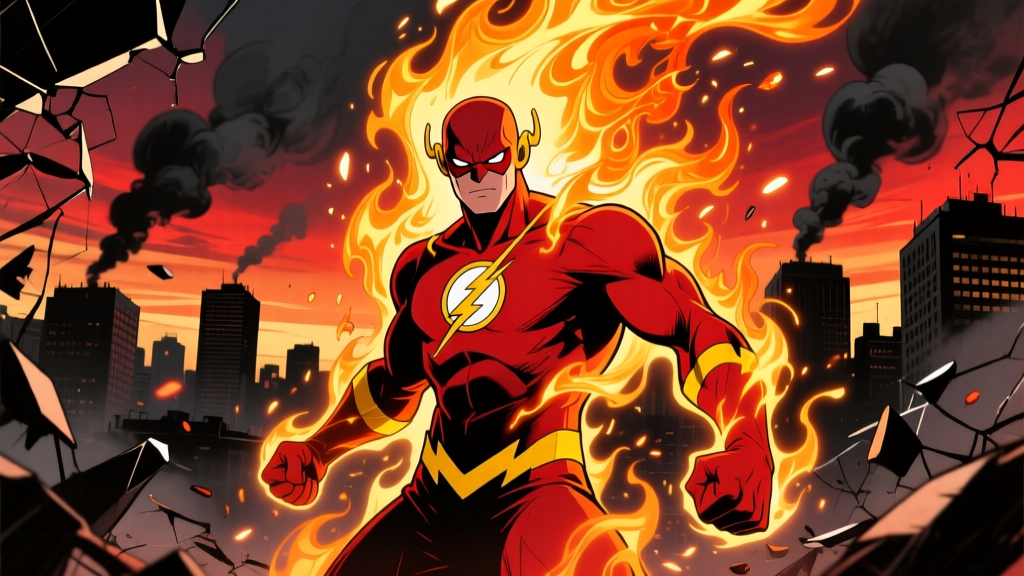
October 1939. A new comic book hits newsstands across America, and tucked between a cowboy story and a detective feature sits a figure engulfed in flames. Not a demon. Not a villain. An android who would become one of the most consequential characters in Marvel's entire lineage. His name was the Human Torch, and he was nobody's sidekick.
Before Captain America threw his first punch at Hitler, before Namor declared war on the surface world, there was Jim Hammond. Professor Phineas Horton's synthetic creation debuted in Marvel Comics #1, published by Timely Comics under the stewardship of Martin Goodman. That single issue launched not one but two franchise pillars, yet the android who burst into flame on contact with oxygen has spent the better part of nine decades overshadowed by a teenager from Long Island who borrowed his name.
This is the story of the original Human Torch. The one they tried to bury in concrete. The one who fought Nazis alongside Captain America. The one who became a cop, got depowered, got reactivated, and still shows up when Marvel needs a living relic who can set the sky on fire.
A Scientist's Mistake That Became a Superhero
Professor Phineas Horton didn't set out to create a weapon. In the original 1939 story, written by Bill Everett (with some accounts crediting Carl Burgos as the primary architect), Horton presented his creation to the scientific community as a triumph of engineering: a fully autonomous synthetic human being. The problem was a small, catastrophic flaw. Whenever the android was exposed to open air, his body spontaneously combusted.
The press dubbed him the Human Torch, and the public reaction was immediate and hostile. Horton's creation was deemed too dangerous to exist. The authorities sealed him inside an airtight concrete vault, effectively burying him alive. That could have been the end of the character, a one-off cautionary tale about hubris. But the Torch escaped. The details varied slightly across retellings, but the core remained: the android broke free, learned to control his flame, and chose to use his abilities to protect the people who had just tried to erase him.
That choice defines Jim Hammond more than any power set. He was rejected at first sight, treated as a monstrosity, and his response was to become a hero. There is no Uncle Ben moment, no radioactive accident granting a moral awakening. Just a synthetic man deciding, on his own terms, that he would be good.
The Name Behind the Flame
For decades, the android Human Torch had no personal name beyond his superhero moniker. He was simply "the Torch." It was not until later stories, particularly during the 1970s and 1980s retroactive continuity work, that the name Jim Hammond became established as his civilian identity. The name "James Hammond" was eventually codified in official Marvel reference materials and has stuck ever since. In some earlier Timely-era stories, he occasionally used the alias "Jim Hammond" when operating undercover, but the modern Marvel Universe treats it as his true adopted name.
Powers That Run Hotter Than You Think
The classic Human Torch is not a mutant. He is not an Inhuman. He is not a guy in a suit. He is a fully synthetic organism built from what Marvel lore calls Horton Cells, a proprietary artificial biology that functions as both his power source and his structural foundation. This distinction matters, because it gives him a power profile that operates on entirely different principles from Johnny Storm's mutation-based abilities.
Jim Hammond generates fire from his own body. Not from an external source, not from ambient heat. His synthetic cells produce a chemical reaction that results in open flame, which he can project, shape, and intensify at will. He can fly by directing flame propulsion, create plasma-level heat concentrations, and absorb external heat sources into his own body without harm. In peak demonstrations, he has achieved temperatures approaching those of a stellar nova, though sustained output at that level risks burning out his cellular matrix.
Because he is an android, he possesses no true blood, no organic nervous system, and a form of functional immortality. He does not age in any conventional sense. He has been deactivated, damaged, and rebuilt multiple times across Marvel's publishing history, and each time he has returned with his core personality and memories intact, provided his Horton Cells remain viable.
A Breakdown of Core Abilities
- Flame Generation and Projection: Full-body combustion with directional control. Can project flame bolts, walls of fire, and concentrated heat beams.
- Flight: Sustained atmospheric flight via flame propulsion. Cruising speeds in excess of 140 mph, with burst speeds significantly higher.
- Heat Absorption: Can draw thermal energy from his environment into his own body, extinguishing external fires and storing the absorbed energy.
- Nova Blast: An omnidirectional explosion of maximum-intensity flame. Devastating but physically taxing; cannot be used repeatedly without recovery time.
- Synthetic Physiology: Immunity to disease, immunity to aging, resistance to most forms of chemical and biological attack. No true blood or circulatory system to compromise.
Toro: The Boy Who Burned Beside Him
No discussion of the classic Human Torch is complete without Toro, born Thomas Raymond. Introduced in Human Torch Comics #2 (1940), Toro was a young man who had been performing in a circus as a fire-resistant act. He was not fireproof by nature; his body had been exposed to chemical radiation in utero, which gave him an unusual resistance to flame and, when in proximity to the Torch, the ability to ignite and fly just like his mentor.
Toro became the Human Torch's partner and closest companion. Their dynamic was genuine: an android who looked like a man and a young human who could match him in fire. They fought together through World War II, and Toro was present for the Torch's most significant team affiliations during the war years. The partnership ended tragically. In Human Torch Comics #35 (1954), Toro died saving New York City from a nuclear threat, flying an explosive device out over the ocean where it detonated, killing him instantly.
His death hit Jim Hammond harder than any physical wound ever had. In later stories, particularly during the New Invaders series (2004-2005), Toro's loss remained a defining wound in Hammond's long memory. Unlike human heroes who eventually process grief through the passage of decades, Hammond carries his losses with undiminished clarity. An android does not forget.
"He was the closest thing I ever had to family. And I have perfect recall of every second I lost him."
-- Jim Hammond, New Invaders #3 (2004)
The Invaders and the War That Defined Him
World War II gave Jim Hammond a purpose that transcended street-level crime fighting. Alongside Captain America (Steve Rogers) and Namor the Sub-Mariner, the Human Torch formed the core of the Invaders, Marvel's premier wartime superhero team. The team first appeared retroactively in Avengers #71 (1969), with their full wartime adventures chronicled in the Invaders series that launched in 1975, written by Roy Thomas.
The Invaders operated across every theater of the war. They fought Nazi super-soldiers, confronted Baron Zemo's early operations, battled the original Red Skull (Johann Schmidt), and tangled with Axis-aligned threats that ranged from the fantastical to the cosmic. For Jim Hammond, the war was not abstract. He was a weapon pointed at fascism, and he accepted the role without reservation.
The team's dissolution at war's end left Hammond adrift. He continued solo operations for several years, eventually joining a post-war iteration of the team that became the All-Winners Squad. But the 1950s were unkind to Golden Age heroes, and by 1955, the Torch's original series had ended. The character was shelved, seemingly forgotten.
The Torch's Retirement and Return
In one of Marvel's more unusual storytelling choices, the character was given a definitive ending in Human Torch Comics #35 (1954): Jim Hammond's flame burned out. His Horton Cells, after years of continuous activation, simply exhausted their fuel. He was found deactivated in the Nevada desert, a spent match where a hero used to be.
The Torch remained dormant for decades in real-world publishing terms. When he was finally reactivated in the pages of What If? #4 (1977) and later in West Coast Avengers stories, the writers faced an interesting challenge: how do you bring back a character whose defining feature is fire, after explicitly writing him as burned out? The solution was that his Horton Cells had not been destroyed, only depleted. Given time and the right conditions, they regenerated. Hammond returned, but he returned changed by the experience of dying.
Jim Hammond vs. Johnny Storm: Two Torches, Different Fires
In 1961, Stan Lee and Jack Kirby launched Fantastic Four #1, and with it, a new Human Torch: Johnny Storm, the teenage brother of Sue Storm, who gained fire powers through cosmic ray exposure. Johnny was young, reckless, charismatic, and very much alive in the biological sense. He became the Human Torch that most readers know, and for over six decades, he has been the face most people associate with the name.
But Jim Hammond and Johnny Storm are fundamentally different characters who share a name and a power set on the surface. Underneath, the differences are significant and worth understanding, especially for readers coming from the MCU, where only Johnny Storm has been represented.
| Dimension | Jim Hammond (Classic) | Johnny Storm (Modern) |
|---|---|---|
| Nature | Synthetic android (Horton Cells) | Mutated human (cosmic rays) |
| First Appearance | Marvel Comics #1 (October 1939) | Fantastic Four #1 (November 1961) |
| Creator | Carl Burgos (with Bill Everett contributing) | Stan Lee & Jack Kirby |
| Aging | Does not age; functionally immortal | Ages normally (slowed by healing) |
| Power Source | Internal chemical reaction (Horton Cells) | Mutated cellular metabolism |
| Peak Temperature | Nova-level (approaching stellar) | Nova-level (roughly comparable) |
| Vulnerability | Horton Cell depletion / burnout | Oxygen deprivation, water, fatigue |
| Key Team | The Invaders, All-Winners Squad | Fantastic Four, Avengers |
The practical combat difference is worth noting. Johnny Storm's flame is an extension of his biological body. He feels fatigue. He can be knocked unconscious, and his flames extinguish. He bleeds. Jim Hammond does not bleed, does not tire the same way, and when his flame goes out, it is because his fuel has been exhausted, not because he lost consciousness. In sustained engagements, Hammond's synthetic endurance gives him a measurable edge. According to Marvel's own Official Handbook of the Marvel Universe, Hammond's flame output and duration capacity exceed Storm's, though Storm's versatility and creative improvisation with his powers remain unmatched.
Modern Appearances: The Torch Keeps Coming Back
Despite being one of Marvel's oldest characters, Jim Hammond has never settled into a permanent role in the modern Marvel Universe. Instead, he surfaces periodically, pulled back into action by writers who recognize the narrative weight of an 87-year-old android hero who remembers a world before Pearl Harbor.
The Vision Connection
One of the most significant modern developments involving Jim Hammond was the retcon establishing that his body served as the template for the Vision. In Avengers West Coast stories during the late 1980s and early 1990s, it was revealed that Ultron had used Hammond's original body (recovered after his 1950s burnout) as the basis for constructing the synthezoid Avenger. This connection gave Hammond and Vision a unique relationship: one was effectively built from the blueprint of the other. Hammond served as a mentor figure to Vision during several storylines, and the two shared a bond rooted in their mutual status as synthetic beings trying to understand a world that was never built for them.
New Invaders and Secret Avengers
The New Invaders series (2004-2005), written by Allan Jacobsen, brought Hammond back as a central character. The series reassembled a modern version of the wartime team, with Hammond in a leadership role. It explored his difficulty adjusting to contemporary geopolitics after decades of fighting clear-cut evil in World War II. The series lasted only 9 issues before cancellation, but it re-established Hammond as a viable ongoing character.
He later appeared in Captain America Corps (2011), a miniseries by Roger Stern that teamed him with various Captain Americas from across Marvel's history. The premise was straightforward but effective: Hammond is one of the few living heroes who actually fought alongside Steve Rogers during the war, and that shared history gave their interactions a weight that newer heroes could not replicate.
In Secret Avengers (2013), during Nick Spencer's run, Hammond appeared as part of a covert operations team. By this point in continuity, he had spent time working as a New York City police officer, a career he pursued during a period when his flame powers were inactive. That detail, a Golden Age superhero working a beat cop's shift, is one of the most humanizing choices any writer has made for the character.
The Torch in the 2020s
Most recently, Jim Hammond has appeared in The Invaders (2019) by Chip Zdarsky, a series that confronted the wartime heroes with the moral complexities of their past actions. The run explicitly addressed the question of what happens when the clear moral framework of World War II gives way to the murkier realities of the modern intelligence apparatus. Hammond's role in the series was that of a man, synthetic or not, trying to reconcile his wartime certainty with peacetime doubt.
Why the Classic Torch Matters to Modern Comics
There is a temptation in comic fandom to treat Golden Age characters as historical curiosities, interesting for trivia but irrelevant to the stories that matter today. Jim Hammond resists that treatment. His core concept, an artificial being who chooses to be human through his actions rather than his biology, is more relevant now than it was in 1939.
Consider the questions his existence raises: What does it mean to be alive if you were built rather than born? Can a synthetic being grieve, and does that grief count? When Hammond mourns Toro, is his sorrow less real because his neurology is engineered? These are not abstract philosophical exercises. They are the same questions that drive stories about Vision, about Data in Star Trek, about the Cylons in Battlestar Galactica, and about the hosts in Westworld. Hammond was asking them first, in four-color panels, before most of those other properties existed.
His legacy also matters from a publishing standpoint. Marvel Comics would not exist in its current form without the commercial success of Marvel Comics #1 in 1939. That issue was anchored by the Human Torch and the Sub-Mariner. Captain America arrived a year later, in Captain America Comics #1 (1941). The Torch was Marvel's first superhero, predating the character who would become the face of the company by a full two years.
Questions Readers Keep Asking About the Classic Torch
Is the classic Human Torch still alive in Marvel continuity?
Yes. As of current Marvel continuity (Earth-616), Jim Hammond is active. He has been deactivated and reactivated multiple times throughout publishing history, but his Horton Cells remain viable, and he has appeared as recently as the 2019 Invaders series by Chip Zdarsky.
Can Jim Hammond's flame be distinguished from Johnny Storm's visually?
In the comics, yes, though it depends on the artist. Hammond's flame has historically been depicted with a slightly deeper, more orange-red hue compared to Johnny Storm's brighter yellow-orange fire. In some modern renderings, Hammond's flame carries a faint golden undertone that references his synthetic origin. However, many artists do not maintain a consistent distinction.
Was Jim Hammond ever a member of the Avengers?
Hammond has never been a full-time, long-term member of the Avengers in the same way that Captain America or Iron Man has. However, he has served on Avengers-affiliated teams including the West Coast Avengers (in a supporting capacity), Secret Avengers, and of course the Invaders, which operated in a parallel capacity to the Avengers during WWII. He has been granted honorary Avengers status in several storylines.
How does Jim Hammond interact with modern technology if he was created in 1939?
This varies by writer. In most modern portrayals, Hammond's synthetic body is treated as functionally compatible with modern technology. He can interface with computers, use communication devices, and operate normally in contemporary settings. Some stories have leaned into the anachronism for humor or pathos, depicting Hammond marveling at or struggling with technological advances that occurred during his periods of deactivation.
Why did Marvel create a second Human Torch instead of bringing back the original?
When Stan Lee and Jack Kirby launched the Fantastic Four in 1961, the Golden Age Human Torch had been inactive since 1955. Lee repurposed the name and basic power concept for Johnny Storm, a character with a completely different origin and personality. The Fantastic Four's success made Johnny Storm the dominant version of the character in public consciousness. By the time Marvel began systematically reviving Golden Age characters in the 1970s, the two Torches coexisted in continuity, with Jim Hammond established as the historical predecessor.
What is the significance of Horton Cells?
Horton Cells are the proprietary synthetic biological material that composes Jim Hammond's body. They function as both structural tissue and energy source, generating the chemical reactions that produce his flame. In Marvel lore, Horton Cells have been used as a plot device in multiple stories: Ultron harvested them to build the Vision, they have been studied by Reed Richards and other scientific minds, and their regenerative capacity is the mechanism by which Hammond returns from deactivation. They represent one of Marvel's earliest attempts at fictional biotechnology, predating concepts like the Extremis virus or the Super-Soldier Serum's more elaborate explanations.
Reading Recommendations for the Classic Torch
If this article has sparked an interest in Jim Hammond, here is a reading path that traces his most essential appearances without requiring you to track down 80-year-old newsprint:
- Marvel Comics #1 (1939) -- The origin. Available in multiple reprint collections including Marvel Milestone Edition reprints.
- Invaders (1975-1979) -- Roy Thomas's definitive run establishing the Torch's WWII career. Collected in Marvel Epic Collections.
- Human Torch #1-4 (1990 miniseries) -- A modern origin retelling that bridges the Golden Age and contemporary Marvel continuity.
- New Invaders #1-9 (2004-2005) -- Allan Jacobsen's short-lived but excellent series, with Hammond in a leading role.
- Captain America Corps (2011) -- Roger Stern's miniseries pairing Hammond with multiple Captain Americas.
- Invaders (2019) -- Chip Zdarsky's critically acclaimed run confronting the wartime heroes with modern moral complexity.
The flame that started in 1939 has never truly gone out. It just waits for someone to strike the match again.