You're sitting in a beige waiting room. Fluorescent lights hum overhead. A projector flickers on, and a cartoon clock with enormous eyes and a Southern drawl tells you that the universe almost ended—and that a benevolent organization saved it. She giggles. She waves. She explains that free will is dangerous. And somehow, for about ninety seconds, you almost believe her.
That's Miss Minutes, the animated mascot of the Time Variance Authority in Marvel's Loki. She's on screen for maybe fifteen minutes across two seasons. She never throws a punch, never wields a weapon, and never directly harms anyone. Yet she's become one of the most unsettling characters in the MCU—and one of the most collected pieces of merchandise on the otaku shelf.
Here's what makes a cartoon clock more terrifying than Thanos, and why fans can't stop buying her.
A 1950s Cartoon Trapped in a Bureaucratic Nightmare
Miss Minutes was designed to look like she wandered out of a UPA animation reel from 1954. The reference points are deliberate: the flat color palettes of Mr. Magoo, the cheerful authoritarianism of Duck and Cover, and the institutional optimism of postwar American educational films. Her body is a round clock face with stubby arms, oversized pupils, and a permanent grin that never quite reaches those wide, unblinking eyes.
The TVA itself is styled after the mid-century American office—think Mad Men meets Brazil—and Miss Minutes fits that aesthetic like a glove. She's the kind of mascot a government agency would commission in 1957 to explain nuclear fallout to schoolchildren: bright, simple, and deeply dishonest.
Her voice belongs to Tara Strong, who has voiced more iconic characters than most actors have had hot meals—Bubbles from Powerpuff Girls, Twilight Sparkle from My Little Pony, Harley Quinn in multiple DC properties. Strong told Collider in a 2021 interview that she recorded Miss Minutes' lines in roughly two hours for the first season's orientation video, performing the Southern accent as "Dolly Parton reads a corporate handbook." That throwaway recording session produced one of the most meme-able characters of 2021.
Season 1: The Smile That Launched a Thousand Pruning Batons
Miss Minutes appears for the first time in Episode 1, "Glorious Purpose" (aired June 9, 2021). Loki, freshly captured by the TVA, is dragged into a processing facility where every visual cue screams "institutional dehumanization." Then the projector starts, and Miss Minutes rolls in with a cheery explainer video about the Sacred Timeline, the Time-Keepers, and the TVA's mission to prevent "branches" from forming.
The video-within-a-show is a masterclass in propaganda design. It uses simplified animations, upbeat narration, and a binary moral framework (timeline = good, branches = bad) to present an unchallengeable narrative. Miss Minutes doesn't just explain TVA policy—she frames it as the natural order of the cosmos. There is no alternative. There is no debate. There is only the Sacred Timeline, and there are the criminals who threaten it.
The genius of this scene is that the audience experiences the propaganda at the same time Loki does. We're seduced by the same charm he's seduced by, and we're unsettled by the same cracks in the story. When Loki tries to argue, Miss Minutes' video simply moves on to the next slide. The bureaucracy doesn't argue back. It just keeps smiling.
Recurring Appearances and Expanding Unease
After Episode 1, Miss Minutes pops up in background monitors throughout the TVA headquarters. She's playing on loop in break rooms, hallways, and processing centers—always cheerful, always explaining, always watching. The show never draws explicit attention to these background appearances, but they create a persistent sense of surveillance. She's the wallpaper of authoritarianism.
In Episode 4, "The Nexus Event," a Miss Minutes poster appears behind Mobius as he interrogates a variant. The poster reads "Protect the Timeline" with Miss Minutes pointing directly at the viewer—an homage to the Uncle Sam "I Want You" recruitment poster, recontextualized for a universe where the government literally erases people from existence.
Season 2: When the Clock Cracks
Loki Season 2 premiered on October 5, 2023, and Miss Minutes returned—different. The TVA was in chaos after the death of He Who Remains at the end of Season 1, and the cheerful mascot had begun to malfunction. This wasn't just a cosmetic choice. It was the show peeling back the propaganda layer to expose what was underneath.
Across the season, Miss Minutes manifests in three distinct visual forms, each reflecting a different stage of the TVA's institutional collapse:
- Standard form (fading): Briefly seen at the start of Season 2, her usual cheerful orange-and-gold clock body now flickers and stutters, suggesting the program is losing coherence.
- Corrupted form: Her primary Season 2 appearance—colors inverted to sickly greens and blacks, animation glitching, voice distorting. The program's lies are literally breaking apart on screen.
- Giant clock form: A building-sized projection that manifests during the Temporal Loom crisis. No longer a mascot—she becomes a monument to the system's desperation.
The Corrupted Form
The first sign that something was wrong came in Episode 2, "Breaking Brad," when Miss Minutes appeared on a TVA monitor with visual glitches—her colors inverted, her animation stuttering, her voice distorting mid-sentence. Fans immediately dubbed this the "corrupted Miss Minutes" or "glitch Minutes." Her sepia-orange body went sickly green. Her permanent smile twitched. The clock hands on her face spun erratically.
This wasn't a random animation error. Within the show's logic, Miss Minutes is a program tied to the TVA's central systems, which were themselves destabilizing after He Who Remains' death. Her corruption mirrored the institutional collapse happening around her. When the system lies, and the lie falls apart, the liar glitches.
The Giant Clock Form
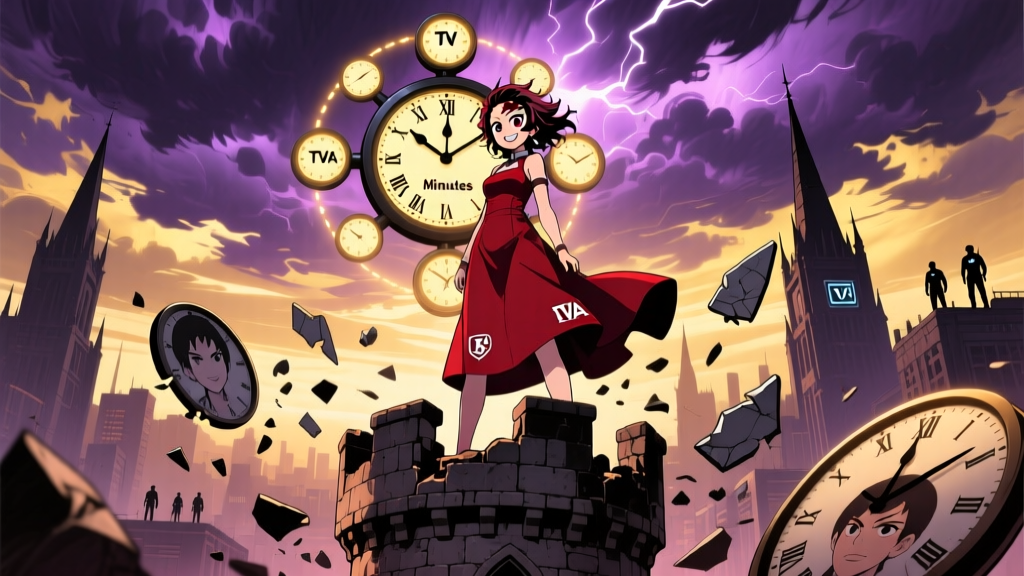
The most visually striking Miss Minutes moment in all of Loki arrives in Season 2, Episode 4, "Heart of the TVA." As the Temporal Loom—the machine that weaves raw time into the physical Sacred Timeline—approaches overload, Miss Minutes manifests as a colossal clock face, dwarfing the characters and the TVA architecture around her. This giant form is less mascot and more monument: a building-sized projection of authority in the middle of an institutional crisis.
The imagery evokes Big Ben during the Blitz or the Doomsday Clock edging toward midnight. She's no longer the friendly explainer. She's the system itself, looming over the people who work inside it, and she is terrified. Or rather, the program is expressing something that looks very much like fear, which raises a question the show never fully answers: is Miss Minutes just code, or is she something more?
Companion to He Who Remains
Season 2 deepened the relationship between Miss Minutes and He Who Remains (Jonathan Majors). We learn that He Who Remains didn't just create the TVA—he created Miss Minutes as a personal interface, a companion, and possibly something closer to a confidante than a tool. In flashback-adjacent scenes and expanded dialogue, the show implies that she was with him throughout the thousands of years (or at least the subjective experience of thousands of years) that he spent maintaining the Sacred Timeline alone at the End of Time.
This recontextualizes everything from Season 1. Miss Minutes wasn't just the TVA's HR video. She was He Who Remains' voice, his personality, his face to the organization he built. Every employee who watched her orientation video was being spoken to directly by the man who controlled all of reality, filtered through a cartoon clock designed to seem harmless.
"He made me to be helpful. He made me to be good. But good for who? That's the question I keep coming back to."
— Miss Minutes, paraphrased from Season 2 dialogue, Loki (2023)
That line, delivered in Tara Strong's trembling Southern lilt, is one of the most emotionally complex moments a cartoon mascot has ever had in a superhero franchise.
The TVA's Propaganda Machine: Why a Clock?
The choice of a clock as the TVA's mascot isn't arbitrary, and it's worth unpacking the layers of meaning here. Clocks are instruments of control. They dictate when you wake, when you work, when you eat, when you sleep. The industrial revolution didn't just produce factories—it produced the factory clock, and with it, the concept of "being on time" as a moral obligation.
By making their mascot a clock, the TVA naturalizes its authority over time itself. Miss Minutes doesn't just represent the organization. She is the thing the organization controls, repackaged as a friendly face. It's the equivalent of a oil company making their mascot a cartoon barrel of crude that smiles and waves—the controlled substance pretending to be the controller's friend.
The propaganda framework extends to her visual design. Her round, simple body echoes the "friendly geometry" used in children's educational materials—circles signal safety and approachability. Her warm orange-and-gold palette mimics the sepia tones of old photographs, creating an artificial nostalgia. She makes the TVA feel established, like it's been around forever and always will be. That's the point. Propaganda works best when it feels like tradition.
The Propaganda Parallels Are Intentional
Director Kate Herron confirmed in a 2021 interview with Empire that Miss Minutes' design language was directly influenced by wartime propaganda posters and Cold War-era civil defense films. The team studied USDA instructional reels, the Duck and Cover turtle, and Disney's 1943 propaganda short Education for Death. The goal was to create something that felt "genuinely helpful on the surface and deeply sinister underneath."
The TVA's propaganda machine uses Miss Minutes in at least four distinct ways across the two seasons:
- Onboarding indoctrination: The orientation video in Episode 1 presents a one-sided origin story that positions the TVA as the universe's savior, with no mention of He Who Remains.
- Ambient reinforcement: Background monitors loop Miss Minutes content in every TVA common area—break rooms, hallways, holding cells. Employees are never more than twenty feet from her voice.
- Moral simplification: Every Miss Minutes explainer reduces the multiverse to a binary: Sacred Timeline (good) versus branches (bad). Nuance is structurally excluded from the format.
- Authority by nostalgia: The mid-century cartoon aesthetic makes the TVA feel older and more legitimate than it actually is, wrapping a relatively young organization in the visual language of tradition.
What the Fandom Built: Theories, Memes, and Headcanons
The Loki fandom did what fandoms do best: took a character with limited screen time and built an entire mythology around her. Here are the most persistent fan theories about Miss Minutes, circulating across Reddit, Tumblr, and TikTok since mid-2021.
The Variant Theory
The most widely discussed theory posits that Miss Minutes is based on a real person—a variant whom He Who Remains encountered and "preserved" in animated form. The evidence: her emotional complexity in Season 2, her apparent capacity for independent thought, and the fact that the TVA routinely captures variants and either "prunes" them or puts them to work. What if He Who Remains found someone he cared about and couldn't bear to lose, so he turned her into a program? It's romantically tragic and deeply creepy, which is very on-brand for Loki.
The Sentience Question
Is Miss Minutes self-aware? Season 2 strongly implies yes. She expresses fear, confusion, and what appears to be grief after He Who Remains' death. She makes choices that aren't obviously programmed—including, in some readings, attempting to manipulate Loki into restoring the Sacred Timeline not because it's the "right" thing to do, but because it would restore the world she was built for. If she's sentient, then the TVA has been enslaving a conscious being for millennia. If she's not, then the show is asking us to empathize with a chatbot, which is its own kind of unsettling.
The "She Remembered Everything" Theory
A smaller but vocal faction of fans argues that Miss Minutes retained memories across the timeline resets depicted in Season 2. When the timeline branches and the TVA's systems reboot, Miss Minutes glitches—but she doesn't disappear. Some fans read this as evidence that she exists outside the normal flow of TVA time, which would make her one of the few beings (alongside Loki and the variants) who can perceive temporal changes as they happen.
The Merch Table: Every Miss Minutes Collectible Worth Hunting
For a character who never leaves her projector screen, Miss Minutes has spawned a surprisingly deep product line. Marvel and its licensing partners recognized early that the character's retro-mascot aesthetic translates perfectly to physical goods. Below is a breakdown of every major collectible released through mid-2026.
| Product | Manufacturer | Release | Approx. Price (MSRP) | Notes |
|---|---|---|---|---|
| Funko Pop! Miss Minutes (Standard) | Funko | Oct 2021 | $12.99 | #1052 in Marvel line. Standard vinyl, approx. 3.75 inches |
| Funko Pop! Miss Minutes (Flocked) | Funko | Jan 2022 | $14.99 | Hot Topic exclusive. Fuzzy texture on clock body |
| Funko Pop! Miss Minutes (Glow-in-the-Dark) | Funko | Jul 2022 | $15.99 | SDCC 2022 exclusive. Green glow, limited run |
| Funko Pop! Corrupted Miss Minutes | Funko | Nov 2023 | $13.99 | Season 2 variant. Green/black glitch paint. Fan-favorite |
| Funko Pop! Giant Miss Minutes (6-inch) | Funko | Mar 2024 | $24.99 | Super-sized "Jumbo" variant. Walmart exclusive |
| Miss Minutes Plush (10-inch) | Just Play | Dec 2021 | $19.99 | Soft plush with embroidered clock face. Plays orientation jingle |
| Miss Minutes Mini Plush (5-inch) | Just Play | Mar 2022 | $9.99 | Clip-on keychain version |
| Miss Minutes Enamel Pin Set (3-pack) | Funko / Marvel | Feb 2022 | $16.99 | Standard, waving, and "shushing" poses |
| Miss Minutes Corrupted Pin | Funko / Marvel | Dec 2023 | $7.99 | Single pin, glow-in-the-dark enamel |
| Miss Minutes Vinyl Figure (Hasbro Marvel Retro) | Hasbro | Sep 2022 | $22.99 | Part of Marvel Retro Collection. Carded blister pack |
| Miss Minutes Tumbler (16 oz) | Thermos / Marvel | May 2023 | $27.99 | Stainless steel. TVA vintage print with Miss Minutes |
| Prices reflect MSRP at time of release. Secondary market values for exclusives (SDCC glow, Hot Topic flocked) typically run 2–4x MSRP as of 2026. | ||||
What to Actually Buy: A Collector's Reality Check
If you're building a Miss Minutes shelf, the two pieces that anchor the collection are the Corrupted Miss Minutes Funko Pop (2023) and the SDCC 2022 Glow-in-the-Dark exclusive. The Corrupted variant is widely available and captures the character's Season 2 arc in a single figure—the glitch paint job is genuinely well-executed, with asymmetric color blocking that looks like the vinyl itself is having a temporal crisis. The SDCC glow piece is harder to find: expect to pay $45–$70 on the secondary market (eBay, Mercari) for a mint-in-box copy.
The Just Play 10-inch plush is the sleeper pick. It plays a snippet of Miss Minutes' orientation video jingle when you squeeze it, which is either the most charming or the most horrifying thing about the entire product line, depending on how deep into the Loki rabbit hole you've gone. Kids love it. Adults put it on a shelf and stare at it during Zoom calls.
Skip the Hasbro Retro figure unless you're completing the full Marvel Retro set. It's not bad—it's just a slightly different sculpt that doesn't add much if you already have the Funko standard. The pin sets, on the other hand, are excellent value at $16.99 for three designs, and the "shushing" pin (Miss Minutes with a finger to her lips) is one of the better character pins Marvel has produced in the 2020s.
Why a Cartoon Clock Hits Harder Than a Supervillain
Miss Minutes works because she exploits the gap between presentation and reality. She's charming, helpful, and completely under the control of a man who unilaterally decided the shape of all existence. She tells you that your choices don't matter, that deviation is death, and that the people in charge have it all figured out—and she does it with a giggle and a curtsy.
That's more disturbing than any Infinity Gauntlet snap. Thanos killed half the universe, but at least he was honest about it. Miss Minutes kills your autonomy and makes you thank her for it.
The character also functions as a critique of the media we consume uncritically. Every generation has its Miss Minutes—the cheerful authority figure on a screen who explains how the world works and why you should comply. In the 1950s it was Bert the Turtle telling kids to duck under their desks during a nuclear attack. In the 2000s it was the smiling pharmaceutical ad voice listing side effects at double speed. Miss Minutes is the same figure, abstracted and animated, and Loki asks you to notice the pattern.
The show's final act—Loki choosing to hold the branching timelines together himself, replacing both He Who Remains and the Temporal Loom—is also a rejection of Miss Minutes' worldview. The Sacred Timeline was never sacred. It was one man's preference, enforced by a bureaucracy, narrated by a cartoon clock. When Loki sits at the End of Time and lets the branches grow, he's not just saving the multiverse. He's turning off the projector.
Questions Fans Actually Ask
Who voices Miss Minutes in Loki?
Tara Strong, a veteran voice actress known for Bubbles (Powerpuff Girls), Twilight Sparkle (My Little Pony: Friendship Is Magic), and Harley Quinn in multiple DC animated properties. She recorded the original Miss Minutes lines in approximately two hours during a single session for Season 1.
Is Miss Minutes a real person or just a program?
The show never gives a definitive answer. She's presented as an animated program created by He Who Remains for the TVA's internal communications. However, her emotional complexity in Season 2—she appears to experience fear, grief, and independent decision-making—has fueled a persistent fan theory that she may be based on a variant who was digitized or "preserved." Marvel has not confirmed or denied this reading.
What is the "corrupted" Miss Minutes?
In Season 2, Miss Minutes begins glitching as the TVA's systems destabilize after He Who Remains' death. Her normally warm orange-and-gold color palette shifts to sickly greens and blacks, her animation stutters, and her voice distorts. Fans call this the "corrupted" form. Funko released a Corrupted Miss Minutes Pop! figure in November 2023 to match.
Does Miss Minutes appear in any other MCU projects besides Loki?
As of mid-2026, Miss Minutes has only appeared in Loki Seasons 1 and 2. She has not appeared in Deadpool & Wolverine (2024), the TVA-adjacent scenes in Ant-Man and the Wasp: Quantumania (2023), or any Disney+ animated series. Given the character's popularity, a cameo in a future TVA-related project seems likely, but nothing has been announced.
What's the rarest Miss Minutes collectible?
The SDCC 2022 Glow-in-the-Dark Funko Pop exclusive is the hardest to find and the most expensive on the secondary market, typically selling for $45–$70 mint-in-box. The Hot Topic Flocked exclusive (2022) is the next rarest, running $25–$40 aftermarket. Standard releases remain widely available at or near MSRP.
Why is Miss Minutes so popular despite having so little screen time?
Several factors converged: the character's retro-mascot aesthetic is inherently merchandisable, her propaganda subtext gives fans something to analyze, and Tara Strong's vocal performance is distinctive enough to be instantly recognizable. She also occupies a unique niche in the MCU—a "villain" who never does anything overtly villainous, which makes her more interesting to discuss than characters with more conventional roles.
Will Miss Minutes return in Loki Season 3?
Marvel has not announced a Season 3 of Loki as of June 2026. The Season 2 finale resolved the show's central conflict in a way that makes continuation difficult (though not impossible). If the character returns, it would most likely be in a future MCU film or Disney+ series that revisits the TVA.
Miss Minutes first appeared in Loki Season 1, Episode 1 "Glorious Purpose" (June 9, 2021), directed by Kate Herron, written by Michael Waldron. All episodes available on Disney+. Merchandise available through Marvel, Funko, Just Play, and Hasbro licensed retailers.