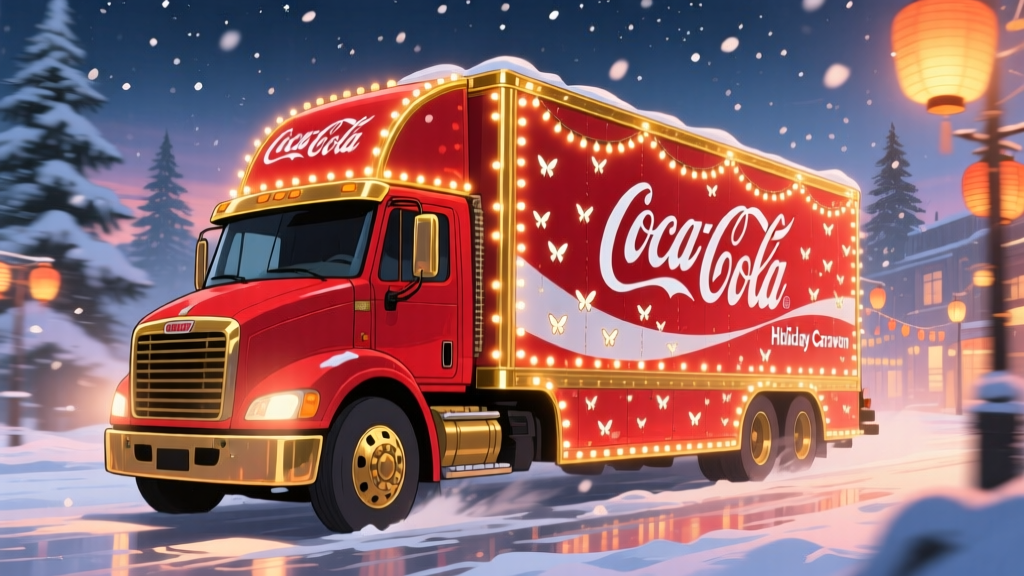
You hear it before you see it. A low rumble beneath the chatter of a December high street, then the glow — thousands of warm amber bulbs bleeding into the fog, and a 40-foot articulated lorry in that unmistakable lacquered red crawling past a queue of families who have been standing in the cold for the better part of two hours. Someone lifts a phone. A child tugs a parent's sleeve. For the next ninety seconds, the entire block smells faintly of diesel and caramel.
This is the Coca-Cola Holiday Caravan truck. Love it or find it mildly absurd, the numbers do not lie: over 737,000 miles driven on live tour routes, a hashtag (#HolidaysAreComing) tweeted more than 57 million times, and a die-cast collectible market that has produced individual chase variants pressed in runs as tight as 1 in 750 units. For a marketing activation that began as a 60-second television spot in 1995, the caravan has become something stranger and more durable than anyone at Coca-Cola likely anticipated. It has become a tradition that people plan their Decembers around, a collectible object of genuine obsession, and one of the longest-running brand-to-street rituals in modern advertising history.
The Spot That Started the Convoy: 1995 and the W.B. Doner Gamble
In 1995, Coca-Cola's advertising agency W.B. Doner pitched a concept that sounded expensive and possibly sentimental to the point of embarrassment: a fleet of illuminated red trucks winding through a snow-dusted landscape, scored to a choral jingle that repeated the words "Holidays are coming" with the cadence of a hymn. The client approved it, and the production team made a decision that elevated the spot above typical holiday advertising — they hired Industrial Light & Magic, the visual effects house George Lucas built, to handle the lighting and compositing work.
The original commercial featured three real trucks. Each was 40 feet long, weighed roughly two tonnes when loaded with set dressing and lighting rigs, and carried over 30,000 individual bulbs wired along the trailer's edges. The snaking convoy effect — hundreds of trucks stretching to the horizon — was a digital composite. ILM built the illusion by filming the three real vehicles from multiple angles against the Vancouver landscape in 1999 and layering dozens of digital duplicates into a single serpentine line. The result looked like a migration of red beetles carrying fire across a mountain pass. It aired in over 100 countries by 1998.
The original "Christmas Caravans" spot was so effective that Coca-Cola pulled it from rotation between 2001 and 2007, reportedly in response to growing public health scrutiny of sugary drink marketing aimed at families. The backlash to its absence was louder than the backlash to its presence. It returned in 2008 to immediate, almost relieved, viewership.
The jingle itself became a secondary cultural artifact. In 2001, American singer Melanie Thornton recorded "Wonderful Dream (Holidays Are Coming)," a full-length pop adaptation of the ad's chorus. The single reached number three on the German charts and sold over one million copies across Europe before Thornton's death in a plane crash later that year. The song still re-enters European streaming playlists every November, a ghost in the algorithm.
From Screen to Street: The Live Tour Phenomenon
The television commercial was the seed, but the live truck tour is what turned the caravan into a civic event. Germany hosted the first physical tour in 1997, sending a single decorated truck through towns and cities in the weeks before Christmas. The United States followed with its own touring program in 2001. The United Kingdom did not get a live visit until 2010, and when it arrived, it landed with disproportionate force — the 2025 UK tour marks the caravan's 15th consecutive year on British roads, with 15 confirmed stops spanning Edinburgh, Cardiff, Belfast, and multiple English cities from mid-November through the third week of December.
The current UK tour partners with FareShare, the UK's largest food redistribution charity, and Coca-Cola has committed to funding the equivalent of one million meals during the 2025 holiday season. This charitable framing is relatively recent. Earlier tours were more straightforward brand activations: pull up in a town center, open the trailer to reveal a walk-in Coca-Cola experience, hand out free cans, and let families take photos next to a truck they had only ever seen on television. The shift toward cause-marketing reflects a broader industry recalibration, but the core draw remains the truck itself — people want to stand next to the thing they remember from childhood and feel the scale of it.
What Actually Happens at a Tour Stop
The logistics are specific. The truck arrives at a pre-arranged location — typically a shopping center car park or a pedestrianized high street — between one and three days before the scheduled public visit. Local authorities coordinate road closures. Coca-Cola field staff, identifiable by red uniforms and branded beanies, set up a perimeter with stanchions and signage. On the day itself, the trailer opens to reveal an interior fitted with:
- Interactive screens displaying holiday animations and Coca-Cola trivia
- A photo station where families can pose with holiday props and branded backdrops
- A dispensing unit handing out free cans of Coca-Cola and Coca-Cola Zero Sugar
- Branded merchandise displays, including limited-edition holiday items
Families queue. The average wait time at UK stops in 2023 was reported at approximately 45 minutes during peak afternoon hours. Visitors spend roughly 8 to 12 minutes inside the trailer. A staff photographer takes a picture that can be downloaded later. Everyone leaves with a can and a slightly dazed expression, the way you might exit a very short, very red theme park ride.
By 2015, demand had grown so substantially that Coca-Cola commissioned a second truck, allowing simultaneous North and South routes through the UK in a single season. Both trucks carry identical specifications: 8,772 individually wired fairy lights, a custom sound system broadcasting the jingle at a volume calibrated to carry roughly 200 meters in open air, and a paint job in the exact shade of Coca-Cola red that the company has used since 1886.
The Numbers Behind the Route
The modern Coca-Cola Christmas truck stops at over 40 cities globally each year, though the precise route changes annually. A single truck's cumulative mileage since the program's inception exceeds 737,000 miles — roughly the distance from London to Moscow and back fourteen times. The trucks are driven only by certified professional operators; the one exception granted to a public figure was actor Matt Smith, who drove the truck during a 2015 UK tour stop as part of a promotional partnership tied to his role in Doctor Who. He remains the only non-Coca-Cola employee to have done so.
The Collector's Cabinet: Die-Cast Models, Ornaments, and the Hunt for Chase Variants
Somewhere between nostalgia and hoarding, there is a shelf in a glass cabinet in someone's living room holding a 1:64 scale replica of a 1960 Volkswagen delivery van painted in Coca-Cola Christmas livery. That shelf is more common than you might assume. The die-cast collectible market around Coca-Cola's holiday trucks is a genuine secondary economy, sustained by annual limited releases, a dedicated collector base, and the peculiar thrill of finding a rare variant in a Walmart bin.
M2 Machines, a Connecticut-based die-cast manufacturer, has been producing Coca-Cola-branded holiday vehicles since at least 2019. Their releases typically drop in late autumn and sell through major retail chains — Walmart, Target, and the Coca-Cola Store online — as well as direct from the M2 Machines website. Standard retail pricing for a 1:64 scale Coca-Cola holiday truck or van sits between $6.99 and $9.99. Ornament editions, which include a hanging loop and display card, retail around $8 to $12.
| Category | Scale | Manufacturer | Retail Price | Secondary Market Range |
|---|---|---|---|---|
| Standard retail release (e.g., VW Delivery Van, Ford Econoline) | 1:64 | M2 Machines | $6.99 - $9.99 | $12 - $25 |
| Holiday ornament edition | 1:64 | M2 Machines | $8 - $12 | $15 - $35 |
| Limited edition / numbered release | 1:64 | M2 Machines | $12 - $20 | $35 - $75 |
| Chase variant (1/750 ratio) | 1:64 | M2 Machines | N/A (randomly inserted) | $60 - $150+ |
| Premium collector truck (1:87 HO scale) | 1:87 | Motor City Classics / Oxford Diecast | $14 - $30 | $40 - $120 |
| Large-scale display model | 1:24 | Danbury Mint / specialty | $60 - $150 | $120 - $350 |
The chase variant economy deserves a specific mention. M2 Machines randomly inserts chase editions at a ratio of approximately 1 in 750 units within standard retail cases. A chase variant might feature a different paint scheme, a unique tampo print, or chrome-plated wheels not found on the standard release. Because these are inserted randomly into retail distribution, the only reliable way to acquire one is to either open dozens of sealed packages or purchase verified specimens on the secondary market. eBay listings for verified M2 Machines Coca-Cola Christmas chase variants in 2024 and 2025 routinely close between $60 and $150, with occasional spikes above $200 for particularly sought-after editions.
The Older Stuff: Vintage Coca-Cola Truck Collectibles
Pre-dating the M2 Machines partnership, several other manufacturers produced Coca-Cola holiday truck models that now circulate on the secondary market. Oxford Diecast released a Bedford J6 Coca-Cola delivery truck in 1:76 scale that has since gone out of production; used copies surface on eBay UK between £15 and £40 depending on condition and box state. The Coca-Cola Store's own collectible vehicle line, which includes a beverage truck with sliding doors, retails at $29.95 and is one of the few officially branded models available directly from the company. Motor City Classics produces a 1:87 scale 1937 Coca-Cola bottle truck — the HO scale favored by model railroad enthusiasts — that holds steady value in the $25 to $45 range when still sealed in original packaging. A 1998 Coca-Cola Holiday Truck die-cast, one of the earliest collectible editions tied directly to the caravan campaign, was spotted in an antique mall in the American Midwest in 2024 and discussed in collector forums as a genuine find.
Condition matters enormously across all of these. Box state, paint integrity, and wheel condition are the three grading factors collectors reference when pricing these pieces. Here is a quick grading scale that experienced collectors use:
- Mint in Sealed Box (MISB) — original packaging unopened, no sun fading, all decals intact. Commands 40–60% premium over loose specimens.
- Mint No Box (MNB) — vehicle in perfect condition but separated from packaging. Small paint chips on the base or wheel axles reduce the grade.
- Played-With Condition — visible paint wear, missing mirrors or aerials, scratched windows. Value drops to roughly 30–40% of MISB pricing.
The Convoy as Cultural Object: Why a Truck Became a Tradition
There is something specific about the Coca-Cola caravan that resists easy categorization. It is not a parade float, though it shares DNA with one. It is not a pop-up shop, though it functions like one. It is closest to a secular procession — a red-and-gold reliquary moving through public space, inviting strangers to gather around it and briefly share the feeling that something seasonal has arrived. The anthropologist in you might call it a ritual object. The marketer in you would call it the most effective owned media asset Coca-Cola has ever built.
The data supports the emotional claim. According to YouGov brand tracking, approximately 50 percent of British adults report that seeing or hearing the Coca-Cola Christmas truck advertisement "genuinely changes their mood" toward the holiday season. That figure is unusually high for any single piece of advertising — for context, John Lewis's Christmas advertisements, widely considered the UK benchmark for emotional retail marketing, hover around 30 to 35 percent on comparable sentiment measures. The Coca-Cola truck occupies a different register. It is not trying to make you cry. It is trying to make you recognize that a specific time of year has arrived, and it does so with the blunt efficiency of a foghorn.
The convoy format itself is part of the appeal. A single truck arriving in your town is an event. A fleet of them snaking through a landscape, real or composited, is a migration — something ancient-feeling dressed in corporate livery. The original ILM composited footage from 1999 used just three real vehicles to imply a procession of dozens, and the visual language of that shot — red shapes winding through white countryside — has been replicated in nearly every subsequent iteration of the campaign, including print, outdoor billboards, and social media animations.
Santa, Sundblom, and the Visual Lineage
It is worth noting that Coca-Cola's visual association with Christmas extends well beyond the truck. Haddon Sundblom's illustrations of Santa Claus, commissioned by Coca-Cola beginning in 1931, are among the most reproduced images in twentieth-century commercial art. The modern Coca-Cola Santa — ruddy-cheeked, white-bearded, red-suited — descends directly from Sundblom's oil paintings, and the holiday truck carries that visual DNA on its trailer. The red is the same red. The gold trim on the truck's lettering echoes the warm amber tones Sundblom used in his hearth-light scenes. The convoy is, in a meaningful sense, a moving gallery of a ninety-year-old brand aesthetic.
Where the Caravan Goes from Here
The 2025 tour is running. The trucks are on the road as of mid-November, and they will continue through December 21 across UK routes. The FareShare partnership represents a concrete output — one million meals funded — layered on top of the same fundamental activation that Germany pioneered in 1997: drive a very large, very red, very loud truck into a public space and let people experience it up close.
The collectible market shows no signs of contraction. M2 Machines continues to release new Coca-Cola holiday vehicles annually, and the 2025 lineup includes a 1960 VW Delivery Van, a 1965 Ford Econoline, and a 1966 Ford Bronco in Santa-themed Coca-Cola livery. Chase variants remain the holy grail for serious collectors. And somewhere in an antique mall or an eBay listing, a 1998 holiday truck die-cast is changing hands for more than its original owner ever imagined it would be worth.
The Coca-Cola Holiday Caravan truck has survived format changes, public health controversies, the collapse and reconstruction of global supply chains, and the slow erosion of shared cultural moments in the streaming era. It has done so by being exactly what it appears to be: a very large, very bright, very loud reminder that the year is ending and something warm is passing through. Sometimes that is enough. Sometimes that is exactly what a town full of cold people standing in a queue needs.
Frequently Asked Questions
When did the Coca-Cola Holiday Caravan truck first appear?
The "Christmas Caravans" television commercial first aired in 1995, created by advertising agency W.B. Doner with visual effects by Industrial Light & Magic. The first live physical truck tours began in Germany in 1997, followed by the United States in 2001 and the United Kingdom in 2010.
How many Coca-Cola Christmas trucks are there?
The original 1995 commercial used three real 40-foot trucks, with CGI multiplying them into a full convoy. For live tours, Coca-Cola initially operated a single truck per country. By 2015, the UK program commissioned a second truck to run simultaneous North and South routes. Globally, the trucks stop at over 40 cities each holiday season across multiple countries.
How many lights are on the Coca-Cola Christmas truck?
Modern Coca-Cola Christmas tour trucks carry 8,772 individually wired fairy lights. The original 1995 commercial trucks had over 30,000 bulbs each, though those were purpose-built for filming rather than touring.
Are Coca-Cola Christmas truck die-cast models valuable?
Standard M2 Machines 1:64 scale Coca-Cola holiday trucks retail between $6.99 and $9.99 and typically sell for $12 to $25 on the secondary market. Limited edition and numbered releases command $35 to $75. The rarest items are chase variants — randomly inserted at a ratio of approximately 1 in 750 units — which can sell for $60 to $150 or more on eBay. Large-scale 1:24 display models from specialty manufacturers like Danbury Mint can reach $120 to $350 on the secondary market.
Where can I buy Coca-Cola Christmas truck collectibles?
M2 Machines releases new Coca-Cola holiday die-cast models annually through Walmart, Target, the Coca-Cola Store online, and the M2 Machines website directly. Older and out-of-production models from Oxford Diecast, Motor City Classics, and other manufacturers are available through eBay, Etsy, antique dealers, and collector forums. The Coca-Cola Store also sells a branded beverage truck with sliding doors at $29.95.
How far has the Coca-Cola Christmas truck driven?
Since the live tour program began, the cumulative mileage across all Coca-Cola Christmas trucks exceeds 737,000 miles. The modern tour covers over 40 city stops globally each year, with individual country routes typically running from mid-November through the third week of December.
Can anyone drive the Coca-Cola Christmas truck?
No. Only certified professional drivers employed by Coca-Cola's logistics partners operate the tour trucks. The sole public exception was actor Matt Smith, who drove the truck during a 2015 UK tour stop as part of a Doctor Who promotional tie-in. He remains the only non-staff member to have done so.