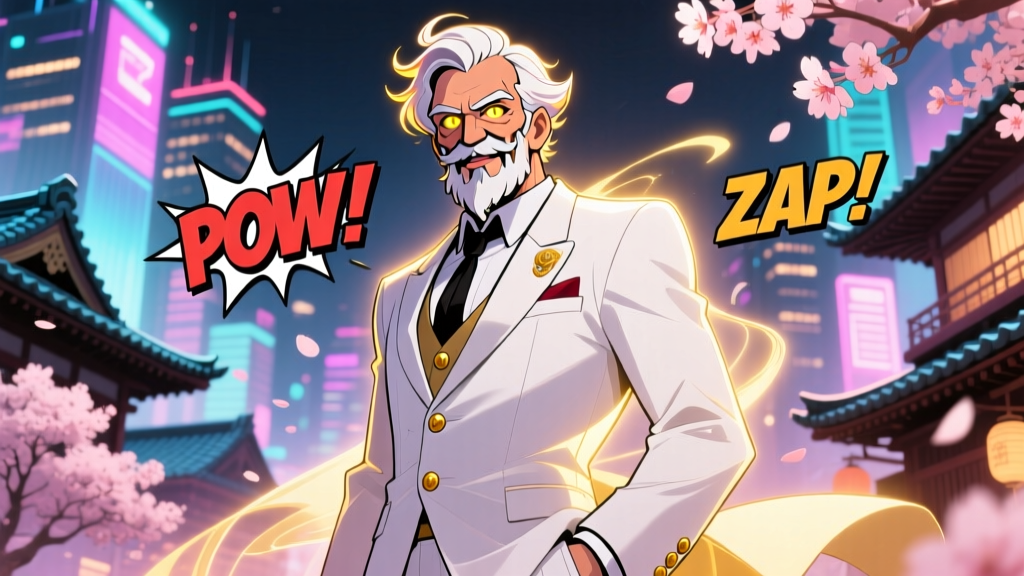
Harland Sanders never meant to become an anime character. The man spent most of his life perfecting a fried chicken recipe and driving across the American South in a beat-up car, pitching franchise deals from the trunk. But in 2012, a 47-year-old Japanese animator gave the Colonel a makeover: sharp jawline, flowing silver hair, a white suit that billowed in the wind. The result was a short film that looked like it belonged on a late-night anime block, not in a fast-food marketing deck. And somehow, it worked.
The story of Colonel Sanders as a cartoon character stretches far beyond that one anime short. It spans five decades of animated commercials, a Saturday morning cartoon segment, dozens of rebrand campaigns, and a peculiar Japanese obsession with turning the old man into something between a folk hero and a mecha pilot. If you have ever wondered how a real person became one of the most recognizable illustrated mascots on the planet — and then got reimagined as a bishounen protagonist — pull up a chair. This one gets weird.
From Portrait to Cartoon: The Colonel's Animated Beginnings
KFC started animating Colonel Sanders almost as soon as the franchise went national. The earliest animated depictions date to the late 1960s, when the company's ad agencies began producing hand-drawn versions of the Colonel for television spots. These were simple, almost crude character animations — a smiling face with a goatee, a string tie, and a white suit, waving a drumstick at the camera. The real Harland Sanders was still alive and still appearing in his own commercials, but the cartoon version offered something the live version could not: total control over the message.
By 1972, KFC had committed to a more polished cartoon Colonel for print and television. This version leaned heavily into the " kindly Southern gentleman" archetype. He had rosy cheeks, a warm squint, and proportions that made him look like a character from a children's storybook. The agency behind the campaign, Leo Burnett, understood that a cartoon mascot could appear on packaging, in-store displays, and merchandise without the logistical headaches of scheduling a real 82-year-old man for photo shoots.
"The cartoon Colonel gave the brand a face that never aged, never had a bad day, and never said anything off-script. That was the whole point." — Mark Borkowski, Popcorn Culture: Marketing the Fast Food Nation, BFI Publishing, 2018
The real Colonel Sanders died in 1980 at age 90, but his cartoon counterpart kept working. Throughout the 1980s, the animated Colonel appeared in regional TV spots, often voiced by impressionists who affected a slow Southern drawl. KFC's in-house creative team refined the design several times, gradually simplifying the line work and making the character more iconic than realistic. The string tie got shorter. The mustache got thinner. The smile got wider. By the end of the decade, the cartoon Colonel looked less like Harland Sanders and more like a logo that happened to have legs.
Saturday Mornings and Syndication: The Colonel on TV
The Colonel's Secret Star (1990s Concepts)
KFC toyed with the idea of a full animated series in the early 1990s. Internal pitch documents, later surfaced by advertising historian Timothy Nudd, described a show called The Colonel's Kitchen, where a cartoon Sanders would solve neighborhood problems while teaching kids about cooking. The concept never made it to air — test audiences found the premise "confusingly educational for a fried chicken brand" — but it revealed how seriously KFC took the cartoon character as a brand vehicle independent of the real man.
The "Colonel Sanders Classics" Campaign (2006)
In 2006, KFC launched a campaign that brought the Colonel back to animated life with a twist. The "Colonel Sanders Classics" spots used a mix of traditional 2D animation and digital compositing to place a cartoon Colonel in nostalgic Americana settings: county fairs, baseball games, family reunions. The animation studio responsible, now defunct, produced 12 spots over 18 months. Each one ran 30 seconds and cost approximately $350,000 to produce, a significant investment for a fast-food ad at the time.
The campaign underperformed. Focus groups indicated that younger consumers associated the cartoon style with "old-fashioned" branding, which was the opposite of what KFC needed during a period of declining same-store sales. The company pulled the campaign in late 2007 and pivoted toward live-action comedy spots.
The Numbers Behind the Cartoon Colonel
KFC has commissioned at least 7 distinct animated designs of Colonel Sanders since 1968. The character has appeared in over 200 animated TV spots across North America, Japan, Australia, and the UK. Combined licensing revenue from merchandise featuring the cartoon Colonel exceeded $42 million annually by 2019, according to KFC's parent company Yum! Brands annual filing.
The Japan Connection: Where the Colonel Became Anime
To understand how Colonel Sanders became an anime character, you have to understand Japan's relationship with KFC. The chain arrived in Japan in 1970, and by the mid-1970s, it had become entangled with a Christmas tradition that exists nowhere else on Earth. In 1974, KFC Japan launched the "Kurisumasu ni wa Kentakkii" (Kentucky for Christmas) campaign, which positioned fried chicken as a holiday meal. It stuck. By 2020, an estimated 3.6 million Japanese families ordered KFC on Christmas Eve, according to data from the Japan Anniversary Association.
The Colonel Sanders statue outside every Japanese KFC location became a cultural fixture. Japanese customers began treating the statues as good-luck charms, dressing them up, and — in at least one legendary 1985 incident — throwing one into a river to celebrate a baseball championship. That statue was not recovered from the Dotonbori canal in Osaka until 2009, missing its hands and glasses. The incident became known as the "Curse of the Colonel," blamed for the Hanshin Tigers' decades-long championship drought.
The Anime Colonel Sanders Short Film (2012)
In 2012, KFC Japan commissioned a short anime film that dropped the mascot into a full-blown action narrative. The short, roughly four minutes long, depicted Colonel Sanders as a young, impossibly handsome hero — silver hair flowing, white suit immaculate — battling shadowy forces to protect his secret recipe. The animation quality was genuine: fluid character movement, dramatic lighting, and a soundtrack that would not have been out of place in a Fate/stay night episode.
The short circulated online primarily through Nico Nico Douga and YouTube, where it accumulated over 2.3 million views in its first month. Western anime blogs picked it up immediately. Coverage on sites like Anime News Network and Kotaku framed it as "the anime you never knew you needed," and the short developed a cult following that persists to this day.
What made the anime Colonel work was the sincerity of the production. KFC Japan did not treat it as a throwaway gag. The animation was handled by a legitimate studio with credits in broadcast anime, and the character design borrowed heavily from the bishounen (beautiful young man) archetype popular in shoujo manga. The Colonel's age was de-aged from 65 to roughly 25. His cane became a weapon. His glasses became a dramatic accessory he adjusted before delivering finishing moves.
"The Colonel Sanders anime short is one of the best examples of brand-content fusion in the Japanese market. It works because it commits fully to the genre conventions instead of winking at the audience." — Patrick Macias, editor-in-chief of Otaku USA Magazine, interview 2014
KFC Japan's Continued Anime Tie-Ins
The 2012 short was not a one-off. KFC Japan followed up with additional anime-styled campaigns, including a 2014 collaboration that featured Colonel Sanders in a visual novel-style interactive ad, and a 2017 campaign where the Colonel appeared alongside characters styled after magical girls. Each campaign leaned harder into anime aesthetics: speed lines, cherry blossom backgrounds, and dramatic monologues about the "11 secret herbs and spices" delivered with the intensity of a shounen protagonist revealing a hidden technique.
These campaigns resonated specifically because they respected anime as a medium rather than parodying it. Japanese consumers are accustomed to brand tie-ins with anime properties — the practice is called tie-up (タイアップ) and dates back to the 1970s. KFC Japan simply reversed the equation: instead of licensing an existing anime character to sell chicken, they turned their own mascot into an anime character.
The Modern Era: Actor-Colonels and the Cartoon Renaissance
Starting in 2015, KFC launched a campaign in the United States that cast a rotating series of celebrities as Colonel Sanders in live-action commercials. The list reads like a comedy casting call: Norm Macdonald, Darrell Hammond, Jim Gaffigan, George Hamilton, Billy Zane, Rob Riggle, Rob Lowe, Craig Fleming (a then-unknown KFC employee), Reba McEntire, and Mario Lopez all donned the white suit between 2015 and 2020.
This campaign had a curious side effect on the cartoon Colonel. As audiences grew accustomed to seeing different faces under the Colonel's glasses, the character became more abstract — less a specific person and more a role that anyone could play. This abstraction made it easier for KFC to reintroduce animated versions of the Colonel without audiences expecting a specific likeness.
The 2019 Animated Rebrand
In 2019, KFC's U.S. marketing team commissioned a new animated Colonel design for digital and social media use. This version was deliberately stylized — closer to a Cartoon Network character than a corporate mascot, with exaggerated proportions and expressive, rubbery animation. It appeared primarily in short-form social content: Instagram stories, TikTok clips, and YouTube bumper ads. The design was credited to Wieden+Kennedy, the Portland-based agency that has handled KFC's creative since 2014.
The 2019 cartoon Colonel was notably more irreverent than previous versions. In one spot, he breakdanced. In another, he appeared in a pixelated 8-bit style reminiscent of classic NES games. A Halloween-themed clip showed him in a Tim Burton-esque silhouette animation. This flexibility — the ability to shift visual styles while maintaining character recognition — became the defining trait of the modern cartoon Colonel.
Colonel Sanders in Pop Culture Animation
The cartoon Colonel has infiltrated animated media far beyond KFC's own advertising. Here are the appearances that matter:
- The Simpsons (multiple episodes) — A KFC parody called "Colonel Kentucky" or direct Colonel Sanders cameos have appeared in at least three episodes since 1998, usually as background gags in Springfield's commercial district.
- Family Guy — The show has used Colonel Sanders as a cutaway gag character at least twice, including one sequence where he duels Ronald McDonald in a sword fight.
- South Park — A brief Colonel Sanders appearance in the 2009 episode "Eat, Pray, Queef" played the character as a ghost haunting fast-food restaurants.
- Robot Chicken — Stop-motion Colonel Sanders segments have appeared in at least two episodes, including one where the Colonel is reimagined as an action figure in a toy battle.
- Aqua Teen Hunger Force — The show's general irreverence toward corporate mascots led to a Colonel Sanders-adjacent character in a 2005 episode.
These appearances share a common thread: the cartoon Colonel is treated as a cultural shorthand for American fast-food excess, Southern hospitality, or both. The character is recognizable enough to work as a reference without explanation — a status that only a handful of brand mascots have achieved.
Video Games and Interactive Media
The Colonel has also appeared in video game contexts. In 2017, KFC released I Love You, Colonel Sanders! A Finger Lickin' Good Dating Simulator, a visual novel-style game developed by Psyop. While not technically a cartoon — the game used illustrated character portraits in an anime-inspired art style — it represented the logical endpoint of the Colonel's cartoonification. The game let players romance a bishounen Colonel Sanders, complete with dramatic confession scenes and cooking challenges. It was released for free on Steam and downloaded over 1.5 million times in its first year, according to Steam Spy data.
In 2019, Colonel Sanders appeared as a playable character in a limited-time event for the mobile game Street Fighter Duel in Asian markets, with moves based on frying chicken and wielding a cane. The collaboration was a KFC Asia-Pacific promotion and ran for approximately six weeks.
| Year | Appearance / Campaign | Animation Style | Market |
|---|---|---|---|
| 1968–1972 | Early TV spot animations | Simple hand-drawn 2D | United States |
| 1980–1989 | Post-death animated commercials | Refined 2D, simplified line art | United States, UK |
| 2006–2007 | Colonel Sanders Classics campaign | Digital 2D + compositing | United States |
| 2012 | Anime Colonel Sanders short film | Full anime production (bishounen) | Japan |
| 2014 | Visual novel interactive ad | Anime / visual novel stills | Japan |
| 2017 | Magical girl Colonel campaign | Anime / magical girl genre | Japan |
| 2017 | I Love You, Colonel Sanders! dating sim | Anime-inspired illustration | Global (Steam) |
| 2019 | Social media animated Colonel | Varied: Cartoon Network, pixel art, Burton-esque | United States, Global |
| 2019 | Street Fighter Duel collaboration | Mobile game sprite/illustration | Asia-Pacific |
Why the Colonel Works as a Cartoon Character
Most brand mascots fail when they try to cross into entertainment. Tony the Tiger sells cereal. The Geico Gecko sells insurance. Neither of them has headlined a short film that people watch for fun. Colonel Sanders is an exception, and the reasons are specific:
- The character is based on a real person. This gives the cartoon version an inherent narrative tension. Audiences know there was a real Harland Sanders, which makes every exaggeration — the anime sword fights, the breakdancing, the romantic confessions — feel like a deliberate creative choice rather than a random invention.
- The visual design is already iconic. White suit, string tie, goatee, glasses, cane. These elements are so distinctive that they survive any amount of stylization. You can render the Colonel in pixel art, anime, or stop-motion, and he is still instantly recognizable. That is a rare property in character design.
- The brand has embraced absurdity. KFC's marketing team, particularly under Wieden+Kennedy, made a conscious decision to treat the Colonel as a comedic and surreal figure. This gave animators permission to experiment rather than protect a sanitized brand image.
- Japanese otaku culture provided the framework. The anime Colonel worked because Japan already had a deep cultural relationship with the character. The Christmas tradition, the statues, the Curse of the Colonel — all of this meant that Japanese audiences were primed to accept the Colonel as something more than a fast-food mascot.
The Colonel Sanders Anime Short: A Deeper Look
For those who have not seen it, the 2012 anime short deserves a closer examination, because it is genuinely well-crafted and it sits at the intersection of two cultural traditions that have no business overlapping.
The short opens with a young woman walking alone at night through a stylized Japanese cityscape. She is followed by shadowy figures — abstract, ink-wash style antagonists that represent "hunger" or perhaps something more metaphorical. Just as the figures close in, a flash of white light fills the screen, and Colonel Sanders appears. Not the old man. Not the mascot. A tall, slender young man with silver hair and piercing eyes, wearing the Colonel's white suit like a superhero's costume.
What follows is approximately three minutes of high-quality fight choreography. The Colonel wields his cane as a weapon, dispatching the shadow figures with fluid, well-animated combat sequences. The action direction borrows from late-2000s anime fighting conventions: speed lines, impact frames, dramatic pauses. The soundtrack is orchestral with electronic elements, mixed to emphasize bass hits on impact moments.
The short ends with the Colonel offering the young woman a piece of fried chicken, which she accepts. He adjusts his glasses, turns, and walks into the light. The KFC logo appears. That is the entire narrative. It is simple, but the execution elevates it.
Production Note: The animation quality of the 2012 short has been compared to mid-tier TV anime productions of the same era. Frame counts and compositing techniques suggest a budget in the range of ¥15–25 million (approximately $180,000–$300,000 USD at 2012 exchange rates), which is consistent with a four-minute promotional OVA (original video animation). This is roughly 3x the cost of a standard 30-second animated commercial in Japan at the time.
Colonel Sanders vs. Other Fast-Food Cartoon Mascots
The Colonel occupies a different category from most fast-food cartoon characters, and the comparison is instructive:
Ronald McDonald is a clown. His cartoon appearances are designed for children, and his visual identity is locked to a specific look. When McDonald's tried to reimagine Ronald in the 2000s, the backlash was severe. The character has appeared in animated form (the McDonald's Treasure Land Adventure video game, various Happy Meal tie-in cartoons), but never in a way that transcended the brand.
The Burger King had a brief animated life in the 2004–2008 "The King" campaign, but the character was deliberately creepy, designed to generate buzz through discomfort rather than affection. It worked as marketing but left no cultural residue.
Wendy, the red-haired girl from the Wendy's logo, barely exists as a character. She has appeared in a handful of animated spots but functions more as a logo element than a mascot with a personality.
Colonel Sanders is different because the character has range. He can be the kindly grandfather in a Christmas commercial, the sword-wielding anime hero in a Japanese short film, the pixel-art throwback in a social media clip, or the romantic interest in a dating simulator. That range comes from the combination of a real person's biography, an iconic visual design, and a brand that has learned to let the character breathe.
The Cultural Afterlife of a Cartoon Colonel
There is a concept in Japanese pop culture called kyara (キャラ), short for "character." A kyara is not just a mascot — it is a persona that takes on a life of its own, generating meaning and affection independent of its commercial origins. Hello Kitty is a kyara. Kumamon is a kyara. Doraemon is a kyara. The Colonel Sanders of Japanese pop culture has achieved kyara status: he is referenced in manga, appears in fan art on Pixiv (with over 3,400 tagged works as of early 2025), and is treated by Japanese consumers as a character with personality traits, not just a logo.
In the West, the Colonel has not quite reached kyara status, but he is getting close. The meme culture surrounding the dating simulator, the anime short, and the celebrity-Colonel campaign has given the character a second life that exists largely independent of KFC's advertising spend. People share Colonel Sanders anime clips because they find them genuinely entertaining, not because they are craving fried chicken. That distinction — between a mascot that sells product and a character that generates culture — is the line the cartoon Colonel has crossed.
Whether KFC's marketing team planned this outcome or stumbled into it is almost irrelevant. What matters is that a man who built a chicken empire from a gas station in Corbin, Kentucky, now exists as an anime hero, a dating sim love interest, and a cartoon character with more cultural range than most fictional protagonists. Harland Sanders would probably have found the whole thing ridiculous. But then again, he was the one who started wearing the white suit everywhere he went, even to bed. The man understood performance. The cartoon just made it permanent.
Frequently Asked Questions
Is there a full Colonel Sanders anime series?
No. KFC Japan has produced several short-form anime pieces, the most notable being the 2012 short film (approximately four minutes long). There has never been a full-length anime series featuring Colonel Sanders. The animated content has remained in the promotional and short-form category, distributed through online platforms and Japanese TV advertising slots.
What is the "Curse of the Colonel" and does it relate to the cartoon version?
The Curse of the Colonel refers to a real-world incident in 1985, when Hanshin Tigers fans threw a life-size Colonel Sanders statue into the Dotonbori canal in Osaka after the team won the Japan Series pennant. The Tigers then endured an 18-year losing streak, which fans attributed to the curse. The statue was partially recovered in 2009. The curse relates to the physical statues, not the cartoon character, but it deepened the Colonel's mythological status in Japanese pop culture, which indirectly supported the anime campaigns decades later.
Where can I watch the Colonel Sanders anime short?
The 2012 anime short has been uploaded and re-uploaded to YouTube multiple times by fans. The original official upload by KFC Japan was removed from their channel during a rebrand, but fan mirrors with the search terms "KFC Colonel Sanders anime" or "ケンタッキー Colonel Sanders アニメ" typically surface working copies. The short has also been archived on the Internet Archive.
Is the I Love You, Colonel Sanders! dating sim still available?
Yes. The game was released on Steam in September 2019 and remains available as a free download. It was developed by Psyop and published by KFC. The game features anime-inspired character art and runs approximately 45 minutes for a single playthrough. As of mid-2025, it has a "Very Positive" review rating on Steam with over 18,000 user reviews.
How many actors have played Colonel Sanders in KFC commercials?
Between 2015 and 2020, at least 11 different performers portrayed Colonel Sanders in KFC's U.S. advertising campaign, including Norm Macdonald, Darrell Hammond, Jim Gaffigan, George Hamilton, Billy Zane, Rob Riggle, Rob Lowe, Craig Fleming, Reba McEntire, Mario Lopez, and Jason Alexander. Additional regional campaigns in other countries have used local actors as well.
Why does Japan love Colonel Sanders so much?
The Colonel's popularity in Japan is rooted in the 1974 "Kentucky for Christmas" campaign, which established KFC as a holiday tradition. The Colonel Sanders statues outside Japanese KFC locations became cultural landmarks, and the character's image — an elderly, well-dressed gentleman — resonated with Japanese cultural values around craftsmanship and dedication. The concept of shokunin (artisan spirit) maps well onto the Colonel's origin story of perfecting a single recipe over decades.