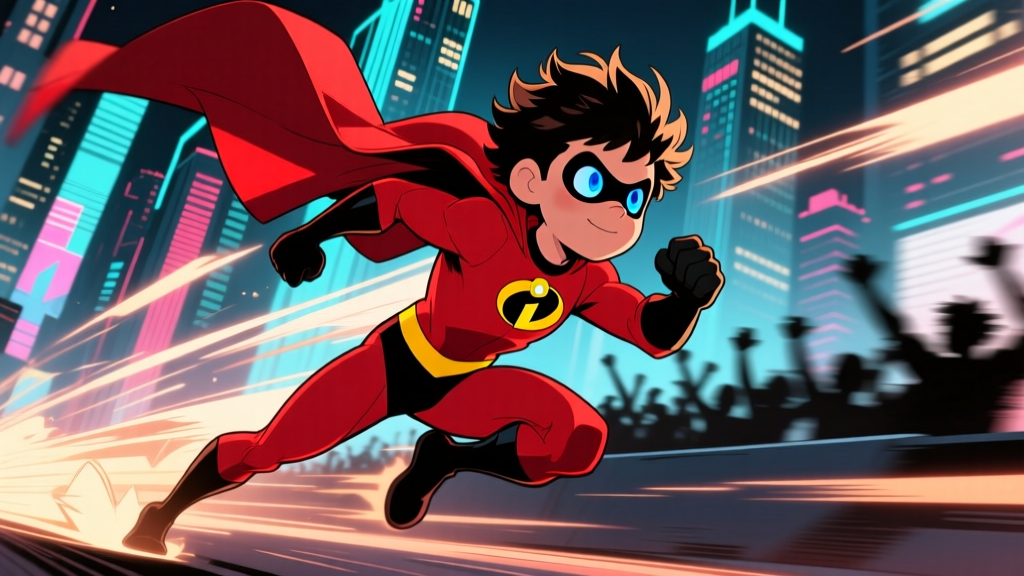
There's a moment early in The Incredibles (2004) that tells you everything about Dash Parr without a single line of exposition. A ten-year-old boy sits in a school office, grinning while his mother scolds him, and when the camera cuts to his feet — they're vibrating. Just barely. A twitch of kinetic energy that says: this kid has somewhere to be, and sitting still is physically painful. That tiny animation choice — twelve frames of foot-tapping looped under a desk — became the visual shorthand for one of Pixar's most technically demanding characters.
Dashiell Robert Parr doesn't just run fast. He is speed, and the image of Dash — orange suit streaking across water, red hair flattened by G-force, a grin wider than any ten-year-old has a right to wear — is one of the most recognizable character designs in modern animation. For otaku culture, Dash occupies a rare space: a Western superhero kid who feels like a shonen protagonist. Impulsive, cocky, endlessly energetic, and visually coded in the language of speed that anime fans already know by heart.
The Anatomy of a Speedster: How Pixar Designed Dash
Character designer Teddy Newton and director Brad Bird built Dash on a deceptively simple principle: every line on his body should point forward. His red-orange hair sweeps back in a permanent windblown wedge. His chin juts out. His shoulders lean into an invisible headwind even when he's standing still. The Incredibles family was designed by Tony Fucile, and Dash's silhouette — narrow, angular, built like a dart — contrasts sharply with Bob Parr's barrel-chested mass and Violet's rounded, closed-off posture.
The color palette tells its own story. Dash's super suit, designed by Edna Mode within the film's universe, uses cardinal red as the base with orange-gold accent stripes that trail backward from the chest emblem. These aren't decorative. They function as speed lines — when Dash moves, those orange streaks elongate and blur, creating a visual trail that the eye reads as velocity before the brain processes the actual motion. It's a trick borrowed directly from manga: the kind of speed-effect lines you'd see in Dragon Ball or Naruto, translated into 3D geometry.
"Dash had to look fast in a still frame. If you paused the movie on any shot of him, even standing still, you should feel like he's about to bolt. That's what separates a good character design from a great one — motion baked into the silhouette."
— Teddy Newton, character designer, from The Art of The Incredibles (Chronicle Books, 2004)
Dash's civilian clothes follow the same logic in reverse. Baggy t-shirts, loose shorts, sneakers — clothing that can move when he does. In the dinner-table argument scene, his oversized collar flaps when he gestures. Pixar's cloth simulation team, led by Michael Kashtan, built over 2,100 individual control points for Dash's civilian wardrobe alone, more than any other family member. The reasoning was practical: a speedster's clothes would experience extreme aerodynamic forces, and even in calm scenes, the fabric needed to behave like it existed in a world where sudden acceleration was always possible.
The Speed Problem: Why Animating Dash Nearly Broke Pixar
Here's a number that should make any animator wince: 24 frames per second, with Dash moving up to 400 miles per hour. At that velocity, a character crosses roughly 17 feet per frame. In a standard camera shot with a 30-foot visible range, Dash would enter and exit the frame in under two frames — effectively invisible.
This is the fundamental paradox of animating super-speed. The faster a character moves, the less the audience can actually see them. Pixar's animation team, supervised by Alan Barillaro and Kori Rae, developed several workarounds that have since become standard practice in the industry:
- Motion blur stretching: Rather than applying uniform blur, Dash's blur was directional and exaggerated — his entire body smears into an orange-red streak while his face remains semi-readable for 2-3 frames at key moments. This "face-in-the-blur" technique lets audiences track emotion even at peak velocity.
- Speed afterimages: Inspired by anime like Dragon Ball Z, Pixar added translucent echo-frames behind Dash during his fastest sequences. These ghost images persist for 4-6 frames each, creating a visual trail that reads as "he was just here, and here, and here."
- Environmental reaction over character motion: Instead of showing Dash moving, the camera often holds on what he does to his surroundings — water spraying upward in his wake, papers scattering from a desk, a teacher's hair blown back. The audience infers speed from consequence.
- Frame-rate modulation: In Incredibles 2 (2018), Dash's sequences were sometimes animated on ones (every frame) and sometimes on twos (every other frame) within the same shot. Switching between the two creates a rhythmic "stutter" that makes his movements feel impossibly fast while remaining visually coherent.
The water-running sequence on Nomanisan Island — where Dash sprints across the ocean surface while being chased by velocipods — required the creation of an entirely new fluid simulation pipeline. Pixar's technical team published details of this system in a SIGGRAPH 2005 paper, noting that Dash's footfalls needed to generate realistic splash columns at 1/60th-second intervals, a computational cost that rendered single frames for up to 90 hours on the studio's render farm at the time.
Fourteen years later, Incredibles 2 pushed Dash's animation even further. The sequel's higher-resolution rigs meant Dash's model had roughly 4x the polygon count of the original, and his hair simulation — originally a rigid sculpted cap — was rebuilt with a strand-based system that responded to acceleration forces in real time. When Dash stops suddenly in the sequel, his hair keeps moving forward for an extra 3-4 frames. Physics-accurate, and a detail that audiences feel even if they can't name it.
Five Scenes That Define Dash (And What Animators Learn From Them)
The Classroom Prank (The Incredibles, 2004)
Dash places a thumbtack on his teacher Bernie Kropp's chair, returns to his seat, and the entire sequence plays out in under four seconds of screen time. But those four seconds contain some of the most precise timing in the film. Dash accelerates from zero, plants the tack, and decelerates back to his chair — and the only evidence is a slight breeze that ruffles a poster on the wall. It's the scene that introduced audiences to the idea that super-speed isn't just about going fast; it's about what you can accomplish in the space between other people's blinks.
The Island Chase (The Incredibles, 2004)
Running from Syndrome's velocipod drones through jungle terrain, Dash discovers he can run on water. The moment he realizes it — looking down at his feet, grin spreading, before whooping with joy — is peak character-through-action storytelling. The sequence runs approximately 90 seconds and uses three distinct camera strategies: tracking shots from behind (speed emphasis), wide aerial views (scale and environment), and extreme close-ups of Dash's face (emotional beats). The blend keeps the sequence from becoming a blur-fest and gives each speed technique room to breathe.
The Omnidroid Fight (The Incredibles, 2004)
Dash circles the Omnidroid at full speed, creating a dust vortex that lifts debris in a perfect ring. From a technical standpoint, this scene required coordinating Dash's particle trail with the Omnidroid's rigid-body simulation and the environment's cloth and foliage systems — all in the same frame. From a character standpoint, it's Dash proving he can contribute to a team fight without just being a distraction.
The Elastician Chase (Incredibles 2, 2018)
In the sequel, Dash and Violet pursue a villain through a cityscape, and the animation language has evolved dramatically. Dash now leaves visible contrails — thin lines of displaced air rendered as subtle refractive distortions. It's a more mature visual vocabulary than the simple color streaks of the first film, reflecting both Pixar's improved technology and Dash's growth as a character. He's faster, but also more controlled.
The Race (Incredibles 2, Deleted/Concept Scene)
Concept art released in The Art of Incredibles 2 (Chronicle Books, 2018) showed a planned sequence where Dash races against another speedster. Though cut for pacing, the pre-production art revealed Pixar's design explorations for "speed vs. speed" — two characters leaving competing visual trails, their motion blurs overlapping and interacting. The images circulated widely in animation communities and inspired a wave of fan art exploring what a Dash-vs-Flash or Dash-vs-Quicksilver matchup might look like.
Dash by the Numbers: A Character Profile Table
| Attribute | The Incredibles (2004) | Incredibles 2 (2018) |
|---|---|---|
| Age | 10 years old | 10 years old (timeline unchanged) |
| Voice Actor | Spencer Fox | Huckleberry Milner |
| Model Polygon Count (approx.) | ~45,000 | ~180,000 |
| Hair System | Rigid sculpted cap | Strand-based dynamic simulation |
| Suit Color Primary | Cardinal red (#B22222 range) | Cardinal red (slightly warmer tone) |
| Max On-Screen Speed | ~190 mph (water run) | ~400 mph (city chase) |
| Motion Blur Technique | Directional smear + afterimages | Refractive contrails + echo frames |
| Render Time (hardest Dash frame) | ~90 hours per frame | ~120 hours per frame |
| Sources: The Art of The Incredibles (2004), SIGGRAPH 2005 production notes, The Art of Incredibles 2 (2018) | ||
Collectible Figures and Merchandise: The Dash Shelf
For collectors, Dash has been surprisingly well-served despite being the youngest and arguably most underrated member of the Incredibles lineup. Here's a breakdown of the major physical releases:
Funko Pop! Dash (Incredibles 2, #366) — Released in 2018 alongside the sequel's merchandising push. The figure captures Dash mid-run with motion-blur paint effects on the base and trailing arms. It retailed around $10.99 and sits at approximately 3.75 inches. Secondary market prices hover between $8 and $15, with the exclusive Hot Topic variant (glow-in-the-dark suit accents) commanding $25–$40.
Funko Pop! 20th Anniversary Incredibles (2024) — A rerelease with refreshed packaging for the film's 20th anniversary. Dash was included alongside the full family set. The anniversary editions use slightly updated molds with more defined facial features — a nod to the improved character rigs from the sequel.
Disney Store Action Figure (2004/2018) — The classic 6-inch articulated figure sold through Disney Stores and shopDisney. Two versions exist: the original 2004 release with simpler paint applications and a 2018 rerelease with more accurate suit detailing. Neither is rare, but the 2004 original in sealed packaging has started creeping up in price among Pixar memorabilia collectors.
LEGO The Incredibles (2018) — Dash appears as a playable character in the LEGO video game and as a minifigure in several sets, most notably the LEGO 10761: The Great Home Escape. The minifigure uses a custom hair mold — a swept-back wedge piece unique to Dash — and a printed torso with the suit's orange speed-line accents.
Bandai S.H.Figuarts Incredibles — A Japan-market premium release (2019) that included Dash with multiple face plates and interchangeable speed-effect accessories. Priced around 7,700 yen for the family set, these figures are aimed squarely at the adult collector market and feature articulation far beyond the Funko and Disney Store offerings. Dash's set includes a translucent orange "speed trail" accessory that clips to the figure's back — a physical representation of the animation techniques discussed earlier.
"Speed characters are always the hardest to merchandise. A figure that's standing still has to convey motion through pose and paint alone. Dash's swept-back hair and trailing speed lines do a lot of that heavy lifting."
— Product design lead, Bandai collector division interview, Figure King magazine #256 (2019)
Fan Art, Cosplay, and the Dash Community
Search "Dash Parr" on DeviantArt, Pixiv, or Twitter/X in 2026 and you'll find a thriving ecosystem of fan work that spans two decades. The character occupies a specific niche in otaku-adjacent art communities: he's a kid speedster, which means fan artists frequently explore "aged-up" versions — teenage Dash, college-age Dash, adult Dash taking over as the family's primary hero. The aged-up designs tend to amplify the visual language of the original: longer, more dramatic hair, leaner build, suits that incorporate the orange speed-line motifs into more complex patterns.
Cosplay presents a unique challenge with Dash. The hair — that rigid, swept-back wedge of red-orange — requires significant structural support. Most cosplayers use a combination of wire armature inside a wig and heavy-hold styling product (Got2b Glued is the community consensus, based on cosplay build logs on Reddit's r/cosplay and Instagram). The suit is comparatively straightforward: red spandex base with heat-transfer vinyl orange accents. The hardest part, ironically, is the gloves — Dash's gloves have specific orange bands at the wrists that need to stay aligned during movement, and cheap vinyl tends to peel at the stress points.
The crossover fan art scene is where Dash truly shines. Artists regularly place him alongside anime speedsters — My Hero Academia's Tenya Iida, One Punch Man's Speed-o'-Sound Sonic, JoJo's Bizarre Adventure's various Stand users — in head-to-head race compositions. These pieces often use split-panel layouts borrowed from manga, with each character's speed rendered in their franchise's native visual language. Dash's Pixar-style motion blur next to anime-style speed lines creates a visual contrast that artists and audiences both love.
The "Image Dash" Search Phenomenon
It's worth noting that "image dash" as a search term has an unusual dual life. In web analytics and SEO contexts, it frequently appears as a query combining the character's name with the intent to find visual content — wallpapers, screenshots, concept art, fan illustrations. Google Image Search results for "image dash" are dominated by Dash Parr content, particularly his water-running sequence and his Funko Pop product shots. Pinterest boards dedicated to Dash imagery routinely accumulate 5,000+ saves, with the most-pinned image being the production still of Dash running across water with the orange sunset behind him — a frame from the original film's marketing kit that has become the definitive "Dash image" across the internet.
The term also surfaces in design communities where "dash" refers to dashboard UI elements and speed-line graphic assets. The overlap between Pixar's Dash and motion-design dash imagery creates an amusing search-result collision that the fan community has leaned into with memes and mashup graphics.
Why Dash Matters to the Otaku and Animation Crowd
Strip away the superhero trappings and Dash Parr is a character built on a universal childhood feeling: the urge to go. To move, to race, to burn energy that has nowhere to go while adults tell you to sit still. Pixar's genius was translating that feeling into a visual design so tight that every element — hair direction, suit lines, posture, even the way his clothes hang when he's forced to stand still — communicates kinetic potential.
For anime and otaku audiences specifically, Dash resonates because he follows a pattern we recognize intimately: the young shonen hero who discovers his power is both a gift and a liability. His speed makes him special, but it also makes him impatient, reckless, and occasionally dangerous to the people around him. The scene where Dash runs on water for the first time and nearly drowns when he stops — because momentum is what keeps him atop the surface — is as close to a power has consequences lesson as a PG-rated Pixar film can deliver.
Animation students still study Dash's sequences as case studies in motion communication. The SIGGRAPH papers on his water-running simulation are cited in graduate-level coursework. And the fan art keeps coming, twenty-two years after a ten-year-old boy tapped his foot under a school desk and grinned like he knew something nobody else did.
He did know something. He knew he was fast. And two decades of animators, designers, collectors, and fans have been trying to keep up ever since.
Frequently Asked Questions
How fast can Dash Parr actually run?
Within the film's canon, Dash's top speed is never given a precise number, but production materials and the Incredibles 2 animation data suggest he can exceed 400 mph in short bursts. The original film's water-running sequence was animated at approximately 190 mph based on the splash physics simulated by Pixar's fluid team. For context, that's faster than any land animal and roughly half the speed of sound.
Why does Dash have red hair when both parents have dark hair?
From a genetics standpoint, red hair is a recessive trait — both Helen and Bob would need to carry the MC1R gene variant for Dash (and Violet) to express it. From a design standpoint, Dash's red-orange hair serves a critical visual function: it creates a high-contrast streak of warm color against cool backgrounds during speed sequences, making him easier to track on screen. Violet's purple-black hair serves the opposite purpose — it blends into shadows, reinforcing her introverted character and invisibility power.
Was Dash's character design influenced by anime speedsters?
Brad Bird has acknowledged the influence of Japanese animation on The Incredibles broadly, and the speed-line visual language used for Dash directly parallels techniques developed in manga and anime. The afterimage effect in particular mirrors Dragon Ball Z's approach to high-speed combat. However, Dash's specific character silhouette — the wedge-shaped hair, the forward-leaning posture — was developed independently by Pixar's design team.
What are the most valuable Dash collectibles?
As of mid-2026, the highest-value Dash collectible is the Bandai S.H.Figuarts set (complete family, sealed) which trades between $200–$350 on secondary markets. Individual Dash figures from that line reach $60–$90. The Funko Pop Hot Topic exclusive glow-in-the-dark variant sits at $25–$40. Sealed 2004 Disney Store action figures in original packaging have been trending upward, with recent sales in the $40–$70 range.
Why doesn't Dash age between the two movies?
Incredibles 2 picks up immediately after the events of the first film — literally days later in the story's timeline. The Parr family exists in a compressed timeline by design, which is also why the sequel's improvements to Dash's model (higher polygon count, strand-based hair) represent a technology upgrade rather than a character aging decision.