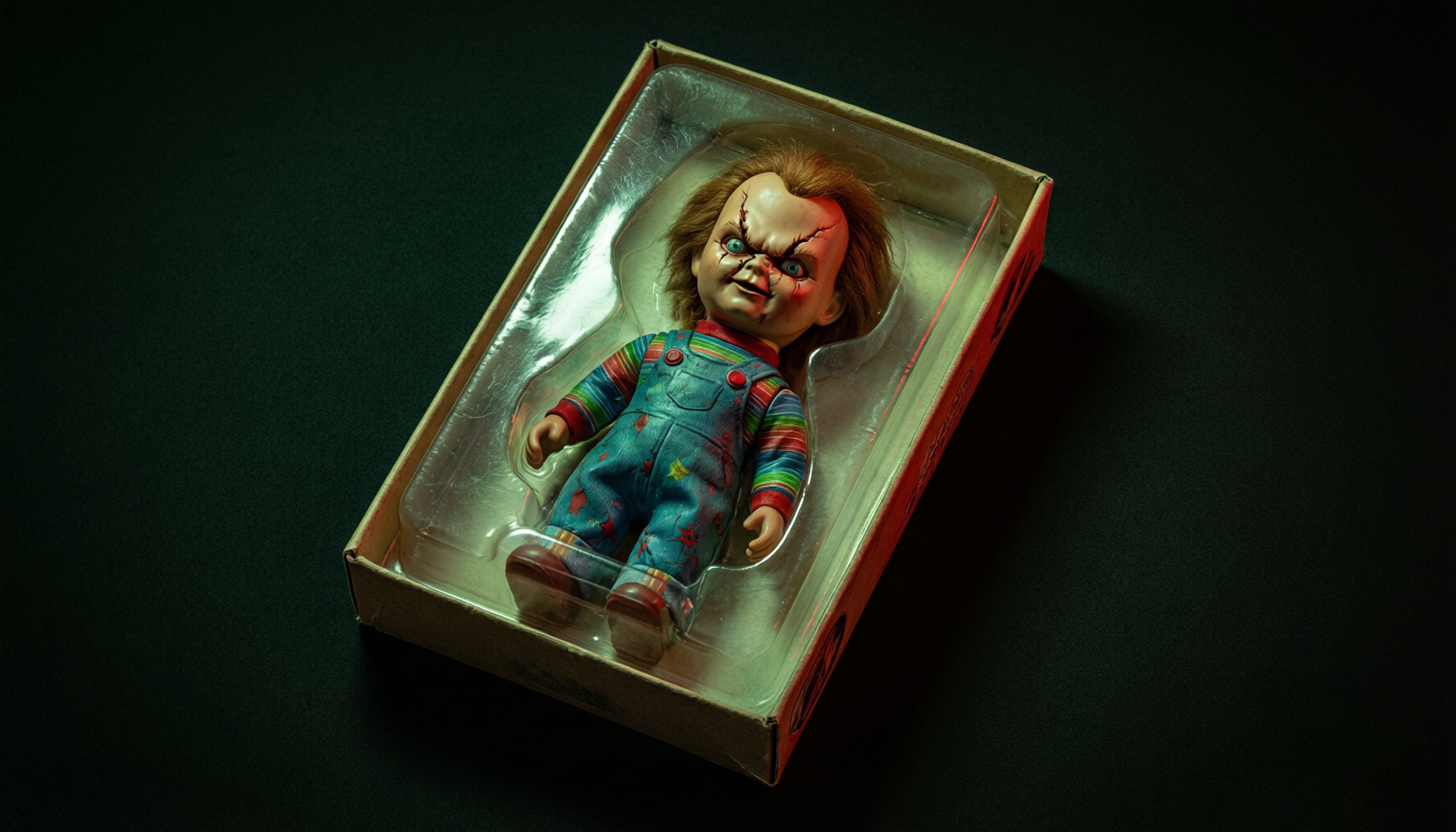
The Good Guy Doll: How a Children's Toy Became Horror's Most Unforgettable Killer
It's November 1988. A single mother named Karen Barclay stands outside a toy store in downtown Chicago, desperate. Her son Andy wants a Good Guy doll for his birthday — the one every kid on the block is talking about, the one with the freckled face and the denim overalls and that jingle you can't get out of your head. She buys one from a vagrant in an alley for twenty bucks. That decision, in the hands of screenwriter Don Mancini and director Tom Holland, became the catalyst for one of the longest-running horror franchises in cinema history.
The Good Guy doll isn't just a prop. It's the entire thesis of Child's Play: the idea that the thing designed to comfort your child could instead become the thing that destroys your family. And thirty-eight years later, that idea hasn't lost a single volt of its charge.
Don Mancini Had a Very Specific Nightmare
Before the franchise, before the catchphrase, there was a film student with a disturbing premise. Don Mancini, writing his thesis project at UCLA in the mid-1980s, wanted to explore something that genuinely frightened him: the way advertising manipulates children into wanting things they don't need. He'd watched the Cabbage Patch Kids craze of 1983 — parents literally fighting in stores, adults shoving each other to grab a $25 doll — and thought, what if the doll fought back?
The original script, titled Blood Buddy, went through several revisions before producer David Kirschner picked it up at United Artists. Mancini's concept was always more psychological than slasher-flick: a six-year-old boy who can't convince anyone that his toy is alive and murderous. The horror wasn't just the knife — it was the gaslighting, the isolation, the slow erosion of a child's credibility in the adult world.
"I was interested in the relationship between children and their toys, and how that relationship gets manipulated by corporate interests. Chucky was always a satire first, a monster second."
— Don Mancini, interview with Fangoria, Issue #372 (2018)
The film's budget was $9 million — modest even by 1988 standards — and it grossed $33.2 million domestically, according to Box Office Mojo. That's roughly a 3.7x return, which in Hollywood accounting terms means the studio greenlit a sequel before the opening weekend numbers even finished printing.
The Anatomy of a Good Guy: Design, Voice, and Uncanny Terror
What makes the Good Guy doll genuinely unsettling isn't what it does — it's what it looks like before it does anything. The production team, led by special effects artist Kevin Yagher (who would later create the Crypt Keeper for Tales from the Crypt), designed Chucky to hit a very specific note on the uncanny valley spectrum.
The Physical Design
Standing approximately 29 inches tall in the fictional toy line, the Good Guy doll features:
- Red-auburn hair — not bright orange, not brown. That specific in-between shade that reads as "almost natural" but not quite right.
- Freckles — scattered across the nose and cheeks, the kind of detail that makes a doll look like it was modeled after a real child, which is exactly the problem.
- Blue eyes — oversized, glass-like, with pupils that seem to track you. The original props used hand-painted irises.
- Denim overalls and striped shirt — the universal costume of a 1980s American boy. Relatable. Innocent. Familiar.
Kevin Yagher built multiple versions for the first film: a fully articulated animatronic for close-up work (with cable-controlled facial expressions operated by a team of six puppeteers), a simpler radio-controlled version for walking sequences, and static rubber copies for scenes where Chucky was "just a doll." The animatronic head alone had nine points of articulation — eyebrows, eyelids, cheeks, upper lip, lower jaw — enough to produce expressions that sat in the viewer's brain like a splinter.
Brad Dourif and the Voice That Won't Leave
Here's where the Good Guy doll crossed from "creepy prop" to "cultural phenomenon." Brad Dourif — an Academy Award-nominated actor for One Flew Over the Cuckoo's Nest (1975) — provided Chucky's voice, and he made a choice that defined the character for four decades. Rather than playing the doll as a monotone killer, Dourif leaned into the contradiction: Chucky sounds like a children's toy when he recites his pre-programmed catchphrases ("Hi, I'm Chucky, and I'm your friend 'til the end!"), but the voice curdles into something raw and gutteral when the voodoo wears off.
That transition — from saccharine toy to profane, rage-filled murderer — is the engine of every scene Chucky appears in. Dourif has voiced the character in all eight films and three seasons of the TV series, making him one of the most consistent performer-character pairings in horror history, rivaling Robert Englund's Freddy Krueger (eight films, 25 years in the role).
Thirty-Eight Years of Murder: The Franchise at a Glance
The Child's Play franchise has produced eight theatrical films, a television series, and a 2019 reboot, spanning nearly four decades. Here's how the Good Guy doll evolved across each era:
| Year | Title | Domestic Gross | Good Guy Doll Role |
|---|---|---|---|
| 1988 | Child's Play | $33.2M | Origin — serial killer soul transfer via voodoo |
| 1990 | Child's Play 2 | $28.5M | Resurrected by the toy company to cover up the original incident |
| 1991 | Child's Play 3 | $14.9M | Military school setting; Good Guys line relaunched |
| 1998 | Bride of Chucky | $32.4M | Tiffany (Jennifer Tilly) joins; tone shifts to dark comedy |
| 2004 | Seed of Chucky | $17.0M | Glen/Glenda introduced; Good Guy becomes family man (sort of) |
| 2013 | Curse of Chucky | Direct-to-video | Return to horror roots; confined house setting |
| 2017 | Cult of Chucky | Direct-to-video | Multiple Chucky dolls via voodoo soul-splitting |
| 2019 | Child's Play (reboot) | $29.2M | AI-powered "Buddi" doll replaces voodoo origin |
| 2021–2024 | Chucky (TV series, 3 seasons) | 4.4M premiere viewers | Full franchise continuity; multiple Chuckys across suburban America |
| Combined domestic box office (original timeline films): ~$155M+ | Source: Box Office Mojo, The Numbers | ||
That's a franchise with staying power — and the Good Guy doll is the single constant thread running through every installment. Other horror icons have been recast, rebooted, and reimagined. Chucky's design? Nearly identical since 1988. That's not laziness. That's a design so effective it doesn't need updating.
The Voodoo Mechanics: Why a Doll Specifically
Mancini's original mythology gave Chucky a specific supernatural framework that separated him from Jason Voorhees or Michael Myers. Charles Lee Ray — the Lakeshore Strangler, played by Alex Vincent's scene partner Chris Sarandon in the first film's opening sequence — isn't a supernatural force. He's a dying criminal who uses a Damballa voodoo chant to transfer his soul into the nearest available vessel: a Good Guy doll sitting on a shelf in a toy store.
This matters because it creates a set of rules that the franchise has explored with increasing creativity:
- The doll is a container. Charles Lee Ray's consciousness is trapped inside a plastic shell. He doesn't want to be a doll — he wants a human body. That desperation drives every plot.
- The longer he stays in the doll, the more human the doll becomes. By the second film, Chucky bleeds, feels pain, and can be killed like a person. The toy is slowly transforming into a vessel of flesh.
- The voodoo chant can be repeated. This is how Cult of Chucky introduced the "soul-splitting" mechanic — one Chucky becomes dozens, each with the full personality of Charles Lee Ray. Imagine an army of Good Guys, all equally homicidal.
The 2019 reboot discarded voodoo entirely, replacing it with a hacked AI doll (the "Buddi" line) whose safety protocols are disabled. This was a deliberate commentary on smart-home anxiety — Alexa listening to your conversations, your Ring camera uploading footage you didn't authorize. Different era, same fundamental fear: the thing in your home that's supposed to serve you has its own agenda.
Good Guy vs. the Competition: Horror Dolls Compared
Chucky didn't invent the killer doll trope — that distinction probably belongs to The Twilight Zone's "Living Doll" episode from 1963, featuring Talky Tina. But the Good Guy doll sits at the center of a surprisingly crowded subgenre. Here's how the major contenders stack up:
| Doll | Source | Year | Kill Count | Personality |
|---|---|---|---|---|
| Good Guy (Chucky) | Child's Play | 1988 | 60+ across franchise | Profane, darkly funny, vengeful |
| Talky Tina | The Twilight Zone | 1963 | 1 | Cold, methodical, one-line taunting |
| Slappy the Dummy | Goosebumps | 1993 | 0 (chaos, not murder) | Mischievous, theatrical, PG-rated menace |
| Annabelle | The Conjuring universe | 2013 | ~8 across 3 films | Silent, demonic, vessel-only |
| M3GAN | M3GAN | 2022 | 5 | Protective AI gone rogue, uncanny valley dancing |
The difference? Personality. Annabelle is a haunted object — she doesn't talk, doesn't scheme, doesn't crack jokes. M3GAN is a malfunctioning machine. Slappy is a Saturday-morning villain. Chucky is a person — a foul-mouthed, darkly hilarious, genuinely charismatic person who just happens to be trapped inside 29 inches of injection-molded plastic. That's why the Good Guy doll endures while others fade into trivia answers.
Collecting the Nightmare: The Good Guy Doll Merchandise Market
If you've ever wanted a Good Guy doll of your own — the unpossessed kind, ideally — you're not alone. The collectibles market around Chucky is surprisingly deep, spanning mass-market reproductions, limited-edition statues, and screen-used props that sell for jaw-dropping figures at auction.
Mass-Market Reproductions
Several companies have produced officially licensed Good Guy doll replicas over the years. The most widely available options in 2026 include:
- NECA "Ultimate Chucky" (15-inch) — Priced around $45–$60, these feature multiple interchangeable faces (innocent, scarred, grinning), articulated joints, and accessory packs including knives and the iconic Good Guys packaging box.
- CultureFly "Chucky Noir" series — Available through retailers like Walmart and Hot Topic, typically $15–$30. These are stylized takes — think Chucky in alternate colorways or crossover costumes.
- ReAction Figures (3.75-inch) — The retro-action-figure format, roughly $20 per figure. Good Guy Chucky in his original packaging is one of their best sellers.
- Trick or Treat Studios life-size replica — A 29-inch full-scale Good Guy doll, retailing around $200–$300. This is the one that sits on the shelf and makes your houseguests uncomfortable.
Screen-Used Props and Auction Pieces
This is where things get serious. Heritage Auctions sold a screen-used Good Guy doll prop from the original 1988 Child's Play — constructed of cast hard rubber with hand-painted features — for $40,000 in 2022. A separate animatronic head unit used in close-up scenes fetched over $65,000 at a Prop Store auction in Los Angeles.
For context, that's in the same ballpark as screen-used Freddy Krueger gloves and original Michael Myers masks. The Good Guy doll has achieved blue-chip status in the horror memorabilia market, with values appreciating roughly 8–12% annually for authenticated pieces, according to tracking by Horror Memorabilia Quarterly (2024 annual report).
The Good Guys Box: An Artifact Unto Itself
Collectors pay particular attention to one detail: the original Good Guys packaging. In the film, the box features a cheerful illustration of Chucky with the tagline "I'm Chucky, your friend 'til the end!" and a list of features that read like a 1980s toy commercial parody: "He talks! He walks! He's your best friend!" Reproduction boxes are themselves collectible items, with vintage-style packaging replicas selling for $25–$40 empty — just for the box.
Why the Good Guy Doll Hits Different in Otaku and Pop-Culture Circles
There's a reason Chucky resonates in anime and broader otaku-adjacent communities, beyond just the horror-fan overlap. Japanese pop culture has its own deep tradition of possessed objects — tsukumogami (付喪神), tools and objects that gain sentience after a hundred years of use. The concept appears everywhere from Natsume's Book of Friends to Touhou Project. A Western horror doll that gains consciousness maps cleanly onto a framework Japanese audiences already understand.
And then there's the aesthetic. Chucky's design — the overalls, the freckles, the slightly-too-big head — translates remarkably well into figure culture. Good Guy dolls appear regularly in Japanese horror-figure lines like Medicom's RAH series and the Super7 ReAction wave. At Wonder Festival (ワンダーフェスティバル), Japan's premier figure convention, garage-kit Chucky variants show up alongside Gundam and Evangelion builds more often than you'd expect.
The TV series (2021–2024) leaned into this crossover energy. Season 2 featured a storyline involving a Japanese art installation that incorporated Good Guy dolls, and the show's social media presence on platforms like X (formerly Twitter) and TikTok consistently draws engagement from anime-adjacent audiences who appreciate the dark-cute aesthetic — what Japanese fans sometimes call kimo-kawaii (キモかわいい): creepy-cute.
The Legacy: A Toy That Refuses to Stay on the Shelf
Thirty-eight years after a fictional vagrant sold a fictional mother a cursed doll in a Chicago alley, the Good Guy doll remains one of the most recognizable images in all of horror. Not because it's the scariest — Annabelle has better jump scares, and M3GAN has the uncanny valley dance that broke the internet. But because Chucky has character. He's funny. He's pathetic. He's terrifying. He's a father figure, a husband, a father again (don't ask about Seed of Chucky unless you have time).
Don Mancini has said in interviews that he modeled Chucky's personality partly on his own experiences as a gay kid growing up in the American South — the sense of being an outsider forced into a shell that doesn't fit, raging against the constraints of a body (or in Chucky's case, a doll) that the world sees as harmless. That emotional truth, buried under layers of latex and profanity, is what makes the Good Guy doll more than a gimmick.
The franchise has no announced plans to stop. Mancini has outlined concepts for future seasons and films, and the Good Guy doll's likeness continues to appear on everything from Funko Pops to Halloween costumes to that one shirt you see at every comic convention — the denim overalls, the striped shirt, the freckled grin.
Your friend 'til the end, indeed.
Good Guy Doll FAQ — Everything New Fans Ask
Is the Good Guy doll a real toy?
No. The "Good Guy" doll and the "Good Guys" toy line were created entirely for the Child's Play films. No company ever sold a real Good Guy doll to children — though the irony is that the franchise's popularity spawned a massive licensed merchandise market where you can buy Chucky dolls that are intentionally designed to look like the fictional Good Guy product.
What is Chucky's real name?
Charles Lee Ray, named after three real-life figures associated with violence: Charles Manson, Lee Harvey Oswald, and James Earl Ray. Screenwriter Don Mancini combined their names to create the Lakeshore Strangler's identity.
How tall is a Good Guy doll?
In the films, the Good Guy doll stands approximately 29 inches (74 cm). Licensed life-size replicas from companies like Trick or Treat Studios match this dimension. Standard collectible figures range from 3.75 inches (ReAction) to 15 inches (NECA Ultimate).
Why did the 2019 reboot change the doll's name to "Buddi"?
Rights issues. The 2019 reboot was produced by Bron Creative and Orion Pictures, but Don Mancini and Universal retain the rights to the "Good Guy" name and the original Chucky character for the ongoing franchise. The reboot created an original doll called "Buddi" with a different backstory (AI malfunction rather than voodoo) to avoid trademark conflicts.
Can Chucky be permanently killed?
In the original timeline, Chucky has been "killed" at the end of nearly every film — shot, dismembered, melted, shredded — and always returns. The in-universe explanation is that the voodoo soul transfer makes his consciousness extremely difficult to fully destroy. Cult of Chucky introduced soul-splitting, meaning even destroying one Chucky body doesn't eliminate the others. As of the TV series finale in 2024, Chucky remains alive and scheming.
Where can I buy an official Good Guy doll replica?
The most accessible options include NECA's Ultimate Chucky line (via entertainmentearth.com and specialty retailers), ReAction figures (via super7.com), and Trick or Treat Studios' life-size replica (via trickortreatstudios.com). Prices range from $15 for stylized mini-figures to $300+ for full-scale display pieces. Screen-used props occasionally appear at Heritage Auctions and Prop Store, typically in the $20,000–$65,000 range.
Sources: Box Office Mojo (Child's Play franchise data); The Numbers (franchise box office tracking); Fangoria Issue #372 (2018 Don Mancini interview); Heritage Auctions lot #7356-89857 (2022); Prop Store Los Angeles auction results (2022); Horror Memorabilia Quarterly annual report (2024); SYFY/USA Network press release on Chucky series premiere ratings (October 2021).