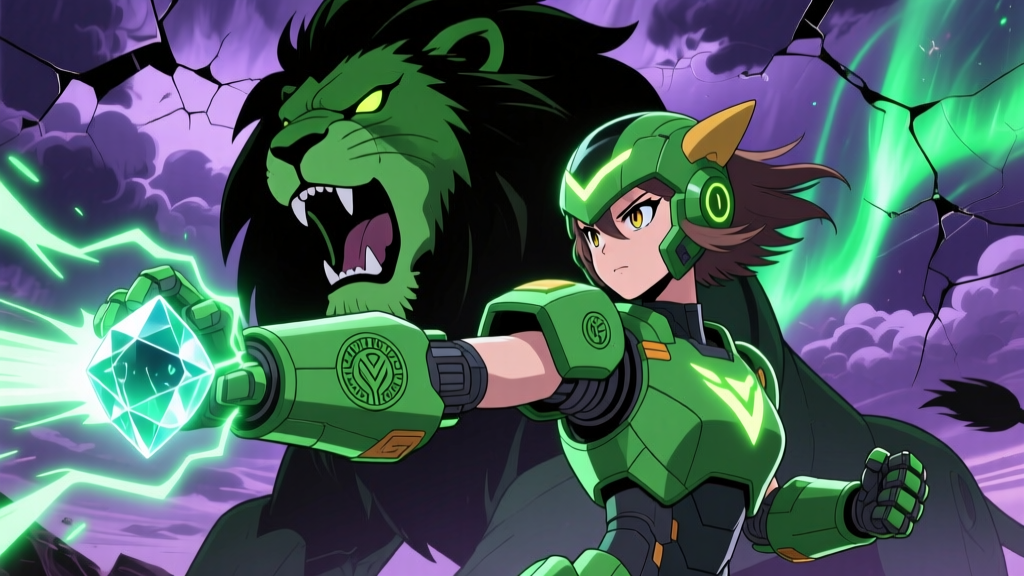
Mention the Green Lion to any Voltron fan and you'll get one of two reactions. Older fans will immediately picture a stubby-nosed mecha from Beast King GoLion, the 1981 Toei Animation production that started it all. Younger fans will think of the sleek, feline machine from Voltron: Legendary Defender, the 2016 Netflix reboot that introduced a whole generation to the franchise. Both are right. Both are talking about the same fundamental concept — a mechanical lion colored in forest green, bonded to a pilot whose brains matter more than brawn.
The green voltron lion has appeared in over 150 episodes across five separate television series, three theatrical films, dozens of comic book arcs, and a merchandise catalog that spans four decades. Its design has shifted dramatically. Its role hasn't. Whether it's 1981 or 2018, the Green Lion remains the team's reconnaissance unit, the tactical wildcard, and proof that you don't need to be the biggest presence on the battlefield to change the outcome.
A Lion Born from GoLion: The 1981 Origin
To understand the Green Lion, you have to go back to Hyakujūō GoLion (Beast King GoLion), which premiered on Japanese television in March 1981. The series was produced by Toei Animation, the same studio behind Dragon Ball and Sailor Moon. In GoLion, five young warriors return to a devastated planet Altea after being held as prisoners by the Galra Empire. They discover five robotic lions that can combine into a single giant warrior — GoLion.
The Green Lion in GoLion was piloted by Hiroshi, a character loosely inspired by the actor Hiroshi Kawai. Hiroshi was the team's youngest member, a tech-savvy operator who preferred analyzing enemy formations over charging into them headfirst. In the original Japanese production, the Green Lion formed GoLion's left arm — a role that sounds minor until you watch the actual fights. GoLion's left arm was frequently the limb that grappled, blocked, and held enemies in place while the right arm (the Black Lion) delivered killing strikes with the Ten King Sword.
The 1981 Green Lion design was unmistakably a product of its era: heavy angular plating, minimal articulation, and a color palette that leaned toward a muted olive green with chrome accents. Its eyes were simple white rectangles. The mouth barely opened. Animation budgets in early-1980s Japanese television were tight — Toei reportedly allocated roughly ¥8-12 million per episode for GoLion's animation, which meant the combining sequences had to be reused constantly. The Green Lion's transformation into GoLion's left arm was a 4-second stock clip that aired in nearly every episode.
World Events Productions and the American Adaptation
In 1984, World Events Productions (WEP), a Texas-based television syndication company, licensed GoLion and rebranded it as Voltron: Defender of the Universe. The adaptation was a ratings phenomenon — it became the highest-rated syndicated children's show in the United States by the end of 1984, pulling in a 35 share in some markets, according to WEP's internal reports cited in Animation Magazine (1985).
Hiroshi was renamed Pidge. The reason was never officially explained, but fans and industry historians generally agree that WEP wanted names that sounded less Japanese and more universally marketable for American children. Pidge became the team's "little guy" — not in capability, but in physical stature and age. The Green Lion itself received a minor color shift: WEP's colorists pushed the green slightly warmer, closer to a true forest green, to make it pop against the darker backgrounds that American animators favored.
"Pidge was the character kids related to most. He wasn't the strongest or the fastest. He was the one who figured things out. That made him the heart of the team in a way that Keith or Lance never could be." — Marc Handler, story editor for Voltron: Defender of the Universe, interviewed in Retro Animé Review, Vol. 12 (2003)
Forming the Left Arm: Why Position Matters
Every Voltron fan knows the combining sequence by heart. Black Lion forms the torso and head. Red Lion becomes the right arm. Green Lion becomes the left arm. Blue Lion forms the right leg. Yellow Lion forms the left leg. It's iconic. But few people stop to think about what forming the left arm actually means in a combat context.
In mecha combat choreography — and yes, this is a real discipline within Japanese animation production — the left arm typically serves a support function. The right arm is the "weapon arm," the one that swings the sword, fires the main cannon, or delivers the finishing punch. The left arm is the control arm. It grabs, restrains, shields, and stabilizes. When Voltron forms its Blazing Sword, it's the right arm that draws and swings. But the left arm is what holds the enemy in position for the strike.
This division of labor is consistent across nearly every series. In Voltron: The Third Dimension (1998–2000), the CGI-animated sequel series, the Green Lion's role as the left arm became even more pronounced because the 3D animation allowed for more complex combat sequences. Pidge's lion would routinely grab a Robeast's weapon arm, pin it, and let Keith's Black Lion deliver the killing blow. The choreography team at Netter Digital, the studio behind the CGI, confirmed in a Cinefex magazine interview (Issue 78, 1999) that they deliberately assigned "restraint and grapple" animations to the left arm.
The Claw Hand Advantage
One detail that often gets overlooked: when Voltron combines, the Green Lion's head sits at the end of the left arm, and its jaw becomes a functional claw or pincer. This isn't just cosmetic. The Green Lion's mouth-claw has been used in dozens of episodes to grip enemy mechs, tear armor plating, and even catch projectiles mid-flight. In Voltron: Legendary Defender Season 3, Episode 6 ("The Hunted"), the Green Lion's claw hand is specifically used to pry open a Galra cruiser's hull — a scene that lasts roughly 8 seconds but required 14 distinct keyframes to animate, according to the production notes released by Studio Mir.
Unique Combat Abilities: Sonic Beams, Camouflage, and the Scout's Edge
What separates the Green Lion from its four siblings isn't just its position on Voltron's body. It's the standalone combat abilities that make it a genuinely dangerous unit even before combination.
Sonic Beam
The Green Lion's signature weapon is the Sonic Beam — a concentrated burst of high-frequency sound energy fired from the lion's mouth. In the original Voltron: Defender of the Universe, the Sonic Beam was depicted as a shimmering green wave that could shatter metal, disorient enemy pilots, and create localized shockwaves. The weapon appeared in approximately 23 episodes across the original series' two seasons (the "Vehicle Voltron" episodes didn't feature the Green Lion, as that was a separate continuity altogether).
The Sonic Beam was never the most powerful weapon in the arsenal — that honor goes to the Blazing Sword — but it was the most versatile. It could be modulated: low frequency for area-of-effect stun attacks, high frequency for precision cutting. In Season 2, Episode 15 ("The Treasure of Planet Tyrus"), Pidge uses the Sonic Beam at a frequency calibrated to shatter crystalline structures, destroying an enemy fortification without harming the prisoners inside. That kind of precision was rare for a Saturday morning cartoon in 1985.
Cloaking and Camouflage
This ability was introduced in Voltron: Legendary Defender and quickly became one of the Green Lion's defining traits. In Legendary Defender's continuity, each lion possesses a unique elemental or tactical ability tied to its pilot's personality. The Green Lion, bonded to Pidge Gunderson (whose real name is Katie Holt — she disguised herself as a male cadet to infiltrate the Galaxy Garrison), can activate an active camouflage system that renders the lion virtually invisible.
The cloaking ability debuted in Season 1, Episode 3 ("Fall of the Castle of Lions"), when Pidge instinctively triggers the camouflage during a Galra attack. The visual effect is striking: the Green Lion's armor ripples, its color desaturates, and within two seconds the machine is a barely perceptible shimmer against the landscape. This isn't just a visual trick — the camouflage extends to electromagnetic shielding, making the Green Lion invisible to Galra sensor arrays as well.
The camouflage ability transformed how the team used the Green Lion tactically. Instead of just being the smallest lion, it became the reconnaissance unit. Pidge would routinely detach the Green Lion from the formation, cloak it, and scout enemy positions before the team committed to an engagement. This shifted the Green Lion from a purely support role into something closer to a special operations asset.
Additional Abilities Across Continuity
- Energy Shield (Legendary Defender, Season 4): The Green Lion can project a localized energy barrier, used primarily to protect allied units during retreat operations.
- Enhanced Agility: Across all series, the Green Lion is consistently depicted as the fastest and most agile of the five lions on the ground, with a top running speed that outpaces the Red and Yellow Lions by a noticeable margin.
- Technological Interface: In both The Third Dimension and Voltron Force (2011–2012), the Green Lion's onboard computer can interface with alien technology, reflecting Pidge's role as the team's tech specialist.
- Sonic Howl (Voltron Force): An upgraded version of the original Sonic Beam, the Sonic Howl creates a wide-area disruption field that disables electronic systems within a 200-meter radius.
Pilots Across the Timeline: From Hiroshi to Pidge Gunderson
The Green Lion has had essentially two pilots across the franchise's history, though the characterization has shifted dramatically between them.
| Series | Year | Pilot Name | Character Notes |
|---|---|---|---|
| Hyakujūō GoLion | 1981 | Hiroshi | Youngest GoLion warrior. Tech-oriented. Modeled after actor Hiroshi Kawai. |
| Voltron: Defender of the Universe | 1984 | Pidge | Adapted from Hiroshi. Youngest Voltron Force member. Intelligence specialist. |
| Voltron: The Third Dimension | 1998 | Pidge | Adult version. Retains tech specialist role. Voice: Billy West. |
| Voltron Force | 2011 | Pidge | Continuation of the Defender universe. Returns as veteran pilot after time away. |
| Voltron: Legendary Defender | 2016 | Pidge Gunderson (Katie Holt) | Female pilot disguised as male. Hacker. Daughter of Samuel Holt, a missing astronaut. |
The most significant change came with Legendary Defender. Showrunners Joaquim Dos Santos and Lauren Montgomery made the decision to reimagine Pidge as a young woman hiding her identity — a narrative choice that added layers to the character and resonated strongly with the show's audience. Katie Holt's motivation is deeply personal: her father, Samuel Holt, was a pilot who disappeared during an early space mission, and she joins the Galaxy Garrison specifically to find him. Her bond with the Green Lion is rooted in that search — the lion's reconnaissance capabilities mirror her own obsessive need to find answers.
Bex Taylor-Klaus, who voiced Pidge in Legendary Defender, noted in a 2017 interview with Collider that the character's relationship with the Green Lion was intentionally written as the most intimate of all the pilot-lion bonds: "Pidge doesn't just fly the Green Lion. She thinks through it. The lion becomes an extension of her mind in a way the other pilots don't experience."
Design Evolution: Four Decades of Green Metal
The visual transformation of the Green Lion across four decades of Voltron is a microcosm of how mecha design has evolved in anime and Western animation.
GoLion Era (1981): Angular and Raw
The original 1981 Green Lion was designed under the supervision of Yuki Hijiri, the mechanical designer credited on GoLion. The design language was pure early-80s super robot: heavy rectangular plating, minimal organic curves, and a head that looked more like a helmet than an animal. The green was flat, almost olive-toned, with silver trim on the legs and tail. Articulation in the animation was limited — the lion typically moved in three or four poses, recycled across episodes. Total screen time for the standalone Green Lion (outside combining sequences) averaged roughly 45 seconds per episode.
Defender of the Universe Era (1984): Warmer and Bolder
WEP didn't redesign the lions — they used the same animation cels from Toei. But the color grading was adjusted for American CRT televisions, which tended to render colors more warmly than Japanese sets. The result was a Green Lion that appeared slightly more vibrant, with richer green tones and more visible detail in the chrome accents. The Sonic Beam, which was white in GoLion, was recolored bright green for the American version, making it more visually associated with the lion itself.
The Third Dimension (1998): Chrome and CGI
When Netter Digital took over production for Voltron: The Third Dimension, every lion was rebuilt as a CGI model. The Green Lion received the most dramatic redesign: its proportions were elongated, its head was given more feline features (narrower eyes, a more pronounced jaw), and its armor was textured with a metallic sheen that made it look genuinely chrome-plated. The green shifted darker, closer to an emerald tone. This version of the Green Lion also gained visible weapon ports on its shoulders, foreshadowing the expanded armament that would appear in later series.
Legendary Defender Era (2016–2018): Organic and Expressive
Studio Mir, the South Korean animation studio behind The Legend of Korra, handled the animation for Legendary Defender. Their Green Lion is arguably the most visually distinctive version in the franchise's history. The design is distinctly feline — the body proportions resemble a real lion, with a powerful chest, tapered waist, and a head that can express emotion through ear position and eye shape. The color palette uses a deep forest green as the base with luminescent teal accents along the spine, joints, and energy conduits. When the camouflage ability activates, those teal accents pulse before fading.
Studio Mir's designers confirmed in a 2016 ArtStation post that they studied real lion anatomy for the models, particularly the musculature of the shoulders and hindquarters. The Green Lion in Legendary Defender can crouch, stalk, and pounce with a fluidity that no previous version achieved. The team also gave each lion a distinct "voice" through body language: the Green Lion tends to tilt its head and crouch low, mimicking the curious, cautious behavior that defines Pidge's personality.
Collectibles: From Die-Cast to Premium Statues
If you want a Green Lion on your shelf, you've got options spanning four decades and price points from $15 to $1,500. The collectible market for Voltron has always been strong, with the Green Lion consistently ranking as the second most sought-after lion (behind the Black Lion) according to secondary market data from eBay's collectible toys category.
Vintage: Matchbox and Playmates
The original Matchbox Voltron lions (1984–1986) were die-cast metal with plastic accessories. The Green Lion was item number MT-503 in the Matchbox lineup. It featured spring-loaded legs, a mouth that opened and closed, and a chrome-finished Sonic Beam projectile. Original Matchbox Green Lions in mint-on-card condition now sell for $180–$350 on the secondary market, depending on packaging condition.
Playmates Toys took over the Voltron license in the early 1990s and produced a line of 6-inch action figures. Their Green Lion was fully poseable (a first for Voltron toys) and included a small Pidge figure that could sit inside the cockpit. These are more affordable on the secondary market — typically $40–$80 for complete specimens.
Modern Premium: Diamond Select and Voltes
The premium collectible market has treated the Green Lion well. Diamond Select Toys released a 15-inch Voltron statue in 2016 where the Green Lion could be detached from the combined form. Priced at $250 at retail, it now commands $350–$500 on the secondary market.
For the serious collector, ThreeZero's Robo-Dou Voltron (announced 2020, shipped 2022) is the gold standard. The Green Lion in this set features die-cast metal joints, fabric-textured armor panels, and LED-activated eyes. The complete five-lion set retailed for approximately $1,200, and the Green Lion individual unit (sold separately in the second production run) went for $280. ThreeZero confirmed in their 2022 annual report that the Robo-Dou Voltron line was among their top five best-selling products globally.
| Product | Manufacturer | Year | Material | Approx. Price (Secondary) |
|---|---|---|---|---|
| MT-503 Die-Cast Lion | Matchbox | 1984 | Die-cast metal / plastic | $180 – $350 |
| 6" Poseable Lion | Playmates | 1992 | ABS plastic | $40 – $80 |
| 15" Voltron Statue (detachable) | Diamond Select | 2016 | PVC / ABS | $350 – $500 |
| Robo-Dou Green Lion | ThreeZero | 2022 | Die-cast / fabric / LED | $280 (individual unit) |
| Super Minipla GoLion (kit) | Bandai | 2021 | Injection-molded plastic | $35 – $55 |
Bandai's Super Minipla line deserves a mention as well. Released in 2021 to commemorate GoLion's 40th anniversary, this model kit lets builders assemble all five lions from injection-molded parts with snap-fit construction. The Green Lion in this kit has 34 individual parts and takes approximately 90 minutes to assemble. It's the most affordable entry point for collectors who want an authentic GoLion-era Green Lion, and the articulation is surprisingly good for the price point — the jaw opens, the legs are poseable, and it can combine with the other four lions into a 15cm GoLion figure.
The Green Lion in Fan Culture: More Than a Sidekick
Here's something that might surprise you if you haven't spent time in Voltron fandom spaces: the Green Lion and Pidge consistently rank in the top two most popular characters in fan polls, often trading the number one spot with Shiro (the Black Lion's pilot in Legendary Defender). A 2019 fan poll conducted by the Voltron subreddit (r/Voltron, currently over 115,000 members) placed Pidge at #1 with 28.4% of the vote, ahead of Shiro at 26.1%.
Fan communities have kept the Green Lion alive in ways the franchise itself sometimes hasn't. Here's what that looks like in practice:
- Fan art: DeviantArt and Pixiv host over 4,000 tagged works featuring the Green Lion, with the camouflage scenes from Legendary Defender being the most popular subject by a wide margin.
- Custom toy modification: A thriving community of makers modifies mass-produced figures with hand-painted detailing, LED installations, and 3D-printed accessories. Etsy alone lists roughly 200 Green Lion custom pieces at any given time.
- Cosplay: Pidge Gunderson remains one of the most-cosplayed Voltron characters at conventions like Anime Expo and New York Comic Con, with the Green Lion helmet being the most recognizable prop.
- Video essays and analysis: YouTube channels dedicated to mecha anime have produced dozens of long-form breakdowns examining the Green Lion's tactical role, with some videos exceeding 500,000 views.
The reasons for this devotion aren't hard to parse. Pidge's intelligence, resourcefulness, and refusal to back down despite being physically outmatched resonate with fans who see themselves in the character. The Green Lion amplifies that — it's the lion that proves you don't need to be the biggest or loudest presence in the room to matter. In a franchise that could easily have made the Black Lion and its sword-swinging hero the sole focus, the Green Lion's persistent relevance is a quiet act of narrative rebellion.
Questions Fans Keep Asking About the Green Lion
What part of Voltron does the Green Lion form? The Green Lion forms Voltron's left arm in every major continuity — from the original Hyakujūō GoLion (1981) through Voltron: Legendary Defender (2016–2018). During combination, the Green Lion attaches to the left shoulder of the Black Lion torso, with its head positioned at the end of the arm, where its jaw functions as a claw or pincer. Is Pidge from Legendary Defender a girl? Yes. In Voltron: Legendary Defender, Pidge's real name is Katie Holt. She disguises herself as a male cadet named "Pidge Gunderson" to infiltrate the Galaxy Garrison and search for her missing father, Samuel Holt. Her identity is revealed to the team during Season 1. She is the first female pilot of the Green Lion in the franchise's history. What is the Green Lion's signature weapon? The Sonic Beam — a concentrated burst of high-frequency sound energy fired from the lion's mouth. It can shatter metal, disorient enemies, and be modulated to different frequencies for varying effects. In Legendary Defender, the Green Lion also gains an active camouflage system and energy shield capability. How much is an original Matchbox Green Lion worth? An original Matchbox Green Lion (item MT-503, 1984) in mint-on-card condition typically sells for $180 to $350 on the secondary market. Loose specimens with accessories run $60–$120. Condition of the packaging, particularly the cardback and bubble clarity, is the primary price driver. Who piloted the Green Lion in the original Japanese version? In Hyakujūō GoLion (1981), the Green Lion was piloted by Hiroshi, a character modeled after actor Hiroshi Kawai. He was the youngest member of the GoLion team and served as the group's intelligence and technology specialist — a characterization that carried over to the American adaptation, where Hiroshi was renamed Pidge. Can the Green Lion camouflage itself in every series? No. Active camouflage was introduced specifically in Voltron: Legendary Defender (2016). In earlier series (GoLion, Defender of the Universe, The Third Dimension, Voltron Force), the Green Lion does not have cloaking abilities. Its primary tactical advantages in those series are speed, agility, and the Sonic Beam weapon. Which company makes the best Green Lion collectible? For premium display pieces, ThreeZero's Robo-Dou line is widely considered the highest quality, with die-cast joints, LED eyes, and fabric armor panels. For vintage collectors, the original Matchbox die-cast (MT-503) holds the most nostalgic and monetary value. For budget-friendly model building, Bandai's Super Minipla GoLion kit (2021) offers the best detail-to-price ratio.The Green Lion has been roaring for over four decades now. From a low-budget Japanese super robot show to a Netflix original with millions of viewers, from a $3 die-cast toy to a $1,200 premium collectible, it has remained one of the most recognizable mecha in anime-adjacent pop culture. Its pilot has been a young Japanese warrior, a scrappy American kid, and a teenage girl searching for her father — and through every iteration, the core idea hasn't changed. The Green Lion is the one that watches, waits, and strikes when it counts. The left arm. The quiet one. The one you underestimate right up until it closes around your wrist and won't let go.