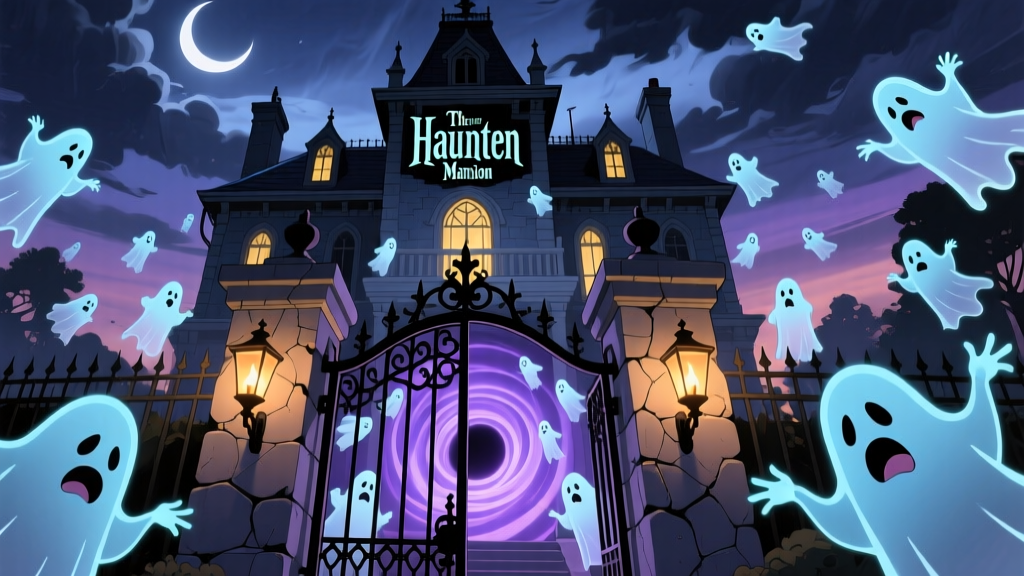
You're standing in the foyer. The wallpaper is peeling at the edges, a sickly green-gold damask pattern that repeats bats and ravens in a way that makes you unsure whether you actually noticed them or whether they just appeared. A disembodied voice welcomes you. Somewhere above, a chandelier flickers. And stamped on every surface, from the wrought-iron gate outside to the doom buggy's dashboard, is a visual signature that half a billion people have now memorized by heart: the Haunted Mansion logo.
Unlike most Disney iconography, which leans on character silhouettes and Mickey ears, the Haunted Mansion logo is not a face. It is an atmosphere. A stately colonial-era manor facade rendered in cold iron and muted purple, typically framed by dead trees and a crescent moon. No single character owns it. No voice actor is attached to it. And yet it has become one of the most reproduced, collected, and tattooed images in the entire Disney Parks canon. The 2023 film starring LaKeith Stanfield and Tiffany Haddish grossed over $117 million worldwide (Box Office Mojo, 2023), and its marketing leaned almost entirely on that single silhouette.
This piece is about how that happened. How a ride that opened in 1969 with no clear protagonist became a visual brand more recognizable than most Disney characters, and what that logo actually means to the people who collect it, study it, and line up at midnight to ride the Mansion on Halloween.
The Mansion Before the Logo: 15 Years of False Starts
The Haunted Mansion took longer to build than almost any other Disney attraction. Walt Disney himself announced the concept as early as 1957, and imagineer Ken Anderson produced early concept art depicting a crumbling Victorian estate. But the project stalled repeatedly. Walt wanted the ride to be walk-through; his engineers wanted a ride system. The Civil War-era Harper Goff sketches depicted something far more decrepit than what eventually got built. By the time construction actually began in New Orleans Square at Disneyland, it was 1962, and the exterior shell sat unfinished for years because the imagineering team could not agree on the tone.
The facade that finally went up drew from at least four architectural traditions. The overall massing borrows from antebellum Southern plantation homes, specifically the kind of columned Greek Revival frontage you'd find in Natchez, Mississippi. The iron balcony work references the French Quarter of New Orleans. The mansard roof nods to Second Empire French architecture. And the general decay, the overgrown hedges and the grimy windows, comes from gothic revival traditions that trace back to Horace Walpole's Strawberry Hill.
Claude Coats, the imagineer most responsible for the ride's interior design, and Marc Davis, who handled character concepts, fought a quiet war over whether the Mansion should feel funny-scary or genuinely unsettling. Coats pushed for dark hallways and genuine dread. Davis wanted gags. The compromise is what you actually ride: the first two-thirds of the experience are atmospheric horror, and the graveyard sequence at the end is a full-blown musical comedy. That tonal whiplash is the ride's secret weapon, and it shapes everything about how the logo functions visually.
What the Logo Actually Is (and What It Isn't)
People say "the Haunted Mansion logo" and mean different things. Strictly speaking, the logo is the stylized illustration of the mansion's facade as it appears on park signage, merchandise tags, and attraction posters. It typically shows the house in profile or three-quarter view, with three visible stories, a widow's walk on the roof, dead trees flanking the structure, and often a full or crescent moon behind it. The color palette is overwhelmingly purple, black, and muted gold or green, which mirrors the actual paint scheme of the Anaheim attraction's exterior.
But the visual identity of the Haunted Mansion extends well beyond that single illustration. There are at least five distinct visual systems operating under the Mansion brand, and fans treat each one as a collectible category of its own.
The Stretching Portraits
Perhaps the most iconic images inside the attraction are the four stretching portraits in the octagonal room. Guests enter what appears to be a portrait gallery. The lightning flashes. The room "stretches" upward (technically, the ceiling rises), revealing the lower halves of each painting, and every one of them depicts a grim fate. These were designed primarily by Marc Davis between 1968 and 1969.
The Four Stretching Portraits Henry Ravenswood (Phantom Manor variant) — standing on a keg of dynamiteThe Flying Dutchman — revealed to be perched on a fraying tightrope over a crocodile
The Tightrope Girl (Sally Slater) — balanced on a thin wire above an open grave
The Medusa / Aging Man — sitting atop a crumbling pillar over a shark-infested sea
The portraits have been reproduced on everything from enamel pins to high-end framed prints sold at Disney Parks galleries. A limited-edition giclée print of the original Marc Davis concept art, released at the 2019 D23 Expo, sold out within three hours and now trades for roughly $400 on secondary markets like eBay and Mercari. The portraits are not technically the "logo," but they function as the Mansion's most recognizable character-level imagery.
The Wallpaper Pattern
If you've ridden the Haunted Mansion and remember a repeating pattern on the walls, you're not alone. The wallpaper is one of the most obsessively discussed design elements among Disney Parks fans. The original 1969 installation featured a custom damask-style pattern that incorporated bats, ravens, and what appear to be abstract floral shapes that, on closer inspection, reveal themselves to be skulls. The dominant colors are a sickly yellow-green and charcoal, which Coats selected to evoke decomposition without being overtly gross.
The wallpaper has been reproduced on fabric (sold by the yard at Disney Parks' Magic Shops and on ShopDisney), on ceramic tile sets, and on at least three different Spirit Jersey releases. A 2021 collaboration with the fashion brand Loungefly produced a full line of mini-backpacks and wallets using the wallpaper pattern, and that line remains one of Loungefly's best-selling Disney licenses according to the company's parent company Funko's Q3 2021 earnings report.
The Doom Buggy and Ghost Host
The doom buggy itself, a small clamshell-shaped ride vehicle originally designed by WED Enterprises, has become a secondary logo element. Its silhouette appears on ride vehicle decals, on the Haunted Mansion Holiday overlay branding, and on dozens of pins. The Ghost Host, voiced originally by Paul Frees, has no physical form, but his "Welcome, foolish mortals" line appears on merchandise text so often that it functions as a typographic logo alongside the visual one.
A Timeline of Visual Evolution
The Mansion's visual identity has not stayed static. Each decade has brought adjustments, some subtle, some controversial. Here's how the key elements shifted over time.
| Year | Event | Visual Change |
|---|---|---|
| 1969 | Grand opening at Disneyland (August 9) | Original facade, stretching portraits, and wallpaper installed. Color palette: muted purple exterior, green-gold interior wallpaper. |
| 1971 | Walt Disney World's Magic Kingdom opens | Florida mansion gets a different facade (Dutch Gothic style, brick instead of white columns). Logo variants now must accommodate two distinct exteriors. |
| 1983 | Tokyo Disneyland opens | Tokyo version closely mirrors Anaheim's facade. Merchandise logo standardizes around the Anaheim silhouette globally. |
| 1992 | Phantom Manor opens at Disneyland Paris | Complete visual rebranding. Darker, more European gothic aesthetic. Stretching portraits replaced by a narrative about Henry Ravenswood. Logo becomes a distinct, separate design. |
| 2001 | Haunted Mansion Holiday overlay debuts | Tim Burton's Nightmare Before Christmas characters added. Jack Skellington appears on wreath logos. Annual overlay creates a seasonal "second logo." |
| 2013 | Mystic Manor opens at Hong Kong Disneyland | Entirely different concept (no ghosts, set in Papua New Guinea). Deliberately avoids the Haunted Mansion logo to respect cultural sensitivities. |
| 2023 | Feature film release | New cinematic logo variant designed for the movie poster. Blends the Anaheim facade with more realistic architectural rendering. Grossed $117M globally. |
| 2024 | Major Anaheim refurbishment | Expanded queue, new grounds landscaping. Logo updated to reflect revised exterior with additional wrought iron elements and expanded garden graveyard. |
One thing this timeline makes clear: the "Haunted Mansion logo" is not one thing. It's a family of visual identities that share DNA but differ in important ways depending on which park, which era, and which merchandise line you're looking at. That fragmentation is actually part of what makes collecting Mansion memorabilia so addictive for fans. There are always variants.
The Wallpaper, the Ironwork, and the Hidden Details
The genius of the Haunted Mansion's visual design is that it rewards repeat viewing. The wallpaper pattern contains hidden skulls that most guests never consciously register. The iron gate at the entrance of the Anaheim mansion features bat silhouettes that cast specific shadow patterns at certain times of day. The pet cemetery outside the Florida mansion includes gravestones with puns and inside jokes (RIP "Mr. Tom B.stone," RIP "Sea Captain Culpepper Clyne") that require you to stop and read them.
This approach, what imagineers call "discovery design," means the visual identity functions at multiple depths. At surface level, you get the silhouette: big old creepy house, purple, bats. That's the logo as most people know it, and it works perfectly on a coffee mug or a t-shirt. But at a deeper level, you get an entire visual language of symbols that repeat across the attraction: the raven (Edgar Allan Poe's influence, though never explicitly credited), the candelabra, the grandfather clock striking thirteen, the eye that follows you in the portrait hall.
Walt Disney Imagineering's own design philosophy document, referenced in Jeff Baham's "The Unauthorized Story of the Haunted Mansion" (2014), describes this approach as "building the iceberg." Ninety percent of the design detail exists below the surface of what any single guest will notice. But that hidden depth is precisely what creates the feeling of authenticity, the sense that this place exists independent of your visit, and it's what drives fans to keep coming back, keep buying, and keep studying.
"We don't design for the first visit. We design for the fortieth visit. The first time, you feel the atmosphere. The fortieth time, you notice a skull hidden in the wallpaper that you've been staring at for years and never saw. That's when the Mansion owns you."
— Attributed to Claude Coats, via "The Haunted Mansion: From the Magic Kingdom to the Movies" by Jason Surrell (2003, Disney Editions)
Collectibles and the Logo Economy
The Haunted Mansion is, by any reasonable measure, one of Disney Parks' top three merchandise performers among attractions that are not character-based. The only rides that consistently outsell it in merchandise revenue are Star Wars: Rise of the Resistance and Pirates of the Caribbean, and Pirates benefits from a billion-dollar film franchise backing it. The Mansion's merchandise stands on the strength of its visual identity alone.
Here's a rough breakdown of the major collectible categories that feature the Haunted Mansion logo or its associated visual elements:
- Enamel Pins: The Mansion has one of the largest pin catalogs of any single attraction. A 2024 inventory on DisPins.com listed over 340 unique Haunted Mansion pins. The "stretching portrait" pin set, released in various iterations since 2004, is consistently among the top sellers at Disneyland's Pins on Pine store.
- Spirit Jerseys: Disney's Spirit Jersey line has released at least 8 Haunted Mansion variants since 2018. The original black-and-purple release sold out in under 24 hours online. Resale prices on StockX and Poshmark regularly hit $150–$220 for first-edition versions.
- Loungefly Collection: The Loungefly x Haunted Mansion line includes mini-backpacks, full-size backpacks, wallets, and cosmetic bags. The wallpaper-pattern mini-backpack (style WDTB2461) is one of the brand's perennial restock items, suggesting consistent demand across multiple seasons.
- Vinyl Figures: Funko has produced over 30 Haunted Mansion Pop! figures. The "Ghost Host" exclusive, released at the 2022 D23 Expo, trades at approximately $180–$250 on secondary markets.
- LEGO Set 10337: Released in 2024, the LEGO Haunted Mansion set retails for $249.99 and contains 2,350 pieces. The set's box art prominently features the mansion logo. It sold out within its first two weeks at most Disney Store locations.
- Apparel and Home Decor: Spirit Halloween stores (a Spirit Entertainment subsidiary, unrelated to Disney's Spirit Jersey brand) carry licensed Haunted Mansion items every September, including full-size facade decorations that replicate the logo's silhouette at roughly 6 feet tall, retailing around $200.
The collectible market around the Haunted Mansion logo has created its own economy. Dedicated trading groups on Facebook, such as "Haunted Mansion Collectors & Traders" (approximately 18,000 members as of early 2026), facilitate secondary market transactions. Certain limited-edition items, particularly pins from the annual Haunted Mansion Holiday overlay at Disneyland, appreciate significantly. A "Jack Skellington as the Ghost Host" pin from the 2019 Holiday overlay, originally priced at $14.99, was selling for $85–$120 on eBay by late 2020.
Fan Culture: The Mansionites and Beyond
There's a word that Disney Parks fans use for themselves when they're specifically obsessed with this ride: Mansionites. It's informal, not sanctioned by Disney, but widely understood in the community. Mansionites are the people who have ridden the Haunted Mansion over a thousand times (a small but vocal group documents their ride counts on social media), who can recite Paul Frees' Ghost Host narration from memory, and who debate the theological implications of Madame Leota's seance room at dinner parties.
The fan culture around the Haunted Mansion is unusual in Disney fandom because it skews older and more male than the typical Disney Parks fanbase. A 2019 informal survey conducted by the fan site Doombuggies.com found that 62% of their respondents were over 30, and roughly 55% identified as male. This is almost the inverse of the broader Disney adult community demographics, which trend heavily female and 25–45. The Mansion fandom overlaps significantly with horror fandom, gothic subculture, and vintage Disney collecting communities.
The logo plays a specific role in this fan culture. It functions as a recognition signal. A Haunted Mansion pin on a lanyard at a Disney park is a way of identifying other fans. The wallpaper pattern on a jacket is a conversation starter at conventions like D23 Expo or the now-defunct Midsummer Scream Halloween convention in Long Beach, California. There are Mansion-themed wedding proposals (the stretching room has been the site of at least a dozen documented engagements), Mansion-themed tattoos (the facade silhouette is one of the most common Disney tattoo designs), and Mansion-themed funerals. In 2018, a California woman's funeral was held at a funeral home that had been decorated to replicate the Mansion's interior, complete with the wallpaper pattern projected onto the walls. The story was covered by the Orange County Register and shared over 40,000 times on Facebook.
The Phantom Manor Schism
No discussion of Haunted Mansion fan culture is complete without addressing the Phantom Manor divide. Disneyland Paris's version of the ride, which opened in 1992 as Phantom Manor, tells a fundamentally different story with a different visual identity. Where the American versions are anthology-style tours with no central narrative, Phantom Manor follows a specific plot about a bride named Melanie Ravenswood whose father Henry murders her suitors from beyond the grave.
Phantom Manor fans and Haunted Mansion fans are not always the same people. The Paris ride has a devoted following among European Disney enthusiasts who consider it narratively superior to the American versions. When Phantom Manor underwent a major refurbishment in 2018–2019 that replaced several beloved scenes (including the Vincent Price narration in the French-English pre-show), the backlash from this community was intense. A Change.org petition demanding the restoration of the original Phantom Canyon sequence gathered over 9,000 signatures, and the fan site PhantomManor.org published a detailed shot-by-shot comparison of the changes that remains one of the most thorough pieces of fan-generated ride documentation in existence.
The two rides' logos are visually distinct, and fans of each tend to be loyal to their version. The Phantom Manor logo features a more angular, more explicitly sinister mansion with a volcanic backdrop (referencing Big Thunder Mountain, which shares the Manor's Frontierland narrative). Merchandise featuring the Phantom Manor logo is significantly rarer outside Europe, making it a prized collectible for Mansionites who want variants that most American fans have never seen in person.
Why This Logo Works When Others Don't
Disney has built dozens of dark rides with original concepts. Most of them have logos you couldn't describe from memory. Why does the Haunted Mansion's visual identity persist and strengthen decade after decade, when attractions like Adventure Thru Inner Space, Journey to the Center of the Earth, or even more recent rides like Mystic Manor have far less visual brand recognition?
The answer breaks down into four distinct factors:
- Architectural specificity without character dependency. The mansion facade is detailed enough to be memorable but generic enough to be iconic. You don't need to know the story of Madame Leota or the Hatbox Ghost to recognize a creepy Victorian house on a hill. That accessibility gives the logo a baseline recognition that narrative-dependent icons can never achieve.
- Color ownership within the Disney Parks ecosystem. Purple is not a color Disney uses heavily elsewhere. The Haunted Mansion essentially owns that specific shade of deep violet-purple within Disney Parks visual language, in the same way that Pirates of the Caribbean owns turquoise-and-gold and Space Mountain owns chrome-and-black. When you see that purple in a Disney context, your brain goes to one place.
- Earned impressions at scale. Every Halloween season, the Haunted Mansion Holiday overlay generates press coverage, social media content, and YouTube videos that feature the logo prominently. Every Disney vlogger who visits the parks films themselves riding the Mansion. The ride's 2023 film adaptation, while critically mixed (it holds a 38% rating on Rotten Tomatoes), put the mansion silhouette in front of millions of viewers who had never visited a Disney park. All of these exposures are functionally free advertising for the visual brand.
- Participation-based branding. The logo works because it represents an experience, not a product. When you wear a Haunted Mansion t-shirt, you're not advertising a movie or a TV show. You're signaling that you've been inside that building, that you've sat in the doom buggy, that you've heard the Ghost Host say "there's always room for one more." Participation-based branding is always stickier than consumption-based branding.
The Logo in the Streaming Era and Beyond
Disney's current strategy, visible across their 2024–2026 merchandise catalogs and announced projects, is to treat the Haunted Mansion as a franchise rather than a single attraction. The 2023 film was the first step. A Haunted Mansion animated special has been rumored in industry trade publications (The Hollywood Reporter mentioned it in a September 2024 piece about Disney's Halloween content pipeline), though nothing has been officially confirmed.
If that happens, the logo will evolve again. Film and television require different visual treatment than park signage. The cinematic variant used for the 2023 movie poster already pushed the mansion silhouette toward a more photorealistic, less illustrated style. An animated series would likely introduce yet another variant, potentially with brighter colors and more character-forward design.
For the Mansionites, this is both exciting and anxiety-producing. Every expansion of the brand risks diluting the visual purity that made the original logo so powerful. But every expansion also means more variants to collect, more stories to debate, and more reasons to stand in that foyer, look up at the stretching portraits, and feel the wallpaper's hidden skulls watching you from the walls.
The ghosts are restless. They always are. That's kind of the point.
Questions People Actually Ask
Who designed the Haunted Mansion facade that appears in the logo?
The exterior was primarily designed by imagineer Claude Coats, with input from architect Bill Martin. The final design synthesized elements from antebellum Southern architecture, New Orleans French Quarter ironwork, and gothic revival traditions. The logo illustration itself has been redrawn by multiple Disney artists over the decades, but the architectural design it depicts traces to Coats and Martin's 1962–1968 concept period.
Why is the Haunted Mansion logo purple?
The deep purple-violet color scheme was chosen during the original attraction's development in the 1960s. Purple has historical associations with mystery, the supernatural, and aristocratic mourning in Victorian culture. Within Disney Parks' color strategy, purple also distinguishes the Haunted Mansion from neighboring attractions; New Orleans Square's other buildings use warmer earth tones, so the purple makes the Mansion visually distinct from a distance.
Is the Haunted Mansion logo the same at every Disney park?
No. The Anaheim (Disneyland) and Tokyo versions share the most similar facades and logo treatments. Walt Disney World's Magic Kingdom version has a different Dutch Gothic brick exterior. Disneyland Paris uses the "Phantom Manor" brand with a completely different logo and visual identity. Hong Kong Disneyland's Mystic Manor is an entirely separate concept that deliberately avoids the Haunted Mansion branding.
What does "999 happy haunts" mean?
The Ghost Host's narration states there are "999 happy haunts" residing in the Mansion, with "room for a thousand" if any guest wishes to volunteer. This line, written by X Atencio and performed by Paul Frees, has become one of the most quoted phrases in Disney Parks history. It appears on merchandise, on the pet cemetery gravestones outside the Florida mansion, and has been referenced in virtually every piece of Haunted Mansion marketing since 1969.
What is the most valuable Haunted Mansion collectible?
Among widely documented sales, original Marc Davis concept art pieces have fetched the highest prices. A Davis sketch of the stretching portrait concept, sold through Heritage Auctions in 2017, went for approximately $16,000. Among mass-produced merchandise, the original 2004 "Ghost Gallery" stretching portrait pin set in mint condition with original packaging typically sells for $300–$500 on the secondary market. Vintage 1970s Haunted Mansion slide transparencies (originally sold in park gift shops) can also reach $200–$400 depending on condition.
Why does the wallpaper have hidden skulls?
The skull motifs in the Haunted Mansion's wallpaper pattern were a deliberate design choice by Claude Coats to create subconscious unease. The technique, sometimes called "hidden imagery" or "subliminal design," places recognizable shapes (skulls, bats, ravens) within decorative patterns so that guests register them without consciously identifying them. This creates a feeling that "something is wrong" without being able to pinpoint what, which is a core principle of the ride's atmospheric horror approach in its first two-thirds.