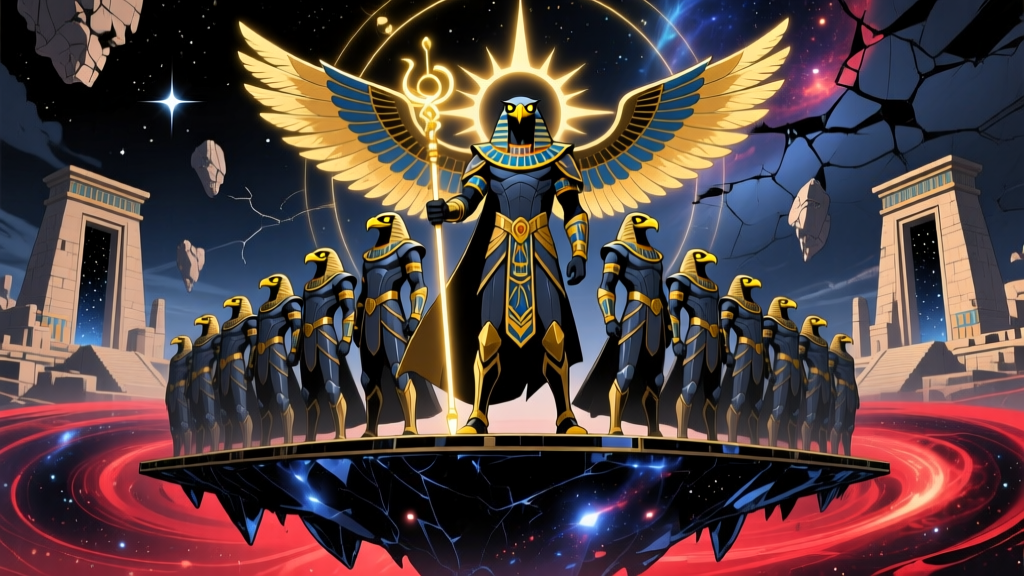
You hear them before you see them. The rhythmic thud of armored boots on sandstone, the mechanical hiss of a hawk-headed helmet pivoting toward you, the low hum of a staff weapon charging to lethal capacity. In Roland Emmerich's 1994 film Stargate, the first thing that sells the alien world of Abydos isn't the pyramids or the twin moons overhead. It's the guards. Silent, faceless, their human features swallowed by golden raptor masks, they patrol the corridors of Ra's stronghold like something between a pharaoh's honor guard and a nightmare.
Those guards are the Horus Guard, and over three decades of Stargate storytelling, they've become one of the franchise's most visually iconic creations. More recognizable than almost any individual Jaffa character, the Horus Guard silhouette appears on merchandise, cosplay reference sheets, and fan art dating back to the mid-1990s. For a faction that never had a named protagonist until deep into the television run, they carry an outsized weight in how audiences remember Stargate's visual identity.
Origins on Screen: The 1994 Film
When production designer Holger Gross and creature designer Carlo Rambaldi began work on Stargate (1994), they faced a specific challenge: how do you create alien soldiers that feel ancient and advanced at the same time? The answer came from the script's own mythology. Ra, the film's villain, was a Goa'uld who had positioned himself as the sun god of ancient Egypt. His soldiers would reflect that stolen divinity.
The Horus Guard helmets were conceived as mechanized headpieces modeled after the head of Horus, the Egyptian sky god typically depicted as a falcon or as a man with a falcon's head. In Egyptian mythology, Horus was the protector of the pharaoh, "he who is above," a deity of kingship and the sky. The parallel was deliberate. Ra's personal guard would wear the face of the god who, in myth, protected the throne Ra was mimicking.
Rambaldi, who had previously designed the animatronic creatures for E.T. and Alien, engineered the helmets with practical mechanisms. The beak could articulate. The eyes could shift. Each helmet was a physical prop built from foam latex, fiberglass, and mechanical armatures, weighing roughly 4 to 5 kilograms. Actors reported limited visibility and significant neck strain during long shooting days in the desert locations around Yuma, Arizona, and the Sonoran Desert.
In the original 1994 film, Ra's guards were not Jaffa as the television series would later define them. They were human Abydonians, conscripted from the desert planet's population, armored in golden plating and given the hawk mask to strip away individual identity.
This distinction matters. The film's Horus Guards were ordinary humans forced into service, which made their silent, mechanical demeanor all the more unsettling. They were people who had been erased by the mask. When Colonel Jack O'Neil's team encounters them in the second act, the horror isn't that they're alien soldiers. It's that they're human beings who've had their faces replaced with a god's.
From Film to Television: The SG-1 Retcon
When Stargate SG-1 premiered in July 1997 with the two-part episode "Children of the Gods," showrunners Brad Wright and Jonathan Glassner made significant changes to the franchise's internal logic. The most consequential: introducing the Jaffa, a genetically modified warrior race with abdominal pouches designed to carry immature Goa'uld symbiotes. The Horus Guard, in this new continuity, became Jaffa rather than conscripted humans.
On screen, this meant the Horus Guard's role shifted. They were no longer the terrified Abydonian conscripts from the film. Instead, they were elite Jaffa warriors, hand-selected to serve Ra directly. The hawk-head helmets remained, but the bodies beneath them were now something other than baseline human, enhanced by the larval Goa'uld each warrior carried.
The early seasons of SG-1 use the Horus Guard primarily in flashback sequences, Abydos-set scenes, and episodes involving Ra's remaining power base. A few specific appearances stand out:
- "Children of the Gods" (Season 1, Episodes 1-2): The pilot introduces Apophis as a rival System Lord, but Horus Guard imagery and Ra's former authority are woven throughout the worldbuilding. Teal'c, the renegade Jaffa, is familiar with the guard's structure from his time serving under a different System Lord.
- "Bloodlines" (Season 1, Episode 22): Teal'c returns to Chulak and confronts the social structures that produced him. Horus Guard references appear in discussions of Jaffa hierarchy and the political order among different System Lord retinues.
- "Moebius" (Season 8, Episodes 19-20): The time-travel two-parter revisits ancient Abydos under Ra's direct rule, giving viewers some of the clearest SG-1-era footage of Horus Guards operating in their original context, guarding Ra's pyramid and patrolling Abydonian settlements.
One of the more memorable tactical moments in the franchise involves Teal'c himself. In a sequence set on Abydos, Jack O'Neil stuns a Horus guard, and Teal'c takes the guard's armor as a disguise, infiltrating Ra's stronghold from within. The scene works because it acknowledges what the audience already suspects beneath that golden helmet is just a soldier, and a soldier can be replaced.
The Armor and Weapons: Function Meets Mythology
The Horus Guard's visual design operates on two levels. First, it has to read as functional military equipment for a space-faring empire. Second, it needs to carry the symbolic weight of Egyptian iconography. The costume department managed both, though not without trade-offs.
The Helmet
The defining piece. A full-head enclosure shaped like the head of a hawk or falcon, with a pronounced beak curving downward over what would be the wearer's face. The surface is finished in metallic gold, with lapis lazuli blue accents around the eyes and crest, mimicking the color scheme associated with Egyptian royalty. In the film, the helmets featured practical animatronic elements: the beak could open and close, and the eye panels could shift, giving the impression that the helmet was alive, or at least monitoring its surroundings independently of the wearer.
The SG-1 television series simplified the helmet for budget and practicality reasons. The animatronic features were largely dropped in favor of static sculpted helmets, though the overall silhouette remained faithful to the film design. This is a common pattern in television adaptations of film properties: the iconic shape survives, but the engineering underneath gets stripped to what a TV schedule can accommodate.
Body Armor
Beneath the helmet, Horus Guards wore segmented chest and shoulder armor in matching gold tones, with a kilt-like lower garment that again referenced Egyptian military dress. The armor in the film was constructed from vacuum-formed plastic and resin with metallic paint, designed to look heavy on camera while remaining wearable for stunt choreography. In SG-1, the armor was reused and occasionally modified, with some units receiving darker or more muted finishes depending on the episode's lighting conditions.
Weapons
Horus Guards carried the standard Goa'uld weapon loadout:
- Staff Weapon: A two-handed, roughly 2-meter-long energy weapon with a circular emitter at one end. The staff weapon fires concentrated plasma bursts capable of punching through solid stone walls and disabling light vehicles. It's inaccurate at range compared to projectile weapons, but its intimidation factor and raw destructive power made it the default Jaffa armament across all System Lord retinues.
- Zat'nik'tel (Zat Gun): A sidearm shaped like a coiled serpent. One shot stuns. Two shots kill. Three shots disintegrate the target entirely. The zat was the Goa'uld's tool for crowd control and prisoner management, and Horus Guards carried them as secondary weapons at the hip.
The contrast between Goa'uld and Tau'ri weaponry became a running theme in SG-1. The P90 submachine gun that SG-1 carried was lighter, more accurate, and used conventional ammunition, but the staff weapon's sheer destructive output made individual engagements unpredictable. A Horus Guard who got close enough to aim properly was a genuine threat, even to trained Air Force operatives.
"The mask takes the face. The armor takes the body. What's left obeys."Notable Horus Guards: The Character Named Horus
Among the relative anonymity of the guard, one figure emerged with an actual name. A character identified simply as Horus appeared in SG-1 lore as a specific Jaffa who served in Ra's Horus Guard and later became entangled in the Abydonian rebellion. According to GateWorld's Stargate Omnipedia, this individual was caught up in the uprising on Abydos and, like many of Ra's former soldiers, had to navigate the collapse of the power structure that had defined his entire life.
The character "Horus" is interesting precisely because the franchise rarely individualized the guard. Giving one member a name, and tying his fate to the liberation of the very people he'd been policing, adds a layer of complexity to what is otherwise a faceless military unit. It suggests that beneath those hawk masks were people with arcs of their own, even if the cameras rarely lingered long enough to show them.
| Production | Year | Role / Context | Notable Detail |
|---|---|---|---|
| Stargate (feature film) | 1994 | Ra's palace guard on Abydos | Animatronic helmets with articulated beaks; human conscripts |
| SG-1 "Children of the Gods" | 1997 | Referenced in Jaffa hierarchy exposition | First TV mention of guard structure under System Lords |
| SG-1 "Bloodlines" | 1998 | Background context for Teal'c's origin | Jaffa caste system and guard assignments discussed |
| SG-1 "Moebius" Parts 1 & 2 | 2005 | Time-travel to Ra-ruled Abydos | On-screen Horus Guard patrols; Teal'c disguise scene |
| SG-1 "Threads" and later seasons | 2004-2007 | Flashbacks and references to Ra's fall | Guard's role in pre-series Abydonian history |
Behind the Mask: Production and Design Legacy
The Horus Guard helmet is one of those rare sci-fi designs that transcends its source material. Even people who have never watched a single episode of SG-1 can identify the hawk-head silhouette. That recognition traces back to specific decisions made during the 1994 film's pre-production.
Carlo Rambaldi's involvement gave the design credibility in practical effects circles. A three-time Academy Award winner (for King Kong, Alien, and E.T.), Rambaldi understood that creature and costume design needed to function mechanically, not just aesthetically. The Horus helmets weren't sculpted shells glued to actors' heads. They were wearable mechanisms with moving parts, designed to perform on camera without requiring post-production enhancement.
This commitment to practical construction is part of why the design has aged well. In an era when many 1990s sci-fi productions leaned on early CGI for complex headpieces, the Horus Guard helmets were real objects occupying real space. The light catches them naturally. They have weight and inertia when the actors turn their heads. Modern viewers, fatigued by weightless digital effects, often respond to that physicality even if they can't articulate why.
The SG-1 production inherited these props and the design language they established. Over ten seasons, the costume department built, rebuilt, and modified numerous Horus Guard helmets and armor sets, sometimes cannibalizing parts from one episode's batch to outfit the next. Budget constraints on a cable television show meant that the animatronic sophistication of the film helmets was never fully replicated, but the visual identity held. The gold hawk-head became shorthand for Ra's authority, the same way the serpent-head helmet of Apophis's guard (the Serpent Guard) signaled his.
The Cosplay and Fan Builder Community
One measure of a design's strength is whether fans attempt to build it themselves. The Horus Guard helmet has been a staple of Stargate cosplay since the mid-2000s, with builders employing techniques ranging from pepakura (paper folding and resin coating) to full 3D printing and foam fabrication. A detailed Instructables guide on adding animatronics to a Horus helmet using servo motors and Wii Nunchuk controllers has accumulated a dedicated following, and YouTube build logs document multi-month projects to replicate the film-accurate version.
The most ambitious fan builds incorporate motorized beak articulation, LED eye panels, and voice modulators to approximate the way the helmets looked and sounded on screen. The cosplay community around Stargate has remained smaller than franchises like Star Wars or Star Trek, but the Horus Guard is consistently one of the most technically ambitious builds at convention masquerades when it does appear.
Collectibles and Merchandise: What's Available
If you want a Horus Guard on your shelf, the options span nearly the entire history of the franchise, though availability varies wildly depending on how deep your pockets are and how patient you're willing to be.
1994 Applause Limited Edition Figurine
Released the same year as the film, the Applause Stargate Horus limited edition collectible is the oldest Horus Guard merchandise in existence. Standing approximately 8 to 8.5 inches tall, this resin figurine was sold as part of a wave of film tie-in collectibles. Original packaging versions surface on eBay periodically, with prices typically ranging from $80 to $200 depending on condition and whether the original box is included. The sculpt is faithful to the film design, with the gold finish and hawk-head proportions rendered in static miniature.
1994 Hasbro Action Figure Line
Hasbro's Stargate action figure line, released alongside the film, included a Horus (Palace Guard) carded figure at approximately 5 inches tall. These figures were aimed at the mass-market toy audience rather than collectors, and they show it in their articulation and paint applications. Still, complete-in-box examples have become scarce, pushing secondary market prices upward. A mint-carded Horus figure can command $60 to $150 from dedicated Stargate collectors.
Funko Pop! Horus Guard (Metallic) #1574
Funko's entry into Stargate merchandise came much later, with the Horus Guard (Metallic) Pop! figure #1574 standing approximately 3.75 inches tall. The metallic variant features the signature gold-and-blue color scheme in a stylized, chibi-proportioned format. Retail pricing hovers around $11 to $15, making it the most accessible Horus Guard collectible currently in production. Funko also released a standard (non-metallic) version as part of the same Stargate wave. As Funko notes on the listing: "No zat guns included."
Horizon 1/5 Scale Resin Model Kit
For builders who want a display piece with serious presence, the Horizon Stargate Horus Guard 1/5 scale resin model kit produces a finished figure approximately 35 centimeters tall. This is a garage-kit-style product requiring assembly, painting, and some modeling skill. It's been available through specialty retailers and direct-from-manufacturer channels, with prices typically in the $120 to $180 range before shipping. The detail level is significantly higher than mass-market figures, with separate parts for the armor segments, helmet, staff weapon, and base.
Master Replicas Animatronic Helmet
The most anticipated collectible in the Horus Guard merchandise space is the Master Replicas Hero Animatronic Horus Guard Helmet. Announced in late 2024 with updates continuing into 2026, Master Replicas used screen-used props from the original 1994 film as direct reference for 3D scanning and printing. The first 3D test prints were shown to the community in mid-2025, with the company documenting the process from scanning to prototyping.
The animatronic version is designed to replicate the film's practical helmet mechanisms, including beak articulation and eye movement. Master Replicas has positioned this as a premium collector item, with expected pricing in the $800 to $1,500 range based on comparable animatronic helmet releases from the company's catalog. For cosplayers and display collectors, this represents the closest thing to an authentic screen-accurate Horus Guard helmet that has ever been commercially produced.
| Product | Manufacturer | Scale / Size | Approx. Price | Type |
|---|---|---|---|---|
| Limited Edition Figurine (1994) | Applause | ~8.5 inches | $80 - $200 (secondary) | Pre-painted resin statue |
| Horus Palace Guard (1994) | Hasbro | ~5 inches | $60 - $150 (secondary) | Carded action figure |
| Horus Guard Metallic #1574 | Funko Pop! | ~3.75 inches | $11 - $15 | Vinyl figure |
| 1/5 Scale Model Kit | Horizon | ~35 cm | $120 - $180 | Resin garage kit (assembly required) |
| Hero Animatronic Helmet | Master Replicas | 1:1 wearable | $800 - $1,500 (est.) | Animatronic prop replica |
Why the Horus Guard Endures
There's a question worth sitting with: why does a faceless military unit from a 1994 science fiction film still generate new merchandise thirty years later? The Funko Pops are still being manufactured. Master Replicas is investing in 3D scanning original props. Cosplayers are wiring servo motors into homemade hawk beaks. The Stargate franchise has been dormant on screen for years, yet the Horus Guard persists.
Part of it is the design's simplicity. A hawk head in gold is immediately legible. It communicates "ancient Egyptian" and "alien warrior" simultaneously without requiring any explanation. You don't need to have seen the film to understand what a Horus Guard represents. That kind of visual shorthand is rare in science fiction, where faction designs often collapse under their own complexity.
Another part is the uncanny quality the mask creates. The Horus Guard is unsettling in a way that typical sci-fi soldiers are not. Stormtroopers are faceless but anonymous. Klingons are alien but expressive. The Horus Guard occupies a middle space where you can see there's a human body under the armor, but the face has been replaced with something that isn't a face at all. It's a god's face, bolted onto a conscript's shoulders. That tension between the human and the divine, the individual and the institution, gives the design an emotional charge that purely mechanical armor never achieves.
And then there's the nostalgia factor, which is honest and worth acknowledging. For people who saw Stargate in theaters in 1994 or caught SG-1 during its original run, the Horus Guard is a visual anchor to a specific era of science fiction television and filmmaking. The franchise occupied a particular niche, military sci-fi with Egyptian mythology, that nothing else has quite filled. The Horus Guard is the most concentrated expression of that niche: ancient gods, futuristic weapons, and the desert light of a world with three moons.
Frequently Asked Questions
Were the Horus Guards in the 1994 film the same as the Jaffa in SG-1?
No. In the original film, Ra's guards were human Abydonians, conscripted from the planet's native population. When SG-1 introduced the Jaffa as a genetically modified warrior race with Goa'uld symbiote pouches, the Horus Guard was retroactively redefined as Jaffa soldiers serving Ra. The visual design remained consistent, but the biological and cultural background of the characters changed between productions.
Why did the Horus Guard wear hawk-head helmets instead of something practical?
The helmet design served the Goa'uld strategy of presenting themselves as gods. By outfitting their soldiers in helmets modeled after the Egyptian god Horus, the Goa'uld reinforced the religious mythology they used to control subject populations. The mask also dehumanized the guards, making them instruments of divine authority rather than identifiable individuals. From a production standpoint, the design was created by Carlo Rambaldi for the 1994 film to visually merge Egyptian iconography with alien military technology.
What weapons did the Horus Guard carry?
Standard Goa'uld loadout: the staff weapon (a roughly 2-meter energy weapon firing plasma bursts) as the primary arm, and a zat'nik'tel sidearm at the hip. The zat could stun with one shot, kill with two, and disintegrate a target with three. These were the same weapons issued across most System Lord retinues, not unique to the Horus Guard.
Is the Master Replicas Horus Guard helmet actually available to buy?
As of mid-2026, the Master Replicas Hero Animatronic Horus Guard Helmet has been in development with 3D test prints shown to the community. The company used screen-used props from the original film as scanning references. Pricing and availability details have been shared through Master Replicas' community updates and newsletter. It is positioned as a premium collector item in the estimated $800 to $1,500 range, consistent with their other animatronic helmet releases.
Which SG-1 episodes feature the Horus Guard most prominently?
The "Moebius" two-parter (Season 8, Episodes 19-20) contains the most direct on-screen depiction, with time-travel sequences set on Ra-controlled Abydos showing Horus Guard patrols. The pilot "Children of the Gods" and "Bloodlines" (Season 1) reference the guard's structure within Jaffa society. The guard also appears in flashbacks and background sequences across multiple seasons wherever Ra's historical influence is discussed.
Can I build my own Horus Guard helmet for cosplay?
Yes, and a significant community has done exactly that. Methods range from pepakura templates (paper models hardened with resin and fiberglass) to 3D-printed components. Popular upgrades include servo-motor-driven beak articulation, LED eye panels, and internal ventilation to manage heat during convention wear. Detailed build guides are available on Instructables and YouTube, with several builders documenting full animatronic conversions using Arduino controllers or Wii Nunchuk inputs for beak movement.