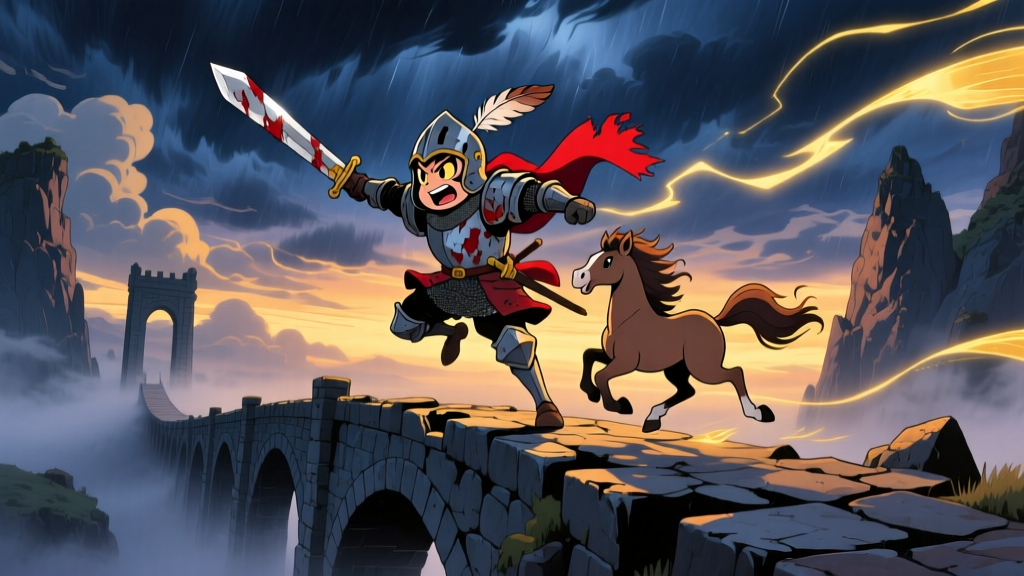
Picture the scene. Sarah has thirteen hours to solve an impossible maze and rescue her baby brother from a glam-rock goblin king. She’s been running through stone corridors, dodging talking worms, and narrowly avoiding a peach-scented dream trap. And then she reaches a bridge over a swamp that smells like death itself, and standing there — legs spread, chest puffed, staff clutched in one paw — is a fox terrier in a tunic who declares, with absolute unearned authority, that nobody passes without his permission.
This is Sir Didymus. He is approximately fourteen inches tall. He believes he is the greatest warrior who ever lived. His mount is a sheepdog who is terrified of everything. And he might be the most entertaining character Jim Henson ever put on screen.
Sir Didymus appears in the second act of Labyrinth (1986), and in roughly eight minutes of screen time, he manages to outshine characters with triple his runtime. That’s not an accident. It’s the result of deliberate design choices, extraordinary puppetry, and a comedic concept so precise that it elevates a children’s fantasy film into something genuinely clever.
Brian Froud, Jim Henson’s Dog, and the Birth of a Terrier Knight
Every character in Labyrinth began as a painting. Conceptual designer Brian Froud — the English illustrator whose work on The Dark Crystal (1982) had already proven indispensable to Henson’s fantasy ambitions — spent months producing sketches and paintings that would define the film’s visual language. For Sir Didymus, the inspiration arrived on four legs during a production meeting.
Screenwriter Terry Jones later recalled that Jim Henson kept watching his own Jack Russell terrier pace around the room during story sessions. “Jim couldn’t take his eyes off our dog,” Jones said in interviews collected for the film’s production archives. The terrier’s wiry coat, alert ears, and the way it held itself with a posture that seemed almost proud — these physical details fed directly into the character. Froud took the seed and ran with it, producing concept art that depicted a fox terrier reimagined as a medieval knight errant: complete with tunic, staff, and an expression somewhere between noble determination and clinical insanity.
The design choice was not arbitrary. Fox terriers, historically bred for vermin control, are among the most fearless dog breeds in existence. A full-grown fox terrier will charge at a badger ten times its size without a second thought. Froud and Henson recognized that this specific breed trait — boundless aggression housed in a compact frame — was inherently funny when mapped onto a knightly archetype. Sir Didymus doesn’t know he’s small. In his mind, he is ten feet tall and invincible. The comedy lives in the gap between that self-perception and the reality of a fuzzy terrier shaking a stick at people.
The literary reference wasn’t subtle, and it wasn’t meant to be. Sir Didymus is Labyrinth’s version of Don Quixote — a figure whose chivalric code is completely detached from the world he actually inhabits. Where Quixote attacked windmills he believed were giants, Didymus guards a bridge over the Bog of Eternal Stench as though it were the gates of Camelot. The delusion is the character. Strip away the knightly posturing and you have a small, yappy dog on a bridge with no strategic value whatsoever.
Dave Goelz: Three Puppeteers in a Trenchcoat
The physical performance of Sir Didymus fell primarily to Dave Goelz, one of the most accomplished puppeteers in the Henson stable. Goelz had joined Jim Henson’s team in 1973, originally as a puppet designer, and had spent over a decade developing characters across the Muppet franchise — most notably Gonzo, the Great Gonzo, whose manic energy and total lack of self-awareness made him a natural fit for the Didymus assignment. Goelz understood something fundamental about playing characters who don’t understand how ridiculous they are: you have to play them completely straight.
Sir Didymus required multiple performers working in coordination. Goelz handled the primary puppeteering — the body, the head, and the staff-wielding arms — while David Barclay operated additional controls for facial expressions and fine motor detail. Kevin Clash, who would later become famous as the voice and performer of Elmo on Sesame Street, also contributed to the character’s on-set operation during certain sequences. The voice was provided by David Shaughnessy, an English actor whose crisp, theatrical delivery gave Didymus the kind of gravitas that the character’s physical appearance immediately undermined.
“The trick with Didymus was never letting the puppet look like it knew it was funny. He’s absolutely serious. He genuinely believes he’s a great knight. The moment the audience sees the puppet winking at them, the joke dies.”
— Dave Goelz, speaking at the Labyrinth Experience & Masked Ball event (as reported by fan convention coverage, 2024)
Shaughnessy’s vocal performance deserves separate attention. He gave Didymus a clipped, slightly archaic speaking style that sounded like a Shakespearean actor who had been shrunk to terrier size. Lines like “None shall pass!” and “I am Sir Didymus, and this is my faithful steed, Ambrosius!” are delivered with a conviction that borders on the religious. The voice is not a cartoon voice. It’s a real performance, grounded in theatrical tradition, and that seriousness is what makes the absurdity work. When Didymus challenges Ludo — a rock giant roughly fifteen times his size — to single combat, Shaughnessy’s voice carries not a flicker of doubt. This terrier believes he can win. And for a split second, so does the audience.
The Bridge Guardian: Eight Minutes of Comedic Perfection
Sir Didymus’s function in the narrative is simple: he’s an obstacle. Sarah, Hoggle, and Ludo need to cross the bridge over the Bog of Eternal Stench to reach the Goblin City, and Didymus refuses to let anyone pass without a formal challenge. It’s a classic fairy-tale gatekeeper scenario — the same structure that gives us riddle-posing sphinxes and toll-demanding trolls — but Labyrinth subverts it by making the gatekeeper more dangerous to himself than to anyone else.
The bridge sequence runs approximately eight minutes on screen, and within that window, the film accomplishes a remarkable amount of character work. Didymus challenges each member of the group in turn. He squares up to Ludo, completely unbothered by the fact that Ludo could crush him by sitting down. He confronts Hoggle with a disdain that suggests he considers goblins beneath his station. And when Sarah attempts diplomacy, Didymus responds with the kind of courtly condescension that makes you want to shake him and laugh at the same time.
The resolution of the bridge scene is one of the film’s quiet comedic masterstrokes. Sarah, having exhausted patience and protocol, simply picks Sir Didymus up and moves him out of the way. Physically relocates him. The knight who declared himself immovable is lifted like a houseplant and set down a few feet to the left. And the extraordinary thing is what happens next: Didymus immediately reframes the event as his own victory. He wasn’t defeated. He allowed the passage. His honor remains intact because his delusion is impervious to evidence. That’s not just good comedy. That’s character writing with genuine psychological insight.
From that point forward, Didymus attaches himself to Sarah’s party with the unshakeable confidence of a man who believes he was always going to come along. He doesn’t ask permission. He doesn’t wait for an invitation. He simply joins, because in his mind, a knight of his stature naturally accompanies a princess on a quest. The fact that Sarah never actually asked for his help is irrelevant. Sir Didymus has decided, and his decisions are final.
Ambrosius: The Cowardly Sheepdog Who Steals Every Scene
No discussion of Sir Didymus is complete without Ambrosius, and there is an argument to be made that the sheepdog is the real comedic engine of the pair. Ambrosius is Sir Didymus’s “faithful steed” — a large, shaggy Old English Sheepdog who serves as the knight’s mount and who is, in every observable way, the opposite of his rider.
Where Didymus is fearless, Ambrosius is paralyzed by terror. Where Didymus charges forward, Ambrosius tries to bolt in the other direction. Where Didymus delivers rousing battle cries, Ambrosius whimpers. The visual gag is immediate and constant: a small terrier sitting atop a much larger dog, both of them supposedly part of the same knightly unit, with the steed visibly regretting every life choice that led to this moment.
The Ambrosius puppet was operated by a separate team of performers and required its own rigging system. The sheepdog’s size and shaggy coat made it an ideal platform for hiding mechanical controls — the puppeteers could run rods and cables through the fur without them being visible on camera. Ambrosius’s key expressions were wide-eyed panic and full-body flinching, both of which were achieved through internal mechanical controls that manipulated the puppet’s ears, eyes, and jaw. When Ambrosius hears the sounds coming from the Bog of Eternal Stench and his ears flatten against his skull, that’s a mechanical effect executed in real time by performers working just off-camera.
The relationship between Didymus and Ambrosius mirrors the film’s broader thematic concern with loyalty under duress. Ambrosius is terrified of everything, but he never runs away. He stays. He lets the tiny lunatic ride him into situations that no reasonable dog would tolerate. That’s loyalty — not the brave, chest-thumping kind, but the exhausted, long-suffering kind that shows up every day despite having every reason not to. It’s the same quality that defines Hoggle’s arc, and it’s telling that both characters — the goblin and the sheepdog — are defined more by their willingness to endure than by any conventional heroism.
Puppetry as Performance Art: The Technical Achievement Nobody Talks About
Labyrinth grossed approximately $12.7 million at the domestic box office against a production budget of $25 million. The film was, by most financial metrics, a disappointment in its initial theatrical run. But the technical work inside that film — particularly the creature design and puppetry executed by Jim Henson’s Creature Shop — represented a significant leap forward in practical effects, and Sir Didymus was one of its showcase pieces.
Unlike Hoggle, who required a full-body suit worn by a performer inside the costume, Sir Didymus was operated as a traditional hand-and-rod puppet, albeit one with unusually complex internal mechanisms. The puppet’s head alone contained multiple servo-controlled mechanisms for eye movement, brow articulation, and mouth synchronization. The body was mounted on a rod system that allowed Goelz to manipulate the character’s posture and movement from below the set floor, which had been constructed with hidden channels specifically for this purpose.
The staff that Didymus carries — his iconic weapon, essentially a wooden pole topped with a carved bird — presented a particular engineering challenge. The puppet needed to appear to grip and wield the staff independently, which required a secondary rod system operated by a separate performer. When Didymus slams the staff down on the bridge and issues a challenge, three people are coordinating that single gesture in real time: Goelz on the body and head, Barclay on the facial expression, and a third puppeteer on the staff. The seamlessness of that coordination is what separates great puppetry from good puppetry. The audience sees one character, not three operators.
| Category | Detail |
|---|---|
| Primary Puppeteer | Dave Goelz (body, head, primary rod controls) |
| Additional Puppeteers | David Barclay (facial mechanisms), Kevin Clash (on-set support) |
| Voice Actor | David Shaughnessy |
| Concept Designer | Brian Froud (original paintings and character sketches) |
| Breed Inspiration | Fox terrier (inspired by Jim Henson’s own Jack Russell terrier) |
| Puppet Type | Hand-and-rod puppet with servo-controlled head mechanisms |
| Mount (Ambrosius) | Old English Sheepdog puppet, separate performer team, rod-and-cable system through fur |
| Literary Archetype | Don Quixote (delusional knight errant) |
| Film Release | June 27, 1986 (US theatrical); $12.7M domestic gross vs. $25M budget |
Cult Status: How a Flop Became a Forty-Year Obsession
The story of Labyrinth’s journey from box-office disappointment to cult phenomenon has been told many times, but it bears repeating here because Sir Didymus occupies a specific and interesting position within that trajectory. The film found its audience through VHS rentals and cable television broadcasts throughout the late 1980s and 1990s. Teenagers who had been too young for the theatrical release discovered the film on home video and became obsessed — not just with David Bowie’s Goblin King (though certainly that), but with the entire visual world Henson and Froud had created.
Sir Didymus benefited from this rediscovery in a way that larger, more prominent characters did not. He was small enough to be quotable. His lines were short, declarative, and inherently memorable — the kind of dialogue that lodges in your brain and resurfaces at parties. “None shall pass!” became a shorthand among Labyrinth fans, a way of signaling membership in the cult without explanation. The character’s visual design — a fuzzy terrier in medieval garb — was distinctive enough to work as a badge of identity. If you recognized Sir Didymus, you were one of us.
The annual Labyrinth of Jareth Masquerade Ball, held in Los Angeles since the early 2000s and now in its twenty-fourth year as of 2025, has become the premier gathering for Labyrinth fandom. While Jareth and Sarah cosplays dominate the event numerically, Sir Didymus costumes have become a recurring presence — particularly among fans who prefer puppet-craft to traditional costume sewing. Building a wearable Didymus requires different skills than building a Goblin King outfit. The masquerade’s craft culture has elevated Didymus from a supporting character to a maker’s challenge, and successful builds typically demand mastery across several disciplines:
- Foam sculpting and shaping — Forming the terrier head from high-density EVA foam or upholstery foam, with particular attention to snout proportions and ear placement
- Fur application — Layering faux fur to mimic a fox terrier’s wiry coat without ending up with something that resembles a carpet sample
- Miniature armor fabrication — Creating the tunic, belt, and knightly accessories at a scale that reads correctly both on camera and in person
- Staff and prop construction — Building the iconic bird-topped staff as a lightweight but rigid prop that can survive convention floor handling
Results shared on social media have introduced the character to audiences who may never have seen the film itself.
Collectibles: From Mass-Market Toys to $399 Polystone Statues
The Sir Didymus collectibles market tells the story of Labyrinth’s commercial evolution in miniature. In 1986, merchandise tie-ins were limited. The film’s underperformance meant that toy manufacturers had little incentive to produce deep product lines, and Sir Didymus appeared in only a handful of licensed items during the original release window — primarily a basic action figure included in the Labyrinth toy assortment produced by Hasbro, and a PVC figurine distributed through European markets.
The landscape changed dramatically in the 2010s and 2020s, as boutique collectible companies recognized the spending power of adults who had grown up with the film. The most significant Sir Didymus collectible to date is the Weta Workshop 1:6 scale polystone statue of Sir Didymus and Ambrosius, released as a limited edition of 700 units at a retail price of $399. Standing approximately 16 cm tall with a 24 cm base footprint, the statue was hand-painted in resin and depicted Didymus astride Ambrosius in full knightly regalia, staff raised. It sold out rapidly, and secondary market prices on platforms like eBay and collector forums have since pushed well above the original retail figure.
Other notable collectibles include:
- Funko Pop! vinyl figures — A Labyrinth line released in the mid-2020s included Sir Didymus as a character figure, produced in the standard Funko stylized format. These retail in the $12–$15 range and remain relatively accessible, though certain exclusive variants have appreciated on the secondary market.
- 3.75-inch scale figures — Produced for the collector market, these articulated figures paired Didymus with Ambrosius at a roughly $14.99 price point, targeting fans who wanted shelf-display pieces rather than high-end statuary.
- Infinite Statue / Kaustic Plastik — European collectible studios have announced additional Sir Didymus figures as of 2025, though specific release dates and pricing remained in pre-production stages at the time of writing.
- Etsy and fan-made items — The handmade marketplace supports a robust ecosystem of fan-created Sir Didymus merchandise, including needle-felted replicas, resin cast miniatures, embroidered patches, and cross-stitch patterns. Prices range from $8 for digital patterns to $150+ for hand-sculpted one-of-a-kind pieces.
The secondary market for vintage 1986 Hasbro Labyrinth figures, including the original Sir Didymus, has grown steadily. Loose figures in good condition typically sell for $30–$60 on eBay, while carded examples — still sealed on their original packaging — can command $150 or more depending on condition and variant. For a character who appeared in roughly eight minutes of a film that lost money on its initial release, that’s a remarkable aftermarket performance.
The Psychology of the Character: Why Delusional Confidence Charms Us
There is a reason Sir Didymus resonates beyond nostalgia and puppetry craft. The character taps into something psychologically universal: the appeal of confidence unmoored from competence. Didymus is not brave because he has assessed the situation and decided courage is warranted. He is brave because bravery is his default state and assessment is not in his toolkit. He is, in modern parlance, operating at maximum confidence with minimum information — and somehow it works. Not because the confidence is justified, but because the acting on it changes the situation around him.
When Didymus joins Sarah’s party after the bridge scene, the group’s dynamic shifts. Ludo is strong but passive. Hoggle is clever but cowardly. Sarah is determined but overwhelmed. Didymus brings something none of them have: absolute, unshakable certainty that they will succeed. It’s not based on evidence. It’s not based on skill. It’s based on the unexamined assumption that a knight of his quality cannot possibly fail. And while that assumption is ridiculous, it functions as a kind of emotional ballast for the group. Having someone around who genuinely believes everything will be fine — even when that someone is a delusional terrier — changes the energy of a team.
This is the same principle that makes characters like Captain Jack Sparrow and the Joker compelling, though Didymus occupies the wholesome end of that spectrum. Unearned confidence, when deployed without malice, reads as charm. When deployed with malice, it reads as menace. Sir Didymus is all charm because his delusion harms no one and sustains everyone around him. He is, in his own fractured way, the emotional support animal of Labyrinth.
Frequently Asked Questions About Sir Didymus
What breed of dog is Sir Didymus based on?
Sir Didymus is modeled after a fox terrier, specifically drawing inspiration from Jim Henson’s own Jack Russell terrier, whose behavior during production meetings caught the attention of both Henson and screenwriter Terry Jones. Fox terriers were historically bred for vermin hunting and are known for their fearlessness despite their small size — a trait that directly feeds into Didymus’s character as a knight who charges at opponents many times his size.
Who performed and voiced Sir Didymus in Labyrinth?
The primary puppeteer was Dave Goelz, a veteran Henson performer best known for Gonzo in the Muppet franchise. Additional puppeteering support came from David Barclay and Kevin Clash. The voice was performed by David Shaughnessy, an English actor whose theatrical delivery gave the character his distinctive courtly speaking style. Goelz and Clash also collaborated on operating both Didymus and Ambrosius during scenes requiring simultaneous performance.
Is Ambrosius a real dog or a puppet?
Ambrosius is a puppet — specifically, a large-scale Old English Sheepdog puppet operated by a separate team of performers using a rod-and-cable system. The puppet’s shaggy coat was designed to conceal mechanical controls, allowing the performers to manipulate ear position, eye movement, and jaw articulation without visible rigging. While real Old English Sheepdogs were reportedly used in certain wide shots for reference and establishing footage, all close-up and performance scenes used the puppet.
What is the most valuable Sir Didymus collectible?
As of 2025, the highest-value production collectible is the Weta Workshop 1:6 scale polystone statue of Sir Didymus and Ambrosius, originally retailing at $399 in a limited edition of 700 units. Sold-out secondary market prices have exceeded the original retail price. Among vintage items, carded 1986 Hasbro action figures in mint condition can reach $150 or more on platforms like eBay, though pricing fluctuates with condition and market demand.
Is Sir Didymus based on Don Quixote?
The connection is widely acknowledged by the film’s creative team and critics, though it was never explicitly stated as a one-to-one adaptation. Sir Didymus shares Don Quixote’s core traits: a delusional adherence to chivalric codes, a tendency to perceive ordinary situations as epic challenges, and an inability to be discouraged by contradictory evidence. The “faithful steed” dynamic between Didymus and the long-suffering Ambrosius also mirrors the Quixote-Sancho Panza relationship, with Ambrosius serving as the grounded, reluctant counterpart to his rider’s manic idealism.
How long is Sir Didymus actually on screen?
Sir Didymus appears in approximately eight minutes of screen time across Labyrinth’s 101-minute runtime. His primary sequence is the bridge-guardian scene in the second act, followed by his integration into Sarah’s party through the film’s climax. Despite the limited screen time, the character has become one of the film’s most quoted and recognizable figures — proof of what efficient writing and committed performances can accomplish in a short window.
None Shall Pass (Except Everyone, Eventually)
Forty years after Labyrinth limped out of theaters to indifferent numbers, Sir Didymus is still standing on his bridge. Still issuing challenges to travelers who are going to cross regardless. Still riding a sheepdog who would rather be anywhere else. Still delivering lines with a conviction that would be inspiring if it weren’t so completely divorced from reality.
And that’s the point, isn’t it? The characters we remember aren’t always the ones with the most screen time, the most heroic arcs, or the most impressive visual effects. Sometimes the character who sticks is the one who captures a very specific human quality — in this case, the ability to maintain total self-belief in the face of overwhelming evidence to the contrary — and presents it with enough craft and precision that it becomes art rather than gimmick.
Sir Didymus is a puppet made of foam, fur, and wire. He was operated by three people in a trench below a movie set. He was on screen for eight minutes in a film that lost money. And yet. There are people reading this who can hear his voice in their heads right now, declaring that none shall pass, as though the bridge he guards leads somewhere worth guarding.
Maybe it does.