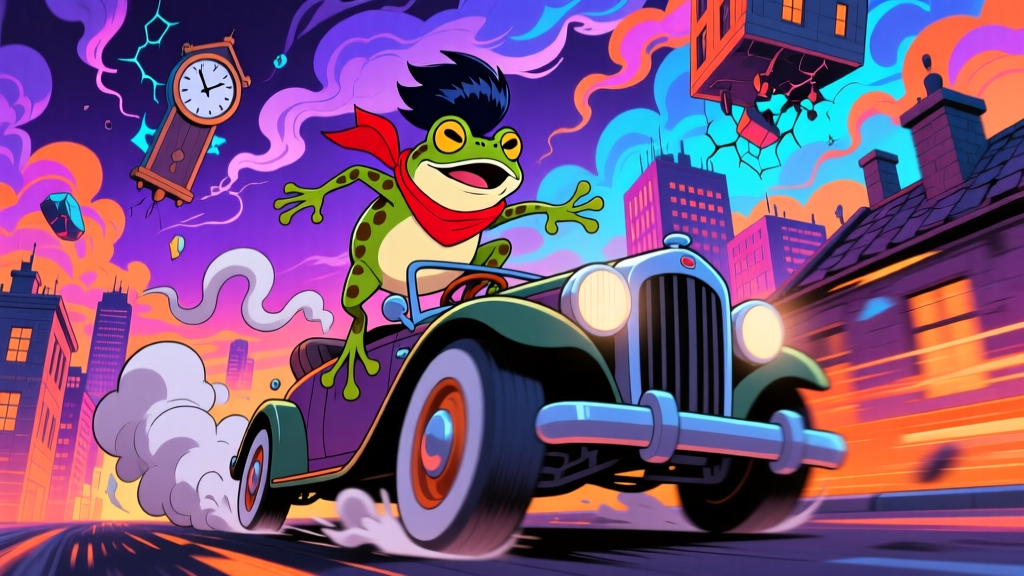
Picture this: you're eight years old, strapped into a wooden motorcar that looks like it belongs in a museum of Edwardian folly. The lights dim. A portrait of a top-hatted amphibian stares down at you. And then, without warning, you're careening through the English countryside at impossible speed, narrowly avoiding trains, policemen, and the literal fires of Hell. This was Mr. Toad's Wild Ride—a 98-second journey that imprinted itself on the brains of millions of children and refuses, even decades after its Florida demise, to be forgotten.
Among the pantheon of defunct Disney attractions, few command the reverence—or the outright grief—that Mr. Toad's Wild Ride does. The ride closed at Walt Disney World's Magic Kingdom on September 7, 1998, yet fan mourning continues to this day. There are t-shirts. There are websites. There was, improbably, a protest plane. To understand why a dark ride about a reckless amphibian became one of the most beloved attractions in theme park history, you have to go back much further than 1998.
A River Bank, a Book, and a Very Impulsive Amphibian
The story of Mr. Toad's Wild Ride doesn't begin in Anaheim or Orlando. It begins on the banks of the River Thames in 1908, when Kenneth Grahame published The Wind in the Willows. The novel—a pastoral meditation on friendship, home, and the intoxicating pull of adventure—featured one of literature's most memorable comic creations: Mr. Toad of Toad Hall, an aristocratic amphibian whose obsession with motorcars leads him into increasingly disastrous situations.
Grahame's Toad was loud, wealthy, impulsive, and utterly incapable of learning from his mistakes. He crashes seven motorcars in the novel's opening chapters alone. His friends—Rat, Mole, and Badger—attempt an intervention that fails spectacularly. Toad escapes, steals a car, crashes it, gets arrested, escapes prison disguised as a washerwoman, and eventually reclaims Toad Hall from a gang of invading weasels. It's genuinely excellent source material for a theme park ride: relentless forward momentum, a protagonist who is essentially an agent of chaos, and a setting that practically demands lush, detailed scenery.
"The world, he told himself, was his oyster, and he was going to make the most of it. Rules and regulations were for lesser creatures." — Kenneth Grahame, The Wind in the Willows (1908)
Disney came calling in 1949 with The Adventures of Ichabod and Mr. Toad, a package film that paired Grahame's story with Washington Irving's "The Legend of Sleepy Hollow." The Toad segment—animated with characteristic Disney flair and voiced by Eric Blore—compressed the novel's sprawling narrative into about 30 minutes of manic energy. The film's visual style, with its saturated colors and exaggerated caricatures of Edwardian England, would become the direct template for the ride that opened six years later.
Opening Day at Disneyland: July 17, 1955
When Disneyland opened its gates on July 17, 1955—an occasion now infamously known as "Black Sunday" due to asphalt still softening in the California heat—Mr. Toad's Wild Ride was among the Fantasyland dark rides greeting visitors. Designed by WED Enterprises (the precursor to Walt Disney Imagineering), the attraction placed guests inside Toad's motorcar for a first-person journey through the English countryside, complete with near-misses, crashes, and the ride's now-legendary finale: a plunge into Hell itself.
That finale deserves emphasis. In an era when Disney was carefully engineering experiences like Peter Pan's Flight and Snow White's Scary Adventures, Mr. Toad's Wild Ride stood apart for its willingness to terrify. After a chaotic chase sequence involving police, farm animals, and oncoming traffic, riders were suddenly confronted by bouncing red devils, flickering flames, and the suggestion that they had, in fact, died in a catastrophic collision. Children screamed. Parents questioned their life choices. And somehow, everyone got back in line.
The original 1955 version ran approximately 98 seconds and featured hand-painted flat scenes with basic lighting effects. It was charming but crude by later standards—a product of the park's tight opening budget. The real magic was in the concept: you weren't watching Mr. Toad's adventure; you were Mr. Toad, barreling toward doom with no brakes and no apologies.
The 1983 Redesign
Disneyland's Mr. Toad's Wild Ride received a significant overhaul in 1983 as part of the broader Fantasyland renovation. The update added more sophisticated audio-animatronics, improved scene transitions, and enhanced the Hell sequence with better lighting and projection effects. The ride's core narrative remained unchanged, but the new version felt more polished—less like a charmingly rickety carnival ride and more like the immersive experience Disney had become known for by the 1980s. This is the version that still operates in Anaheim today, making it one of the few opening-day concepts to survive in some form across seven decades.
The Florida Version: Bigger, Wilder, and Ultimately Doomed
When Walt Disney World's Magic Kingdom opened on October 1, 1971, Mr. Toad's Wild Ride was there—but with a twist that Disneyland never received. The Florida version featured a dual-track system: two separate ride paths that offered slightly different experiences. One track sent riders through the village and countryside; the other took them through Toad Hall and the courtroom before joining the main chase sequence. Both tracks converged for the Hell finale, but the variation meant repeat riders could experience something new each time—a clever piece of Imagineering that rewarded enthusiasm.
| Feature | Disneyland (California) | Magic Kingdom (Florida) |
|---|---|---|
| Opening Date | July 17, 1955 | October 1, 1971 |
| Closure Date | Still operating | September 7, 1998 |
| Track Configuration | Single track | Dual track (two paths) |
| Ride Duration | ~98 seconds (original) | ~2 minutes 30 seconds |
| Major Redesign | 1983 | None (original 1971 version) |
| Hell Scene | Yes (enhanced 1983) | Yes (original) |
| Replaced By | N/A | The Many Adventures of Winnie the Pooh |
| Current Status | Operating | Closed and demolished |
The Florida ride also benefited from a longer track and more spacious show building, allowing for scenes that the cramped Anaheim original simply couldn't accommodate. The courtroom scene—in which Toad stands trial before a judge who is clearly enjoying himself far too much—was a Florida exclusive that many Disneyland regulars never experienced. So too was the expanded Toad Hall interior, with its portrait gallery and sense of faded aristocratic grandeur.
For 27 years, the Magic Kingdom's Mr. Toad's Wild Ride operated as a beloved but somewhat overlooked Fantasyland staple. It wasn't the headliner that Space Mountain or Pirates of the Caribbean represented. It didn't have the cultural cachet of the Haunted Mansion. But it had something those rides didn't: personality. A specific, weird, slightly dangerous personality that made you feel like you'd stumbled into something that wasn't quite sanitized for mass consumption.
The Controversy: How Disney Killed the Toad
The trouble began, as it often does in theme park history, with Winnie the Pooh.
By the mid-1990s, Disney's merchandising machine had identified A.A. Milne's honey-obsessed bear as a property with enormous untapped potential in the American market. The character was already massively popular in Asia and Europe, and Disney—having acquired the rights decades earlier—wanted a flagship attraction to anchor the brand in its Florida parks. The logical home was Fantasyland, and the logical casualty was Mr. Toad's Wild Ride.
The first public indication that something was afoot came in October 1997, when the Orlando Sentinel reported that Disney was planning to replace the attraction. Disney, characteristically, neither confirmed nor denied. But in the pre-internet days of 1997, that silence was enough to ignite a firestorm among dedicated fans who understood what was at stake.
The Rise of Team Toad
What happened next was unprecedented in theme park fandom. A group of dedicated enthusiasts—dubbing themselves "Team Toad"—organized one of the first internet-coordinated fan campaigns in Disney history. They built savetoad.com, a website that served as both a rallying point and a petition drive, gathering thousands of signatures from visitors who wanted the ride preserved. They designed and sold t-shirts. They wrote letters—actual physical letters—to Disney executives and Florida newspapers.
In May 1998, the campaign reached its visual apex when a small plane flew over Walt Disney World trailing a banner that read: "Save Mr. Toad's Wild Ride." It was absurd. It was heartfelt. It was exactly the kind of passionate, slightly unhinged gesture that Mr. Toad himself would have appreciated. The New Yorker magazine even covered the protest in a September 1998 piece, noting the dedication of a "small band" of fans who refused to let their favorite attraction disappear without a fight.
Disney's response was, essentially: thank you for your feedback. The Many Adventures of Winnie the Pooh was already under construction. On September 7, 1998, Mr. Toad took his final ride through the Florida countryside, plunging into Hell one last time before the track was ripped up and the show building was gutted to make room for Pooh's honey-themed adventures.
The closure of Mr. Toad's Wild Ride represented something larger than a single attraction disappearing. It marked a shift in Disney's philosophy—away from quirky, property-agnostic experiences and toward attractions that served as brand extensions for merchandise-friendly franchises.
To be fair to Disney, The Many Adventures of Winnie the Pooh is a genuinely well-crafted dark ride. It's charming, it's accessible, and it serves its target demographic (very young children) better than the comparatively intense Mr. Toad experience. But it's also safer, gentler, and more obviously commercial. When you replace a ride that ends in literal Hell with one that ends in a honey pot, something ineffable is lost.
Why the Grief Lasted: The Psychology of a Defunct Attraction
Twenty-eight years after its closure, Mr. Toad's Wild Ride remains one of the most discussed, mourned, and mythologized attractions in Disney history. This isn't just nostalgia—though nostalgia plays a significant role. The ride's enduring legacy rests on several specific factors that distinguish it from other closed attractions.
The Hell Scene. No discussion of Mr. Toad is complete without addressing the elephants—or rather, the devils—in the room. The ride's finale, in which riders "died" and descended into a cartoonish underworld populated by bouncing red demons, was genuinely startling. For many children raised in the 1970s and 1980s, this was their first encounter with the concept of mortality, delivered in the context of what was supposed to be a whimsical family outing. The cognitive dissonance was profound. You expected cute animals and English countryside; you got existential terror. That juxtaposition created memories so vivid that they resist fading.
The Source Material's Depth. Unlike many Disney attractions based on thin premises (a submarine voyage, a bobsled run through the Matterhorn), Mr. Toad's Wild Ride drew from a novel with genuine literary weight. The Wind in the Willows has been continuously in print since 1908 and has been adapted dozens of times for stage, screen, and radio. Visitors who knew the book brought that context to the ride; visitors who didn't often sought out the novel afterward, creating a feedback loop between Grahame's pastoral vision and Disney's theme park interpretation.
The "You Can't Go Home Again" Factor. Disneyland's version still operates, which paradoxically makes the Florida closure hurt more. You can visit the concept in California. The physical space in Orlando is gone—demolished, not preserved. The queue, the exterior facade, the distinctive English cottage architecture—all replaced. There is no plaque, no tribute, no "in memory of" marker. For fans who grew up riding the Florida version, this erasure feels personal.
The Hidden Tributes
Disney did, eventually, acknowledge the passion. In the queue for The Many Adventures of Winnie the Pooh at Magic Kingdom, there is a subtle nod to the former occupant: look carefully at the mural near the loading area, and you'll spot Mr. Toad among the illustrated characters. It's easy to miss—a brief Easter egg rather than a memorial—but it exists. Some Imagineers who worked on the Pooh attraction have spoken publicly about their affection for Mr. Toad's Wild Ride and their awareness that they were replacing something beloved.
- Disneyland's version continues to operate with the 1983 redesign, featuring improved animatronics and the enhanced Hell sequence
- The "Toad's" exterior at Disneyland retains its original English countryside charm, making it one of Fantasyland's most photogenic facades
- Merchandise featuring Mr. Toad remains popular, with Disney occasionally releasing limited-edition pins and apparel referencing the defunct Florida ride
- The 2011 film "The Muppets" included a brief gag referencing Mr. Toad's Wild Ride, demonstrating its cultural penetration beyond theme park circles
The Wind in the Willows: Grahame's Enduring Gift to Disney
It's worth examining why Kenneth Grahame's novel proved so adaptable to theme park translation. Published in 1908, The Wind in the Willows emerged from the same English pastoral tradition as writers like E. Nesbit and A.A. Milne—a literary movement that idealized rural life while acknowledging its cruelties. Grahame, a banker by profession, wrote the book partly as an escape from the pressures of modern life, and that tension between freedom and responsibility animates every page.
Mr. Toad, the novel's most dynamic character, embodies the seductive danger of pure freedom. He is wealthy enough to indulge every whim, impulsive enough to act on every impulse, and resilient enough to survive every consequence. When Disney adapted the character in 1949, they wisely emphasized the spectacle—the car crashes, the chase sequences, the courtroom drama—while softening Grahame's more melancholic observations about aging and loss.
The 1949 Disney film, narrated by Basil Rathbone and featuring the vocal talents of Eric Blore as Toad, runs about 30 minutes and covers the novel's major plot beats: Toad's motorcar obsession, his arrest and imprisonment, his escape, and the battle to reclaim Toad Hall. The animation is some of Disney's most fluid from the package-film era, with the motorcar sequences in particular displaying a sense of speed and chaos that would translate perfectly to ride form six years later.
Grahame himself never saw the Disney adaptation—he died in 1932—but his estate has maintained a complicated relationship with the company's interpretation. The novel's public domain status in the United States means that Disney cannot prevent other adaptations, but their specific visual designs for the characters remain proprietary. This legal reality is partly why Mr. Toad's Wild Ride uses designs that are distinctly "Disney Toad" rather than the original E.H. Shepard illustrations that accompanied Grahame's text.
Mr. Toad in the Modern Era: A Ghost That Won't Stay Buried
The internet has ensured that Mr. Toad's Wild Ride—particularly the demolished Florida version—remains vividly alive in collective memory. YouTube hosts dozens of ride-through videos captured by visitors in the 1990s, and these have accumulated millions of views. Reddit communities dedicated to defunct Disney attractions regularly feature Mr. Toad discussions that attract hundreds of comments. The savetoad.com domain, while no longer active in its original form, is remembered as a pioneering example of fan organizing.
There's also the matter of the ride's influence on subsequent attractions. The first-person dark ride format that Mr. Toad pioneered influenced decades of Imagineering work. Roger Rabbit's Car Toon Spin at Disneyland, which opened in 1994, is perhaps the most direct descendant—another chaotic vehicular journey through a stylized world, complete with the sense that your ride vehicle is barely under control. Even modern attractions like Rise of the Resistance owe a conceptual debt to Mr. Toad's willingness to put riders inside the story rather than observing it from a comfortable distance.
Among serious Disney historians and Imagineering scholars, Mr. Toad's Wild Ride is frequently cited as an example of what made early Disney theme park design special: a willingness to embrace ambiguity, to mix tones (comedy and terror, whimsy and darkness), and to trust that audiences—particularly young audiences—could handle more intensity than corporate focus groups might suggest.
Could Mr. Toad Ever Return to Florida?
It's the question every Team Toad member eventually asks, and the honest answer is: probably not in its original form. The show building that housed the Magic Kingdom version was structurally modified for Winnie the Pooh, and the dual-track system would be prohibitively expensive to reconstruct. Disney's current approach to Fantasyland prioritizes attractions tied to its most commercially successful animated properties—Frozen, Tangled, and the upcoming Encanto-themed experiences.
That said, Disney has demonstrated a willingness to revisit its past. The return of the Electrical Parade, the refurbishment of classic dark rides at Disneyland, and the incorporation of retro elements into newer parks all suggest that nostalgia remains a potent force in Disney's decision-making. A Mr. Toad attraction in some form—perhaps as part of a broader "classic Disney" land that fans have advocated for—cannot be entirely ruled out.
Until then, the original continues to run in Anaheim. The motorcars still lurch forward. The portrait of Toad still watches from the wall. And somewhere, in the flickering red light of that final scene, the devils are still bouncing.
Frequently Asked Questions
- Is Mr. Toad's Wild Ride still open anywhere?
- Yes. The Disneyland (Anaheim, California) version remains operational with its 1983 redesign. It's located in Fantasyland and typically has shorter wait times than neighboring attractions like Peter Pan's Flight, making it an easy add to any park visit.
- Why did Disney close Mr. Toad's Wild Ride in Florida?
- Disney replaced the Magic Kingdom attraction to make room for The Many Adventures of Winnie the Pooh, which opened in 1999. The decision was driven by merchandising strategy—Pooh represented a larger commercial opportunity—and a desire to update Fantasyland with a more contemporary attraction.
- What is the "Hell scene" in Mr. Toad's Wild Ride?
- The ride's finale depicts riders apparently dying in a collision and descending into a cartoon Hell populated by red devils and flames. It was considered genuinely frightening by many children and remains one of the most discussed elements of any classic Disney dark ride.
- What is The Wind in the Willows, and how does it connect to the ride?
- The Wind in the Willows is a 1908 novel by Kenneth Grahame about anthropomorphic animals in rural England. Mr. Toad, one of its main characters, is an aristocratic amphibian obsessed with motorcars. Disney adapted the novel's Toad storyline in the 1949 film The Adventures of Ichabod and Mr. Toad, which directly inspired the ride.
- Did the fan campaign to save Mr. Toad's Wild Ride accomplish anything?
- While the campaign—centered on savetoad.com and featuring a famous banner plane—did not prevent the ride's closure, it succeeded in generating significant media coverage (including a New Yorker article) and demonstrated the power of organized fan advocacy. It's considered a landmark moment in theme park fandom and influenced how Disney communicates with its audience about attraction changes.
- How long was the original Mr. Toad's Wild Ride?
- The original 1955 Disneyland version ran approximately 98 seconds. The Magic Kingdom (Florida) version, which featured a longer dual-track layout, ran approximately 2 minutes and 30 seconds.
- Was Mr. Toad's Wild Ride an opening day attraction?
- Yes, at both parks. It opened with Disneyland on July 17, 1955, and with Magic Kingdom on October 1, 1971. This makes it one of the oldest ride concepts in Disney history.