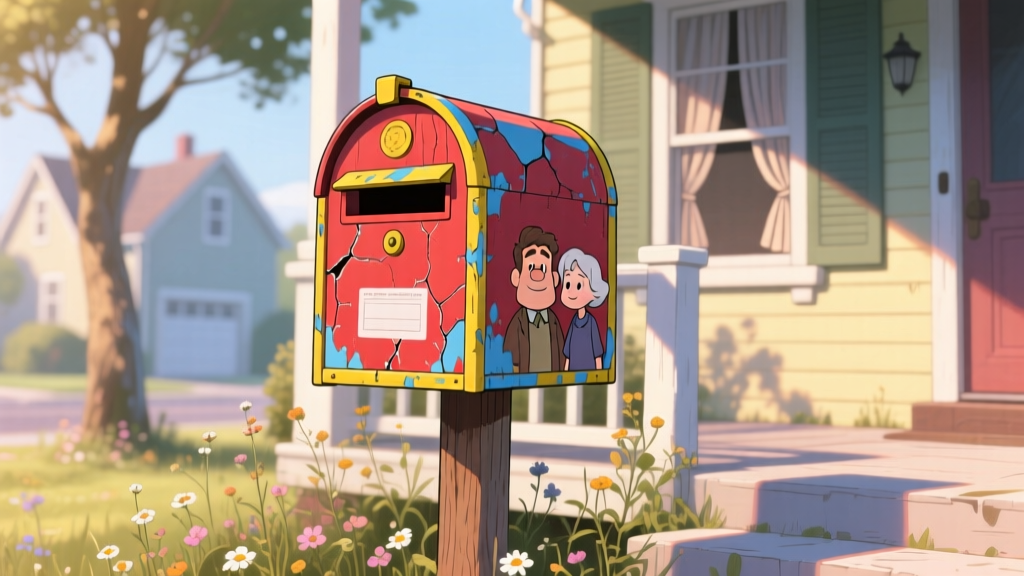
There is a moment in Up, roughly two minutes and forty seconds into the film, that most viewers never consciously register but never forget. Carl Fredricksen—square-jawed, stiff-backed, already settling into the rigid geometry that will define his character—walks to the mailbox outside the house he shares with Ellie. The camera holds on it just long enough: a weathered wooden post, a simple box painted with their names in looping, uneven letters, a small handprint smudged near the bottom. Ellie's handprint. You can see the enthusiasm in the paint stroke, the slight wobble that says she did this herself, outside, on a Tuesday afternoon that meant nothing and everything.
The shot lasts maybe two seconds. It says more about love than most romantic films manage in two hours.
Pixar has always been obsessive about what its production teams call "story props"—objects that carry emotional weight beyond their narrative function. Woody's pull-string voice box in Toy Story. Bing Bong's tear-candy in Inside Out. But the Carl and Ellie mailbox occupies a different tier entirely. It is not a gadget, a MacGuffin, or a plot device. It is a piece of furniture. And it might be the most devastating piece of furniture in animation history.
A Hand-Painted Love Story: Designing the Fredricksen Home
When director Pete Docter and production designer Ricky Nierva began conceptualizing Up in 2004, they started with an unusual constraint: the entire emotional arc of the film had to be legible through a single house. Not through dialogue, not through character expressions—through architecture, color, and the small objects scattered inside and around it. The mailbox was among the first props Nierva sketched.
The Fredricksen house drew direct inspiration from the painted Victorian homes of San Francisco and the New England saltbox cottages that dot coastal Maine. Its exterior palette—warm turquoise, buttery yellow trim, salmon-pink accents—was chosen to telegraph Ellie's personality before the audience ever meets her. She is, in Docter's own words from a 2009 Animation World Network interview, "the color in Carl's life. Literally. Every scene with Ellie has warmer, more saturated tones. Every scene without her drains toward gray and brown."
The mailbox followed the same logic. In early concept art held at the Walt Disney Animation Research Library, the mailbox goes through several iterations: a standard metal box, a whimsical birdhouse shape, a miniature replica of the house itself. The final design is deliberately unremarkable—a plain wooden box on a post, the kind you might find at any rural American home built before 1960. What makes it extraordinary is the paint. Ellie's name appears in slightly larger letters than Carl's. Her handprint is pressed into the wood beside his (or perhaps beside where his would be, if Carl had bothered to add one—which is, of course, the point).
"We wanted every object in that house to feel like two people lived there. Not a set designer. Two people who loved each other and made things together, imperfectly." — Ricky Nierva, Production Designer, The Art of Up (Chronicle Books, 2009)
This philosophy extended to the interior, where Ellie's adventure scrapbook, the "My Adventure Book" journal with its hand-drawn Paradise Falls illustration on the cover, sits on a shelf beside Carl's neatly organized balloon-animal manuals. The contrast is constant and deliberate. Ellie's things are colorful, slightly messy, alive with intent. Carl's are ordered, functional, closed. The mailbox, sitting at the threshold between their private world and the outside, is where both aesthetics meet.
Four Minutes Without Words: The Montage That Changed Everything
The opening montage of Up runs approximately four minutes and thirty seconds. It contains no spoken dialogue. It is scored entirely by Michael Giacchino's "Married Life," a waltz that begins with a tentative, music-box melody on piano and gradually builds through strings, woodwinds, and brass until it swells into something so full of feeling that it barely fits inside the speakers.
The sequence covers roughly fifty years of Carl and Ellie's life together. They meet as children in an abandoned house. They marry. They buy a dilapidated Victorian and rebuild it plank by plank—Ellie painting, Carl hammering, the mailbox going up sometime around the third measure of Giacchino's theme. They work at the zoo (Carl sells balloons, Ellie tends the animals). They picnic on a hillside, watching clouds drift into shapes. They discover they cannot have children. The montage shifts from golden warmth to muted blues. Ellie paints a mural of Paradise Falls on their living room wall. They start a savings jar labeled "Paradise Falls." They break it for car repairs. They start another. They break it for a broken arm. They start another. The jar never fills.
"Four minutes and thirty seconds. No dialogue. And more emotional truth than most screenwriters deliver in a full script."The mailbox reappears at least three times during this sequence, always in passing, always as background. Once when Carl and Ellie return home from work, groceries in hand. Once when Ellie rushes out to check for mail, her step still buoyant and quick. And once, late in the sequence, when Ellie is gone—when Carl walks to the mailbox alone, opens it, finds nothing, and closes it with a small, mechanical gesture that contains an entire vocabulary of grief.
This is the shot that lingers. The mailbox does not change. The paint is the same. Ellie's handprint is still there, slightly faded now by rain and sun. But the context has shifted so violently that the same object reads as a completely different symbol. Before, it was a declaration of partnership. Now it is a memorial. Pixar's animators achieved this without altering the mailbox itself—only by changing the light, the weather, and the posture of the man standing beside it.
The Score as Emotional Architecture
Giacchino's "Married Life" has been analyzed by music theorists and film scholars alike for its deceptive simplicity. The piece is built on a repeating waltz pattern in 3/4 time, shifting through four distinct emotional movements that correspond to the montage's narrative beats. The first movement (0:00–1:15) uses solo piano and light strings for the couple's early courtship. The second (1:15–2:30) introduces full orchestration as their life flourishes. The third (2:30–3:20) strips back to a solo violin over sustained chords—the infertility discovery, the quiet recalibration of dreams. The fourth (3:20–4:30) returns to piano alone, slower now, with spaces between the notes that feel like absences.
The mailbox's final appearance falls precisely in that fourth movement. The piano plays two notes. Carl closes the lid. The camera pulls back. And something in the audience breaks, quietly, in a way that does not fully heal for the rest of the film.
Why a Mailbox? The Unlikely Power of an Ordinary Object
Of all the props Pixar could have elevated to emotional icon status—a wedding ring, a photograph, a letter—they chose a mailbox. This is not accidental. A mailbox is, by definition, a point of contact between the private self and the public world. It is where the outside reaches in. Letters arrive. Bills arrive. Junk mail arrives. And sometimes, nothing arrives, which is its own kind of message.
In the specific context of Carl and Ellie's story, the mailbox functions as a barometer of their connection to the world beyond their front door. Early in the marriage, Ellie races to check it. She paints it. She decorates it. It is an outward gesture, an act of claiming space and declaring presence. As the montage progresses and Ellie's health declines, the mailbox becomes Carl's burden rather than Ellie's joy. He maintains it because she would have wanted it maintained. After her death, he stops checking it altogether.
This trajectory mirrors the film's broader thesis about isolation and re-engagement. Carl's journey in Up is not really about reaching Paradise Falls. It is about learning to open the mailbox again—metaphorically and, in the film's final scenes, quite literally, when Russell's presence in his life gives Carl a reason to receive the world once more.
Shape Language and Color Psychology
Pixar's character designers used strict shape-language rules for Up: Ellie is composed of circles and curves (round face, round glasses, round body), representing openness and warmth. Carl is built from squares and rectangles (square jaw, square glasses, square body), representing structure and containment. The mailbox itself is a square—Carl's shape—but the paint on it, the uneven hand-drawn letters, the smudged handprint, all follow Ellie's circular, organic aesthetic. The object is literally a collision of both characters' design philosophies, a small wooden argument between order and spontaneity that ends in compromise and beauty.
The color choices reinforce this. Carl's wardrobe throughout the film sits in the brown-tan-khaki spectrum. Ellie's presence is coded in violet, pink, and warm gold. The mailbox, with its natural wood grain base and hand-painted color accents, sits exactly at the midpoint of both palettes. It is, in color-theory terms, the place where Carl and Ellie meet.
The Collectibles: Owning a Piece of the Montage
The Carl and Ellie mailbox has spawned a surprisingly robust merchandise ecosystem, though it rarely gets the spotlight treatment that Buzz Lightyear or WALL-E receive from Disney's consumer products division. Here is a breakdown of the most notable collectible and replica options available as of mid-2026:
| Item | Type | Approx. Price | Availability | Notable Detail |
|---|---|---|---|---|
| VeVe Digital Collectible — Carl & Ellie's Mailbox | Digital (NFT) | $8–$15 (secondary market) | Sold out (primary); available on resale | Classified as "Rare" tier; 3D model with paint detail |
| Loungefly Up Mailbox Paint Mini Backpack | Fashion accessory | $70–$90 | Convention exclusive (2020 Fall); resale markets | Replicates the painted mailbox surface on vegan leather |
| Disney Pin — "Carl and Ellie at the Mailbox" | Enamel pin (Official) | $12–$18 | Disney Parks / Disney Store (limited runs) | Part of the "Up Portraits" series; features both characters beside the mailbox |
| Loungefly "Carl & Ellie Mailbox" Chaser Pin | Enamel pin (chaser variant) | $25–$45 | Secondary market | Chaser variant includes metallic gold accents on the mailbox paint |
| Etsy Handmade Mailbox Replicas | Physical replica / decor | $45–$150 | Etsy (multiple sellers) | Range from painted wooden boxes to full-size mailbox posts with hand-painted names |
| "Grape Soda" Badge Pin Set | Enamel pin set | $8–$14 | Widely available | Often bundled with mailbox-themed designs; references Ellie's bottle-cap badge |
| Funko Pop! Carl Fredricksen (with mailbox background) | Vinyl figure | $12–$20 | Widely available | Some editions include the mailbox in the display base |
The VeVe digital collectible is particularly interesting from a franchise-history perspective. Released as part of Disney's partnership with the VeVe app platform, the Carl & Ellie's Mailbox model was categorized as "Rare" and sold out rapidly during its initial drop. On the secondary market, prices have fluctuated between $8 and $15, well below the speculative peaks seen with Marvel or Star Wars digital collectibles but reflecting steady collector interest. It remains one of the few Up-themed digital collectibles that focuses on a prop rather than a character.
For physical replicas, the Etsy ecosystem has been the most active source. Sellers like "PixarPaintCraft" and "AnimationHomeDecor" offer hand-painted wooden mailbox replicas that range from decorative shelf pieces (approximately 8 inches tall, $45–$65) to full-size functional mailboxes mounted on wooden posts ($120–$150). The higher-end versions use the same turquoise-and-salmon color palette seen in the film and age naturally outdoors, which adds a layer of poignancy: the replica, like the original, slowly fades.
Fans Who Built It Themselves: Recreations, Cosplay, and Tributes
The Up fandom skews older than you might expect for a Pixar property. A significant portion of active fans are in their late twenties to mid-forties—people who saw the film in theaters in 2009 at an age old enough to understand what Ellie's death meant, young enough to carry the memory forward. This demographic overlap explains why fan recreations of the mailbox tend toward craftsmanship rather than quick cosplay.
Halloween and Cosplay Builds
Carl and Ellie remain one of the most popular couples' costume pairings in the Disney fan community, particularly for Halloween and Disney-themed events. The mailbox frequently appears as a prop accessory: couples have built lightweight cardboard-and-foam mailbox replicas to carry alongside their costumes, and TikTok tutorials for "Carl and Ellie mailbox costumes" have accumulated millions of combined views. The most detailed builds use actual wooden posts (cut to about 3 feet for portability) with foam-board mailbox tops, painted to match the film's color palette.
Some cosplayers go further. A notable trend on platforms like Instagram and TikTok involves couples recreating the mailbox scene itself—standing beside a handmade mailbox, mimicking the film's framing, and posting the comparison side-by-side with screenshots from the movie. These posts consistently perform well, often reaching hundreds of thousands of views, because the visual language is so immediately recognizable.
Permanent Installations and Garden Tributes
Perhaps the most touching fan recreations are the permanent ones. Search Etsy or Reddit's r/Pixar community and you will find multiple accounts of fans installing Carl and Ellie-style mailboxes in their own gardens, on their front lawns, or at the entrances to their homes. Some paint their own names in the same hand-drawn style. Others leave the mailbox blank, using it purely as a visual tribute. A few have added small details not present in the film—a grape soda bottle cap pinned to the post, a small cluster of balloons painted on the side, a tiny replica of Ellie's adventure book tucked inside.
One particularly well-documented project, shared by a user on the Pixar fan forums in 2022, involved a full-scale recreation of the Fredricksen house facade as a garden shed, complete with the mailbox, the chimney, and the multicolor balloon cluster anchored to the roof peak. The build took approximately six months and cost around $4,200 in materials. The creator noted that the mailbox was the easiest part to build but the hardest to get right: "The paint has to look like someone did it on a Saturday afternoon because they felt like it, not like a sign painter did it professionally. That wobble is everything."
The Mailbox as a Cultural Object: Why It Endures
Sixteen years after Up's release, the Carl and Ellie mailbox has not faded from fan consciousness the way many Pixar props do. It persists for reasons that go beyond nostalgia. Here is what makes it different:
- It represents a love story, not an adventure. Most iconic Pixar props are tied to action or discovery—a spaceship's steering wheel, a monster's scream canister. The mailbox is tied to domesticity, to the ordinary rhythms of a shared life. That grounding in the mundane makes it feel more real, and therefore more painful to lose.
- It is reproducible. Unlike the Up house (which requires a full architectural build and roughly 10,923 helium-filled balloons to achieve the film's visual), a mailbox is something anyone can make. A wooden box. A post. Some paint. The accessibility of the craft invites participation.
- It carries the film's thesis in a single object. Up is, at its core, a film about what happens when the adventure you planned never happens, and the adventure you did not plan turns out to be the important one. The mailbox embodies this perfectly: it was built for letters from the world, but the only message it ever really carried was the one painted on its surface—that two people chose to share a life.
- It ages. In the film, the mailbox's paint fades over the decades. Fan replicas age the same way. This built-in impermanence means the object never looks quite the same twice, which mirrors the film's insistence that time passes whether you are ready or not.
There is also something to be said about the generational weight of the montage itself. Up was released in 2009. The children who watched it then are adults now, and many of them have experienced loss—not necessarily the death of a spouse, but the erosion of plans, the quiet grief of a savings jar that never filled, a Paradise Falls that stayed on the wall. When they encounter the mailbox again, whether in a Disney park, on a piece of merchandise, or in a fan recreation, they bring all of that accumulated life to the object. The mailbox means more to them now than it did when they were ten.
"The things we make when we love someone—a painted mailbox, a scrapbook page, a savings jar with a label—these are the artifacts that outlast us. Pixar understood that. That's why four minutes of animation can feel like a documentary." — Film critic Scott Tobias, No Film School, 2019 retrospective on Up's 10th anniversary
Questions Collectors and Fans Actually Ask
Is the Carl and Ellie mailbox based on a real object?
No. The mailbox is an original prop designed by Pixar's art department for Up (2009). Production designer Ricky Nierva and his team drew inspiration from rural American mailboxes of the mid-20th century, but the specific design—including the hand-painted names and handprint—was created for the film. Early concept art shows several rejected designs, including a birdhouse-shaped box and a miniature replica of the Fredricksen house itself.
How many times does the mailbox appear in the film?
The mailbox appears at least four distinct times: during the montage's "rebuilding the house" sequence, when Ellie checks for mail during the couple's early married life, during the later montage as Ellie's health declines, and most memorably in the shot where Carl checks it alone after Ellie's passing. It also appears briefly in background shots throughout the film's opening act.
Can I buy an official Carl and Ellie mailbox replica from Disney?
Disney has not released a standalone full-size mailbox replica through its official retail channels. The closest official products include the Loungefly mini backpack (2020 convention exclusive, $70–$90 on resale markets), various enamel pins featuring the mailbox in the design, and the VeVe digital collectible. For full-size replicas, fans typically turn to Etsy sellers or commission custom woodworkers.
What colors are used on the Carl and Ellie mailbox?
The mailbox sits on a natural wood-grain post. The box itself features hand-painted lettering in a warm turquoise and soft pink, matching the Fredricksen house's exterior palette. Ellie's handprint appears in a slightly darker shade. The overall effect is intentionally imperfect—the paint strokes are uneven, the letters wobble, and the design looks like it was done by hand on a warm afternoon, which is exactly what the animators intended.
Why does the mailbox scene make people cry?
The emotional impact comes from context, not the object itself. When Carl checks the mailbox alone after Ellie's death, the audience has just watched four and a half minutes of their entire life together. The mailbox was present throughout that journey—painted together, checked together, maintained together. Seeing Carl interact with it alone, performing a routine that was once shared, communicates the enormity of his loss without a single word. The animators deliberately kept the mailbox unchanged to emphasize that the world did not shift to accommodate his grief; only his relationship to it changed.
Is the mailbox featured in any Disney theme park attractions?
The mailbox appears as a design element in various Up-themed merchandise and photo-op spots at Disney parks, though it is not a centerpiece of any ride or walkthrough attraction. It has appeared in Up-themed parade floats and has been recreated as a photo backdrop during special events. At Disney California Adventure, the "A Bug's Land" area (now replaced by Avengers Campus) previously featured subtle Up Easter eggs, though the mailbox was not a permanent fixture.
What is the "grape soda" badge, and how does it relate to the mailbox?
The grape soda bottle cap is Ellie's homemade "badge" that she pins on Carl when they first meet as children, declaring him a member of her adventure club. It reappears at the end of the film when Carl pins it on Russell, completing the emotional circle. While not directly attached to the mailbox, the grape soda badge is frequently paired with mailbox imagery in fan art and merchandise because both objects represent Ellie's spirit of connection. Many Etsy sellers bundle grape soda pins with mailbox-themed designs.
Up was released on May 29, 2009, directed by Pete Docter with co-direction by Bob Peterson. The film grossed over $735 million worldwide and won two Academy Awards at the 82nd ceremony in 2010: Best Animated Feature and Best Original Score (Michael Giacchino). The "Married Life" theme from the opening montage remains one of the most recognized pieces of film music of the 21st century.