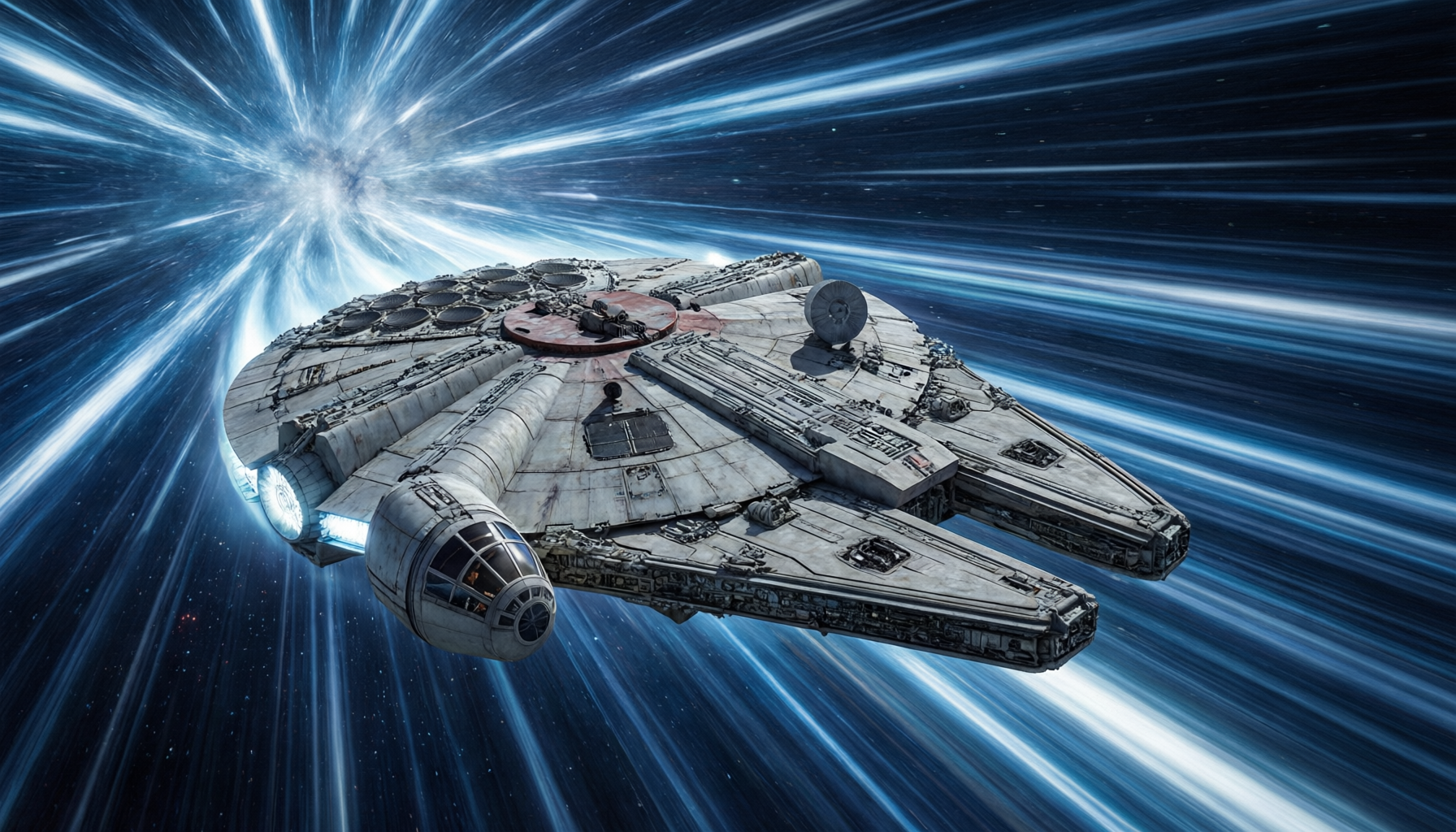
The Millennium Falcon: Why a Beat-Up Freighter Owns the Galaxy
She may not look like much, but she's got it where it counts.
Walk into any comic shop, any convention hall, any retro toy store on the planet, and you will spot it. The shape is unmistakable — a flattened disc with an offset cockpit pod and a pair of mandibles jutting forward like the jaw of some mechanical beast. The Millennium Falcon does not just appear in Star Wars. She is Star Wars for millions of fans, the single object that crystallizes everything the saga represents: rebellion, improvisation, speed, and the stubborn refusal to die. This is the deep dive she deserves.
Origin Story: From Concept Art to the Most Recognizable Ship in Cinema
The Falcon almost looked completely different. Joe Johnston and George Lucas cycled through dozens of concepts during pre-production of the original 1977 film. Early sketches resembled a sleek, symmetrical craft — something closer to a Star Destroyer in miniature. Lucas rejected them all. He wanted the hero ship to look like a hunk of junk. Fast, yes. Reliable? Debatable. The design that stuck was reportedly inspired by a half-eaten hamburger with an olive off to the side. That olive became the cockpit.
The final model measured roughly five feet long for the original trilogy's motion-control photography sequences. Industrial Light & Magic built it from kit-bashed parts — pieces from World War II tank models, Formula 1 car kits, and random greeblies harvested from hobby shops across Los Angeles. That asymmetry, that sense of a ship patched together by desperate mechanics on backwater planets, gave the Falcon a personality that no amount of CGI polish has ever replicated.
When she first appears on screen in A New Hope, parked in Mos Eisley's Docking Bay 94, Obi-Wan Kenobi dismisses her outright. "What a piece of junk." Han Solo's wounded pride in that moment tells you everything. This ship is not a vehicle to him. She is a companion. A partner. Maybe even a lover, if you squint hard enough at Harrison Ford's delivery.
The Falcon's History Inside Star Wars Lore
Before Han Solo
The YT-1300 light freighter rolled off the Corellian Engineering Corporation's assembly lines decades before the Clone Wars. In Legends continuity (now rebranded as the old Expanded Universe), the ship passed through countless owners. She was originally called the Stellar Envoy, then the Second Chance, and eventually ended up in the hands of a gambler named Lando Calrissian. Lando won her fair and square at a sabacc table — or so he thought. He lost her the same way, to Han Solo, in a game of Corellian Spike just before the events of A New Hope.
The current canon has streamlined some of this backstory but kept the essential beats: Lando owned her first, Han won her in a card game, and neither man ever truly let go. The Force Awakens visually confirms this emotional ownership when Lando's face lights up at the sight of her on Takodana, decades after he last flew her.
The Kessel Run and the Parsec Controversy
Han Solo's boast about making the Kessel Run in "less than twelve parsecs" has fueled nerd arguments since 1977. A parsec is a unit of distance, not time. Critics called it a script error. Lucas himself initially shrugged it off as Han talking himself up.
The prequels and Expanded Universe retroactively gave it meaning: the Kessel Run passes near a cluster of black holes called the Maw. A faster ship can cut a tighter route through the gravitational chaos, shaving distance off the standard safe corridor. So Han wasn't bragging about speed in the traditional sense. He was bragging about navigational audacity — flying a route that would tear a lesser ship apart. Solo: A Star Story finally depicted this on screen in 2018, with the Falcon literally dodging gravity wells and emerging battered but intact. Twelve parsecs. Not bad for a freighter.
From Smuggler's Ship to War Hero
The Falcon's arc mirrors Han's own transformation. She starts as a tool for criminal enterprise — spice running, smuggling, the kind of work that gets you killed or worse, forgotten. By the time of Return of the Jedi, she is leading the attack run on the second Death Star's reactor core, piloted by Lando with Nien Nunb as co-pilot. A garbage scow that helped blow up the Emperor's ultimate weapon. That is the Falcon in a nutshell: underestimated, written off, and then devastatingly effective when it matters.
In The Force Awakens, she has been stolen and sold multiple times, sitting under a tarp on Jakku like a forgotten muscle car in someone's backyard. When Han reclaims her, the grin on his face is the most genuine emotion in the entire sequel trilogy. She then participates in the assault on Starkiller Base, proving once again that newer ships are not always better ships.
Technical Specifications: What Makes Her Tick
The YT-1300 is, on paper, a mundane freighter. Corellian Engineering built thousands of them for short-haul cargo routes across the galaxy. What makes the Falcon special is not the base platform. It is what Han and Chewbacca did to her over years of illegal modifications.
Key Modifications by Han Solo & Chewbacca:
- Upgraded hyperdrive from a stock Class 2 to a military-grade Class 0.5 — twice as fast as most Imperial vessels
- Reinforced hull plating scavenged from decommissioned warships
- Concealed smuggling compartments beneath the deck plates (originally designed for spice, later used to hide passengers)
- Quad laser cannons mounted in dorsal and ventral turrets, far beyond what any civilian freighter should carry
- Custom navicomputer with an attitude — the Falcon's systems are notoriously temperamental, often requiring percussive maintenance
- Sensor suite powerful enough to detect an Imperial fleet at extreme range
Millennium Falcon vs. Other Iconic Star Wars Ships
| Specification | Millennium Falcon (YT-1300) | X-Wing (T-65B) | TIE Fighter (TIE/ln) | Imperial Star Destroyer (ISD-I) | Slave I (Firespray-31) |
|---|---|---|---|---|---|
| Class | Light Freighter | Starfighter | Starfighter | Capital Ship | Patrol/Attack |
| Length | 34.75 m | 12.5 m | 7.2 m | 1,600 m | 21.5 m |
| Hyperdrive Class | 0.5 (modified) | 1.0 | None (stock) | 2.0 | 1.5 |
| Max Atmospheric Speed | 1,050 km/h | 1,050 km/h | 1,200 km/h | 975 km/h | 1,000 km/h |
| Crew | 2 (+ passengers) | 1 (+ astromech) | 1 | 37,000+ | 1 |
| Primary Armament | Quad lasers, concussion missiles | Quad lasers, proton torpedoes | Twin laser cannons | Turbolasers, ion cannons | Laser cannons, seismic charges |
| Shields | Yes (upgraded) | Yes | No | Yes (heavy) | Yes |
| Cargo Capacity | 100 metric tons | 110 kg | None | 36,000 tons | 70 metric tons |
Look at that hyperdrive number. A Class 0.5 rating means the Falcon outruns virtually anything the Empire fields in a straight-line chase. The Star Destroyer, a kilometer and a half of Imperial terror, is stuck at Class 2.0. That is the difference between a ship designed for bulk force and a ship built for getting the hell out of dodge. Han Solo's entire combat philosophy is encoded in those specs: do not stand and fight. Outmaneuver, outlast, escape.
The TIE Fighter technically beats the Falcon in atmospheric speed, but it has no shields and no hyperdrive. It is a disposable weapon. The Falcon is a survivor.
Cultural Impact: More Than a Spaceship
The Falcon as Character
Few fictional vehicles have achieved the status of a named character. The Batmobile comes close. The Enterprise, perhaps. But the Millennium Falcon occupies a space that neither can touch because she is treated, within the narrative, as alive. She has moods. She breaks down at inconvenient moments. She responds to praise and sulks under neglect. When Han pats the console and says "Good girl," it lands because we believe it.
Chewbacca's relationship with the ship is even more intimate. Wookiees are mechanics by nature, and Chewie spent years keeping the Falcon flying through sheer stubbornness and ingenuity. The running gag about the hyperdrive failing at the worst possible moment is not just comic relief. It is a testament to the bond between a Wookiee and his impossible machine.
Real-World Influence on Design and Pop Culture
The Falcon's influence bleeds far beyond Star Wars. Video game designers have cited her as the template for the "lived-in spaceship" aesthetic. The Normandy in Mass Effect, the Serenity in Firefly, the Ebon Hawk in Knights of the Old Republic — all owe debts to the idea that a hero's ship should feel like home, not a showroom. Scuff marks, flickering lights, a chess table in the lounge. These details matter because they tell you the people inside this ship actually live here.
In the world of model-making and toy design, the Falcon is the single most produced Star Wars vehicle. Hasbro, Lego, Hot Toys, Bandai, Bandai Spirits, Micro Machines, Kenner — every manufacturer worth their licensing agreement has attempted to capture her. Some have succeeded spectacularly. Others have produced abominations that look like someone sat on a dinner plate.
The Dejarik Table Scene
One of the most beloved sequences in all of Star Wars takes place entirely inside the Falcon's lounge. The Dejarik holographic chess game, with its tiny monsters fighting across a circular board, encapsulates everything brilliant about the original film's production design. It tells you this universe is old, textured, full of games and rituals and petty competitions. And it happens on a ship that feels like a trucker's cab crossed with a submarine. The Falcon's interior is as important as her exterior, and that Dejarik scene proved that science fiction could feel ancient.
The Collectibles Market: Owning a Piece of the Falcon
If you want a physical piece of the Millennium Falcon, prepare your wallet. The collectibles market around this ship is enormous, with price points ranging from twenty bucks to tens of thousands.
Lego Millennium Falcon (75192)
The Lego UCS Millennium Falcon, released in 2017, remains one of the most iconic sets the company has ever produced. At 7,541 pieces, it held the record for the largest Lego set by piece count for years. Retail price was $799.99. Secondary market prices have climbed above $1,200 for sealed copies as of recent years. It is a staggering build that takes most people 20 to 40 hours. The completed model is over three feet long and weighs nearly thirty pounds.
There was also the earlier 2007 UCS Falcon (set 10179), which had 5,195 pieces and a retail price of $499.99. That set has appreciated enormously, with mint-condition sealed copies selling for $3,000 to $5,000 at auction. If you bought one at retail and never opened it, you made a better investment than most index funds over the same period.
HasLab Crowdfunded Hasbro Falcon
In 2021, Hasbro launched a HasLab crowdfunding campaign for a 41-inch-long Millennium Falcon in the Vintage Collection scale (3.75-inch figures). The campaign required 8,000 backers at $349.99 each. It funded, hitting the minimum threshold with hours to spare. The finished product shipped in 2023 and immediately became a grail item for Star Wars collectors who missed the crowdfunding window. Secondary prices hover around $500 to $600.
Studio Replicas and High-End Collectibles
At the top end, EFX Collectibles and other premium manufacturers have produced studio-scale replicas that run $2,000 to $5,000. These are typically limited runs of a few hundred units, hand-painted with obsessive attention to the greebling details of the original ILM models. For the truly committed collector, some companies offer full-scale cockpit replicas — yes, you can sit inside a 1:1 recreation of the Falcon's cockpit — at prices north of $15,000.
Original production-used props and model pieces occasionally surface at auction. A section of the five-foot hero model from The Empire Strikes Back sold at Heritage Auctions for over $100,000. The market for authentic screen-used Star Wars artifacts has only grown, driven by collectors who view these items as equivalent to historical antiquities. In a way, they are. The Falcon model shaped how an entire generation imagined space travel.
Entry-Level Options
Not everyone needs to spend four figures. Bandai's 1/72 scale Perfect Grade model kit retails around $100 and is widely considered the best value in Falcon collectibles. The detail is extraordinary for the price point, and the snap-fit construction means no glue is required. Hot Wheels has produced dozens of Falcon variants over the years, most available for under $10. Funko Pop! versions exist in abundance. For a fan who just wants something on their desk that looks right, a $25 die-cast model from the Star Wars Ships of the Galaxy line does the job admirably.
Why the Falcon Still Matters
There is a moment in The Rise of Skywalker that hits harder than it should. Rey hears the voices of past Jedi, and the Falcon is parked in the background, waiting. She is not just a ship anymore. She is a monument. A symbol of everyone who climbed aboard and refused to give up — Han, Chewie, Leia, Lando, Finn, Poe. The Falcon carries their ghosts in her bulkheads.
Part of her enduring appeal is pure design genius. The asymmetric silhouette is instantly recognizable at any size, whether it is a two-inch Hot Wheels casting or the full-scale replica that sits outside Disneyland's Galaxy's Edge. She photographs well from every angle. She looks fast standing still.
Part of it is narrative weight. The Falcon has been there for nearly every pivotal moment in the saga. She was at the Battle of Yavin (well, she showed up late, but she arrived). She navigated the asteroid field of Hoth. She punched through the shield of the second Death Star. She carried the Resistance's last hopes across the galaxy.
And part of it is something harder to articulate. The Falcon represents the idea that you do not need to be polished, perfect, or new to matter. She is old, cantankerous, held together with spit and hope. She breaks down. She needs constant repair. And yet when the moment comes, when everything depends on one ship making one impossible run, she delivers. Every single time.
That resonates with people. It resonates with the kid building the Lego set on their bedroom floor, and it resonates with the forty-year-old collector carefully placing a $3,000 sealed UCS Falcon on a reinforced shelf. The Falcon says: you do not have to be the newest, the shiniest, or the most powerful thing in the room. You just have to show up, hold together, and fly.
Frequently Asked Questions
Why is it called the Millennium Falcon if it looks like a freighter?
The name predates Han Solo's ownership. In Legends continuity, the ship was renamed the Millennium Falcon by one of its previous owners, a captain named Rwookrrorro, who was a Wookiee. The "Millennium" part refers to the ship's ability to outlast and endure — flying into the next millennium no matter what gets thrown at her. The "Falcon" part is a reference to the bat-falcon, a predatory bird from the planet Contruum known for its speed and hunting prowess. The name stuck because it fit. A predator's name on a prey animal's body, until someone with the right hands turned her into exactly what her name promised.
Is the Millennium Falcon the fastest ship in Star Wars?
Not technically, no. Her Class 0.5 hyperdrive is among the fastest in the galaxy for a ship her size, but purpose-built couriers and some military prototypes have better ratings. What sets the Falcon apart is the combination of speed, durability, armament, and cargo capacity. A courier might outrun her in a straight hyperspace jump but would crumble in a firefight. A Star Destroyer has more firepower but cannot navigate an asteroid field. The Falcon is the ultimate all-rounder — fast enough to escape, tough enough to fight, and roomy enough to haul your entire operation when things go sideways.
Who currently owns the Millennium Falcon in Star Wars canon?
As of the latest canon events depicted in the sequel trilogy, the Falcon belongs to the Resistance — effectively, she is in the hands of whoever is fighting for the cause. Chewbacca is her primary pilot after Han's death, though Rey has also flown her. The question of legal ownership is murky at best. Han won her from Lando in a card game, which is not exactly a registered title transfer. Lando clearly still considers her partially his. The galaxy's most iconic ship has the galaxy's most disputed deed.
What is the real-world size of the full-scale Falcon built for Galaxy's Edge?
The full-scale Millennium Falcon at Star Wars: Galaxy's Edge in Disneyland and Disney World is approximately 110 feet (about 34 meters) long, matching the in-universe specification of 34.75 meters. It is a complete exterior structure that guests can walk through, including the cockpit, main hold, and gunner stations. The ride experience, Millennium Falcon: Smugglers Run, puts six visitors in crew positions for an interactive flight simulation. The sheer physical presence of the thing — standing underneath those mandibles, looking up at the radar dish — is genuinely overwhelming. Disney spent an estimated $1 billion on the entire Galaxy's Edge land, and the Falcon is its centerpiece.
How many times has the Millennium Falcon been destroyed on screen?
Never. Not once across nine Skywalker saga films, two spinoff films, multiple animated series, and countless comics and novels. She has been damaged, disabled, stripped for parts, buried under sand, and fired upon by more Imperial warships than anyone could count. But she has never been destroyed. This is not an accident. The writers and filmmakers understand that destroying the Falcon would feel like killing a main character. She survives because she represents survival itself — the stubborn, scrappy, never-say-die spirit of the entire Star Wars saga compressed into thirty-four meters of Corellian engineering.