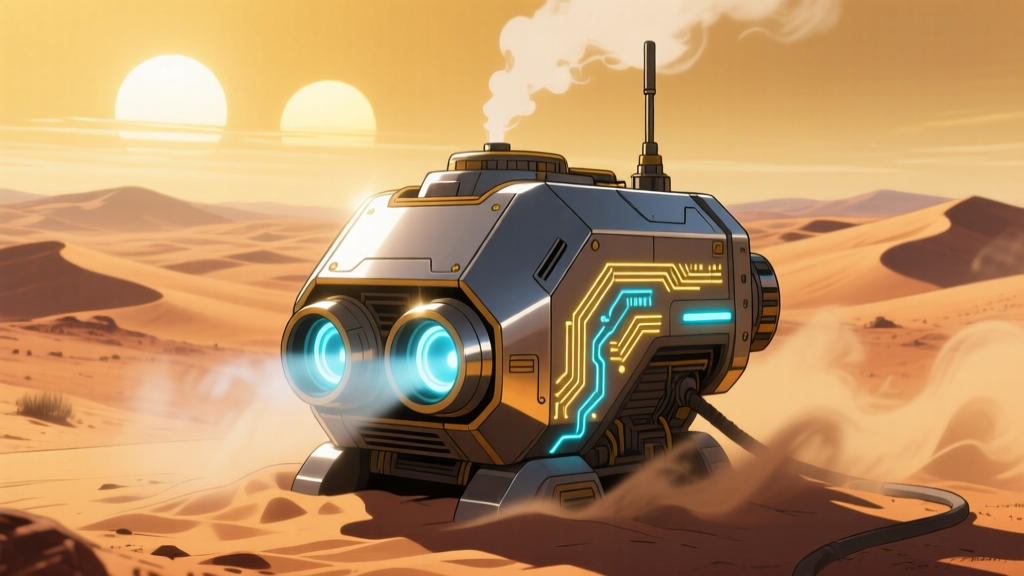
A deep dive into the Lars Homestead's lifeline, the prop that started it all, atmospheric water generators that actually work, and why collectors pay hundreds of credits for a plastic tube.
◑ SenpaiSite Staff · June 2026 · 12 min readLuke Skywalker stands on a ridge of sun-baked rock, squinting at twin suns sinking below the horizon. John Williams' score swells. It is cinema's most famous binary sunset, and it would not exist without a piece of agricultural equipment most viewers never think about twice. Somewhere behind that camera angle, on the salt flats of Chott el Djerid in Tunisia, sits a corroded metal pole studded with blinking lights — a moisture vaporator, quietly pulling water from desert air so a family of farmers can survive on the galaxy's most unforgiving frontier.
The Backbone of the Lars Homestead
In the Star Wars universe, a moisture vaporator is a device that extracts water vapor from the atmosphere and condenses it into drinkable liquid. On a planet like Tatooine — a circumbinary desert world orbiting the stars Tatoo I and Tatoo II, where surface water is essentially nonexistent and rainfall is measured in decades — this piece of hardware is not a luxury. It is the difference between life and desiccation.
The Lars Homestead, located in the Jundland Wastes region of Tatooine's Great Mesra Plateau, operated roughly 30 to 40 vaporator units spread across its property at the time Owen and Beru Lars were raising Luke. Canon reference materials, including Star Wars: Complete Locations (DK Publishing, 2016), place the homestead's moisture output at approximately 400 liters per day during peak humidity cycles — enough to sustain three people, a handful of droids, and a small herd of livestock, with surplus sold to neighboring settlements.
The economics were brutal. Vaporators required constant maintenance: filter replacements, condenser coil cleaning, power cell swaps. Sandstorms could knock a unit offline in minutes. Tusken Raider raids were a persistent threat — Owen Lars lost at least two complete vaporator arrays to Sand People in the decade before A New Hope. When Luke complains about going to Tosche Station to pick up power converters, he is talking about components that keep the family alive. Those converters were not for a hot rod; they were for the machines that made water.
"I was going into Tosche Station to pick up some power converters!" — Luke Skywalker, A New Hope (1977). A line that seems trivial until you understand what those converters were for.
Uncle Owen: The Galaxy's Most Underrated Professional
Pop culture remembers Owen Lars as the grumpy uncle who would not let Luke leave the farm. That reading misses the point entirely. Owen Lars was a skilled technician running a marginal agricultural operation on a planet where the environment was actively trying to kill him, under the shadow of a galactic civil war, while secretly harboring the son of the most dangerous Force user in history.
Moisture farming, as a profession, occupies a very specific rung on the Star Wars socioeconomic ladder. It is frontier work — unglamorous, technically demanding, and financially precarious. The Star Wars Roleplaying Game sourcebooks (West End Games, 1987–1999) describe moisture farmers as operating on profit margins of 200 to 500 credits per month after expenses, making them solidly working-class by galactic standards. A single vaporator unit cost roughly 2,500 credits new, with refurbished units running about 1,200. Given the Lars family ran dozens of units, their initial capital investment was substantial, likely financed through multi-generational savings or homesteading grants from the pre-Imperial government.
What Moisture Farming Actually Involved
The daily routine on a Tatooine moisture farm, as pieced together from canon and Legends sources, followed the planet's punishing thermal cycle:
- Pre-dawn (0400–0600 local): Vaporator collection tanks were drained and water transferred to underground cisterns to prevent daytime evaporation. Nighttime temperature drops on Tatooine could reach 5°C, causing the atmosphere to reach dew point — peak harvesting time.
- Morning (0600–1000): Maintenance rounds. Filter cleaning, condenser inspection, power coupling checks. This is the window where Luke was supposed to be working instead of bullseyeing womp rats.
- Midday (1000–1500): Surface temperatures exceeding 50°C made outdoor work dangerous. Vaporators switched to passive collection mode. Farmers retreated underground.
- Evening (1500–2000): Second maintenance cycle, water quality testing, equipment repairs, and the all-important trip to the local settlement to sell surplus and buy replacement parts.
Owen's insistence that Luke stay on the farm for "one more season" was not simple stubbornness. A moisture farm with 30+ active units required at least two able-bodied workers for maintenance cycles. Losing Luke meant losing half the workforce. From Owen's perspective, he was trying to keep his family's livelihood from collapsing.
The Prop That Built a Galaxy
The moisture vaporators seen in A New Hope are among the most recognizable pieces of science fiction prop design in cinema history, and they were made from almost nothing.
Production designer John Barry and art director Norman Reynolds were tasked in 1976 with creating a believable desert farming aesthetic on a tight budget. The vaporators were assembled in Tunisia from scrap metal, automotive exhaust pipes, old washing machine drums, and surplus aircraft parts. The distinctive tall, skeletal structures with their cylindrical collection chambers were welded together by local Tunisian metalworkers under the supervision of the British art department.
The most iconic vaporator, the one photographed for the Lars Homestead exterior scenes, stood approximately 3.5 meters tall and was positioned on the Chott el Djerid salt flat near the town of Nefta. It featured a base unit (a repurposed industrial compressor housing), a vertical shaft studded with what appear to be sensor vanes, and a top-mounted condenser assembly with a rotating collection dish. The blinking lights — a hallmark of the original trilogy's "used future" aesthetic — were standard automotive indicator lamps wired to a simple flasher circuit.
Design Philosophy: The Used Future
Before Star Wars, science fiction props were overwhelmingly sleek, clean, and chrome-plated. George Lucas explicitly rejected this. He wanted a galaxy that looked lived in. The moisture vaporators embodied this philosophy perfectly: they are rusted, dented, clearly repaired multiple times with mismatched parts. They look like equipment that has been running for decades in hostile conditions — which is exactly what they were supposed to be.
This single design decision influenced virtually every science fiction production that followed. The corroded industrialism of Alien (1979), the retro-fitted spacecraft of Battlestar Galactica (2004), even the distressed aesthetics of The Mandalorian — all trace their lineage back to the decision to make Tatooine's farming equipment look like it had been sitting in the desert for forty years.
| Production | Year | Format | Notes |
|---|---|---|---|
| A New Hope | 1977 | Live-action (Tunisia) | Original physical props, Chott el Djerid |
| Attack of the Clones | 2002 | CGI / Matte painting | Digital recreation of the Lars property |
| Revenge of the Sith | 2005 | CGI / Tunisia shoot | New physical props built for infant Luke scene |
| The Mandalorian S2 | 2020 | Volume / Practical hybrid | LED Volume backdrop with practical foreground elements |
| The Book of Boba Fett | 2021 | Volume / Location | Expanded moisture farm settlements beyond Lars |
| Star Wars Jedi: Survivor | 2023 | Video game (UE5) | Fully interactive 3D models on Koboh |
The original 1976 Tunisia props were left in place after filming wrapped. For decades they sat on the salt flat, slowly deteriorating under the North African sun. By the early 2000s, fan pilgrims reported that most structures had collapsed or been scavenged. A preservation campaign led by the Tunisian Star Wars fan community, with support from the Lucasfilm-affiliated Star Wars tourism board, attempted stabilization of remaining structures around 2012, though the harsh environment continues to take its toll.
The Vaporator Network: How Tatooine's Water Economy Actually Worked
One vaporator does not make a farm. What made the Lars operation viable was the network — a distributed array of units spread across the property, each feeding into a central collection and purification system. The Star Wars Technical Journal (vol. 1, 1993) and later reference works describe a tiered system:
- Collector units — the tall, visible structures that performed atmospheric condensation. These were positioned at 40–60 meter intervals to maximize air flow exposure.
- Transfer lines — buried pipes (to avoid surface heat) carrying raw condensate to a central processing facility. PVC-equivalent tubing in the Star Wars universe, typically plastoid or duraplast composite.
- Purification station — where collected water was filtered, mineralized (raw atmospheric condensate is essentially distilled water and needs remineralization for human consumption — a detail the real-world science confirms), and stored in underground cisterns.
- Distribution system — gravity-fed lines to the homestead, livestock troughs, and any irrigation channels for crop plots (the Lars family grew some hardy grain varieties in a small greenhouse, per Complete Locations).
The entire system was powered by solar arrays — fitting, given that Tatooine's twin suns provided more than enough thermal energy. A standard Lars-pattern vaporator consumed roughly 1.2 kilowatts of continuous power, a trivial draw for the solar installations common on Tatooine properties.
Real-World Atmospheric Water Generation: The Science Owen Lars Never Had
Here is where fiction and reality converge in a genuinely interesting way. Atmospheric water generators (AWGs) are not science fiction. They exist, they work, and the engineering challenges they face mirror almost exactly the problems the Lars family dealt with on Tatooine.
How Real AWGs Work
Modern atmospheric water generators use one of two primary technologies:
Condensation-based systems cool ambient air below its dew point, causing water vapor to condense on a cold surface — the same principle as water beading on a cold glass. These require electricity to run compressors or thermoelectric coolers. A typical unit like the Watergen GENNY (one of the best-known commercial AWGs) produces up to 30 liters per day at 27°C and 60% relative humidity. Energy consumption runs approximately 3.8 kWh per liter of water produced at those conditions. As temperature or humidity drops, both output and efficiency decline sharply.
Desiccant-based systems use hygroscopic materials (silica gel, lithium chloride, or metal-organic frameworks) to absorb water vapor from air, then release it through heating. These can operate at lower humidity levels than condensation systems — some function at relative humidity as low as 15–20%. Researchers at UC Berkeley developed a solar-powered MOF (metal-organic framework) harvester in 2017 that produced approximately 2.8 liters per kilogram of MOF per day in Arizona desert conditions, with ambient humidity around 20–40% (Kim et al., Science, 2017).
The irony is thick: the technology that would make Tatooine habitable already exists on Earth. The constraint, as always, is energy cost. At 3–5 kWh per liter for condensation systems, producing the Lars family's estimated 400 liters per day would require a dedicated solar array of roughly 15–20 kW — large, but entirely feasible with modern panels. Owen Lars was not lacking the science. He was living in a galaxy that never bothered to scale it.
Comparing Fiction and Reality
| Parameter | Star Wars Canon | Real-World AWG (2025) |
|---|---|---|
| Output per unit/day | ~10–13 L (estimated from 400L / 30 units) | 5–30 L (model dependent) |
| Minimum humidity required | Not specified (Tatooine = arid) | 15–20% (desiccant); 30%+ (condensation) |
| Power source | Solar arrays | Grid, solar, or battery |
| Energy cost per liter | ~1.2 kW continuous / unit | 3–5 kWh/L (condensation); 1–2 kWh/L (solar desiccant) |
| Maintenance | Filter replacement, coil cleaning, sand damage | Filter replacement, desiccant replacement, coil cleaning |
| Unit cost | ~2,500 credits new (canon) | $1,500–$8,000 USD (consumer); $50K+ (industrial) |
The parallels are striking. Real AWG operators deal with the same maintenance headaches — filters clogged by dust, condenser efficiency degraded by mineral buildup, power systems that need constant babysitting in harsh environments. The United Nations Environment Programme (UNEP) has funded AWG deployment projects in arid regions of sub-Saharan Africa and the Middle East since 2019, and field reports consistently cite the same issues Tatooine farmers faced: sand infiltration, component wear, and the relentless math of energy input versus water output.
One area where Star Wars quietly got it right: the nocturnal collection cycle. Real atmospheric water harvesting is most productive at night and in the early morning, when relative humidity peaks and temperatures drop. The Lars family's pre-dawn water collection routine mirrors how real AWG operators in desert climates optimize their systems. The fiction anticipated best engineering practice by decades.
Collectibles and Replicas: Owning a Piece of the Homestead
The moisture vaporator occupies a unique niche in Star Wars collecting. It is not a character, not a weapon, not a vehicle — it is a piece of set dressing that somehow became iconic. That paradox has created a surprisingly active collector market.
Official Merchandise
Hasbro's Star Wars: The Vintage Collection released a Lars Homestead playset in 2019 that included two miniature vaporator structures (approximately 15cm tall) alongside a Luke Skywalker figure. Retail price was $39.99; aftermarket prices for sealed units on eBay hover between $80 and $140 as of mid-2026, depending on condition and cardback variant.
LEGO's 75290 Mos Eisley Cantina (2020, 3,187 pieces) did not include vaporators, but the 75198 Tatooine Battle Pack and various polybags have featured small vaporator build elements. The fan-built LEGO community on Rebrickable hosts at least 14 custom MOC vaporator designs, ranging from 50-piece micro-scale models to 800+ piece minifigure-scale reproductions.
Fine Cast Forge, a boutique prop replica studio based in the UK, produced a limited run of 500 1:12 scale vaporator models in 2021, cast in resin with metal detailing. Original retail was £89; these now trade on collector forums for £180–£250.
The Tunisia Pilgrimage Market
Perhaps the most interesting corner of vaporator collecting is not merchandise at all. Fans travel to the original filming locations in Tunisia — Chott el Djerid, the Hotel Sidi Driss in Matmata (the interior of the Lars Homestead), and the abandoned set structures near Nefta — and bring back fragments. This is ethically complicated and legally murky. The remaining set structures are technically on public land, and removing pieces from them constitutes destruction of cultural heritage sites. Tunisia's Institut National du Patrimoine has posted warning signage, but enforcement is inconsistent.
That said, a small market exists for "authentic set fragments" — rusted metal pieces, bolts, and pipe sections allegedly from the original 1976 props. Prices range from $200 to over $1,000 depending on size and claimed provenance. Authentication is essentially impossible; there is no definitive database of the original prop materials, and the Tunisian salt flats are littered with scrap metal from multiple sources.
3D Printing and the DIY Collector
The most accessible path to owning a moisture vaporator replica in 2026 is 3D printing. Several high-quality STL files exist on platforms like Cults3D and Thingiverse, with the most detailed models (priced $15–$35 for the files) producing prints at 1:6 scale that are remarkably faithful to the original props. Makers typically use PLA or resin, with weathering techniques (rust washes, dry brushing, LED wiring for the indicator lights) adding authenticity. A finished, weathered 1:6 scale print with working LED lights runs about $60–$120 in materials and time, making it the most affordable way to put a piece of the Lars Homestead on your shelf.
Why the Vaporator Matters
Strip away the lightsabers, the Force, and the space battles, and Star Wars at its best is about ordinary people surviving in extraordinary circumstances. The moisture vaporator is the quiet symbol of that survival. It is not exciting. It does not blow up a Death Star. It just sits in the desert, day after day, pulling life from thin air while twin suns beat down on a family that cannot afford to leave.
Every time Luke looked out across the Jundland Wastes and dreamed of something bigger, he was standing next to a machine that represented the entire weight of his uncle's world. Owen Lars was not trying to trap Luke. He was trying to keep the water running. The vaporators were the reason the farm existed, the reason Luke had a home, the reason there was food on the table and moisture in the cistern. When the Empire destroyed the homestead in A New Hope, they did not just kill Owen and Beru — they destroyed decades of accumulated infrastructure, an entire life built around those rusted metal poles blinking in the desert wind.
That is why the moisture vaporator endures as an icon. Not because it is flashy, but because it is honest. It is the most working-class piece of technology in a franchise that usually celebrates heroes and villains. And every fan who has ever built a model, printed a replica, or simply paused during the binary sunset scene understands, on some level, that the real heart of Star Wars is not the Force. It is the farm.
Frequently Asked Questions
Are moisture vaporators scientifically plausible?
Yes. Atmospheric water generators exist and are commercially available today. The core physics — condensing water vapor from air by cooling it below the dew point, or absorbing it with desiccant materials — is well-established. The main challenge is energy efficiency in low-humidity environments, which is exactly the problem Tatooine would face. Modern solar-powered MOF-based harvesters (like those developed at UC Berkeley) can operate at humidity levels as low as 20%, which makes the Star Wars concept genuinely achievable with current or near-future technology.
Do the original 1977 vaporator props still exist in Tunisia?
Most of the original physical props from the 1976 Tunisia shoot have deteriorated or been scavenged over the past five decades. Some structural remnants were still visible at Chott el Djerid as recently as 2019, but preservation efforts have had limited success against the harsh desert environment. The Hotel Sidi Driss in Matmata, which served as the Lars Homestead interior, is in much better condition and operates as a hotel and tourist destination.
How much water did the Lars Homestead produce per day?
Canon reference materials, primarily Star Wars: Complete Locations (DK Publishing, 2016), estimate approximately 400 liters per day during peak humidity cycles, drawn from roughly 30–40 vaporator units across the property. This is comparable to what a small real-world AWG installation might produce under favorable conditions.
Why did Luke call them "power converters" and not vaporator parts?
He did not. Luke said he was going to Tosche Station to pick up power converters. Power converters in the Star Wars universe are general-purpose electrical components used in many systems, including vaporators. The line is often misremembered as being specifically about vaporator parts, but Luke was speaking generically. The converters could have been for vaporators, for the household power system, or for Luke's T-16 skyhopper. Owen assumed they were for the farm; Luke may have had other plans.
What is the best moisture vaporator replica I can buy?
For ready-made collectibles, the Hasbro Vintage Collection Lars Homestead playset offers good detail at a moderate aftermarket price ($80–$140). For prop-quality replicas, Fine Cast Forge's limited 1:12 resin models are the highest-quality commercial option, though they are now aftermarket-only (£180–£250). For the best value, 3D-printed models from Cults3D STL files, finished with weathering and LED lights, produce excellent results for $60–$120 in materials.
SenpaiSite · Otaku Culture · Star Wars Franchise Archive
Sources: Star Wars: Complete Locations (DK, 2016) · Star Wars Technical Journal Vol. 1 (1993) · Kim et al., "Water harvesting from air with metal-organic frameworks powered by natural sunlight," Science (2017) · UNEP Atmospheric Water Generation Field Reports (2019–2024)