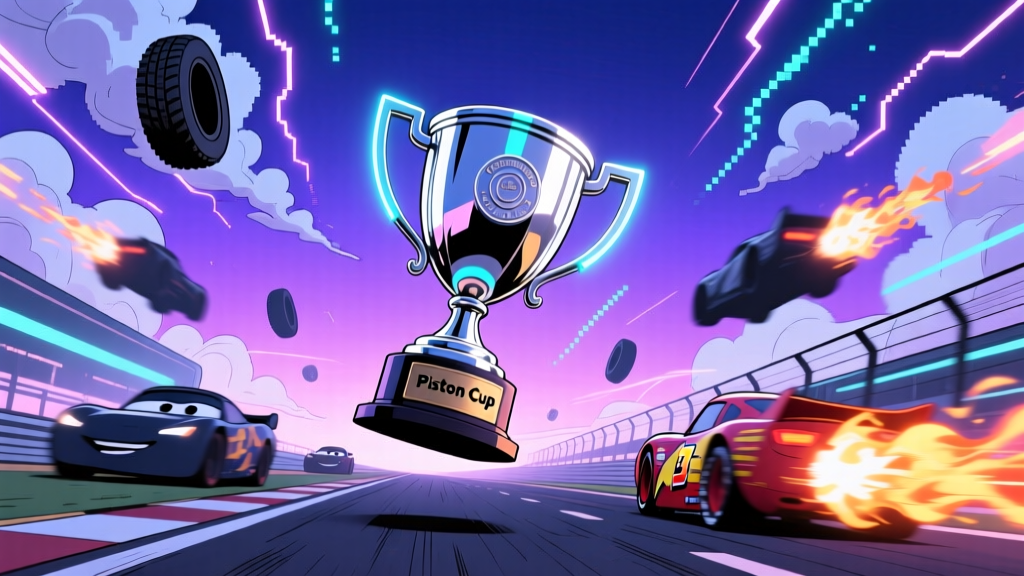
The Motor Speedway of the South is packed. Two hundred thousand fans scream from the grandstands as three cars barrel into the final turn of the Dinoco 400 — the biggest race of the Piston Cup season. Strip "The King" Weathers, the retiring legend, holds the inside line. Chick Hicks, the perennial also-ran who's spent an entire career watching taillights, jockeys for position on his outside. And then there's the rookie, a bright red #95 stock car with no crew chief, no pit team, and no business being this fast. Lightning McQueen crosses the line at exactly the same instant as The King and Chick. Photo finish. Three-way tie. The Piston Cup has never seen anything like it.
That scene, playing out across IMAX screens in the summer of 2006, did something unusual: it made millions of people who had never watched a stock car race suddenly care about a fictional racing championship. Pixar didn't just animate some cars going in circles. They built an entire motorsport ecosystem — a season calendar, team sponsors, rivalries, a points system, broadcast announcers, and a trophy that looked heavy enough to hurt. The Piston Cup became the connective tissue running through all three Cars films, and its influence rippled into real NASCAR garages, die-cast display shelves, and the imaginations of a generation of kids who grew up believing that race cars could have feelings.
This is the story of that championship. Not a plot summary — you can read the wiki for that. This is about why the Piston Cup works so well as fiction, where the seams to real racing culture show (and occasionally hide), and what happened when a cartoon trophy started showing up at actual speedways.
Building a Racing Series Out of Thin Air
John Lasseter has talked at length about the research trips Pixar took to NASCAR races before production on Cars began. The team attended events at Talladega, Daytona, and Bristol. They sat in the infield, walked the garage, and listened to engines idle during practice sessions. What they came back with wasn't just reference photography — it was an understanding of how NASCAR functions as a traveling circus. The sport moves from city to city every weekend, sets up a temporary village of haulers and hospitality tents, tears it all down by Sunday night, and does it again the following week. That rhythm, that impermanence, became the emotional backbone of Lightning McQueen's world: a racer who lives out of a trailer, has no permanent address, and measures his life in race dates.
The Piston Cup mirrors NASCAR's Cup Series in almost every structural detail. It's a season-long points championship culminating in a marquee event — the Dinoco 400, a clear stand-in for the Daytona 500. The race cars are stock cars with sponsor liveries. The tracks include superspeedways, short ovals, and desert road courses. Teams have crew chiefs, pit crews, and transport rigs. There's even a traveling media contingent: Bob Cutlass and Darrell Cartrip handle broadcast duties, their names a winking portmanteau of a news anchor and Darrell Waltrip, the three-time NASCAR champion who voiced Cartrip in all three films.
What Pixar got right — and what most fictional sports get wrong — is the texture of the paddock. In the background of every Piston Cup scene, you see things that only someone who'd spent time in a real garage would think to include: tire warmers, fuel canisters arranged in rows, crew members leaning against haulers with their arms crossed, the particular way a spotter stands on top of a motorhome with binoculars. These details don't drive the plot forward. But they build a world that feels inhabited, not designed.
"The thing about NASCAR is that it's not just a race — it's a traveling community. Everyone knows everyone. The rivalries are personal. We wanted the Piston Cup to feel like that." — John Lasseter, Cars DVD commentary (2006)
Lightning McQueen: From Rookie to Dynasty
McQueen's first Piston Cup season is a study in raw talent without infrastructure. He's the fastest car on the track — that much is obvious from his qualifying runs — but he races alone. No crew chief telling him when to pit. No spotter warning him about the wreck developing in Turn 3. His pit stops are solo affairs, and his strategy amounts to "go fast and stay in front." It works well enough to put him in championship contention, but it's the kind of driving that eventually breaks a car or a career.
The three-way tie at the Dinoco 400 forces a rematch at a special event in California, and that's where McQueen's arc crystallizes. He gets stranded in Radiator Springs, meets Doc Hudson, and learns something that no amount of horsepower could teach him: how to race with patience. Doc, the once-great Fabulous Hudson Hornet who won three consecutive Piston Cups in the early 1950s before being forgotten by the sport he dominated, becomes the crew chief McQueen never had. The old Hudson teaches him to read the track, to conserve his tires, to draft behind competitors and make his move late. These aren't abstract lessons. They're the same techniques that Richard Petty, Dale Earnhardt, and Jeff Gordon used to build their own championship runs.
The rematch race is where McQueen proves he's learned something. He pits late — a calculated risk — takes on fresh tires while Chick Hicks and The King stay out, and charges through the field on the final laps. He's about to win when The King suffers a catastrophic crash, triggered by Chick's dirty driving. McQueen stops inches from the finish line, gives up certain victory, and pushes the damaged King across the line. It's a moment that borrows directly from NASCAR sportsmanship lore — the kind of gesture that wins a driver more respect in the garage than any trophy.
The Championship Years
After the events of the first film, McQueen goes on a tear. He wins four consecutive Piston Cups — 2007, 2008, 2009, and 2010 — establishing himself as the dominant force in the series. These aren't mentioned in detail on screen; they appear in background details, trophy cases, and supplementary materials released by Disney. But the four-peat matters because it puts McQueen in elite company, the kind of sustained excellence that mirrors real-world dynasties. Jimmie Johnson won five consecutive NASCAR Cup Series titles from 2006 to 2010. Dale Earnhardt Sr. won seven championships across his career. McQueen's four puts him in that conversation without quite reaching The King's seven — a gap that keeps him hungry.
By Cars 2 (2011), McQueen is pulled away from Piston Cup competition to race in the World Grand Prix, a global series that trades stock car ovals for road courses in Tokyo, Porto Corsa, and London. The Piston Cup doesn't disappear — it continues without him — but the film acknowledges that McQueen's heart belongs to the series where he started. When he returns to Radiator Springs at the end of Cars 2, it's clear he's coming back to his roots.
Cars 3 (2017) brings the Piston Cup back to center stage with a conflict that hits close to home for anyone who follows real motorsport: the aging champion versus the next generation. Jackson Storm, a sleek, data-driven racer who trains in simulators and optimizes every variable, represents everything McQueen is not. Storm's technology is newer, his methods are sharper, and he's part of a wave of racers making the old guard look obsolete. The parallels to NASCAR's own generational shifts — the introduction of the Car of Tomorrow in 2007, the Next Gen car in 2022, the ongoing debate about simulation versus seat-of-the-pants driving — are unmistakable.
The Trophy Itself: A Chunk of Engine on a Pedestal
Most fictional sports don't bother designing their trophies with any care. The Piston Cup is an exception. The trophy is exactly what its name suggests: a large, polished golden piston — the cylindrical component inside an engine block that converts combustion pressure into mechanical motion — mounted vertically on a dark base. It's unmistakably automotive. You don't need to know anything about engines to understand what it represents, but if you do know, the metaphor lands harder. The piston is the heart of an engine. It's the part that does the actual work. Awarding a piston as a trophy says: this is the car that worked the hardest.
The design is deliberately simple. No wings, no globes, no abstract sculptures — just a massive golden piston catching the stadium lights. In the first film, the trophy is shown on a velvet-lined stage inside the Motor Speedway of the South, flanked by spotlights. When McQueen imagines winning it, the camera lingers on the way the gold surface reflects the crowd. It's treated with the same visual reverence that the Stanley Cup gets during NHL playoffs.
Disney has produced physical replicas of the Piston Cup trophy at various scales. The most common version, sold through Disney Parks and the Disney Store, stands approximately 12 inches tall and is cast in gold-painted resin with a black plastic base. A limited-edition die-cast metal version, released as part of the Cars 10th anniversary collection in 2016, weighed roughly 2.4 pounds and featured a laser-engraved base with "Piston Cup Champion" text. Neither version is particularly expensive — the resin replica typically retails between $25 and $40 — but the 10th anniversary metal edition has become a minor collector's item, with sealed copies selling for $80 to $120 on secondary markets like eBay and Mercari.
For collectors hunting Piston Cup memorabilia, here's a rough guide to what's out there:
- Die-cast 1:55 scale vehicles — Mattel's Piston Cup Racing Series ran from 2006 to ~2014, with 60+ releases. Common models sell for $8–$15; rare variants (like the "Chrome" editions) fetch $40+.
- Resin trophy replicas — Disney Parks exclusive, ~12 inches tall. Retail: $25–$40. Popular for display shelves and cosplay.
- 10th Anniversary die-cast trophy (2016) — Metal construction, laser-engraved base. Secondary market: $80–$120 sealed.
- Piston Cup Speedway track set — Oval track with spring-loaded launcher and finish-line flag mechanism. Original retail ~$50; complete sets now trade for $60–$90.
- Apparel and patches — Piston Cup logo hats, t-shirts, and racing patches have been sold through Disney Stores and Hot Topic. Most items are $15–$30 new.
Piston Cup Championship Record
The following table compiles what's known about Piston Cup champions and competitors across the Cars franchise timeline. Information is drawn from the films, official Disney supplementary materials, and the Cars franchise guidebooks.
| Season / Year | Champion | Car # | Sponsor | Key Detail |
|---|---|---|---|---|
| Early 1950s (3 consecutive) | Doc Hudson (Fabulous Hudson Hornet) | 51 | — | Three-peat; career ended by a crash, later became Radiator Springs judge |
| ~1970s–2005 (career span) | Strip "The King" Weathers | 43 | Dinoco | 7-time champion; Dinoco blue livery; retired after 2006 season |
| 2006 (Dinoco 400) | Three-way tie: McQueen / Weathers / Hicks | 95 / 43 / 86 | Rusteze / Dinoco / Hostile Takeover Bank | Tiebreaker rematch; McQueen forfeits win to help crashed King |
| 2007–2010 | Lightning McQueen | 95 | Rusteze | Four consecutive Piston Cup championships |
| 2017 (Cars 3 season) | Contested — Jackson Storm era begins | 20 (Storm) | IGNTR | New-gen tech cars dominate; McQueen struggles, trains with Cruz Ramirez |
| Career-long rival | Chick Hicks | 86 | Hostile Takeover Bank | Won 2006 tiebreaker by default after McQueen's sportsmanship gesture |
NASCAR's Fingerprints Are Everywhere
If you watch the Piston Cup scenes with any knowledge of NASCAR history, the references come fast. Strip Weathers is not merely inspired by Richard Petty — Petty himself voices the character, and the car is painted in the same Dinoco blue that Petty's #43 STP Pontiac wore for decades. The number 43 is the same. The sunglasses perched on the windshield are the same. Petty's real-world seven NASCAR championships map directly onto The King's seven Piston Cups. Even The King's retirement storyline mirrors the end of Petty's driving career in 1992, when he ran a full farewell season.
Chick Hicks, with his green paint job, his mustache-like grille, and his bitter resentment of The King, is a composite of every second-place driver who spent a career in someone else's shadow. The character's name is reportedly a nod to the aggressive, elbows-out driving style associated with certain NASCAR journeymen. His sponsor, Hostile Takeover Bank, is a pointed jab at the corporate sponsorship model that dominates stock car racing — imagine if a real NASCAR team were sponsored by a hedge fund with that name.
The voice casting deepens the connection. Here's a breakdown of the real NASCAR figures who lent their voices to the Piston Cup world:
- Darrell Waltrip — three-time Winston Cup champion, Fox Sports broadcaster for nearly 20 years → voices Darrell Cartrip, the color commentator
- Rusty Wallace — 1989 NASCAR Winston Cup champion, ESPN analyst → voices Rusty, a Piston Cup competitor
- Richard Petty — seven-time NASCAR champion, "The King" of stock car racing → voices Strip "The King" Weathers, the retiring legend
- Humpy Wheeler — ran Charlotte Motor Speedway for 35 years, one of NASCAR's most influential promoters → voices Tex Dinoco, the oil-company magnate
- Shannon Spake — real NASCAR pit reporter for Fox and NBC → voices Shannon Spokes, the pit-lane correspondent
These aren't celebrity cameos for the sake of name recognition. They're deliberate choices to make the Piston Cup sound like NASCAR when you close your eyes.
Then there's Doc Hudson. The Fabulous Hudson Hornet is based on the real Hudson Hornet that dominated NASCAR in the early 1950s. In 1952, the Hudson Hornet won 27 of 34 NASCAR Grand National races — a win percentage of nearly 80% that remains unmatched. Herb Thomas, Marshall Teague, and Tim Flock drove Hudson Hornets to championships, and their aggressive, low-slung driving style is exactly what Doc Hudson embodies in the film. When McQueen discovers that his grumpy old mentor was once the most dominant car in the sport, it mirrors the experience of any young NASCAR fan who stumbles onto footage of 1950s Grand National racing and realizes how different the sport used to be.
When Fiction Crossed the Pit Wall Into Real Racing
The Cars franchise didn't stay confined to movie theaters and toy aisles. Starting with the first film's release in 2006, Disney and NASCAR began a partnership that brought Piston Cup imagery directly onto real racetracks. Multiple NASCAR teams ran Cars-themed paint schemes during race weekends tied to the film's promotional calendar. In 2006, Dale Earnhardt Jr.'s #8 Budweiser Chevrolet carried a Lightning McQueen-inspired red livery during select events, and Jeff Gordon's #24 DuPont Chevrolet featured Cars branding at the Daytona summer race.
The crossover went both directions. NASCAR's real-world tracks appear as Easter eggs throughout the Cars films — blink and you'll miss signage referencing Bristol Motor Speedway and Darlington Raceway. The layout of the Motor Speedway of the South borrows heavily from Bristol's steep-banked, half-mile design, with some elements of Talladega's massive 2.66-mile tri-oval for the wider exterior shots.
Disney also produced a line of "Piston Cup Racing Series" die-cast vehicles through partner Mattel, featuring 1:55 scale models of McQueen, The King, Chick Hicks, and several background characters from the Piston Cup paddock. The line ran from 2006 through approximately 2014 and included over 60 distinct vehicle releases, many with alternate liveries for different race events. Track sets were released alongside the die-cast line, including a "Piston Cup Speedway" oval track that retailed for roughly $50 and featured a spring-loaded launcher and a finish-line flag mechanism. For a certain generation of kids, that plastic oval was their first racetrack.
Outside of official merchandise, the Piston Cup has inspired fan-built recreations. Model makers and 3D printing enthusiasts have produced detailed replicas of the trophy, the Motor Speedway of the South (some at 1:200 scale with LED lighting in the grandstands), and full dioramas of Radiator Springs. On YouTube, channels dedicated to scale model builds have accumulated millions of views constructing Piston Cup dioramas from foam board, balsa wood, and automotive touch-up paint. The most ambitious fan project, documented on the Cars fan forum Radiator Springs Bulletin Board, was a 1:24 scale Motor Speedway of the South built over 18 months by a hobbyist in Ohio — complete with working pace car, pit stalls, and a press box with a hand-painted Bob Cutlass figure inside.
What Makes a Fictional Championship Feel Real
There's a reason the Piston Cup has stuck around in pop culture while other fictional sports have faded. It's not just the NASCAR connection or the celebrity voice casting. It's that Pixar treated the championship as a system, not a backdrop. The Piston Cup has rules. It has a season structure. It has consequences — retirement, relevance, legacy. The King isn't just a fast car; he's a champion confronting his own obsolescence. Chick Hicks isn't just a villain; he's a talented driver who can't win clean and knows it. McQueen isn't just a hero; he's a rookie learning that speed without discipline is a dead end.
The franchise also understands something that real racing series have struggled with: the balance between individual star power and competitive depth. The Piston Cup is clearly McQueen's world, but the films consistently remind us that he's one car in a field of 40-something competitors. Background characters have names, numbers, and sponsors. The paddock feels populated, not empty. When Cars 3 introduces a new generation of high-tech racers, it doesn't erase the old guard — it creates friction between them, the same friction that exists in every sport when technology outpaces tradition.
That friction is why the Piston Cup resonates with actual racing fans. Anyone who's argued about the Next Gen car in NASCAR, or the halo device in Formula 1, or the tech suits in Olympic swimming, recognizes the tension between Jackson Storm and Lightning McQueen. It's the same argument, wearing different paint.
Things People Keep Asking About the Piston Cup
How many Piston Cups has Lightning McQueen won?
Across the franchise timeline, McQueen has won at least four Piston Cup championships (2007–2010). He did not win the 2006 Dinoco 400 — that race ended in a three-way tie, and the tiebreaker was resolved when McQueen forfeited to help the crashed King, leaving Chick Hicks as the default winner. The exact total of his career Piston Cup wins isn't stated on screen, but supplementary materials and the trophy case shown in Cars 3 suggest four primary championship trophies.
Is the Piston Cup based on a real trophy?
Not directly. The Piston Cup trophy is an original design by Pixar's art team — a golden piston on a base. However, the concept borrows from NASCAR's tradition of oversized, branded trophies. The Daytona 500 trophy, for instance, is a large silver cup standing over four feet tall. The Piston Cup's design is more compact and more directly automotive in its symbolism, but the idea of a trophy that visually represents the sport it celebrates is standard practice in motorsport.
Who voices the Piston Cup announcers?
Bob Costas voices Bob Cutlass, the play-by-play announcer, and Darrell Waltrip voices Darrell Cartrip, the color commentator. Both reprise their roles across all three films. The names are deliberate puns — "Cutlass" references the Oldsmobile Cutlass, and "Cartrip" is a car-themed twist on Waltrip's surname.
Does the Piston Cup exist in real life?
Not as a racing series. The Piston Cup is entirely fictional. However, Disney has produced replica trophies, die-cast Piston Cup Racing Series vehicles, track sets, and apparel. NASCAR teams have run Piston Cup-themed paint schemes during promotional events. The closest thing to a real-world equivalent is the NASCAR Cup Series itself, which the Piston Cup was designed to mirror.
What real NASCAR drivers are referenced in the Cars franchise?
Richard Petty (The King), Darrell Waltrip (Darrell Cartrip), Rusty Wallace (Rusty), and Humpy Wheeler (Tex Dinoco) are the most direct references. Additionally, Junior Johnson, a legendary NASCAR driver and team owner, is widely believed to be an influence on the character of Doc Hudson's racing era, though the Fabulous Hudson Hornet is more directly based on the real Hudson Hornet race cars of the early 1950s. Dale Earnhardt Jr. was considered for a voice role but didn't appear; his influence is visible in McQueen's personality and the #95 number, which echoes the #8 and #88 Earnhardt Jr. drove during his career.
Where does the name "Piston Cup" come from?
A piston is a cylindrical component inside an internal combustion engine that moves up and down within a cylinder, converting the pressure from ignited fuel into rotational force that drives the wheels. It's one of the most fundamental parts of any car engine. Naming the championship's trophy after this component is Pixar's way of grounding the series in automotive authenticity — it's a trophy shaped like the part that makes a car go. The name also has a satisfying phonetic punch: two syllables, hard consonants, easy to chant from a grandstand.
Still Going in Circles — and That's the Point
Twenty years after the first Cars film, the Piston Cup hasn't aged. It still looks and sounds like a racing championship that could exist if you squinted hard enough. The tracks still have the right banking angles. The pit stops still follow real procedure. The rivalries still feel personal. And the trophy — that big, dumb, beautiful golden piston — still looks like something a driver would hoist above their head while confetti rains down and a crowd roars.
Pixar's achievement with the Piston Cup wasn't making cars talk. It was making a fictional sport feel like it had weight. Every championship has a story behind it, every trophy has a driver who didn't win it, and every finish line has someone who stopped just short. That's racing. That's the Piston Cup. And it doesn't matter if you came to it as a NASCAR fan, a Pixar fan, or a kid who just thought the red car looked cool — there's room in the paddock for everyone.
PISTON CUP CARS (PIXAR) NASCAR OTAKU CULTURE RACING