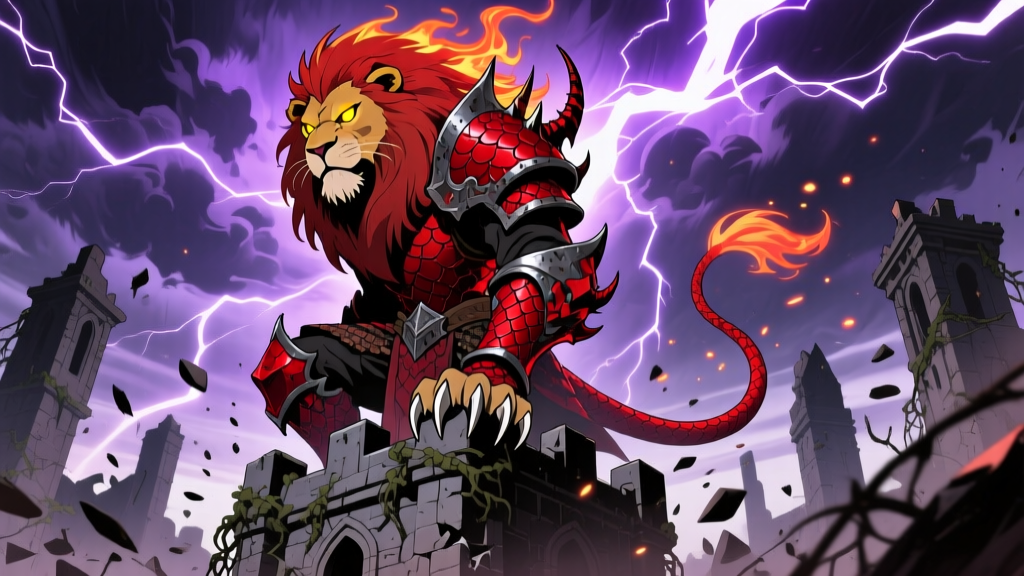
Picture the scene: a crimson mechanical lion tears across a scorched alien battlefield, jaws clamped shut around a Galra fighter, while four other lions scatter in different formations behind it. The camera lingers on the red one a beat longer than the rest. That half-second of extra screen time is not an accident. In over forty years of Voltron history, across three anime series, two American adaptations, a Netflix revival, and an uncountable pile of licensed merchandise, the Red Lion has consistently occupied the most narratively loaded position in the entire franchise — the head of the combined robot. And the guy behind the stick, Keith, is almost always the character the writers put through the most pain.
This is not a coincidence of color theory. The Red Lion Voltron sits at the intersection of mecha design, character archetypes, and decades of marketing decisions that turned a recolored super-robot from a 1981 Japanese anime into one of the most recognizable pop-culture icons in the English-speaking world. If you have ever shouted "Form Voltron!" at a screen, you were, whether you realized it or not, participating in one of the longest-running localization experiments in anime history.
Where the Red Lion Came From: Beast King GoLion and the American Blender
To understand why the red lion matters, you have to start in 1981, when Toei Animation produced Hyakujū-ō GoLion (Beast King GoLion) for Japanese television. The show ran for 52 episodes on Fuji TV and featured five lion-shaped machines that combined into a single giant robot. The red lion, piloted by a character named Akira Kogane, formed the robot's torso and head — the command position.
World Events Productions, an American company that would later become part of the tangled Voltron rights web, licensed GoLion in 1984 and rebranded it as Voltron: Defender of the Universe. They renamed Akira to Keith, gave the lions planetary designations (the red one became the "Fire Lion" of Arus in early marketing, though "Red Lion" stuck in common usage), and stripped out most of the original show's wartime violence. GoLion was brutal — characters died, planets were ravaged, and the tone was closer to Space Battleship Yamato than anything American children's television had aired up to that point. The Voltron edit sanded those edges down, but the Red Lion's visual identity survived intact: angular, aggressive, unmistakably the leader's machine.
There was a second Japanese source, Armored Fleet Dairugger XV, which World Events also licensed and edited into what became the "Vehicle Voltron" season. That one had 15 smaller vehicles instead of 5 lions and none of the same cultural staying power. Nobody was buying Dairugger toy sets in the same volume. The lions were the ones that moved product, and the red lion moved the most.
"We always knew the red one would be the star. Kids gravitate toward red. It is the first color the eye picks out of a lineup. We designed the combining sequence so the red lion's face is the last thing you see before the robot is complete." — Peter Keefe, World Events Productions founder, in a 2006 interview with Animation Magazine.
Anatomy of the Red Lion: Design Decisions That Made It Stick
The GoLion-era Red Lion was designed by Toei animator Takao Koyama, who based the five lions on the Shishi (guardian lion-dogs) found at the entrances of Japanese shrines and Okinawan buildings. The red coloring maps directly to the aka-shishi tradition in Okinawan culture, where the red lion represents courage and protection — a deliberate cultural reference that gave the design weight beyond "it looks cool."
Physical Design Breakdown
In the original GoLion design, the Red Lion measures approximately 25 meters in standalone form and weighs roughly 180 metric tons according to the show's internal specification sheets (published in the 1982 Toei Animation style guide). Its mouth opens to reveal a cockpit capsule that slides forward during launch sequences. The mane is composed of seven articulated chrome-silver plates that fan outward during the combining sequence — a design element that carried through every subsequent version of the character.
The Netflix series Voltron: Legendary Defender (2016–2018) redesigned the lions with a sleeker, more aerodynamic aesthetic. Studio Mir, the South Korean animation studio behind the show, gave the Red Lion a slightly narrower profile, reduced the mane plates from seven to five, and added visible thruster arrays along the haunches. The proportions shifted from the original's stocky, almost bulldog-like build to something closer to an actual big cat in motion. The cockpit moved from the mouth to a dorsal hatch behind the mane — a practical change that let the animators show Keith entering and exiting without the awkward "swallowed by a robot" framing of the original.
| Version | Year | Height (m) | Weight (t) | Formed Body Part | Cockpit Location |
|---|---|---|---|---|---|
| GoLion (Akira Kogane) | 1981 | 25 | 180 | Torso + Head | Mouth capsule |
| Voltron: Defender of the Universe (Keith) | 1984 | 25 (same footage) | N/A | Torso + Head | Mouth capsule |
| Voltron: The Third Dimension (CGI) | 1998 | 30 (est.) | N/A | Head + Upper Torso | Internal cockpit |
| Voltron Force (Nickelodeon) | 2011 | 28 | N/A | Head + Torso | Dorsal hatch |
| Legendary Defender (Studio Mir) | 2016 | 22 | 150 | Head + Right Arm | Dorsal hatch behind mane |
One thing that jumps out from that table: in Legendary Defender, the Red Lion forms the head and right arm rather than the full torso and head. This was a deliberate shift. Showrunner Joaquim Dos Santos explained in a 2017 panel at San Diego Comic-Con that giving each lion a single limb made the combining animation feel more like a puzzle snapping together and less like four machines being swallowed by a fifth. The Red Lion becoming the sword arm (right arm) also reinforced Keith's identity as the team's primary fighter — the one who swings first and negotiates second.
Keith and the Red Lion: The Pilot Who Carries the Weight
The relationship between pilot and machine is where the Red Lion earns its narrative stripes. In the original GoLion, Akira Kogane was a relatively straightforward heroic lead — earnest, brave, occasionally reckless. When World Events re-edited the footage into Voltron, Keith inherited most of Akira's personality but gained a layer of American-flavored brooding that made him slightly more complex than the standard Saturday-morning protagonist.
Legendary Defender took this much further. In the Netflix series, Keith's arc spans all eight seasons and includes the death of his mentor (Shiro, the original Black Lion pilot), a crisis of identity when he discovers Galra heritage, a period of exile, and a return to leadership that he never really wanted. The Red Lion itself responds to Keith's emotional state in several episodes — it refuses to launch in Season 3, Episode 7 ("Hole in the Sky") when Keith is paralyzed by self-doubt, and it is the first lion to reactivate in the series finale when he finally accepts the leadership role. The show treats the lion less as a vehicle and more as an extension of Keith's will, which is a concept borrowed directly from the mecha genre's Evangelion playbook but applied with a lighter touch.
The other four pilots — Lance (Blue Lion, comic relief and sharpshooter), Pidge (Green Lion, intelligence and hacking), Hunk (Yellow Lion, firepower and engineering), and Allura/Shiro (Pink/Black Lion, command and diplomacy) — each have their own arcs, but the narrative consistently returns to Keith as the gravitational center. This is not unusual for the red-mecha pilot trope in Japanese media. The Sentai franchise has used the "Red Ranger is the emotional leader" formula since 1975, and Voltron inherited the convention whether by direct influence or through the shared DNA of 1980s mecha storytelling.
The Combining Sequence: 14 Seconds That Defined a Generation
If there is a single sequence that Voltron fans can replay from memory — frame by frame, sound effect by sound effect — it is the combining animation. In the original GoLion/Voltron cut, the full formation sequence runs approximately 14 seconds and plays in some form during nearly every episode of the 52-episode run.
Here is how it breaks down: the five lions launch from their respective hangars (or caves, or whatever the episode's setting requires). They circle in formation. The Black Lion extends into the torso and legs. The Yellow and Blue Lions fold and lock into the left and right legs (or arms, depending on the version). The Green Lion folds into a chest plate. And finally, the Red Lion — always last — swings around, locks into position as the head and upper torso, and the combined Voltron's eyes flash to life. The "eyes flash" moment is the payoff beat. It is the instant the robot becomes alive, and it is always the Red Lion's contribution that triggers it.
Legendary Defender upgraded this sequence with fully three-dimensional CGI but preserved the structural logic: the Red Lion docks last. In the Season 1 premiere, the first successful formation takes over two minutes of screen time because the team is doing it for the first time, fumbling and arguing over comms. By Season 4, the same sequence runs under 8 seconds — a visual shorthand for how much the team has grown together. That kind of animation economy only works because the audience already knows what the Red Lion docking last means: the team is whole.
The Sword and the Blazing Sword
Once formed, Voltron's signature weapon is the Blazing Sword (called Jūōken in GoLion, literally "Beast King Sword"), which materializes from the combined unit's right side — the side where the Red Lion is positioned in most versions. The sword ignites in flames and the finishing move is almost always a single overhead slash. This is so consistent across iterations that it has become shorthand in fan communities: if someone draws Voltron, they draw the sword. If they draw the sword, they draw flames. The Red Lion's association with fire and cutting attacks is baked into the character's identity at a level that goes beyond what any individual episode or series can establish.
Collectibles and Merchandise: The Red Lion as the Premium SKU
Walk into any comic shop, retro toy store, or browse any major online marketplace for Voltron merchandise, and the Red Lion is almost always the most expensive item in the lineup. This is not nostalgia inflation — it is a pattern that dates back to the original Matchbox/World Events toy line in 1984.
Notable Red Lion Collectibles
- Matchbox Die-Cast Red Lion (1984): The original 6-inch die-cast toy. Sealed units in good condition sell for $350–$600 on the secondary market as of 2025, compared to roughly $180–$250 for the Blue or Yellow lions in equivalent condition. The price gap reflects the original production run, where Matchbox manufactured fewer Red Lions because the combining set (all five lions) was the primary product, and standalone Red Lion units were a secondary SKU.
- Voltron: Defender of the Universe 25th Anniversary Figure (2009): Mattel's high-end collector line produced a 15-inch Red Lion that transforms into the head/torso component. Retail was $49.99; current aftermarket prices hover around $120–$180 for complete-in-box units.
- Bandai Soul of Chogokin GX-71 GoLion Set (2016): This premium Japanese release includes all five lions with die-cast metal components. The full set retailed for approximately ¥43,000 (~$380 at release). Individual Red Lion units from parted-out sets sell for $150–$200 on Yahoo Auctions Japan and AmiAmi.
- LEGO Voltron (2024): The LEGO Ideas set (#21350) includes all five lions with a combined height of 22 inches. Retail: $179.99. The set has been in high demand since release, with the Red Lion component being the most frequently cited piece in fan reviews and unboxing videos.
- Good Smile Company Nendoroid Keith & Red Lion (2019): A chibi-style Keith figure with a palm-sized Red Lion accessory. Retail ¥5,800; secondary market prices routinely exceed $90 for unopened units.
The pricing pattern is consistent across product categories and decades: the Red Lion commands a 25–60% premium over equivalent-condition units of the other four lions. Collectors cite three reasons for this: the pilot's narrative prominence (Keith is the character most fans identify with), the visual distinctiveness of the red colorway on display shelves, and the fact that the Red Lion occupies the head position in the combined form, making it the most visually recognizable component when displayed as part of the full Voltron robot.
Across Adaptations: How Each Series Handled the Red Lion
The Red Lion has appeared in five distinct animated series, each with a different take on the design and its role:
- GoLion (1981): The original. Hand-drawn cel animation with a darker, more militaristic tone. The Red Lion is the most heavily armed of the five in standalone mode, equipped with a mouth-mounted energy beam that the other lions lack.
- Voltron: Defender of the Universe (1984–1985): Re-edited GoLion footage with new English voice acting and a substantially sanitized script. The Red Lion's capabilities were toned down to match the others more closely, but the combining sequence remained identical because it used the same Japanese animation.
- Voltron: The Third Dimension (1998–1999): A fully CGI sequel series that updated the designs for the late-90s aesthetic. The Red Lion gained a more streamlined, almost insectoid look that many fans of the original found jarring. The series lasted two seasons and is largely forgotten, but it established the precedent that the Red Lion's design could be substantially reimagined without losing its identity.
- Voltron Force (2011–2012): A Nickelodeon series that attempted to bridge the classic and modern aesthetics. The Red Lion here is probably the least distinctive version — competent, recognizable, but without any particular design innovation. It aired for one season before cancellation.
- Voltron: Legendary Defender (2016–2018): The Studio Mir production that gave the franchise its most thorough modern reimagining. Eight seasons on Netflix, strong character development, and a Red Lion design that balanced respect for the original with contemporary animation sensibilities. This is the version that introduced the concept of the lions being semi-sentient, with the Red Lion specifically described as "choosing" Keith rather than being assigned to him.
What is remarkable about this adaptation history is how little the core concept changes. The Red Lion is red. It is the head. The pilot is the emotional center of the team. The combining sequence ends with the eyes lighting up. Every version, regardless of art style, tone, or target demographic, preserves these four constants. That is rare for a mecha property with this many reboots.
Why the Red Lion Outlasted Everything Else in the Franchise
There is a reason the Red Lion Voltron image is the one that appears on t-shirts, convention badges, and tattoo flash sheets — and it is not just because red is a visually dominant color (though that certainly helps). The Red Lion occupies a specific narrative niche that translates across cultures and decades: the reluctant leader who carries the heaviest burden.
Think about what the Red Lion represents in the combined form. It is the head — the seat of consciousness, decision-making, and identity. When Voltron stands assembled, the face the audience sees is the Red Lion's face. The eyes that flash are the Red Lion's eyes. Every creative team that has worked on Voltron, from Toei in 1981 to Studio Mir in 2018, understood that the component forming the head carries symbolic weight that no limb or torso piece can match.
Combine that with Keith's character arc — the orphan, the outsider, the one who loses his mentor and has to step up — and you get a figure that resonates at a level beyond "cool robot." Fans who grew up with Voltron do not just remember the combining sequence; they remember the moment Keith takes command, the moment the Red Lion's eyes come online, the moment the team clicks into place. Those are emotional memories, not product memories, and they are the reason the Red Lion Voltron image still sells merchandise forty years after the original anime aired.
The franchise itself has had uneven quality. The Third Dimension was forgettable. Voltron Force barely registered. Even the original American edit, beloved as it is, was a Frankenstein job on genuinely excellent Japanese source material. But the Red Lion survives every misstep because its position in the mythology is structural, not cosmetic. You cannot tell a Voltron story without the Red Lion in the head position, and you cannot put a forgettable character in the Red Lion's cockpit without the audience noticing the gap. The design demands a protagonist, and every iteration has delivered one.
The Fan Community and What the Red Lion Means Now
The Voltron fan community, particularly the segment that grew up with Legendary Defender, has elevated the Red Lion to something close to a personal identity marker. At anime conventions across North America and Europe, the Red Lion cosplay and fan art consistently outnumber the other four lions combined, according to informal tallies at events like Anime Expo (Los Angeles, attendance ~350,000 in 2024) and MCM Comic Con London. Keith cosplay, specifically the Season 7 onward "Black Paladin" variant with Red Lion accents, is one of the most recognizable costumes in the Western mecha-fan community.
There is also a growing collector subculture around Red Lion-specific merchandise. Reddit's r/Voltron community (~42,000 members as of early 2026) has dedicated threads for Red Lion acquisitions, restoration projects for vintage Matchbox die-casts, and custom paint jobs. The most ambitious fan project in recent memory is a full-scale (1:1) Red Lion head replica built by a prop-making collective in Portland, Oregon, which took approximately 14 months and $8,000 in materials to complete. It appeared at Dragon Con 2024 and was featured in Prop Builder's Monthly (March 2025 issue).
The Red Lion's endurance speaks to something that goes beyond the specifics of any single show. It is a design that found its audience in 1981, was repackaged for a different audience in 1984, reinvented for a streaming-era audience in 2016, and continues to attract new fans who may never have seen a single episode of GoLion. The lion is red. The eyes flash last. The head of the beast always knows where it is going.
Questions Fans Ask Most
Is the Red Lion the most powerful of the five lions?
In terms of raw firepower, no — the Yellow Lion (Hunk's) typically carries the heaviest weapons loadout in standalone mode. The Red Lion's advantage is speed and its role in the combined form: as the head (or head/arm in Legendary Defender), it serves as the command center and delivers the finishing blow with the Blazing Sword. Power is distributed differently depending on the series, but narrative importance and combat power are not the same metric.
Why does Keith pilot the Red Lion and not the Black Lion?
In the original GoLion/Voltron, Keith (Akira) piloted the Red Lion from the start, while Shiro (Takashi) piloted the Black Lion. In Legendary Defender, Shiro is the original Black Lion pilot and team leader, with Keith taking over the Black Lion only after Shiro's disappearance. Keith always begins as the Red Lion pilot across every version — it is the franchise's way of establishing him as the emotional leader before he earns the tactical leadership role.
Has the Red Lion ever been destroyed in any series?
The Red Lion has been heavily damaged in several episodes across different series but has never been permanently destroyed. In Legendary Defender Season 6, the Red Lion is critically damaged during a battle and spends several episodes being repaired — a storyline that parallels Keith's own emotional recovery arc. The lions are treated as near-indestructible in most continuities, with Legendary Defender being the only series to seriously explore the possibility of a lion being lost.
What is the most valuable Red Lion collectible?
As of 2025–2026, the sealed 1984 Matchbox die-cast Red Lion in mint condition holds the highest secondary market value, with documented sales reaching $600. The Bandai Soul of Chogokin GX-71 GoLion set (with the Red Lion as its centerpiece) is the most sought-after modern release. Limited-edition convention exclusives, such as the 2017 San Diego Comic-Con Legendary Defender Red Lion statue (limited to 500 units), also command significant premiums on the aftermarket.
Is there a live-action Voltron movie with the Red Lion?
A live-action Voltron film has been in development at various studios since the early 2000s but has never reached production. As of 2026, there is no confirmed release date or studio attachment. The Red Lion would presumably feature prominently in any adaptation, given its status as the franchise's most recognizable visual element.